© 2014, IJCSMC All Rights Reserved 417
Available Online atwww.ijcsmc.com
International Journal of Computer Science and Mobile Computing
A Monthly Journal of Computer Science and Information Technology
ISSN 2320–088X
IJCSMC, Vol. 3, Issue. 8, August 2014, pg.417 – 422
RESEARCH ARTICLE
OBJECT DETECTION SCHEME FOR
DYNAMIC VIDEOS BASED ON LOCAL
ILLUMINATION BASED TECHNIQUES
1
T. SOWRYA PRATAP,
2V. SURENDRA BABU
1
Department of ECE, Sir C R Reddy College of Engineering, Eluru, Andhra Pradesh, India
2
Assistant Professor, Department of ECE, Sir C R Reddy College of Engineering, Eluru, Andhra Pradesh, India
Abstract: The paper presents the object detection for dynamic texture scenes using illumination based techniques. They are two types of illumination technique. First one is illumination based background subtraction (ILBS) and second one is illumination based frame difference (ILFS). Illumination frame difference is identifying the objects accurately in dynamic texture scene compare to illumination background subtraction. It has less computation complexity, less computation cost and less space of memory. The experimental results show that ILFS is efficient and robust for the dynamic environment and compare to ILBS.
Index Terms— Background modeling, background subtraction, video segmentation, video surveillance
I.
INTRODUCTION
Detection and tracking of has been an important research topic in computer vision domain. The paper [1]
© 2014, IJCSMC All Rights Reserved 418
Jacques et al. brought a small improvement to the W4 model together with the incorporation of a technique for shadow detection and removal [5]. McHugh et al. proposed an adaptive thresholding technique by means of two statistical models [6]. In most of the suggested schemes, the object detected is accompanied with misclassified foreground objects due to illumination variation or motion in the background. Moreover, shadows are falsely detected as foreground objects during object extraction.
The suggested background model initially determines the nature of each pixel as stationary or non-stationary and considers only the non-stationary pixels for background model formation. In the background model, for each pixel location a range of values are defined. Subsequently, in object extraction phase our scheme employs a local threshold, unlike the use of global threshold in conventional schemes.
The organization of this paper is as follow. Section II presents ILBS scheme. ILFS technique is introduced in section III. In section IV, implementation. Simulation results are reported in section V and conclusions are presented in VI.
II.
LIBS SCHEME
The LIBS scheme is also called local threshold based background subtraction method. In this technique to finding the stationary pixels in the frames required for background modeling and then detect the objects by compare the dynamic background and current frame.
The algorithm of LIBS scheme as given by
Read dynamic texture video and then convert in to frames fr
backgroundi=rgb2gray(background frame)
Fri-1=rgb2gray(fri-1);
object_frame=abs(double(backgroundi)-double(Fri-1) δ-> represent the standard deviation of object_frame
for j=1:width
for k=1:height
If object_frame(k,j)>width/2×δ
Fg(k,j)=label (fr(k,j)) as stationary i.e pixel is zero
else
Fd(k,j)= label (fr(k,j)) as non-stationary i.e pixel is non zero
End End End End
In this algorithm to find the objects from video. If any noise occurs in frame, to remove those noise using morphological operation. The dilation and erosion methods are used in morphological operation. This technique has less accuracy and cannot detect the objects accurately as shown figures in result section. It has less computation complexity compare to existing methods like mixture of Gaussian.
A. dynamic background model
© 2014, IJCSMC All Rights Reserved 419
leaves etc. to update the next back ground model at higher computational cost and thereby making them unsuitable for real time deployment. On the other hand, the background model should react quickly to changes in background. So to avoid that problem, we propose an intensity range based background model in LIBS technique. Here the RGB frame sequences of a video are converted to gray level frames using rgb2gray command in MATLAB. Initially, few frames are considered for background modeling and pixels in these frames are classified as stationary or non-stationary depends up on standard deviations of current frame. The background is then modeled taking all the stationary pixels into zero. Background model thus developed defines a range of values for each background pixel location. After finding the dynamic background model to finding the foreground objects using LIBS technique. It is used to subtraction the back ground model and current frame and then apply the local threshold to get the accurate objects. The algorithm of foreground objects in given by
for i to height of frame do
for j to width of frame do
Threshold T (i, j)= 1/C*[M ( i, j)+N (i, j)]
TL (I,J)= M (i, j)- T (i, j)
TU (I,J)= N (i, j)+ T (i, j)
If TL (I,J) <= f <= TU (I,J)then
Sf (i, j)=0//Background pixel
else
Sf (i, j)=1//Foreground pixel
end if
end for
end for
Where Tu is the upper threshold and Tl is the lower threshold. These local thresholds help in successful detection of objects suppressing shadows if any.
III.
ILFS TECHNIQUE
ILFS technique is also called as Consecutive frame difference. It is a popular approach used in detection moving objects in dynamic texture videos. Traditionally, through the subtracting the previous frame from the current frame, we get the moving objects.
In dynamic texture scenes background model is changes to frame to frame but Background modeling is not require ILFS algorithms. Many researchers have been devoted to developing a background model that is robust against environmental changes.
© 2014, IJCSMC All Rights Reserved 420
Read dynamic texture video and then convert in to frames fr
Fri=rgb2gray(fri)
Fri-1=rgb2gray(fri-1);
object_frame=abs(double(Fri)-double(Fri-1) δ-> represent the standard deviation of object_frame
for j=1:width
for k=1:height
If object_frame(k,j)>width/2×δ
Fg(k,j)=label (fr(k,j)) as stationary i.e pixel is zero
else
Fd(k,j)= label (fr(k,j)) as non-stationary i.e pixel is non zero
End End End End
In this algorithm to find the objects from video. If any noise occurs in frame, to remove those noise using morphological operation. The dilation and erosion methods are used in morphological operation. This technique has less accuracy and cannot detect the objects accurately as shown figures in result section. It has less computation complexity compare to ILBS technique.
The i and i-1 gray scaled images are differentiated and their absolute difference is used to identify the movement between frames. The threshold value is determined such that the pixel values on either side of this value are established to be either a background or a foreground pixel. The noise collected due to differencing is removed by applying the threshold value to the images. Pixels below the threshold are removed from the differenced frame leaving behind our object of interest. As described in equation, the absolute difference between two frames needs to be greater than the threshold for the object to be detected.
|F2-F1|>T
Here F1 is the initial frame and F2 is the following frame and T is the Threshold value. In this technique is
applied to the videos having dynamic textured background, the detection accuracy is poor and noisy output. These
methods are sensitive over the changes occurred in the background. They cannot adapt the background changes and consider the movements in the background as the object of interest (foreground).
Percentage of correct classification ( PCC) is used as the metric for comparison, and is defined as,
© 2014, IJCSMC All Rights Reserved 421
IV.
EXPERIMENTAL RESULTS
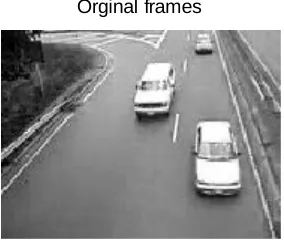
The LIBS and LIFS techniques are simulated using MATLAB.
Fig. 1. 100th frame from video
Fig.2. ILBS technique of 100th frame from video
Fig.3. 10th frame from video
© 2014, IJCSMC All Rights Reserved 422
Fig.4. ILFS technique of 100th frame from video
V.
CONCLUSION
In this work we have proposed ILBS and ILFS techniques. It is a simple robust scheme of background modeling and local threshold based object detection. In this project, we are using dynamic texture Videos with variant illumination background, textured background, and low motion background are considered for simulation to test the generalized behavior of the scheme. ILBS compared with the ILFS, both qualitatively and quantitatively. In general, it is observed that the suggested scheme outperforms others and detects objects in all possible scenarios considered.
REFERENCES
[1] Koller D, Weber J, alik J, “Robust multiple car tracking with occlusion reasoning,” Proceeding of third European conference on computer vision, 1994..
[2] C.Wren, A. Azarbayejani, T. Darrell, and A. Pentland, “Pfinder: Real-time tracking of the human body,” IEEE Trans. Patt. Anal. Mach. Intell., vol. 19, no. 7, pp. 780–785, Jul. 1997.
[3] C. Stauffer and W. Grimson, “Adaptive background mixture models for real-time tracking,” in IEEE Comput. Soc. Conf. CVPR, 1999, pp. 246–252.
[4] I. Haritaoglu, D. Harwood, and L. Davis, “W4: Real-time surveillance of people and their activities,” IEEE Trans. Patt. Anal. Mach. Intell., vol. 22, no. 8, pp. 809–830, Aug. 2000.
[5] J. Jacques, C. Jung, and S. Musse, “Background subtraction and shadow detection in grayscale video sequences,” in Eighteenth Brazilian Symp. Computer Graphics and Image Processing,Oct. 2005, pp. 189–196.
[6] J.McHugh, J.Konrad,V. Saligrama, and P. Jodoin, “Foreground-adaptive background subtraction,” IEEE Signal Process.Letters, vol. 16, no. 5, pp. 390–393, May 2009.