Electronic Thesis and Dissertation Repository
3-22-2016 12:00 AM
The Copyright Board and Tribunals Process: Users in the Balance
The Copyright Board and Tribunals Process: Users in the Balance
Louis J. D'Alton
The University of Western Ontario Supervisor
Dr. Samuel Trosow
The University of Western Ontario Graduate Program in Law
A thesis submitted in partial fulfillment of the requirements for the degree in Master of Studies in Law
© Louis J. D'Alton 2016
Follow this and additional works at: https://ir.lib.uwo.ca/etd
Part of the Administrative Law Commons, Arts Management Commons, Audio Arts and Acoustics Commons, Composition Commons, Entertainment, Arts, and Sports Law Commons, Intellectual Property Law Commons, Musicology Commons, Music Performance Commons, Other Film and Media Studies Commons, and the Other Music Commons
Recommended Citation Recommended Citation
D'Alton, Louis J., "The Copyright Board and Tribunals Process: Users in the Balance" (2016). Electronic Thesis and Dissertation Repository. 3708.
https://ir.lib.uwo.ca/etd/3708
This Dissertation/Thesis is brought to you for free and open access by Scholarship@Western. It has been accepted for inclusion in Electronic Thesis and Dissertation Repository by an authorized administrator of
policy tool has had an extraordinary impact on the information landscape. The
unfettered expansion of collective rights organizations throughout the 20th century
has resulted in increased social costs and a burgeoning bureaucracy surrounding
the collective use of rights.
This thesis considers the role of copyright tribunals within that process, and
more importantly within a critical historical frame. While some work has been done
with respect to copyright tribunals and their role in the policy process, none of it has
considered the tribunals within a critical frame. This thesis considers those
agencies, and the Copyright Board of Canada in particular, within the context of
their initial creation as oversight on copyright collectives, their subsequent
regulatory practice and their current role within the larger policy frame. Utilizing
Antonio Gramsci’s conception of hegemony, the thesis views the current capture of
those agencies as a further indication of the growing hegemony surrounding
copyright in general and collective management regimes in particular.
Keywords: music; performance right; copyright law, copyright collectives, copyright tribunals, intellectual property; critical analysis; Gramsci.
Louis Michael Richard D’Alton &
Sean William Erik D’Alton
iii
Abstract ii
Dedication iii
Table of Contents iv
List of Tables vi
Chapters
1: Introduction and Statement of Problem 1
2: Contextualizing the Copyright & Tribunal Discussion 14
2.1: Copyright Myths 15
2.2: Common Law Model 17
2.3: Justification on the Basis of Economic Efficiency 18
2.4: Limitations on the Efficiency Model 19
2.5: Natural right of the Creator 22
2.6: Reconsidering Natural Right Theory 25
2.7: The Economic Core at the Heart of Copyright 26
2.8: Gramsci, Hegemony & Copyright 28
2.9: The Public Performance Right 31
2.10: Hegemonic Resistance 34
3: Parallel Evolutions of Copyright Tribunals 39
3.1: Creation of the First Tribunal 40
3.2: The Copyright Appeal Board of Canada 45
3.3: The Copyright Board of Canada 46
3.4: The Copyright Tribunal of Great Britain 48
3.5: Copyright Tribunal of Australia 52
3.6: Considering the Three Regimes 53
3.7: Systemic Differences 55
4: The User Returns 58
4.1: Fair Dealing as a User Right 59
4.2: The United Kingdom 64
4.3: Australia 65
4.4: Conclusion 67
5.2: Decisions of the Federal Court of Appeal 75
5.3: The Pentalogy 80
ESA v SOCAN 80
SOCAN v Bell 81
Alberta v Access Copyright 83
Rogers Communications Inc. v SOCAN 86
ReSound v Motion Picture Theatre Associations of Can 87
5.4: Impact of CCH & Pentalogy 88
6: Inquiring Into the Process 93
6.1: The Hargreaves Report 97
6.2: Collecting Societies Codes of Conduct 100
6.3: Lobbynomics 100
6.4: Simpson Report 102
6.5: Recent Canadian Developments 103
7: Reassessing the Copyright Board in a Gramscian Frame 123
7.1: Research Questions 133
7.2: Concluding Thoughts 136
Bibliography 141
Curriculum Vitae 151
v
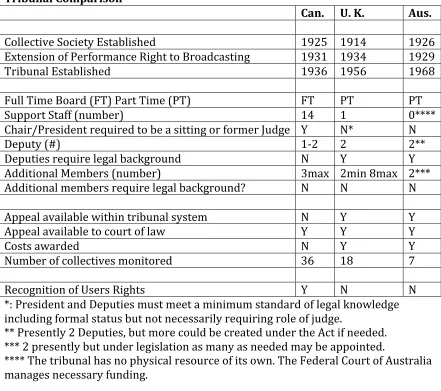
Table 1: Tribunal Comparison 57
Table 2: Federal Court of Appeal Decisions 90
public performance right and its varied interpretations have grown exponentially in
the last thirty years. Performance rights organizations have been responsible for
the massive growth of copyright collectives worldwide, but nowhere more than in
Canada. Prior to the 1988 Phase I revisions to the Copyright Act,1 there was a single
copyright collective authorized under Canadian law, for the collection of music
performance rights. Since the Phase I revisions were enacted, more than thirty-‐‑eight
copyright collectives2 have been registered with the Copyright Board of Canada.
With thirty-‐‑eight registered collectives, Canada has more than double the copyright
collectives of any other nation. 3
The continued growth of copyright collectives reflects their unique ability to
extract value from previously existing works. New collectives mean new revenue
streams on works already in circulation as well as those yet to be created. The
current Canadian copyright collectives owe their existence to the establishment and
expansion of the public performance right in Canada. While initially limited to the
public performance right in musical works, copyright collectives have now
expanded their scope to encompass other areas.4 Several Royal Commissions have
1Copyright Act, RSC 1985, c C-30 s. 1 [Act].
2 A copyright collective is an agency created under the terms of the Copyright Act which collects royalties
or licensing fees on behalf of registered copyright owners. Note however that of the 38 collectives listed there are only 35 separate collectives; 3 collectives (Societe du Droit de Reproduction des Auteurs Compositeurs et Editeurs au Canada [SODRAC], Canadian Mechanical Reproduction Rights Agency [CMRRA] and Society of Composers Authors and Music Publishers of Canada [SOCAN]) collect in multiple areas.
3 Daniel J. Gervais, “Collective Management of Copyright and Neighbouring Rights in Canada: An International Perspective” (2002) 1 CJLT 2 at 18 table 3.
been created in response to the concerns5 from users6 brought forward in the wake
of the creation of the original Canadian collective. Canada established a copyright
tribunal in 1936, well in advance of other common-‐‑law countries.7 While some form
of this tribunal has been in operation for almost eighty years there has been very
little scholarship in regard to its operation and almost none that attempts to
critically engage the issue beyond simple economic or legal function.
The intent of this thesis is to consider the history and expansion of the
Copyright Board of Canada with particular reference to its regulatory oversight role
on behalf of users. Contextualizing the issue within the frames of information policy,
legal theory and critical historical analysis will provide a holistic approach to
understanding the establishment and expansion of the board and its powers. Using a
critical historical holistic approach will enrich the policy analysis with factors
beyond simply the purely economic or legal. This approach is not intended to
derogate the importance of such factors, but rather to recognize that legal and
economic institutions operate in a larger public realm and not only impact that
realm, but are also impacted by it. As an example, the massive expansion of
copyright collectives following the 1988 revisions to the Act can be seen as a
magazines, journals and newspapers. The Producers Audiovisual Collective of Canada collects fees from the sale of blank audiovisual recording media and devices (often referred to as "private copy levies"), from the rental and lending of video recordings, from exhibition or public performance rights, and from
educational copying and performance of audiovisual works.
5 These commissions will be discussed in chapter three but primarily concerned the level of tariff being
charged, and the legitimacy of works for which tariff was sought.
6 User in this context would refer to anyone person or group requiring the use of a copyrighted work subject
to collective license.
7 Daniel Gervais, “A Uniquely Canadian Institution: The Copyright Board ofCanada” in Ysolde Gendreau,
strategic policy initiative on the part of the government. Generally, such far-‐‑reaching
initiatives are the result of factors beyond the simply legal, leading to the question of
how the function of the board has impacted the larger policy process, and was in
turn impacted by it.
Viewing the problem within a critical historical frame, the primary focus will
be upon the changing role of the board over time, in particular the decisions of the
Board given the direction of the Supreme Court of Canada (SCC) in 2004 & 2012.
Justification
Intellectual Property (IP) regimes have traditionally depended upon the
container to provide the physical embodiment of artificial scarcity. Maintaining the
myth of scarcity and the control of intellectual works is increasingly difficult in our
expanding digital society. Increasingly one of the responses being used to address
that concern is that of collectivization. While the expansion of collectives within the
copyright regimes has largely gone unnoticed by the public, these agencies collect
yearly rents in excess of $342 million from Canadian users. Even using this
undoubtedly low figure,8 it still amounts to almost $10 for every man, woman and
child in Canada.
8 This figure is based on information available from only four of the registered collectives, and while it did
include the largest, SOCAN, it is not a true reflection of the actual per capita cost which will be undoubtedly higher. The data was gathered in 2015 and reflects revenues in the 2014 fiscal period (with respect to Societe Quebecise de Gestion Collective, des Droits de Reproduction (COPIBEC) the 2013-2014 fiscal year) See Society of Composers Authors and Music Publishers of Canada (SOCAN) “SOCAN Annual Report” online: <http://www.socanannualreport.ca>, Societe Quebecise de Gestion Collective, des Droits de Reproduction (COPIBEC). “Annual Report 2014-2015” online:
<http://www.copibec.qc.ca/Portals/0/Fichiers_PDF_anglais/rapp_annuel_copibec_2014-15_ang_web.pdf>; Canadian Private Copying Collective, Financial Highlights” online:
Unlike much of the policy analysis done in the copyright arena, this thesis
takes a critical approach to the topic, viewing it not only from its economic
outcomes, but also within the context of its social and cultural impacts. While the
increasing recourse to collective licensing as a policy response is of great concern,
the complete absence of a critical analysis of the functions of the Copyright Board
within this process illustrates a significant absence in the literature. It is the
contention of the author that the primary reason for this lack of critical analysis has
been the extremely successful hegemonic process, which has surrounded the
regimes of collective management from their earliest stages.
Theoretical Framework
Gramsci’s theoretical interpretation provides a strong analytic framework for
this study, as the standard economic and philosophic rationales surrounding the
policy process raise significant questions.9 The economic literature in particular
seems to indicate a reality contrary to the justifications historically offered.
Gramsci’s hegemonic theory will be used to construct an organizing rationale
behind the successful imposition, and expansion of collective management. The
copyright board, collective societies and the copyright and policy experts within the
larger community can in analysis be seen to be indicative of the hegemonic process. In a previous work10 the author utilized this frame to form an analysis of the
establishment and expansion of the public performance right within the Canadian
9 For a more complete discussion see D’Alton 2014, “A Gramscian Analysis of the Public Performance
Right”, in Intellectual Property for the 21st Century Interdisciplinary Approaches, B. Courtney Doagoo, Mistrale Goudreau, Teresa Scassa and Madelaine Saginur ed., (Irwin Law, Toronto, 2014).
10 Louis J. D’Alton, A Critical Historical Analysis of the Public Performance Right (PhD Dissertation,
copyright environment. That work traced the creation and establishment of a public
performance right in the common-‐‑law tradition and its eventual widespread
implementation. The primary issue underlying the creation and expansion of the
public performance right in musical works, when viewed within a critical Marxist
frame, was the essential struggle between authors/composers and the dominant
publishing interests, which dictated their terms of employment and recompense. In
particular, the previous work considered the initial establishment of what Gramsci
referred to as the ‘historic bloc’, a cross class alliance between traditionally
opposing interests, publisher and composer.
The initial study encompassed the history of the public performance right
from its beginnings in the United Kingdom in the 19th century through its global
expansion in the 20th century with a particular emphasis on the Canadian
experience. While much of the focus was on the latter part of the 20th century the
work ended with the 1988 phase one revision to copyright in Canada and the
massive expansion of collective management of copyright in Canada.
In part this thesis can be seen to be a companion piece to that previous work.
Some of the material presented in chapter two and the historical discussion
surrounding the creation of the first tribunal in section 3.1 can also be found in the
earlier work. This material provides the foundational context on which this current
thesis is structured. Where the focus previously was on the creation and dominance
of the hegemonic frame, this thesis concerns itself with the role of the tribunal
within that larger process, and specifically the ways in which the process has
concerned itself with the United Kingdom and Canada, and to a lesser extent the
United States, this work focuses primarily on Canada while also considering the
United Kingdom and Australia, which share the common law tradition and a
common root of copyright legislation.
In terms of contextualizing the appropriateness of the theoretical ‘fit’ to the
current research the author notes that the performance rights organizations initially
balked at the notion of an oversight agency, but over time it appears that the
hegemonic process encapsulated and expanded the role of the board11 to serve the
dominant agenda of the hegemonic process. This process might also be viewed as a
form of regulatory capture, however that does not diminish the theoretical value of
the Gramscian interpretation.
Thesis
The general thesis of this work is that the collective management of rights within copyright as established within the Anglo-‐‑American legal tradition exists and
has been successfully expanded only as a result of capital interests. Contemporary
copyright policy relies upon the use of administrative tribunals within the copyright
environment with little critical evaluation of their nature, justifications or impact
upon the larger society of information users. As will be discussed in chapter two the
original purpose of the Copyright Appeal Board was to provide regulatory oversight
11 Earlier research revealed a number of attempts by collectives to evade their obligations to the board.
Such behavior can be seen to peak with their attempt to discredit the Copyright Appeal Board’s right to oversee them during an appearance before the Ilsley Commission. More recently Knopf has commented on the collectives use of the Copyright Board hearing process to acquire private information that would otherwise be unavailable, Howard P. Knopf “Canadian Copyright Collectives and the Copyright Board: A Snap Shot in 2008” (paper delivered at Law Society of Upper Canada Continuing Legal Education Program, 28 February 2008) online:
over the collective (singular at that point) on behalf of users. That initial role of
oversight and protection has been lost over time and the tribunals now are
generally promoted as agencies driving economic development.
Through a critical historical study of the establishment of the Copyright Board it’s predecessor, the Copyright Appeal Board, and copyright tribunals of other
common law jurisdictions, the author will posit a model to explain the changing role
of the tribunal from one of oversight to participant and its eventual absorption,
along with the policy process, into the policy network surrounding the collective
rights management regimes. This general thesis leads to a series of research
questions, which seek to identify the key actors in the area and consider their
influence on the various sectors.
It is presumed that the readers of this work have at minimum a perfunctory
understanding of copyright,12 and while there will be no attempt to explain the
regime as a whole, it is necessary to provide some definitions of recurring terms
relevant to the discussion of this thesis. The term intellectual property is the broad
designation given the area of law which encompasses works of the intellect.
Specifically, intellectual property includes Copyright, Patent and Trademark. Within
the larger area of intellectual property, copyright is unique insofar as it deals with
literary, dramatic, musical and artistic works as opposed to mechanical contrivances
or inventions.
A Copyright Board or Tribunal is a national regulatory agency established by
legislation through the Copyright Act of it’s country of origin. Their primary role is
12 For a detailed discussion of copyright and intellectual property as a whole see Vaver, David, Intellectual
the regulation of tariffs levied by copyright collectives for the use of copyrighted
works. Copyright collectives are also established by virtue of their national
legislations for the purpose of collecting licence fees or royalties for the use of
copyrighted works on behalf of copyright owners who have assigned their rights to
the collective.
Objectives and Research Questions
The objective of this research is to attempt to discern the role of the
Copyright Board, and copyright tribunals generally, in the acceptance and expansion
of collective management within the policy environment and with particular
reference to the impact on users of copyrighted works and other subject matter.
Note that within this context the notion of ‘user’ can be convoluted. With respect to
the tariff rulings of the Board, they are generally perceived to be directed at large
scale users such as media broadcasters, as well as smaller users such as motels,
hotels, churches and service clubs. However, as the Supreme Court noted in Alberta
Education v Access Copyright, while tariffs are generally crafted based on an
aggregate amount of users, they should in fact be considered on the basis of the
individual user when it comes to issues regarding the implementation of the Act.13 To accomplish this objective, the following research questions are posed: 1. In what ways has the Copyright Board changed with respect to its scope and oversight role since its creation as the Copyright Appeal Board in 1936? 2. How well are user interests represented in the practices of the Board?
13Alberta (Education) v. Canadian Copyright Licensing Agency (Access Copyright), 2012 SCC 37 [Alberta
3. Has lobbying by the various industries represented by collective management shaped/impacted Board practice?
4. Is there evidence of a shift in the policy or findings of the Board as a
function over time?
5. Has the influence of the original public performance right collectives continued to significantly impact the Board since the 1988 copyright revisions, or
has the network seen the establishment of new key players?
Methodology
This study is situated within the critical-‐‑historical paradigm and will utilize both empirical and theoretical inputs. Such research “typically goes beyond mere
description and attempts to interpret the facts as reconstructed. . .. the historian
attempts to give meaning to the facts in light of a relevant theory”.14 This
investigation will begin with a contextual framing of the justificatory theories
underpinning copyright law, and thus the existence of copyright tribunals. It has
been noted by several copyright scholars that the rules of administrative tribunals
greatly impact the policy process with regard to the nature of information which can
be sought, the costs of appearance and the often ‘one sided’ appearance of
information flow in related hearings.15
The study will outline the establishment and expansion of collective
management regimes and their accompanying oversight tribunals, with a particular
14 Ronald R. Powell, Basic Research Methods for Librarians, 2d ed (Greenwich CT: Ablex, 1991) at 137. 15 For further discussion on these issues see Daniel Gervais, “A Uniquely Canadian Institution: The
emphasis on the Canadian experience. The analysis will be framed using multiple
data sources including legal decisions, government policy documents, stakeholder
internal publications, and other sources of data reflecting the positions of the
various stakeholders within the policy process. Particular emphasis will be given to
those decisions of the Board that were later reviewed by the Federal Court.
The case being studied is defined as the actors and roles performed within the system surrounding collective rights management in Canada. The term
surrounding provides linkage to both the foundational networks, which led to the
creation of the system, as well as to extended collective management organizations,
such as the Copyright Board, which can be seen to have derived from the collective
rights management system. While the focus of the research is the operations of the
copyright board, noting the linkage recognizes that the collective management
network exists as an outcome of the foundational networks and their successful
inculcation.
Discussions of copyright policy and process will often situate themselves solely on the basis of legal rulings. Cyril Ehrlich has commented “[s]uch
interpretations of history give undue weight to intricacies of law, a common
tendency in this field of study, and pay scant regard to economic realities”.16 While
legal systems may provide the coercion necessary to insure adherence to whatever
regimes are established, they do not create law purely for their own interests. In
issues of copyright the law is usually responding to economic concerns and as Paul
Romer notes in the American Economic Review, it behooves economists to “explain
that the policy goal should be to maximize consumer welfare, not such popular
proxies as ‘exports’ or ‘industry revenues’”.17 Thus, the focus will be upon the
holistic nature of the network itself and the socio-‐‑economic framework surrounding
it as opposed to purely law or economic theory. Organizational Plan
The study will proceed along the following organizational plan. This chapter
will introduce the problem under study and place it within the context of policy
analysis. It will also outline the justification for the research and its proposed
implication for the field.
Chapter two will briefly consider the justificatory rationales for copyright
and their dependence on the creator myth. The centrality of creator as justification
for the existence and promulgation of copyright will be considered within historical
context. It will also introduce the theoretical work of Antonio Gramsci, whose
conception of hegemony provides the theoretical framework that will be used to
construct an organizing rationale behind the successful imposition, and expansion
of the collective management process. The hegemonic framework explains the
success of the process as well as the ultimate acceptance and support of the
Copyright Board.
Chapter three will consider the operation of the Copyright Board in
comparison with similar tribunal based systems in other jurisdictions, specifically
England and Australia. The chosen jurisdictions all share the same root for their
initial copyright legislation in the United Kingdom Copyright Act of 1911. However,
the UK Act of 1911 did not provide provision for the creation of copyright tribunals.
Each nation would eventually create an administrative tribunal to deal with the
issues surrounding the collective management of copyright but the timeline and
approach to the imposition of tribunal-‐‑based administration was very different, thus
indicating the impact of different policy goals.
Chapter four will consider the status of the user under the three regimes.
Particular attention will be given to the expansion of the status and role of the user
within copyright following the 2004 decision of the Supreme Court of Canada (SCC),
as well as the reconsideration of Fair Dealing by the court. This contemporary
Canadian standard for Fair Dealing and the user will be contrasted with the parallel
regimes.
Chapter five will review Copyright Board decisions that reached the Federal
Court of Appeal in the period 2004-‐‑2014. This period was chosen as it coincides
with the landmark ruling of CCH Canadian Ltd. V. Law Society of Upper Canada 18 in
2004, which fundamentally changed the interpretation of copyright law with
respect to users in Canada. The period also encompasses the Pentalogy rulings of
July 2012, which would further elaborate the understanding of copyright and the
role of users in Canada. These will also be discussed.
Chapter 6 will review inquiries into copyright and the tribunals. In addition
to the Canadian Royal Commissions of the early and mid twentieth century there
have also been numerous (and more recent) reviews in both England an Australia,
though only one single review devoted solely to the tribunals themselves outside of
the early Canadian ones. While no new reviews have taken place in Canada since the
1950s, the current internal review process taking place within the Copyright Board
of Canada will also be considered.
Chapter seven will be divided into two parts. The first section will provide a
brief review of the salient points of the history of the Copyright Board and its
parallel tribunals within a Gramscian hegemonic frame. The final part will consider
the effectiveness of the thesis with respect to the research questions posed, and
consider possible alternatives to the current policy solutions that might more
effectively achieve the intended policy objectives, but with a reduced social cost.
Chapter 2 Contextualizing the Copyright & Tribunal Discussion
“The great enemy of truth is very often not the lie – deliberate, contrived and dishonest – but the myth – persistent, persuasive, and unrealistic.” John F. Kennedy19
There are two primary streams of justification most often cited in the defence of
copyright, the natural right of the author or ‘right’ based system and one based on
economic efficiency or utilitarianism.20 These two systems are often idealized in the
French author centric system of “Droit d’Auteur” and the English common-‐‑law
system centred on economic efficiency. Some theorists, such as von Lewinski, posit
the notion that the incompatible nature of the author versus economic driven
philosophies has been the basis for much of the problems that have accompanied
international agreements with respect to copyright. Conversely, Jane Ginsburg has
noted that the gulf between the two variant systems is not nearly as great as has
been portrayed, and that in fact there is a great deal more in common than at odds.
Regardless of the theoretical basis for justification, the notion of author plays a
central role in both variants. While the author lies at the core of the rationale within
right-‐‑based systems, even within utilitarian/economic frameworks the author plays
a critical role in justifying the system. However, one standpoint is rarely if ever
considered, the irrelevance of the author.
It is the contention of this author that the most significant purpose of copyright
since the onset of the industrial era (which coincides with the expansion of
19 John F. Kennedy, Commencement Address at Yale University, Old Campus, New Haven, Connecticut,
June 11, 1962.
20 Murray, Laura J., Trosow, Samuel E., Canadian Copyright A Citizen’s Guide, 2nd Edition (Between The
copyright systems in the western world) has been to further the creation and
circulation of capital and that the role of the author within copyright has simply
been to provide the human connection needed to sell an unpopular product. When
viewed within that context the centrality of the author loses its import and rather
can be seen simply as an effort to justify a tenuous scheme that intuitively holds
little validity for the average user.
2.1 Copyright Myths
While one tends to think of copyright in respect of the creator, and certainly
the rhetoric surrounding any copyright dispute will generally clothe itself in terms
of the “creator”, with respect to economic rights, copyright does not in fact protect
the creator, but rather the owner. While the creator is usually the first owner of the
copyright,21 under normal circumstances (at least historically in the case of music
and the book trade) the copyright owner is usually the publisher, as the assignation
of copyright to the publishing house is a normal condition of publication.22
Assignment may be for a limited time or may be permanent, but rights guaranteed
under the Act protect the owner of the copyright, not the creator. As copyright
scholar David Vaver has pointed out, the first myth of copyright law is that it “is
designed to protect authors. In locating itself around the central character of the
author . . . copyright law is politically astute.”23
21 The CopyrightAct at s. 13 (1) states the general rule in Canada; however, there are exceptions to this, for
example work done in the employ of others may be owned by the corporate employer unless contractually stipulated otherwise. Similarly, photographs or works of fine art done in return for recompense are owned by the commissioner, unless an agreement to the contrary is made at s. 10 (2).
22 Joanna Demers, Steal This Music: How Intellectual Property Law Affects Musical Creativity, (Athens, Georgia: University of Georgia Press, 2006) at 12.
The other myth to be dispelled is that despite the nomenclature, Intellectual
Property is not in fact property in the traditional sense. Property is by its nature
rivalrous in consumption, which is to say that ownership and use of a piece of
physical property denies anyone else the use of it at the same time. The ownership
of a piece of property by one individual can (at the discretion of the owner) limit the
use of the property by others regardless of whether or not it is in use by the owner.
Likewise, at the discretion of the owner, uses may be made of the property, which
make it unusable for any other purpose in the future. By contrast, many people may
use works of the intellect without diminishing the ability of anyone else to use them.
In many instances the more use that is made of the work the greater its value
becomes (for example books, music, fine art).
At first blush this distinction between intellectual property and real property
might seem to be simply semantic, but it is vitally important to the discussion of
copyright. The fundamental reason we perceive and treat works of the intellect as
extensions of property is because we have been taught to do so. As the economists
Boldrin and Levine noted in their inquiry into intellectual property, " For at least
three thousand years, musical and literary works have been created in pretty much
every society, and in the complete absence -‐‑ in fact, often under the explicit
prohibition -‐‑ of any kind of copyright protection .”24 However as a society we have
been increasingly inculcated into the notion and necessity of intellectual property, in
large part by the legal system which administers it. Reviewing the growth of
intellectual property systems over the last two hundred years, William Fisher stated
24 Boldrin, Michele. Levine, David, Against Intellectual Monopoly, (New York, Cambridge University
the “final force that has contributed to the growth of intellectual-‐‑property rights
consists of a gradual shift in the terminology used by lawyers to describe and
discuss those rights -‐‑-‐‑ in a word, the "propertization" of the field.” 25 Thus, authority
figures throughout society regularly profess that works of the intellect are property,
but they are not property in the traditional sense and that must always be kept in
mind whenever intellectual property is discussed. As Vaver points out, “Capitalists
want to ‘own’ whatever their enterprise produces . . . tangible or intangible. . .. Those
who imitate or appropriate such assets can then be called thieves and pirates. . . ” 26
As will be discussed later, this is hegemonic in its form and function, the inculcation
of processes favourable to those dominating the social order.
2.2 Common-‐‑law Model
While there are historical predecessors, the first copyright legislation in the Anglo-‐‑American legal tradition, and one that would also have great impact on the
French tradition, was An Act for the Encouragement of Learning, by Vesting the
Copies of Printed Books in the Authors or Purchasers of such Copies, During the Times
therein mentioned,27 While much can be made of the history leading up to this Act,28
25 Fisher, William W. III, “The Growth of Intellectual Property: A History of the Ownership of Ideas in the
United States” online: <https://cyber.law.harvard.edu/property99/history.html>.
26 David Vaver, “Agnostic Observations on Intellectual Property” (1991) 6 IPJ 125 at 3.
27An Act for the Encouragement of Learning, by Vesting the Copies of Printed Books in the Authors or
Purchasers of such Copies, During the Times therein mentioned, Copyright Act 1709, 8 Ann c 19.[Statute of Anne]
28 Patterson in his treatise makes much of the connection between the state and the book trade in his
understanding of the ultimate purpose of the Act, conversely Feather’s history seems to focus on the inequity of power relations exhibited in the author-publisher relationship. Deazley however views the Act as fundamentally one of balance, a bargain “It was the free market of ideas, not the marketplace of the bookseller, which provided the central focus for the Statute of Anne” Ronan Deazley, On the Origin of the
ultimately it can be viewed as an attempt at balance. As the full title of the Act makes
clear, its intended purpose was to encourage learning. It did so in several ways. First
by securing to authors the exclusive rights to their works for a period of 14 years
and also by requiring duties of the publishers. As part of their duties publishers
were required to make free copies of the best quality available to the centres of
learning. Penalties were prescribed for failure to do so. Publishers were also
required to keep prices reasonable. Again failure to do so could lead to financial
penalties as well as the price of the book being reduced.29
We tend to think of the history of copyright in terms of rights, be they
author’s rights or publisher’s rights. However, as the initial legislation indicates
users’ rights were also delineated, specifically the protection from usurious fees.
More poignant however is the notion of duties, obligations upon the publishers.
These concepts of users’ rights and publishers’ duties seem to have been largely
forgotten in the history of copyright debate. Ultimately copyright in its present form
is most commonly viewed as an efficient means to ensure economic investment in
information industries.
2.3 Justification on the Basis of Economic Efficiency
The Economic Efficiency model (also sometimes treated as the Utilitarian
model) is often cited as the justificatory basis for the common law tradition.30
Within this model, intellectual property is seen as a necessary response given that
the nature of intellectual works makes control difficult. Without such regimes,
downstream users could make use of works freely without any of the costs normally
associated with creation and development, and thus bring goods to the market at a
significantly reduced cost than could the originator. Ultimately, this free riding
would result in market failure, as creators would have no incentive to invest in
creation given that the costs of research and development would be less likely to be
recovered. Within this framework, copyright operates as a tool of public policy,
utilizing a statutorily created limited monopoly to ensure sufficient return to incent
creation. This is often portrayed as a balance between the creator and the user, in
which the interests of the user (access to works) are balanced against those of the
creator (incentive to create). Thus the copyright monopoly, while limiting access, is
justified by virtue of the fact that works are created and disseminated and should
eventually become available within the public domain.
2.4 Limitations on the Economic Efficiency Model
While the economic efficiency model may seem a reasonable approach there
are nonetheless a number of issues raised to contest it. First and foremost, not all
works are created for monetary gain. This is of course particularly true of works of
an artistic nature. Artists (of any medium) create because they feel a need to do so,
not only for economic incentive, and often despite the lack of economic success. As
Service Canada has noted on their website “Like many other occupations in the arts,
multiple employment is common...their income from activities in this occupation
alone is often not enough to make ends meet”.31 Nigel Parker has noted that
31 The Service Canada website noted that in the 2011 National Household Survey, 46% of all self identified
“Creators do not create for the joy or prestige of owning a copyright -‐‑ or even for the
money which that copyright may earn. Copyright does not itself generate
creativity.”32 This is not to suggest that artists should not be rewarded for
contributing to the culture of our societies, rather it is simply to note that they
would likely do so regardless. Thus, incentive as a necessity for creation becomes
suspect.
There is also a growing body of economic research into copyright that
indicates that the incentive rationale of copyright simply does not hold up. Birgitte
Andersen, R. Kozul-‐‑Wright, and Z. Kozul Wright’s “The Social and Economic Effects
of Copyrights in the Music Industry”33 examines many of the copyright stereotypes
existing in the music industry. Within the study, Andersen et al. comment on the fact
that the distribution of incomes is due as much to “strategic interaction and
bargaining power of individuals and firms, and the governance structures of
copyrights, as to the presence of musical talent or market forces.”34 Andersen et al.
also note areas of conflict within the copyright regimes, which, while perhaps
fruitful economically for those in superior bargaining positions, do not necessarily
benefit either creators or cultural expression. Ultimately they state, “[w]hereas the
copyright system in its current form is good in facilitating income and rent creation
from musical ideas, we must recognize the problem that it is enormously bad in
32 Parker, Nigel, Music Business: Infrastructure, Practice and Law, (London: Sweet and Maxwell, 2004) at 3.
33 Birgitte Andersen, Richard Kozul-‐‑Wright, and Zeljka Kozul-‐‑Wright, “The Social and Economic Effects of Copyrights in the Music Industry: A Contribution to the Convergence versus Divergence Debate” in F. MacMillan, ed, New Directions in Copyright Law (Cheltenham: Edward Elgar, 2005).
creating a ‘fair’ income distribution, acknowledging creativity throughout the industry, and also somewhat unsuccessful in generating cultural expansion.”35
Martin Kretschmer has also considered the author-‐‑driven rhetoric of the
copyright regimes, seeking empirical evidence of their effect. Kretschmer
determines that copyright is in fact structured to benefit investors not creators, with
the exception of those artists who have become so large that they are in essence
corporate entities (e.g. Springsteen, U2, Dylan). Kretschmer concludes:
[O]ur study reveals that orthodox assumptions about the function of
copyright in creator’s lives are largely invalid. Copyright neither appears to support the creative basis of society nor does it make cultural materials available in a legal form that legitimizes creative digital re-‐‑use. Future Copyright policy must be based on a much clearer empirical picture of the role of Copyright in creative production.36
In 2010 Harvard economist Oberholzer-‐‑Gee in conjunction with his colleague
Strumpf constructed an empirical analysis of the impacts of downloading practices.
They determined that practices were affecting music industry sales; however, not to
the extent claimed by the industry. Of greater interest however was their contention
that despite the fact that file sharing had “considerably weakened copyright
protection” there was evidence to indicate that the greater access had resulted in
increasing amounts of creative outputs.
Overall production figures for the creative industries appear to be consistent with this view that file sharing has not discouraged artists and publishers. While album sales have generally fallen since 2000, the number of albums being created has exploded. In 2000, 35,516
35Ibid at 27.
36 Martin Kretschmer, “Artists’ Earnings and Copyright: A Review of British and German
albums were released. Seven years later, 79,695 albums (including 25,159 digital albums) were published (Nielsen SoundScan, 2008).37
Nor was this increase limited to the music industry, Oberholzer-‐‑Gee and Strumpf
noted similar increases in the film and publishing industries. Such a conclusion is a
direct contradiction of the fundamental copyright justification that incentive is
required for creation.
The impact of this economic research underscores the need for clarity in the
roles of policy instruments such as copyright. If the purpose of copyright is to
reward and benefit creators, then the policies are not working given the economic
outcomes these researchers are seeing. While this discussion of policy outcomes
was precipitated by the incentive justification within the Anglo-‐‑American tradition,
the outcomes are the same regardless of the author centric nature of the regimes.
While Oberholzer-‐‑Gee & Strumpf were focusing on America (common-‐‑law) and
Kretschmer on Germany (author-‐‑centric) Andersen et al were looking
internationally. Regardless of the geographic source of data the author did not
benefit significantly relative to the industrial interests.
2.5 Natural Right of the Creator
While this thesis is concerned with the operation of copyright in a common
law tradition, the centrality of the author/creator to the justifications of copyright
historically warrants a brief consideration of the natural right theory. The
continental vision of copyright law is generally seen to have derived from the notion
of a natural right of an author to his work, in particular Georg Wilhelm Friedrich
Hegel’s notion of personhood. Margaret Radin interprets Hegel as stating that “to