CHALLENGES OF FLIPPING THE CLASSROOM IN TECHNICAL DRAWING: CASE OF KIAMBU INSTITUTE OF SCIENCE
AND TECHNOLOGY, KENYA
r"
F~ '- TT~, 1.1"'~S;~
'-:IT V " PO 80X. C,3[S·1~ DO-jOO " !I" NAIF<Ool i,E:NYA ~I
9
Ot.c.
2016
i
i
I
RECEIVED
J'
~i3-ADU.h ..TE,SC1;:OOL.
PETER GACHERU E55/CE/14068/2009
A THESIS SUBMITTED IN PARTIAL FULFILLMENT FOR THE A WARD OF THE DEGREE OF MASTER OF EDUCATION
IN THE SCHOOL OF EDUCATION OF
KENY ATT A UNIVERSITY
DE CLARA TION
I confirm that this research thesis ismyoriginal work and has not been presented in any other university/institution for certification. The thesis has been complemented by referenced works duly acknowledged. Where text, data, graphics, pictures or tables have been borrowed from other works- including the internet, the sources are specifically accredited through referencing in accordance with anti-plagiarism regulations.
Signature: Date
Gacheru, Peter E55/CEI14068/2009
Department: Educational Communication and Technology
SUPERVISORS' DECLARATION
This research thesis hasbeen submitted for appraisal with our approval as University
superViSO~
Signalur~: Dale
Name: Prof. Samson Rosana Ondigi
Department: Educational Communication and Technology University: Kenyatta University
Signature:
J!-<.:~::~:~::V~'
~
DatebJ
.
\
'
2
·20
Lb
Name: Prof. Henry Okello Ayot
DEDICATION
This study isdedicated to all my students in the past, present and future. May you seek and never lack learning opportunities.
ACKNOWLEDGMENT
I am very appreciative of the support of the staff of the Educational Communication and Technology Department and especially that of my supervisors,
Professor H.O. Ayot and Professor S.R. Ondigi.
TABLE OF CONTENTS
Page
DECLARATION : ii
DEDICATION iii
ACKNOWLEDGEMENT iv
LIST OF TABLES : : ~ xi
LIST OF FIGURES xii
ABBREVIATIONS AND ACRONYMS xiii
ABSTRACT xv
CHAPTER ONE
INTRODUCTION
] .l Background to the Study ]
1.2Statement of the Problem 5
1.3Purpose of the Study 5
1.4Specific Objectives of the Study 5
].5 Research Questions , 6
1.6Significance of the Study 6
1.7Assumptions 7
1.8Limitations ofthe Study 7
1.9Delimitations of the Study 8
1.10Theoretical Framework 8
1.11 Conceptual Framework : 9
].1].1 The Independent Variables for the Study 9
1.1].2 The Intervening and Dependent Variables for the Study 10
1.12 Operational Definition of Terms 12
CHAPTER TWO
REVIEW OF RELATED LITERATURE
2.1 Introduction 13
2.2 The Place of the FCA in TVET Institutions 13
2.2.1 Curriculum versus Teaching Subjects 14
2.2.2 Curriculum Implementation versus Teaching Methods 15
2.3The Flipped Classroom Approach as an Evidence-based Intervention 17
2.4 The Flipped Classroom Approach and Blended Learning 19
2.5 Current Learning Innovations in,Kenya 20
2.6 Benefits ofthe Flipped Classroom Approach 23
2.7 Limitations of the Flipped Classroom Approach and their Mitigation 25
2.8 The 4 Cs ofICT : 27
2.9 ICT Competence of Teachers and Learners 28
2.10 Preparing the Learner for Computer Mediated Instruction 30
2.11 Involving the Learner in Developing Lesson Content 31
2.12 Environmental Factors Affecting Learning 33
2.13 Challenges of Teaching Technical Drawing 34
2.14 Performance Trend of Trainees in KNEC Examinations 34
CHAPTER THREE METHODOLOGY
3.1 Introduction 36
3.2 Research Design 36
3.3Variables 37
3.3.1 The Independent Variables 37
3.3.2 The Intervening Variables 38
3.3.2 Dependent Variable 38
3.4 Location of Study : 38
3.5Target Population ~ 38
3.6 Sampling Procedures and Sample Size 38
3.7Research Instruments 39
3.8Pretesting 40
3.8.1 Instrumentation: Validity 40
3.8.2 Instrumentation: Reliability 42
3.9Data Collection Techniques 42
3.10 Data Analysis 43
3.1 0.1Technical Drawing Subject Content Analysis .44
3.10.2 Preparation of the Cooperating Tutor .45
3.10.3 Preparation of the Trainees 46
3.10.4 Physical and ICT Resources .46
3.19.5 Lesson Preparation and Presentation 46
3.10.6 Additional Data 47
3.11 Logistical and Ethical Considerations ,.47
CHAPTER FOUR
PRESENT ATION OF FINDINGS, INTERPRETATION AND DISCUSSION
4.0 Introduction 48
4.1Rationale of Teaching Technical Drawing 48
4.1.1 Content Analysis of the Technical Drawing Syllabus in the Diploma in
Quantity Surveying Programme 49
4.1.2 Topics and Sub-Topics in Technical Drawing 49
4.2 ICT Resources at KIST 51
4.2.1 Availability of and Access to Hardware and Accessories 53
4.2.2 Availability of Standard Productivity Software 53
4.2.3 Data Speeds and Connectivity 54
4.2.4 ICT Personnel 54
4.3 Trainee Characteristics at KIST 54
4.3.1 Ownership of Computing Devices and Access to Computers byTrainees ...55
4.3.2 ICT Competence of Trainees 56
4.3.3 Trainee Participation and Experience in the Study Lesson 57
4.3.4 Attitude of Trainees Towards the FCA 59
4.4 Utilizing the FCA to Teach Technical Drawing at KIST 59
4.4.1 Qualifications of the Cooperating Tutor 59
4.4.2 Preparing for the Study Lesson 60
4.4.3 Delivering the Study Lesson 61
4.4.4 Follow-up of the Study Lesson and Observations Schedule
.
614.5Discussion of Findings 64
4.5.1 ICT Resources for the FCA at KIST 64
4.5.3 Tutor Requirements for Utilizing the FCA to Teach Technical Drawing 65
4.6 Summary of Chapter Four 65
CHAPTER FIVE
CONCLUSIONS AND RECOMMENDATIONS
5.0Introduction : 67
5.1 Summary of the Study 67
5.1.1 Challenges of Flipping the Class in Technical Drawing 67
5.1.2 Challenges the Trainees Faced 68
5.1.3 Challenges the Cooperating Tutor Faced 68
5.2 Conclusions of the Study 69
5.3 Recommendations 69
5.4 Suggestions for Further Study 71
REFERENCES 72
APPENDICES
Research Instruments
Manipulative Skills Content Analysis Sheet 80
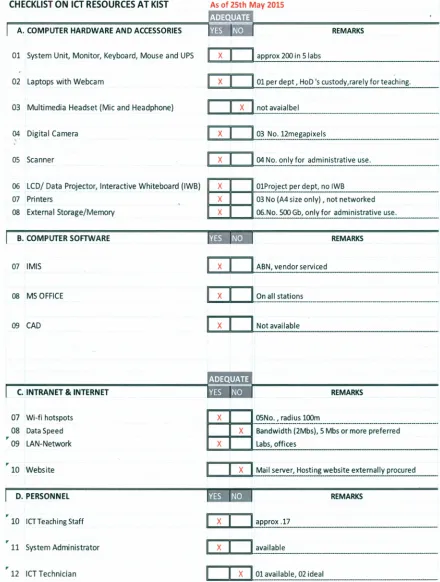
lCT Checklist. 81
Questionnaire for the Trainee 82
Observation Schedule for the Cooperating Tutor 83
Research Authorization
Research Authorization by NACOSTI 84
Research Authorization by County Commissioner, Kiambu 86
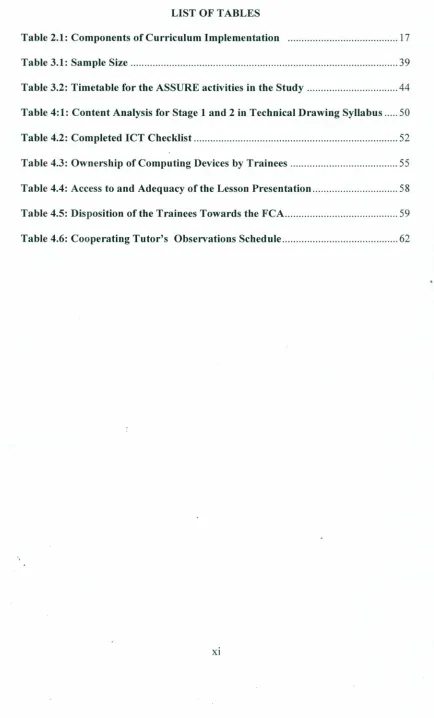
LIST OF TABLES
Table 2.1: Components of Curriculum Implementation 17
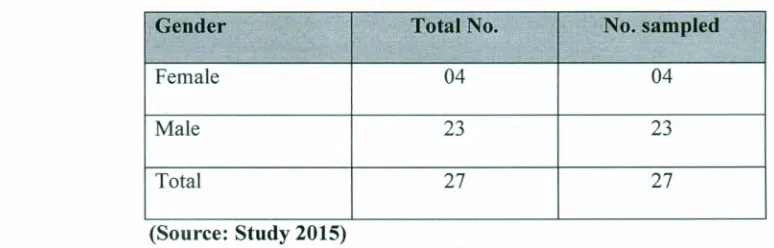
Table 3.1: Sample Size 39
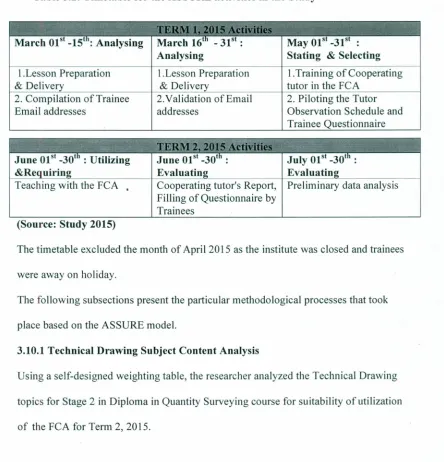
Table 3.2: Timetable for the ASSURE activities in the Study .44
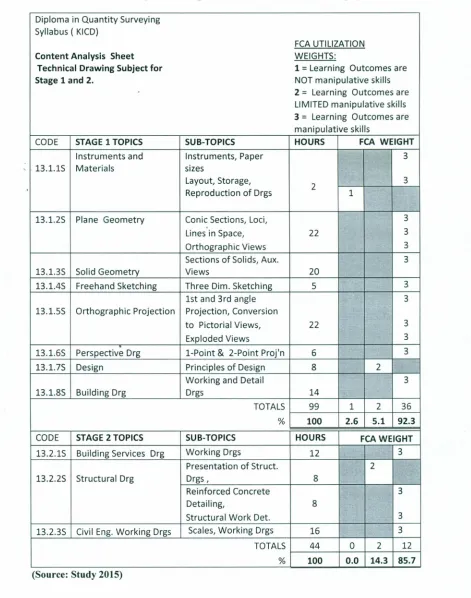
Table 4:1: Content Analysis for Stage 1 and 2in Technical Drawing Syllabus 50
Table 4.2: Completed ICT Checklist 52
Table 4.3: Ownership of Computing Devices by Trainees 55
Table 4.4: Access to and Adequacy of the Lesson Presentation 58
Table 4.5: Disposition of the Trainees Towards the FCA 59
Table 4.6: Cooperating Tutor's Observations Schedule 62
LIST OF FIGURES
Figure 1.1: Conceptualized Research Variables for the Study 9
Figure 2.1: Dale's Cone of Experience 31
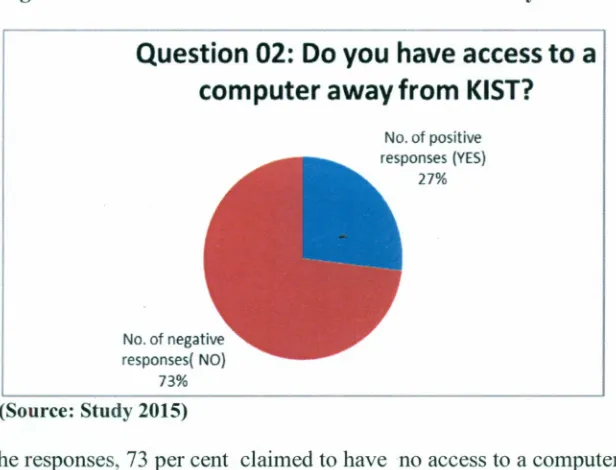
Figure 4.1: Access to ICT Resources Outside KIST byTrainees 56
Figure 4.2: Competence of Trainees in MS PowerPoint 57
BL BOM CAD CD CM DLP DQS DRG DVD F2F FCA GoK ICT IMIS ISP IWB KATTI·
KCSE KICD
KIE KIST
LIST OF ABBREVIATIONS AND ACRONYMS Blended Learning
Board of Management
Computer Aided DraftinglDesign Compact Disc
Computer Mediated.
Digital Literacy Programme Diploma in Quantity Surveying
Drawing
Digital Versatile Disc
Face to Face
Flipped Classroom Approach Government of Kenya
Information and Communication Technology
Integrated Management and Information System
Internet Service Provider
Interactive Whiteboard
Kenya Association of Technical Training Institutes
Kenya Certificate of Secondary Education
Kenya Institute of Curriculum Development (formerly KIE)
Kenya Institute of Ed ucation
Kiambu Institute of Science & Technology
KNEC Kenya National Examinations Council
Mbs Megabytes per second
MoEST Ministry of Education,
.
Science &TechnologyPDF Portable Document File format
PPP PowerPoint Presentation
TVET Technical and Vocational Education and Training
TIVET A Technical, Industrial, Vocational and Entrepreneurship Training
ABSTRACT
The Flipped Classroom Approach (FCA) originated from the United States of America (USA) in 2007. It functions by utilizing the time that is traditionally meant for homework to deliver lesson content via information and communication technology (lCT). Subsequent face-to-face (F2F) sessions in the classroom dwell on hands-on activities. The enhanced interactions between the teacher and the learners makes a teacher "the guide bythe side" rather than "the sage on the stage". At Kiambu Institute of Science & Technology (KIST) in Kenya, there is insufficient time to handle practical work, hence the need to adopt the FCA. An increase inthe contact time inthe classroom could potentially contribute to better academic performance. In this case study, the purpose was to identify the' challenges of flipping a Technical Drawing class. Four tools were used in the study, namely, content analysis of the syllabus, a checklist on ICT resources, a trainee questionnaire and a schedule of observations for the cooperating tutor. Technical Drawing was identified for the study because it lent itself to the use of FCA through its practical nature. Furthermore, it was mandatory for all trainees in the Building and Civil Engineering department at KIST. Content analysis of all topics in the syllabus was done to identify those that could be effectively
taught by flipping the classroom. Up to 92 per cent of the topics identified required manipulative skills and could be effectively flipped. A sample class of 27 trainees from the Diploma in Quantity Surveying programme selected through purposive sampling was used in the study lesson. The trainees filled a questionnaire on their experience
which was analyzed to establish the major challenges they encountered. 89 per cent and 69 per cent of the trainees did not have access to personal computers and smartphones
respectively. This made them heavily dependent on JCT resources at KIST. Moreover,
85 per cent of trainees did not have adequate computer skills. The study lesson was
delivered by a cooperating tutor who filled the schedule of observations detailing his experience in utilizing the FCA. His main challenge was packaging the lesson content for easier access by trainees. The checklist used to examine the capacity of the physical and information communication technology (JCT) infrastructure to support the FCA at KIST revealed that online delivery of lesson was limited by poor data connection speeds. The offline delivery was the preferred solution. The study conlcuded that,
unless the challenges were overcome, only a moderate level of success inachieving the learning outcomes could be obtained by flipping the classroom. The study recommends that the FCA be utilized in Technical and Vocational Education Training (TVET) institutions such as KIST provided that the trainees have basic computer skills toaccess online and offline resources. The study also recommends that tutors should have basic proficiency in ICT and be willing to tryout new learning and teaching approaches. The researcher suggests areplication of the study should be undertaken at other TVET institutions.
CHAPTER ONE
INTRODUCTION
1.1 Background to the Study
When a trend that changes the way business is done gains global significance, one can
easily talk of a revolution. Information and communication technology has radically
changed the way human beings interaot. What role does digital technology, specifically
computers, play in the delivery of content at different levels of education?
This question has universal significance as it impinges on teaching methods and
approaches.
In a typical classroom situation, frontal teaching, in which a teacher delivers a lesson by talking and writing on a chalkboard or whiteboard, takes place. The learners sit,mostly
passively, at their desks and listen, take notes, make sketches and solve given problems
in writing. They may also copy the lesson's assignment to be done later as homework.
This routine is repeated across many subjects even though the method may not lend
itself well to some of them. Where learners do not understand the day's lesson, the
teacher usually does not have the time to meet with them individually during the
normal class period. In the subsequent lesson, the teacher reviews the homework
assignments and only rarely do additional questions from students get enough attention
of the teacher because of time constraints.
Little effort is made to cater for individual differences and the "one-size-fits-all"
approach continues to disadvantage the learners. This observation has also been made
by Brennan (2003) in his work on pedagogy in the online environment.
There is need for educators to replace this essentially group-centred and teacher driven
instructional model with one that focuses on individual learning needs. This can be
Indeed, technology competency is a basic skill for the modern worker. For instance,
the situation in the United States of America (USA) is that around 95 % of the
workforce was expected to use technology for their work by the year 2000 (Oblinger
& Maruyama, 1996);
The situation may not be very different in the rest of the world due to globalisation in
various sectors, including education.
One of the models of instruction which has been gaining prominence is the Flipped
Classroom Approach (FCA). Digital technologies are utilised to create individual
learning spaces instead of relying only on the group learning space (Hamdan,
McKnight & Arfstrom, 2013). Originating from the USA, the FCA places a high
premium on digital instructional videos. Flipping or inverting the classroom involves
using the time that is usually taken up by homework to introduce a theory or a concept.
via avideo presentation. The video presentation may be watched by the learner online
or offline, depending on the learning environment. Consequently, classroom time which
is normally spent on expository sessions is instead optimised for hands-on practical
activities.
With the individual learners engaging the teacher and each other, clarifications of the
new concept or skill can then be made during the class sessions.
American high school science teachers Jonathan Bergmann and Aaron Sams are often
credited with coining the phrase "Flipped Classroom" in 2007 (Tucker, 2012).
Indeed, the process of flipping or inverting the classroom vests in the computer a very
central role. This implies that only countries that have an adequate information and
communication technology (lCT) infrastructure and the concomitant technological
know-how may be able to derive the benefits of the FCA.
This requirement excludes many African countries with underdeveloped ICT
.
infrastructure from flipping the classroom.
However, this situation can be rectified with proper planning, formulation and implementation of a public ICT policy. Rwanda is the first African country to have been supplied with the XO (generic name) machines by One Laptop Per Child Project.
Around 1.4 million children in the world have been provided with the devices in 35 countries including Haiti, Afghanistan, Brazil and Uruguay (Beaumont,201 0)
The organisation's mission statement is to create educational opportunities for the world's poorest children by using rugged, low-cost, low-power laptops.
Already, the Kenya Government has initiated a programme to provide tablets to pupils in primary schools (GoK, 2015). In the foreseeable future, Kenya will have a
technologically savvy population of teachers and learners at all levels of education which enjoy the benefits of the FCA. Kenya ranks among the countries with fairly established ICT infrastructure. According to Kroes (201I),Kenya is one of Africa's most innovation-friendly economy and possesses a legal framework that allows space for new ideas while preventing chaos. The government has an attitude to openness and open data unparalleled on the continent, providing a valuable raw material from which to construct new ideas. In the financial sector, the Mpesa (trade name) and similar mobile payment platform have revolutionised the way business is done. One can anticipate similar innovations in the educational sector. The FCA can be utilized in principle, but the Kenyan situation is such that the FCA is still a relatively unknown concept amongst teachers.
It may perhaps be argued that flipping a classroom is not a completely new educational
practice in Kenya and elsewhere. This is partly true when one considers the subjects
literature in English and Fasihi ( literature in Kiswahili).
The learners are required to read the set books outside the normal class time so as to
familiarise themselves with the story.
Learners then spend more time with the teacher discussing themes and protagonists
during class time and less time on how the plot ofthe story develops.
The fundamental difference between the foregoing situation and the FCA is the
utilisation of ICT including new mobile technology. Globally, there has been an
increase in teachers' and learners' enlightenment in the use of technology such as
mobile phones and social media. For instance,it has been reported that Kenya is a 50%
a smartphone market with 50% of all mobile phones being sold currently in Kenya
across all manufacturers being smartphones (Gicheru, 2014).
Lack of adequate time for practice was the primary factor that the researcher based the
study on. In his study on causes of poor performance in the external Kenya National
Examination Council (KNEC) examinations at selected TVET institutions that included
Kiambu Institute of Science and Technology (KIST), Gatundu (2014), identified
challenges such as lack of learning resources, provision of modern training equipment
and inadequate time for practical lessons. Adopting the FCA for teaching Technical
Drawing subject at KIST was deemed by the researcher to be a suitable instructional
intervention for increasing the practice time in class. KIST is a post-school training
institution that offers technical, vocational education and training (TVET). It also offers
business courses in accounting. It has an ICT infrastructure that is continually being
improved. The FCA had not been utilised at KIST.
1.2Statement of the Problem
The FeA has gained global acceptance as a teaching approach with several benefits and
some limitations. It especially allows learners to have more time for practising in class.
More practice can result in better academic performance. In this regard, Gatundu
(2014) found that the unsatisfactory pass rates at KIST in external examination was
due in part to inadequate practice time. The researcher confirmed through his
experience in teaching Technical Drawing that trainees did not have sufficient time for
practice in class. This could be alleviated by flipping the Technical Drawing class, an
intervention which had not yet been tried before. The problem being handled by the
study was to identify the challenges attendant upon this intervention.
1.3 Purpose of the Study
The purpose of this study was to determine the challenges of adopting the FeA as an
additional teaching approach in the Technical Drawing subject at KIST with a view to
increasing class practice time. Delivery of content in a selected topic using the FeA
provided a means of establishing the main challenges that faced trainees and the
cooperating tutor in the use of the FeA. By and large, flipping the classroom had the
potential of raising the performance levels of the trainees in external (KNEC)
examinations. The study made it possible to recommend best practices in content
delivery when using the FeAat KIST and other TVET institutions.
1.4 Specific Objectives of the Study
This study was conducted inline with the following objectives:
a) To establish the extent to what degree of success lesson objectives for a selected
topic could be achieved by utilizing the FeA in teaching Technical Drawing within
b) Toidentify the main challenges confronting trainees participating in the FCA in
teaching Technical Drawing from the Diploma in Quantity Surveying syllabus at
KIST
c) Toidentify the main challenges confronting the cooperating tutor while utilizing
theFCA in teaching a given topic in Technical Drawing from the Diploma in
Quantity Surveying syllabus at KIST.
1.5 Research Questions
a) Towhat degree of success could lesson objectives of a selected topic in Technical
Drawing from the Quantity Surveying diploma programme be delivered using the
FCA at KIST?
b) What would be the main challenges facing trainees participating in the FCA
inlearning Technical Drawing at KIST?
c) What would be the main challenges facing the cooperating tutor when using the
FCA in teaching a topic from the Technical Drawing syllabus at KIST?
1.6 Significance of the Study
The study sought to identify challenges of a new delivery mode in Technical Drawing
subject for the Diploma in Quantity Surveying programme at KIST. The results from
flipping the classroom in Technical Drawing would be useful for enriching
curriculum implementation at KIST, possibly even in other subjects.
Given the benefits of a learner-centered curriculum implementation, it would contribute
towards attainment of training goals at KIST and by extension at other TVET
institutions as established by the Ministry of Education, Kenya. Given that the
Government ofKenya had declared its intention to provide laptops for primary schools
pupils that from the year 2014, the FCA presents a real opportunity for computer
mediated learning in Kenyan learning and training institutions. Findings from this study
could contribute to the development of policy on digital curriculum implementation. 1.6 Assumptions
The assumptions of this study were:
i) That KIST had aworking ICT infrastructure to support the FCA and this was largely the case during the study period.
ii) That the cooperating tutor identified for the teaching using the FCA would cooperate fully and not withdraw before the conclusion of the study and this was the case.
iii) That all the participants' attitude towards activities relating to the FCA
during the period of study would bepositive and that all responses given
would betruthful. This was also thecase. 1.8 Limitations of the Study
The scope of this study was to identify challenges of adopting the FCA in teaching a
given topic in Technical Drawing subject at Kiambu Institute of Science and
Technology (KIST). Being a TVET institution in Kiambu County, Kenya, KIST was
.the study locale due to the fact that, to the best of the researcher's knowledge, the FCA had neither being applied nor studied at any other Kenyan learning institution.
This being a baseline study, the anticipated limitations were:
a) Only one class being taught using the FCA in the Technical Drawing subject
from the diploma in Quantity Surveying programme at KIST. This was meant to
eliminate other learner-based characteristics inherent in different classes. b) Only one lesson being taught by the cooperating tutor and for only one given
topic in Technical Drawing. This was to avoid extraneous factors that could be
challenges identified by teaching one lesson of a selected topic could be
identified so that subsequent lessons would be continually improved.
1.9 Delimitations of the Study
a) The academic performance of trainees in Technical Drawing when using the
FCA was not assessed because this would have required an extended period of
study.
b) During the study period, the FCA was not used in exclusion of the usual
teaching methods applied in Technical Drawing. It simply served as an
additional pedagogical intervention.
1.10 Theoretical Framework
The study was founded on two theories:
a) The Cone of Experience Theory by Dale, (1969) regarding learning styles.
The researcher appreciated the benefits of audiovisual learning encompassed
in the FCA . There was extensive use of Power Point presentations (PPP) in
the packaging of the lesson content
b) Constructivism by Jonassen (1994) as a philosophical basis on teaching and
learning. In as far as this theory reinforces the need for learners to use their
prior knowledge(constructs) to learn new content, the FCA provided an
excellent opportunity for trainees to interact with new content. The lesson
content was delivered in PPP slides starting from the very familiar and
building up to the new.
Two models were also applied in the study. Firstly, the ACTIONS model by Bates,
(2005) informed the selection of teaching media in delivering the Technical
Drawing lesson content.
Secondly, the ASSURE model byHeinich, Molenda, Russell, & Smaldino, (2002)
guided the research during the preparation and use of all instructional media that were
used in the flipped Technical Drawing lesson.
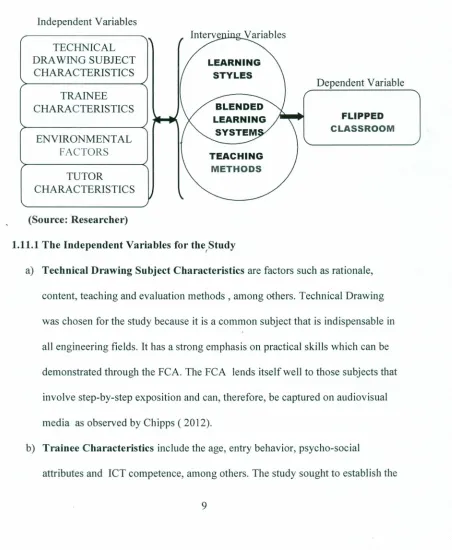
1.11 Conceptual Framework
The conceptual framework used in the study is depicted below:
Figure 1.1: Conceptualized Research Variables for the Study
Independent Variables
;.---=-....cVariables TECHNICAL
DRA WING SUBJECT CHARACTERISTICS
LEARNING
STYLES
Dependent Variable TRAINEE
CHARACTERISTICS
FLIPPED
CLASSROOM
ENVIRONMENTAL
FACTORS TEACHING
METHODS
TUTOR CHARACTERISTICS
(Source: Researcher)
1.11.1 The Independent Variables for the Study I
a) Technical Drawing Subject Characteristics are factors such as rationale,
content, teaching and evaluation methods, among others. Technical Drawing
was chosen for the study because it is a common subject that is indispensable in
all engineering fields. It has a strong emphasis on practical skills which can be
demonstrated through the FCA. The FCA lends itselfwell to those subjects that
involve step-by-step exposition and can, therefore, be captured onaudiovisual
media asobserved by Chipps ( 2012).
b) Trainee Characteristics include the age, entry behavior, psycho-social
experience and perceptions of the trainee regarding the utilization of the FCA.
The FCA is particularly suited to teaching adult learners as found at KIST.
"The time adults spend in training is precious, given all the other demands on
them. So when they are in a classroom - let them work together on activities
that help them apply and retain their learning." (Dudek, 2013, blog post)
c) Environmental Factors are external factors such as the physical location,
infrastructure, climate, among others. The JCT infrastructure at KIST was
evaluated in this study to assess its capacity to support the FCA.
d) Tutor Characteristics encompass qualities that enable a teacher to facilitate
effectively in a learning environments. They include academic and professional
qualifications, psycho-social and physical attributes. The study sought to
identify the practical and attitudinal requirements by a tutor to adopt the FCA.
The researcher was able to get the cooperation of a tutor who was competent
and willing to use the FCA at KIST during the study period.
1.11.2 The Intervening and Dependent Variables for the Study
This study was underpinned by constructivism and Dale's Cone of Experience.
Constructivism is the educational philosophy that emphasizes a learning process
focusing on primary concepts and not mere presentation of isolated or unrelated facts.
Learning styles evolve from learning and teaching processes and it is for this reason
that the study identified learning styles asan intervening variable. Equally, the study
identified teaching methods as the other intervening variable. Together, learning styles
and teaching methods have influenced the emergence of blended learning (BL) systems
or models of which the FCA is one of the more recent. "A rotation model closely
matches the concept of a flipped classroom. Set by a fixed schedule, students move
between required online interaction and required face-to-face interaction."
(Nelson, 2013) By flipping a selected lesson, the FCA constituted the dependent
variable being investigated in this study, with the main focus being the challenges faced
bytrainees and the cooperating tutor.
The researcher notes that a teaching approach is not a teaching method per se and
concurs with Bennett, Jason, Gudenrath & McIntosh (2012) to the effect that theFCA
isnot a methodology but an ideology. BL methods arise from insights arrived at by
marrying traditional delivery methods with computer mediated (CM) delivery modes.
Traditional delivery methods tend to follow rigid principles which have advantages as
well aslimitations. For instance, the lecture method is suitable for large adult
presentations and cannot be usedr effectively for teaching children. The lecture method
is also unsuitable for imparting practical skills. Byapplying educational
communication and technology invarying degrees; blended learning systems can be
created which are more effective for learning and teaching. It islargely within the
context of blended learning that the FCA operates. Anapproach results from
"borrowing" from two or more methods, :Forexample, the traditional lecture (lecture
method) being delivered in video format (audio-visual method). According to a study
byChipps (2012): "Students felt that the elements of the flipped class were more
effective; videos at home were better than lectures in class, and group work inclass was
better than independent work at home." (Chipps, 2012, p.41)
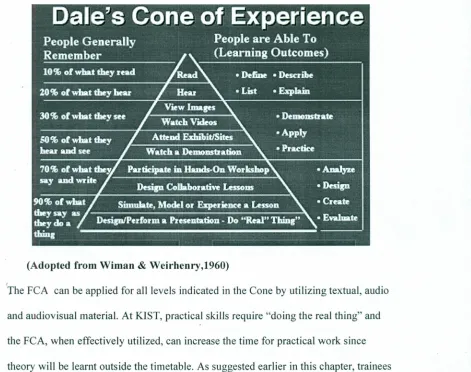
According to Dale's Cone of Experience (1969), instructional media increases in
effectiveness from textual (symbolic) to audio-visual (iconic) with simulations and re
al-lifeexperiences (enactive) being the most effective. Consequently, the study used
visual (PPPs) material and actual drawing inflipping the lesson. Within the study
period, the principle of a teacher being the guide bythe side rather than the sage on the
1.12Operational Definition of Terms
In the context of this study, the terms used are defined as follows:
Attitude - Positive or negative predisposition towards anentity.
Blended Learning- Hybridization of traditional or face-to-face teaching with
distributed /non-residential teaching, usually computer mediated.
Computer Mediated Learning- Use of a computer as an interface between the
trainee, the content and the tutor.
Curriculum Implementation - Teaching processes by which set instructional
objectives are achieved.
Degree of success in Achievement - Achievement ofthe learning objectives
ranging from low (not achieved), moderate (partially achieved) and high (fully
achieved).
Digital Technology - Devices and platforms that process content indigital.
formats such as computers, cameras, smart phones, applications, among others.
Face-to-Face Interaction - Direct interaction of trainees and the tutor.
Flipping the Classroom - Switching the usual class (teaching) time with
homework time so that learning activities are followed by practice during class time.
Information Communication Technology - Technologies that are used to
access, gather, manipulate andpresent or communicate information.
Major Challenge - A hindrance that prevents set learning objectives of the
taught lesson to be fully achieved.
Presentation - Video, audio andtextual content accessible bytrainees via
digital technology.
Technical Drawing - Academic discipline which deals with manual or digital
drawing practices for communicating inspecialised fields.
CHAPTER TWO
REVIEW OF RELATED LITERATURE
2.1 Introduction
This chapter discusses various aspects of curriculum implementation and present
development of the peA as a form of blended learning (BL) by citing relevant
examples. It delves into the degree of success experienced when using the peA in a
number of subjects within different learning environments. Advances in digital media
that support the peA are outlined. It argues for K'T competence of teachers and
learners and also identifies the major challenges that have accompanied the use of this
approach. It provides an objective basis for the utilization of the peA in teaching
Technical Drawing subject at KIST, and other TVET institutions.
2.2 The Place of the FCA in TVET Institutions
There is little or no local research on the peA in Kenya. Indeed, most of the literature
cited in this study was obtained from online sources since local publications on the subject were not available. To address poor performance in KNEe examinations by
TVET institutions, the peA could contribute through improved curriculum
implementation. Teaching by any method or approach constitutes a part of curriculum
implementation. In the absence of previous research, the adoption of the approach at
KIST was essentially a baseline study. By identifying the major challenges that
impeded the effective use of the peA as a means of teaching Technical Drawing, the
study could open avenues for further local research on the approach relating to
2.2.1Curriculum versus Teaching Subjects
In the broadest sense, curriculum is the sum of all that needs to be learnt. That would
suggest that curriculum is all the teaching subjects to be learnt at a given level, that is,
all the syllabi. But it can also imply all that needs to be learnt in a subject or discipline,
for example, the Mathematics curriculum. Regardless of whether one takes a broad or a
narrow view of curriculum, Eisner (1994) categorizes curriculum in three forms.
These are the explicit or official curriculum, the hidden curriculum and the absent
curriculum. The explicit curriculum is what is intended to be taught and is stated in the
designed syllabus. The hidden curriculum is what is learnt without being included in
the official syllabus. For example, "Students who successfully compete for grades are
not only rewarded with grades, but also with admission to honors classes." (Eisner,
1994)
In the example above, students end up learning to be competitive, although this
outcome is not included in the official curriculum.
As for the absent curriculum, it refers to what is supposed to be covered from the
syllabus but is omitted for various reasons. Teachers are the implementers of curricula
and they are supposed to apply their skills as well as knowledge in this undertaking. As
such, they require regular upgrading of their skills and knowledge levels to match
changes taking place in society and the world at large. The Kenya Association of
Technical Training Institutes (KA ITI) held a regional conference from 25th to 30th
of August, 2013 in Mombasa where one of the subthemes referred to "Science,
Technology and Innovations in TVET" and another addressed the issue of "The Future
TVET Instructor". This underscores the importance given to the quality ofTVET
curriculum implementers. Without effective curriculum implementation, the stated aims
of KA ITI would be difficult to achieve.
2.2.2 Curriculum Implementation versus Teaching Methods
As espoused byHoover and Patton (2005) ,curriculum implementation may be
viewed as the process of integrating, arranging, intervening, managing and monit
---
oringinstructional content within the learning environment. A teaching method is the means
bywhich instructional content is delivered. Therefore, ateaching method isclearly an
integral part of curriculum implementation. The official orexplicit curriculum is,
logically, the one tobe implemented through appropriate teaching methods.
The implementation should be done with high fidelity. Fidelity refers to translating the
intentions contained in the curriculum in their totality (Gresham, MacMillan,
Beebe-Frankenberger &Bocian ,2000). It is crucial that this happens, otherwise there would
be no justification of efforts to implement any syllabus within agiven curriculum.
Curriculum implementation results with extremely low or no fidelity ifit isdone
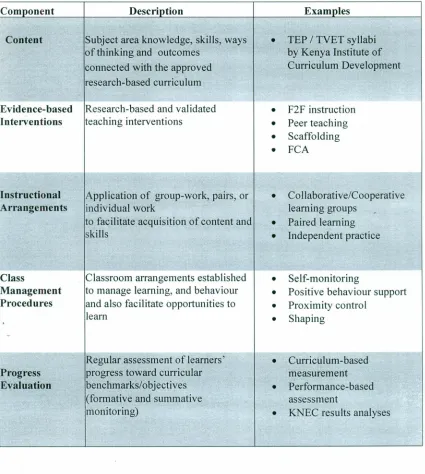
without proper planning and coordination. Hoover and Patton ( 2005) have identified
five key components of curriculum implementation which are:
• Content
• Evidence-based Interventions
• Instructional Arrangements
• Class Management Procedures
• Progress Evaluation
Table 2.1: Components of Curriculum Implementation
Component Description Examples
Content Subject area knowledge, skills, ways
•
TEP /TVET syllabiofthinking and outcomes by Kenya Institute of
connected with the approved Curriculum Development research-based curriculum
-Evidence-based Research-based and validated
•
F2F instructionInterventions teaching interventions
•
Peer teaching•
Scaffolding•
FCAInstructional Application of group-work, pairs, or
•
Collaborative/CooperativeArrangements individual work learning groups
.
to facilitate acquisition ofcontent and
•
Paired learningskills
•
Independent practiceClass Classroom arrangements established
•
Self-monitoringManagement to manage learning, and behaviour
•
Positive behaviour supportProcedures and also facilitate opportunities to
•
Proximity controllearn
•
Shaping,
-1
-Regular assessment of learners'
•
Curriculum-basedProgress progress toward curricular measurement
Evaluation benchmarks/objectives
•
Performance-based(formative and summative assessment
monitoring)
•
KNEC results analyses(Adapted from Hoover & Patton, 2005)
Another view of curriculum implementation describes it as a process which
"... includes translation of planned orofficially designed course of study bythe
teacher into syllabuses, schemes of work and lessons to be delivered to students."
(Nzomo, 2013,p.49).
This view anticipates an interplay of the teacher, the course content and the student.
In undertaking this study, the researcher depended on the official Technical Drawing
syllabus within the diploma curriculum at KIST. By implementing the syllabus
through use of the FCA, a modern intervention in the implementation of the
curriculum atKIST was being adopted.
2.3 The Flipped Classroom Approach as an Evidence-based Intervention
The FCA isfairly recent intervention in classroom interactions. This isattested by
Houston and Lin (2012). They suggestthat Jonathan Bergmann and Aaron Sarns, both
chemistry teachers at Woodland Park High School, USA, were the initiators.
In 2007, the teachers wanted to solve the problem of finding thetime toteach lessons
_ missed by absent students. Their solution was to record and annotate lessons using
some software and then posting them online. Absent students were provided with an
opportunity to watch missed lesson, but sodid the students who had not missed class.
The online material could be utilised to review and reinforce classroom lessons by all
students. Bergmann and Sarns realized they could radically change the way they used
normal class time and coined the phrase "flipping the classroom" (Tucker, 2012).
Importantly, more interaction was observed between the learners themselves as well as
between the learners and the teachers. The level of accountability for the learning
process was raised on the part of all participants.
As stated in the foregoing sections, the FCA is arelatively new concept in teaching.
concepts first before applying the same concepts. This was always deemed to be an
assignment, not alesson tobe learnt. With the advent of computer mediated (CM)
instruction, the paradigm has shifted. Information and communication technology
provides necessary support for learning outside of the class time and results in valuable
time for face-to face (F2F) interaction amongst the learners themselves and their
teacher being gained. This indicates that the FCA is,in fact, a form of blended learning
(BL). Being an approach means the FCA can be integrated or blended with a given
teaching method.
While there is no one model (ofthe FCA), the core idea is to flip the common instructional approach: With teacher-created videos and interactive lessons, instruction that used to occur in class isnow accessed at home,
in advance of class. (Tucker, 2012, p.82).
There appears tobe a lot of emphasis on use of video in the utilisation of the FCA.
In more sophisticated learning setups, custom-made flip-cameras have been provided to
learners who are then able to capture content for use in their lessons (Miller,2009).
The importance of videos is further underscored by Alvarez (2011), who posits that
flipping the classroom enables the teacher to record onvideo the same steps that
would be presented to students within a lesson plan. Subsequently, the structure of the
video should include anoverview of the lesson, the content and ends with a summary.
Could the FCA work without videos? Whereas the researcher accepted that videos do
provide a very effective visual impulse, the researcher was also of the opinion that
any visual stimuli packaged for use in the FCA could serve the same end. The FCA
should not be limited to videos only. The visual impulses should, however, exclude
text-only material, such as lesson notes.
In
the Kenyan situation, it is conceivable thatteachers and learners could make use of inexpensive mobile technologies such as
smartphones to capture relevant content for classroom use.
It would be wise to widen the visual stimuli used in the FCA to include graphic
presentations such asPowerPoint® andthe use of Web 2.0(social media such as
Facebook® and Whatsapp ® ),among others.
The researcher opines that these tools have the advantage of being already in use and it
would berelatively simple to adapt them for learning andteaching.
Ultimately, it is very important that the teacher decides:
• Whether toflip alesson since not all lesson content can be flipped.
• When to flip a lesson.
Byopting to flip, the teacher would be actually blending the learning process.
This enables learners and teachers to reap the benefits accruing from blended learning.
2.4The Flipped Classroom Approach and Blended Learning
A working definition of blended learning (BL) or hybrid learning is the combination of
face-to-face instruction (F2F) with computer-mediated (CM) instruction (Osguthorpe
& Graham, 2003). The researcher supports this definition because it reflects BL as the
outcome of mainly two historically distinct models of teaching and learning. The first is
the traditional F2F learning systems where learning tends to be group-centered. In this
system, learning typically occurs ina teacher-directed environment with
person-to-person interaction inaphysical, synchronous, high fidelity learning environment.
The second model of teaching and learning is the fairly more recent distributed learning
systems in which the computer plays a central role and makes it possible for learning to
be individualized. Significantly, distance learning systems emphasize self-paced
learning. Learning interactions typically occur in an asynchronous, low fidelity
BL represents atrend that has grown with advances in science and technology and the
FCA ,avoiding text only, increases thelevel of fidelity through use of audio-visual
content.
In the Kenyan context, BL has found application in tertiary institutions such as
Kenyatta University's Digital School of Virtual &Open Learning.
This institution offers some degree programmes, courses and units using Open
Learning and Distance Learning delivery systems.
Buruburu Girls secondary school inNairobi, Kenya, provides an example of BL at the
secondary school level. Students and teachers work together to produce digital content
for subjects such as Geography, History, Biology and Chemistry. They capture
presentations on video and package this content on CDs for later use bystudents and
teachers (Ndirangu, 2013). Accountability nolonger rests only on the shoulders of the
teacher in the flipped classroom. Students are also accountable for their own learning
(Chipps, 2012).These innovations at Kenyan learning institutions do not constitute the
FCA because they were not designed to cover specific lesson content before classroom
interactions. However, but they could be adapted to serve this end.
2.5 Current Learning Innovations in Kenya
The use of computers, which is akey component ofICT, can be traced back to the
1970s and that of the Internet from 1993 (Ford, 2007) in Kenya. In recent years, Kenya
has seen agreat breakthrough in the use of mobile phones which includes mobile
internet connectivity. The majority of people still use mobile phones as communication
devices for voice calls and texting but many users also appreciate mobile phones as
information devices. They use their mobile devices (simple cell phones, smartphones
and tablets) to view e-mails, get news updates and browse the internet.
These are now an integral part of the daily routine, especially amongst the youth like in
the study group atKIST. They could beintegrated into educational processes.
In the educational sector, the potential to access information using mobile devices
exists but their use is sub-optimal. Infact, learners are discouraged in many secondary
schools to operate mobile phones, but they find use in tertiary institutions such as
KIST.It only during the examination period when their use isprohibited. Smartphones
andtablet computers come with different specifications such as the screen size clock
speeds, internal and expandable memory sizes, wireless connectivity and the capacity
of the battery. For mobile internet connectivity, a provider is required. The main
providers in Kenya are Safaricom, Airtel Kenya and Orange Kenya. Since their key
business is not educational services, other parties have to develop educational content.
The content can be delivered through mobile applications (apps).
Either native apps orweb-based apps can beutilised. The former are installed programs
that can function offline and only require updates, whereas the latter only work online.
There is also the choice of mobile operating systems (OS) such as iOs® byApple,
Android ® by Alphabet (formerly Google Inc.) and Windows-Mobile ® by Microsoft.
All mobile apps running onvarious platforms can be obtained at no cost or upon
payment. Stores such as Google Pla/M, iOs App Store™,and Windows Phone Store™
provide a repository from which users can install mobile apps. Although mobile devices
present an attractive delivery mode for content, they do also have drawbacks.
These include the initial and running costs as well as the technical proficiency of
users. They also include distraction of the user from the main learning activities, for
example, through games.
The Government of Kenya (GoK) realizes the potential of mobile devices to transform
space of two years, all public primary schools should be covered (Techweez, 2015,
Blog post ). The annual budget for the fiscal year 2015/2016 by the GoK provides
Kshs. 17.58 billion for the following items (GoK, 2015):
• Policy and Strategy :Deployment ofICT learning devices to schools
• Digital Content Management: Development of digital content
• Program sustainability: Building the capacity of teachers
• Device and Infrastructure Management :Computer laboratory for
class 4 toclass 8
All public schools throughout the country will benefit. This amount for the digital
literacy programme (DLP) isless than the initial budget ofKshs. 24 billion earmarked
for laptops. The DLP isbeen carried out within the context of development ofdigital
content, power supply to schools, teachers preparation and deployment on multiple
platforms. The Kenya Institute of Curriculum Development (KICD) is mandated to
put in place digital content. Through the Rural Electrification Authority, those primary
schools which do not have power are will be connected.
Over 61,000 teachers have also been trained in a process whereby 150 master trainers
visit different schools to train teachers (GoK, 2015).
Private initiatives that are geared towards adoption of mobile learning have come up.
At the primary school level, eLimu tablet are available that incorporate content from
the official curriculum. They package the content within animations, videos music,
games and interactive. According to eLimu, the tablets are designed "to make not
only an educational, but also a social impact. eLimu includes extended learning content
that focuses on responsible citizenship (environmental, human rights, civic justice and
even curriculum on personal financial literacy.)" (e-Limu, 2015). They list some of the
advantages their product give to the teachers and learners which include lesson plans
and student performance reports on each subject or quiz taken. Also available is a
teachers' forum every forth Saturday of the month where online questions posted by
learners are answered. Teachers and learners can access the offline Wikipedia.
Yet another private initiative is Elimu TV, an entirely different educational provider
that aims at broadcasting secondary school content as a free-to-air channel on
television. The company intends to reach learners who have missed the opportunity for
normal school attendance.
They have so far developed video content for Mathematics, Physics, Biology and
Kiswahili and carried out testing via the Signet Platform (Elimu Digital Media ,2015).
With these and other public as well as private initiatives striving to deliver lesson
content using digital media, there is huge potential of using the FCA in Kenyan
learning institution.
2.6 Benefits of the Flipped Classroom Approach
In the BL literature, the most common reason provided for adopting BL is that it
combines the best of the traditional and the modern CM worlds.
Osguthorpe and Graham (2003) identified six reasons why one might chose to design or
use a BL system:
• Pedagogical richness which occurs as aresult of using interactive rather than
transmissive strategies.
• Access to knowledge where the learner's flexibility and convenience are put
into consideration. Care hasto be taken so as not to sacrifice the social
interaction and human touch they found in a F2F classroom.
• Social interaction through an increase level of active learning strategies,
• Personal agency whereby the learners are put in control of the learning process and can pace themselves individually.
• Cost effectiveness is achieved through reaching a large, globally dispersed audience in a short period of time with consistent, semi-personal content delivery
• Ease of revision of content covered.
According to Liles (2012), flipping the classroom offers advantages such as:
• Differentiated instruction. One can assign specific videos to help students to gain background information based on the individual student's needs, thus catering to a wide range of ability levels.
• Instructional hours are better spent helping students apply and demonstrate knowledge, and practice skills correctly with the instructor's assistance. Students do not waste time practising 'concepts incorrectly since they'receive guided practice from the teacher.
• Provide all students opportunities to practise using 21st C~ntury skills and technology in the classroom. Multimodal delivery is made possible where students view a video repeatedly, rather than listening to lectures once only. Students that do not have Internet access at home can borrow instructor-created DVDs to view at home.
• Fostering interactive note taking and allowing the student the opportunity to generate questions that can be asked in class when clarity is needed.
• Absent students do not miss out on lessons and important information. They can access a lesson and information, then perform practical sessions according to their own schedules.
• Resources that include creating own videos and presentations with freeware
and using the Khan Academy videos in a different subjects.
2.7 Limitations of the Flipped Classroom Approach and their Mitigation
As isusual with any concept, there are a number of drawbacks that make use of the
FCA challenging. The limitations mayactually amount to misconceptions and
November (20 12) has identified five such misconceptions about the approach:
i) Implementing the FCA reduces the importance of the teacher.
The truth is that ifthe teacher has provided students with enough resources and set up
opportunities for students to think deeply, new questions will arise that possibly may
not be asked during a normal class session. The teacher has to have a good grasp of the
content since the need to cater for individual differences becomes more acute.
ii) Learners rarely sit at home watching teaching videos.
Certainly, learners may be more attracted to watching videos of an entertaining nature
, rather than educational ones. In an FCA setting, it is up to the teacher to provide
presentations that combine interaction and pedagogy. For example, by including
hyperlinks within a presentation, a teacher can quiz students and provide them with
immediate feedback and explanations within the same presentation. Presentations
should be short, 5- to l Ovminute segments. "No student is going to accept a barrage of 1
hour long lessons that they have to view at home on a regular basis." ( Truss,20 11,Blog
post)
iii) Majority of learners have limited or no access to the Internet.
Because ofthe technological advantages that computers have vis-a-vis learning, the
FCA as an intervention is most effective when JCT is involved.
Schools should provide facilities outside timetable allowing learners to use school
ICT devices for a given duration. With the advent of cheaper smartphones, many
learners have the potential to access alternative internet connections away from the
classroom. Where internet connections are limited or non-existent, teachers could
provide audio and video material burned on CDs or DVDs so they could be accessed
on learners' home CD/DVD players.
Furthermore, schools could share their resources as well as those of the surrounding
community centres to make access to presentations easier for learners.
iv) Lack of control and accountability.
The teacher may neither be able to control when the learners access the presentation
used in a flipped lesson, nor what they do with it.However, the teacher can and should
require that every learner submits to reflections, asks questions, and express any
concerns at the beginning of the lesson. Those who do not make contributions should
be encouraged to state any challenges they might be, having.
v) Teacher and learners do not have adequate ICT knowledge and skills.
Indeed, the FCA calls for some proficiency in the use ofICT. An expert who is not
necessarily a teacher can nevertheless assist inmaking the presentations for the classes
at the beginning. School managers could facilitate training of a few teachers who then
cascade the knowledge and skills tothe rest. An arrangement between schools could
also lead to sharing of competent teachers and personnel. As also suggested by Tucker
( 2012), the FCA requires the instructor to explain a concept in a clear, concise,
bite-sized chunk of four-to six-minutes video lesson. This can pose a tremendous
instructional challenge if the instructor does not understand how to integrate ICT in
hisl her lessons.
2.8The 4 Cs of ICT
The acronym ICT is derived from information and communication technology or
alternatively, information and communications technology.
ICT ismore than computers and the Internet. According to Tongia, Subrahmanian and
Arunachalam, (2005), information communication technology is the result of 4 C's.
These are computing, communication, content and human capacity. Computing has
undergone several generational changes which have made hardware and software to be
less and less expensive. Arising from these changes is the development of different
types of communication of varying complexity.This makes software training still
relatively expensive. This also applies for content since even old content has to be
repackaged for digital transmission. Human capacity is often overlooked when dealing
with ICT issues. Since end-users have to interact with hardware and software, due
consideration has to be made on how to optimize this interaction. The development of
user-friendly computer applications serves this end.
Depending on the applications, ICT can be divided intotwo broad categories (Tongia,
Subrahmanian & Arunachalam, 2005). The first category includes applications that
depend a lot on traditional telecommunications networks, including the Internet.
This enables on-demand communication, hence providing information specific to the
user's needs as well as convenience. Some examples ofthis category are blended
learning (BL), e-commerce and e-governance. The second category requires
applications that work mostly independent of the user, for example, weather monitoring
and reporting systems. From the foregoing, it iscrucial that teachers and learners need
2.9 ICT Competence of Teachers am! Learners
In 2004 the Government of Kenya adopted the e-Govemrnent Strategy that
emphasizes transformation of Government services from manual to digital-based
operations. The specific objectives include:
• Improved coordination of government agencies to reduce duplication of efforts • Enhanced efficiency in utilization of resources
• Improved competitive position of the country through provision of timely information and del ivery of services.
• Reduced transaction costs
• Engagement of citizens and the private sector through digital and on-line service provision. (MoE,2006)
Education is intended to actualise these objectives by equipping all parties with
appropriate leT competencies, skills and immerging innovations .
.It,therefore, arises that one of the required characteristics of an effective teacher is
knowledge and skills in ICT. According to Hague and Payton (2010), there is need for
'digital literacy' on the part of teachers. In utilizing the FCA most effectivley, it is necessary to have ICT support. It is therefore paramount that teachers as well as
learners to be digitally literate.
Digital literacy means the ability to communicate and represent knowledge in different
contexts for different audiences. These include visual, audio and textual modes.
"Schools are increasingly encouraged to embed the use ofICT in all subject areas cross
both the primary and secondary curricula ...to ensure that technology-use enhances
.teaching and learning rather than simply becoming an add-on."
(Hague & Payton 2010, p.3). This view is supported by Prensky (2008) who states that
the only role for technology should be to support learners teaching themselves with
some guidance from their teachers. He cautions that using the old pedagogy of telling
or lecturing in which technology is used to show pictures or videos is wasteful.
Teachers have to adapt to technological innovations but more importantly, learners
need to be taught how to use these innovations:
... to learn on their own - from the Internet with almost all the information, to search and research tools to sort out what is true and relevant, to analysis tools to help make sense of it, to creation tools to present one's findings in a variety of media, to social tools to network and collaborate with people around the world. (Prensky, 2008,p. 2)
The researcher finds these arguments compelling and holds that ICT integration in
learning should be focused on both the teacher and the learner, with the teacher playing
a supporting role. The FCA as model appears largely to fulfil this important
requirement ofICT integration in learning by catering to the needs of the learner.
On the part of the learner, Soparat, Arnold and Klaysom, (2015) suggest that ICT
competency should include:
• Communication competence through speech and writing so as to share
information with others.
• Critical thinking and problem-solving that starts with the identification of a
problem followed by effective decision making on best tools and culminates in
a reasonable solution and reflection.
• Capacity for applying life skills, especially through cooperative interaction.
Learner should be able to overcome difficulties, muster self-confidence and engage
inlifelong learning. This applies when using digital social networks.
From the above, learners should acquire knowledge and skills in word-processing
(official languages), spread-sheets, databases, presentation software and internet
(use and risks). They should also have some proficiency in hardware maintenance.
2.10 Preparing the Learner for Computer Mediated Instruction
In utilising the insights of the ASSURE model as suggested by Molenda et al.(2002),
the teacher should select learning media systematically before deciding to flip a lesson.
This isachieved through:
i) Analysing the learners
ii) Stating the objectives
iii) Selecting the methods, media, and materials
iv) Utilizing the media and materials
v) Requiring learner participation
vi) Evaluating and revising the learning outcomes
At KIST, all the trainees have met minimum entry requirements for various courses .
.What tutors do isimplement the syllabi for these courses using varying approaches,
-none of which is similar to the FCA. The researcher opines that, if the FCA is adopted
at KIST by utilizing the available physical and ICT resources, there will be more time
.for trainee participation in the learning process. More participation leads to better
retention of content and performance. This argument is supported by Dale, (1969) ,
who conceived the Cone of Experience. This is illustrated in Figure 2.1 which depicts
how media impacts on the retention of content.
Figure 2.1: Dale's Cone of Experience
(Adopted from Wiman &Weirhenry,1960)
'The FCA can be applied for all levels indicated in the Cone by utilizing textual, audio
and audiovisual material. At KIST, practical skills require "doing the real thing" and
the FCA, when effectively utilized, can increase the time for practical work since
theory will be learnt outside the timetable. As suggested earlier in this chapter, trainees
could be encouraged to use social media and mobile technology for learning.
2.11 Involving the Learner inDeveloping Lesson Content
The FCA has constructivist potential in the sense that learners can be put in the
"driving seat" with regard tothe learning process. Constructivism as a philosophy is
premised on a person's ability to reflect on past experiences.
This enables a person to construct apersonal or individualised understanding of the
world based on these reflections. Each person creates unique systems or models by
which one is able interpret new experiences. Without these systems, one isincapable of
Learning, therefore, isthe process by which one adjusts the existing mental models to
accommodate new experiences. Because of its strong emphasis on individual
interpretation of the environment, constructivism can hardly work within a standardized
curriculum. Instead, it promotes using curricula customized tothe students' prior
knowledge and hands-on problem solving approaches.
Jonassen's (1994) proposed eight characteristics that define constructivist learning
environments:
• They provide multiple representations of reality.
• These multiple representations avoid oversimplification and represent the
complexities found in the real world.
• They are based onreal-world issues or cases and not predetermined sequences
.' of instruction.
• They accentuate knowledge construction instead of knowledge reproduction.
• They enable context- and content- dependent knowledge construction.
• They require authentic tasks ina meaningful context rather than abstractions
• They inspire reflection onpast and new experiences.
• They support collaborative learning through social negotiation and eschew
competition.
Arising from the foregoing discussion onconstructivism ,digital technology provides a
means for creating effective learning environments.
As demonstrated byBuru Buru Girls Secondary school in Nairobi County, Kenya,
conventional video cameras can be placed inthe learners' hands and used effectively.
These learners at a relatively low-cost school use video cameras to make clips of
lessons and field trips. Their teachers assist them in this exercise during editing.
.'
The fact that the presentations are done bypeople the "students can relate with" makes
learning interesting for the students (Ndirangu, 2013, p.31).
Since practically all learners with smartphones participate in the so-called social media
interactions such as Facebook®, Twitter® and Whatsapp®, one can involve them in
learning the required content by individualizing the conventional curriculum. By
harnessing the power of these media, an instructor canenrich lesson content by
requiring the learners to contribute via photographs or videos. Even a simple chat via
short message service (SMS) text can aid in the delivery of required content.
The foreseeable drawback with this intervention is that some learners might resent the
idea of having "the classroom" intrudes in their social lives. Yet others may not afford
the smartphones, making them beleft out of the"conversation". The advantages of
having learners contribute to the lesson content, however, are likely to far outweigh the
limitations.
2.12 Environmental Factors Affecting Learning
Learning spaces have an important bearing on the relationship and social practices of
teaching and learning. They are only one factor among many in the complex
relationships of teaching impact on learning outcomes (Oblinger 2006). Major
environmental factors that have an impact on learning include
lighting (quantity and quality), acoustics (clarity), thermal control and seating
arrangements.
They should be carefully assessed so as to enhance the learning experience, especially
when media are in use. If these factors are ignored, media use may well beviewed by
the learners as either a welcome or bothersome distraction. The physical environment
outlined in the foregoing requires additional consideration in terms of access, comfort