Optimization of Drilling Process Parameters on
Ti-6Al-4V Alloy Using Integrated GRA - Taguchi
method
P Prasanna
#1, V Y Manu Sharma
#2G Shravan
#3#Department of Mechanical Engineering, JNTUH College of Engineering, Hyderabad 1[email protected]
Abstract
—
The optimization of process parameters is of prime importance for the industry to be able to control and optimise the material cost and time effectively. In this paper the average thrust force on the tool, tool wear and average temperature of the work-piece are obtained from the simulation model developed using DEFORM software. The work-work-piece used was Ti-6Al-4V and tool used is carbide type drill. Optimisation of the values is done using Integrated GRA-Taguchi method.Keywords
—
Drilling, Thrust Force, Tool Temperature, Tool Wear, DEFORM Software, Integrated GRA- Taguchi MethodI. INTRODUCTION
Drilling is a popular and widely used machining process in industries. The main considerations during the drilling are hole quality, surface finish and tool life. Industries are constantly striving for lower cost solutions to get the higher quality. Since, machining is largely an operator’s skill dependant job, various methods were used in the past to quantify the impact of machining variables on the final quality of the product. Now, the CNC machinery has replaced the conventional machinery and many computer aided design based modelling tools are being used efficiently by the industries.
During the drilling, a considerable heat is generated due to the deformation and the friction at the interface. The heat generation raises the levels of temperature and this temperature generated greatly affects the material behaviour and the mechanics of chip formation. Many parameters like tool life, cutting forces, surface quality, mechanics of chip formation, etc., are also dependent on the machining temperature. In the present work, Ti-6Al-4V is considered as the work piece material because of its widespread applications in aerospace, medical, marine, and chemical processing. The main advantages of the alloy are high strength to low weight ratio and its outstanding corrosion resistance. Machining of these alloys can be treated as “hard to machine materials” because of their lower thermal conductivity and higher chemical reactivity [Zhang et al., (2010)]. The present work simulates the drilling of the chosen material for temperature and tool wear using a commercial finite element code called DEFORM-3D. The simulated results
II. FEA SIMULATION
In this investigation, cutting speed, feed rate and drill depth are considered as the process control variables. The geometric parameters of the drill are: drill diameter 10 mm, web thickness 2 mm, helix angle 280°, point angle 180°, margin 0.4 mm, and clearance 0.2 mm. Uncoated carbide twist drill bit of 24 per cent cobalt is used to machine Ti-6Al-4V work piece at 2700°C and the convection heat transfer coefficient at the work piece – cutting insert interface is chosen as 45 N/sec/mm/°C. The model is simulated for thermal analysis by assuming the work piece as a plastic material with a diameter of 30 mm and the cutting insert is assumed as a rigid body. Geometrically identical meshes for the thermal equations are used for the computation of cutting temperature and the Usui model (1978) is used to calculate the tool wear. This model is a widely used one for estimating tool wear which was derived considering sliding velocity between chip and cutting tool, tool temperature and normal pressure on tool face.
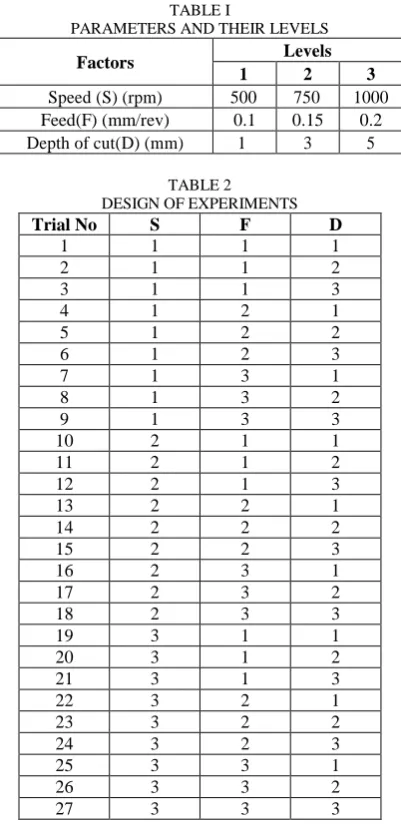
Experiments are planned based on Design of Experiments (DOE). A rotatable central composite full factorial design with two center points is chosen.
TABLE I
PARAMETERS AND THEIR LEVELS
Factors Levels
1 2 3
Speed (S) (rpm) 500 750 1000 Feed(F) (mm/rev) 0.1 0.15 0.2 Depth of cut(D) (mm) 1 3 5
TABLE 2 DESIGN OF EXPERIMENTS
Trial No S F D
1 1 1 1
2 1 1 2
3 1 1 3
4 1 2 1
5 1 2 2
6 1 2 3
7 1 3 1
8 1 3 2
9 1 3 3
10 2 1 1
11 2 1 2
12 2 1 3
13 2 2 1
14 2 2 2
15 2 2 3
16 2 3 1
17 2 3 2
18 2 3 3
19 3 1 1
20 3 1 2
21 3 1 3
22 3 2 1
23 3 2 2
24 3 2 3
25 3 3 1
26 3 3 2
27 3 3 3
The simulation runs were conducted for the design of experiments table and the temperatures were tabulated. The interface of simulation software after loading the tool and the work-piece from its library is given in the Fig.1 below
FIG 1: Deform Interface
The experimental results of Thrust force, tool wear and simulation temperature for all the trails are tabulated in Table 3 as shown below.
TABLE 3 RESPONSES FOR TRIALS
Exp No S F D
Temper ature
(°C)
Tool Wear (mm)
Thrust Force
(N)
1 500 0.1 1 246 0.00244 2280 2 500 0.1 3 499 0.00364 2572
3 500 0.1 5 695 0.0044 2818
4 500 0.15 1 178 0.00473 3111 5 500 0.15 3 437 0.00599 3369 6 500 0.15 5 615 0.0068 3707 7 500 0.2 1 156 0.00642 3987 8 500 0.2 3 390 0.00773 4360 9 500 0.2 5 561 0.00859 4682 10 750 0.1 1 259 0.00789 5001 11 750 0.1 3 524 0.00906 5379 12 750 0.1 5 699 0.00978 5727 13 750 0.15 1 216 0.01013 6099 14 750 0.15 3 461 0.01135 6511 15 750 0.15 5 618 0.01212 6953 16 750 0.2 1 211 0.01176 7348 17 750 0.2 3 424 0.01303 7814 18 750 0.2 5 588 0.01386 8299 19 1000 0.1 1 309 0.01331 8803 20 1000 0.1 3 539 0.01445 9292 21 1000 0.1 5 710 0.01514 9748 22 1000 0.15 1 243 0.01549 10227 23 1000 0.15 3 492 0.01668 10734 24 1000 0.15 5 666 0.01742 11266 25 1000 0.2 1 220 0.01707 11848 26 1000 0.2 3 441 0.01831 12427 27 1000 0.2 5 606 0.01911 12962
III. RESULTS AND DISCUSSION
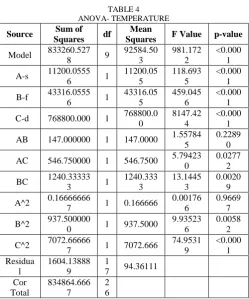
Analysis of Variance is carried out on the obtained experimental data to check the significance of the model.
TABLE 4 ANOVA- TEMPERATURE
Source Sum of Squares df
Mean
Squares F Value p-value
Model 833260.527
8 9
92584.50 3 981.172 2 <0.000 1
A-s 11200.0555
6 1
11200.05 5 118.693 5 <0.000 1
B-f 43316.0555
6 1
43316.05 5 459.045 6 <0.000 1
C-d 768800.000 1 768800.0 0
8147.42 4
<0.000 1
AB 147.000000 1 147.0000 1.55784 5
0.2289 0
AC 546.750000 1 546.7500 5.79423 0
0.0277 2
BC 1240.33333
3 1
1240.333 3 13.1445 3 0.0020 9
A^2 0.16666666
7 1 0.166666
0.00176 6
0.9669 7
B^2 937.500000
0 1 937.5000
9.93523 6
0.0058 2
C^2 7072.66666
7 1 7072.666
74.9531 9 <0.000 1 Residua l 1604.13888 9 1
7 94.36111
Cor Total 834864.666 7 2 6
From the above analysis it was found that feed and depth of cut are the most significant terms affecting the Tool Temperature as their p-values are <0.0001. R2=0.9450 which is 94.5%. The desirable value is close to 1 which indicates that the model has a variance of 5.5% and hence is within the acceptable limits.
TABLE 5 ANOVA- THRUST FORCE
Source Sum of Squares df
Mean
Squares F Value p-value Model 2.79E+08 9 3.10E+07 7.74E+04 <0.0001 A-s 2.45E+08 1 2.45E+08 6.12E+05 <0.0001 B-f 2.72E+07 1 2.72E+07 6.78E+04 <0.0001 C-d 3.09E+06 1 3.09E+06 7.72E+03 <0.0001 AB 1.36E+06 1 1.36E+06 3.39E+03 <0.0001 AC 1.34E+05 1 1.34E+05 3.35E+02 <0.0001 BC 2.53E+04 1 2.53E+04 6.32E+01 <0.0001 A^2 1.83E+06 1 1.83E+06 4.56E+03 <0.0001 B^2 3.59E+04 1 3.59E+04 8.98E+01 <0.0001 C^2 4.63E+01 1 4.63E+01 1.16E-01 0.73796 Residual 6.80E+03 17 4.00E+02
Cor
Total 2.79E+08 26
From the above analysis it was found that speed and feed are the most significant terms affecting the Tool Temperature as their p-values
the model has a variance of 4.54% and hence is within the acceptable limits
B.
Grey Relational Analysis
Data processing must be performed before Grey correlation coefficients can be calculated. A series of various units must be transformed to be dimensionless. Data pre-processing converts the original sequence to a comparable sequence. Several methodologies of pre-processing data can be used in Grey relation analysis, depending on the characteristics of the original sequence.
1)
Normalisation of data: The normalized values are calculated using the formula given below.
TABLE 6 NORMALISED DATA
Trial
No Temperature Tool Wear
Thrust Force
1 0.837545 1 1 2 0.380866 0.928014 0.972664 3 0.027076 0.882424 0.949635 4 0.960289 0.862627 0.922206 5 0.49278 0.787043 0.898053 6 0.17148 0.738452 0.866411 7 1 0.761248 0.840198 8 0.577617 0.682663 0.80528 9 0.268953 0.631074 0.775136 10 0.814079 0.673065 0.745272 11 0.33574 0.602879 0.709886 12 0.019856 0.559688 0.677308 13 0.891697 0.538692 0.642483 14 0.449458 0.465507 0.603913 15 0.166065 0.419316 0.562535 16 0.900722 0.440912 0.525557 17 0.516245 0.364727 0.481932 18 0.220217 0.314937 0.436529 19 0.723827 0.34793 0.389347 20 0.308664 0.279544 0.343569 21 0 0.238152 0.30088 22 0.84296 0.217157 0.256038 23 0.393502 0.145771 0.208575 24 0.079422 0.10138 0.158772 25 0.884477 0.122376 0.104288 26 0.48556 0.04799 0.050084 27 0.187726 0 0
2) Grey Relational Coefficients and Grey Relational Grades:
TABLE 8
DEVIATION SEQUENCE TABLE
Trial
No PC1 PC2 PC3
1 0.162454874 0 0 2 0.039711191 0.137372525 0.077794421 3 0 0.23875225 0.159801535 4 0.619133574 0.071985603 0.027335705 5 0.972924188 0.117576485 0.0503651 6 0.507220217 0.212957409 0.101947201 7 0.185920578 0.326934613 0.254727579 8 0.108303249 0.461307738 0.357517319 9 0.422382671 0.317336533 0.19472009 10 0.828519856 0.26154769 0.133589216 11 0.099277978 0.559088182 0.474442988 12 0.731046931 0.368926215 0.224864258 13 0.664259928 0.397120576 0.290114211 14 0.157039711 0.782843431 0.743961805 15 0.115523466 0.877624475 0.895712413 16 0.276173285 0.652069586 0.610653436 17 0.550541516 0.534493101 0.396086875 18 0.980144404 0.440311938 0.32269238 19 0.483754513 0.635272945 0.518067778 20 0.833935018 0.580683863 0.437464894 21 0.779783394 0.685062987 0.56347126 22 0.69133574 0.720455909 0.65643138 23 0.606498195 0.854229154 0.791424827 C24 0.514440433 0.952009598 0.949915746 25 1 0.76184763 0.699120015 26 0.920577617 0.898620276 0.841228234 27 0.812274368 1 1
The grey relational coefficient is defined as followsfollowing the data pre-processing, a Grey relational coefficient can be calculated using the pre-processed sequences. The Grey relational coefficient is defined as
The grey relational coefficient is
If all the performance characteristics are given equal preferences then ℇ taken as 0.5
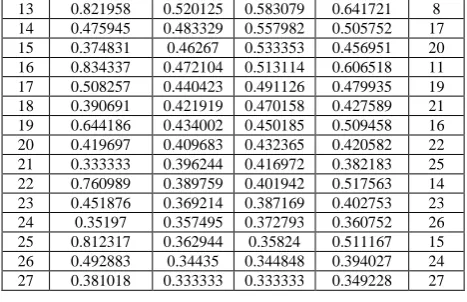
Grey Relational Grade
TABLE 9
GREY RELATION COEFFICIENT AND RANK
Exp
No Temperature Tool Wear
Thrust Force
Grey Relation Coefficient
Rank
1 0.754768 1 1 0.918256 1
2 0.446774 0.874148 0.948163 0.756362 4 3 0.339461 0.809616 0.908488 0.685855 5 4 0.926421 0.784471 0.86536 0.858751 2 5 0.496416 0.701304 0.830638 0.676119 6 6 0.376359 0.656558 0.789155 0.607357 10 7 1 0.676817 0.757804 0.81154 3 8 0.542074 0.611743 0.719714 0.624511 9 9 0.406158 0.575423 0.689784 0.557122 12 10 0.728947 0.604643 0.662491 0.66536 7 11 0.429457 0.557339 0.63282 0.539872 13 12 0.337805 0.531738 0.607761 0.492435 18
13 0.821958 0.520125 0.583079 0.641721 8 14 0.475945 0.483329 0.557982 0.505752 17 15 0.374831 0.46267 0.533353 0.456951 20 16 0.834337 0.472104 0.513114 0.606518 11 17 0.508257 0.440423 0.491126 0.479935 19 18 0.390691 0.421919 0.470158 0.427589 21 19 0.644186 0.434002 0.450185 0.509458 16 20 0.419697 0.409683 0.432365 0.420582 22 21 0.333333 0.396244 0.416972 0.382183 25 22 0.760989 0.389759 0.401942 0.517563 14 23 0.451876 0.369214 0.387169 0.402753 23 24 0.35197 0.357495 0.372793 0.360752 26 25 0.812317 0.362944 0.35824 0.511167 15 26 0.492883 0.34435 0.344848 0.394027 24 27 0.381018 0.333333 0.333333 0.349228 27
IV. CONCLUSION
The optimal values of Temperature, Tool wear and Thrust Force 246°C, 0.00244mm and 2280N respectively were obtained at a cutting speed of 500 rpm, feed rate of 0.1 mm/rev, Drill depth of 1 mm.
REFERENCES
[1]SFTC Deform 3D, V.6.1, Scientific Forming Technologies Corporation
[2] A.V. Mitrfanov, V.I. Babitsky, V.V. Silbersschmidt (2005), Finite element analysis of ultrasonicallyassisted turning of Inconel 718, journal of Materials Processing Technology, vol. 153–154, pp. 233–239.
[3] C.Z. Duan, T. Dou, Y.J. Cai, Y.Y. Li (2005), Finite Element Simulation and Experiment of Chipformation Process during High Speed Machining of AISI 1045 Hardened Steel, International Journal ofRecent Trends in Engineering, Vol. 5, pp. 46–50.
[4] Design Expert Software, version 8, Users Guide, Technical Manual, Stat-Ease Inc.
[5] H.K. Kansal, Sehijpal Sing, P. Kumar (2005), Parametric optimization of powder mixed electricaldischarge machining by response surface methodology, Journal of Materials Processing Technology, vol.169, pp. 427–436.
[6] I.A. Choudary, M.A. El-Baradie (1999), Machinability assessment of Inconel 718 by factorial design ofexperiment coupled with response surface methodology, Journal of Material processing Technology vol.95, pp. 30–39.
[7] K. Kadirgama, M.M. Noor, M.M. Rahman, W.S.W. Harun, C.H.C. Haron (2009), Finite ElementAnalysis and Statistical Method to Determine Temperature Distribution on Cutting Tool in End-Milling, European Journal of Scientific Research, Vol. 30, No. 3, pp. 415–463.
[8] L. Filice, D. Umbrello, S. Beccari, F. Micari (2006), On the FE codes capability for tool temperaturecalculation in machining processes, Journal of Materials Processing Technology, vol. 174, pp. 286–292.
[10] Rui Li, Albert J.Shih (2006), Finite element modeling of 3D turning of titanium, International Journalof Advanced Manufacturing Technology, vol. 29, pp. 253– 261.
[11] A. Karabulut (2010), Determination of diametral error using finite element and experimental method,METABK, vol. 49(1), pp. 57–60
[12] Usui, E., Shirakashi, T. and Kitagawa, T. (1978), Analytical prediction of three dimensional cuttingprocess, part 3: cutting temperature and crater wear of carbide tool, Journal of Engineering for Industry,vol. 100 (5), pp. 236–243.