OPERATING IN KE YA
KF.NY~TTA PNIVERSJTY . PO BOX 43844 00100
NAIROBI KENYA
•
YBD
JJiQOL
1
7 NOV
2016
CHE ENGW
D58F/CTY IPT/21637/2012
A THESIS SUBMITTED TO THE SCHOOL OF BUSINESS IN PARTIAL
FULFILMENT OF THE REQ IREMENTS FOR THE AWARD OF DEGREE
OF MASTER OF SCIENCE (FI A CE) OF KENY ATTA UNIVERSITY
DECLARA TION
This thesis report is my original work and has not been presented for a degree in any other university or for any other award.
Signaturc1%'i ..~.~ . Date
I.r
.
!
II
..
/~Ib
.
Chen Nengwu
Department of Accounting and Finance
SUPERVISORS
We confirm that the work reponed in this thesis was carried out by the candidate under our supervisron.
Signature ~ . Date
I
bl(t(/h
.
Dr. Ambrose O. Jagongo
Department of Accounting and Finance Kenyatta University
ignatllre~~, Date ..
(6
.
.1.
Jl.
.
J
.
Y
.
?
.
~
.
~
.
Dr. Fredrick W.S Ndede
DEDICATION
ACKNOWLEDGEMENT
My deep gratitude goes to my loving family. they encourage and support me come to
do the study, and give me a constant source of motivation. I am deeply obliged to my
supervisors Dr. A. O. Jagongo and Dr. dede. F.W.S. Without their exemplary
guidance and support. this study would not have been a success. Ialways thank GOD
TABLE OF CONTENTS
DECLARATION ii
DEDICATION iii
ACKNOWLEDGEMENT iv
TABLE OF CONTENTS iv
LIST OF TABLES ix
LIST OF FIGURES x
OPERATIONAL DEFINITION OF TERMS xi
ABBREVIATIONS AND ACRONyMS xii
ABSTRACT xiii
CHAPTEH. ONE: INTRODUCTION 1
I Background of the Study 1
I.I.I Firrns Financial Performance 5
1.1.2 Status of Chinese Owned Enterprises Operating in Kenya 6
1.2 Statement of the Problem 9
1.3 Objectives of the Study 10
1.3.1 General Objective 10
1.3.2 Specific Objectives 10
1.4 Hypothesis 11
1.5 Scope of the Study 11
1.6 Limitation of the Study 12
CHAPTER TWO: LlTERAT RE REVIEW 15
2.I Introduction 15
2.2 Theoretical Literature 15
2.2.I International Fisher Effect Theory 15
~.2.~ Interest Rate Paritv. Theon. 16
2.2.3 Relative Version of Purchasing Power Parity Theory 18
2.2.4 ProspectTheory 19
2.2.5 Law of One Price Theory 20
2.3 Empirical Literature Review 20
2.4 Summary or Literature Review 28
2.5 Conceptual Framework 32
CHAPTER THREE: RESEARCH METHODOLOGy 33
3.1 Introduction 33
3.~ Research Philosoph! 33
3.3 Research Design 34
3.4 Target Population : 34
3.5 Sampling Technique and Sample Size 35
3.6 Data Collection Instruments 36
3.7 Data Collection Procedure 37
3.8 Data Analysis 37
3.9 Diagnostic Tests 39
CHAPTER FO R: RESULTS, INTERPRET ATIO A D DISCUSSIO 40
4.1 Introduction 40
4.2 Response Rate 40
4.3.1 Invoicing in Home Currency 43
4.3.2 Leading and Lagging 44
4.3.3 Money Market 45
4.3.4 Forward Contract 46
4.3.5 Factors Affecting Foreign Risk Management Practices 47
4.3.6 Operating Strategies 48
4.4 Residual Diagnostics 49
4.4.1 Multcollinearity Test 49
4.4.2 Heteroskedasticity Test 51
4.5 Results of the Regression Model 51
4.5.1 Translation Exposure Management Practices and Financiai Performance 52
4.5.2 Transaction Management Practices and Financial Performance 52
4.5.3 Economic Exposure Management Practices and Financial Performance S3 4.5.4 Policy and Regulatory Requirements Management Practices and Financial
Performance 54
4.6 Hypothesis Testing 55
CHAPTER FiVE: SUMMARY, CONCLUSIONS A~D RECOMMENDATIONS 57
5.1 Introduction 57
5.2 Summary of the Study 57
5.3 Conclusions 59
5.4 Contri bution to knowledge 59
5.5 Recommendations 59
5.6 Limitations of the study and suggestion for Further Studies ~ 60
REFERE CES 62
Appendix I:Questionnaire 66
Appendix II: List of Chinese Owned Enterprises Operating in Kenya 69
Appendix lll: Residual Diagnostic Tests 73
Appendix IV: ResearchAuthorization 74
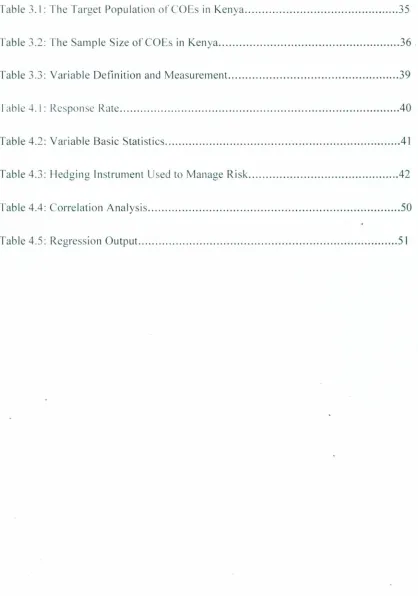
LIST OFTABLES
Table 3.1: The Target Population of COEs in Kenya 35
Table 3.2: The Sample Size of COEs in Kenya 36.
Table 3.3: Variable Definition and Measurement. 39
Table 4.1 : Response Rate .40
Table 4.2: Variable Ba ic Statistics .41
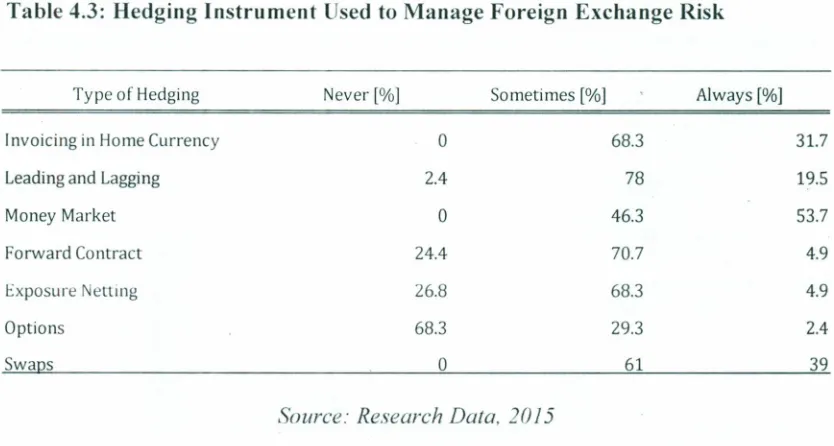
Table 4.3: Hedging Instrument sed to Manage Risk .42
Table 4.4: Correlation Analysis 50
LIST OF FIGURES
Figure 1.1 The Main Source of Foreign Exchange Risk 3
Figure 1.2 China Export Trade Value (US$) with Kenya (1992-2013) 7
Figure 1.3 USD/KES Exchange Rate Charts 9
Figure 2.I Conceptual Frameworks 32
Figure 4.1: Invoicing in Home currency .43
Figure 4.2: Leading and Lagging .44
Figure 4.3: Money Market.. .45
Figure 4.4: Forward Contract .46
Figure 4.5: Factors affecting foreign risk management practices 47
OPERATIO AL DEFINITION OF TERMS
Foreign Exchange Risk Management Practices: Foreign exchange risk management
practices are business activities of taking decisions which aim at minimizing or
eliminating the negative effects of foreign exchange rate fluctuations. They include translation exposure management practices, transaction exposure management practices
and economic exposure management practices.
Financial Performance: I-inancial performance is considered as a subjective measure
of how well a firm can use assets from its primary mode of business and generate
revenues. This term is also used as a general measure of a firm's overall financial health
over a given period of time, and can be used to compare similar firms across the same industry or to compare industries or sectors in aggregation. This study will focus on
ABBREVIATIONS AND ACRONYMS
COEs Chinese Owned Enterprises
CTA Cumulative Translation Adjustment
ERM Enterprise Risk Management
FP Financial Performance
[FE International Fisher Effect
IPR Interest Rate Parity
KEANS Kenya, Egypt. Angola, igeria and South Africa
NSE Nairobi Stock Exchange
NPV Net Present Value
PPP Purchasing Power Parity
PBIT Profitability Before Interest and Tax
RM Risk Management
ROA Return on Assets
ABSTRACT
Economic Liberalization has made it possible for investors to continue investing in other
foreign countries across the globe. Chinese owned enterprises are some of the companies which
have benefitted from the global liberalization. Like in the case of other foreign firms, Chinese owned enterprises operating in Kenya and elsewhere have been formed for purposes of profit making. But recent findings indicate that the firms' profits are to the declines. This possibly is because of inadequate foreign risk management practices. Financial performance is a subjective measure of how well a firm can use assets from its primary mode of business and generate revenues. This term is also used as a general measure of a firm's overall financial health over a given period of time, and also can be used to compare similar firms across the same industry or to compare industries or sectors in aggregation. There are various risks that influence the
financial performance of most companies. Every business activity is confronted with many risks and coping with these risks has always been an important managerial function. Chinese owned enterprises operating in Kenya have challenge managing exposure to foreign exchange risk. The objective of this study was to investigate the effect of foreign exchange risk management
practices and financial performance of Chinese owned enterprises operating in Kenya. The theories which the study relied on include; the international Fisher effect, interest rate parity theory. relative version of purchasing power parity prospect theory, and law of one price. The study adopted the positivism philosophy and employed descripti ve research design. Out of the 82 Chinese enterprises operating in Kenya 41 firms were sampled. Stratified sampling technique was used. Primary and secondary data collected using a questionnaire. Multiple regression analysis was used to examine the magnitude of influence of the independent
variables on the respective dependent variable. Correlation and descriptive analysis methods were used to determine the direction and general information on both independent and
dependent variables. Regressors were esti mated against two reggressands, net profit and return on assets. The study found out that management practices under transaction exposure had a positive effect on the financial performance (ROA) of the enterprises. Conversely, economic exposure management practices had a negati ve infl uence on performance (both on ROA and
Net profit), Also it was noted that the economic exposure variable had a greater negative magnitude to net profit. Firms' strategies on mitigating economic exposure are either inadequate
or inappropriate. No relationship was found between translation exposure practices, policy and
regulatory requirements and financial performance. Based on the results, the study recommends that transaction exposure management practices should be critically examined; Chinese owned companies should embrace transaction exposure management practices to enhance performance. However it was noted that that different firms use different methods of calculating translation
exposure. nevertheless this did not affect the findings since the discrepancy among firms "vas negligible. ln the researcher's insight. the enterprises can better mitigate the economic exposure effect through alternative approaches such as increasing sales volume, adjusting its sales price, aItering product strategy. shi fting production among plants or selecting low cost production
sites. For further research, the study suggests a comparative relook on the foreign risk
CHA
P
TER ONE: INTRODUCTI
O
N
1.1 Background of the Study
Economic Liberalization has made it possible for investors to continue investing 111
other foreign countries across the globe. Business especially foreign businesses are
often confronted with many risks and coping with these risks has always been an
important managerial function. Chinese owned enterprises are some of the companies
which have benefitted from the global liberalization. In recent years, however, risk
management has received increasing attention in both corporate practice and literature
(Jalilvand, Switzer and Tang, 2(00). Foreign exchange risk has become more and more
important in light of the globalization and internationalization of world markets and is
one of the most difficult and persistent problems with which the financial executives
must cope (Faterni, ::2(02). Risk management is a new paradigm for managing business
risks. which is highly strategic in nature and is an array of components (Psica, 2008),
put together through due process within an organization that work together to manage
risk efficiently and effectively over time (Moeller, 2007).
All businesses trading overseas and increasingly in domestic markets will have some
exposure to exchange rate movements either directly or indirectly. While exposure to
exchange rate movements may be an inevitable part of everyday activity, the risk
arising from such exposure can be controlled (Shapiro, 2003). Exchange risk
management is an integral part in every firm's decisions about foreign currency
eliminating or reducing this risk. and require understanding of both the ways that the
exchange rate risk could affect the operations of economic agents and techniques to deal
with the consequent risk implications (Barton. Shenkir, and Walker, 2002).
According to Popov and Stutzmann (2003), foreign exchange risk is the exposure of an
institution to the potential impact of movements in foreign exchange rates. Foreign
exchange risk arises from two factors: currency mismatches in an institution's assets
and liabilities (both on and off balance sheet) that are not subject to a fixed exchange
rate vis a vis the Kenyan shilling. and currency cash flow mismatches. Such risk
continues until the foreign exchange position is covered. This risk may arise from a
variety of sources such as foreign currency retail accounts and retail cash transactions
and services. foreign exchange trading, investments denominated in foreign currencies
and investments in foreign companies. The amount at risk is a function of magnitude of
potential exchange rate changes and the size and duration of the foreign currency
exposure (Shapiro. 2(02).
Foreign exchange risk is the magnitude and likelihood of unanticipated changes in
exchange rate (Brucaite and Yan. 2000). According to Shapiro (2007), exchange rate
exposure is the degree to which a company is affected by changes in exchange rates.
I·nrcigll l'.\(h:lIlgc risk can he further subdivided into three exposures (Figure 1.1):
translation. transaction and economic exposures (Denzil and Antony, 2007). Eitman,
Stone hill and Moffet (2004) state that translation exposure, results from the need to
restate foreign subsidiaries' financial statements into the parent's reporting currency and
subsidiary and its parent. Currency fluctuations also affect a firm's balance sheet by
changing the value of the firm's assets and liabilities, accounts payable, accounts
receivables. loans in foreign currency, investments in foreign banks; this type of
exposure IS called transaction exposure (Eitman, 2004). Economic exposure is the
extent to which a firm's market value, In any particular currency, is sensitive to
unexpected changes in foreign currency. Like inthe case of other foreign firms, Chinese
owned enterprises operating in Kenya and elsewhere need to use financial instruments
to avoid foreign exchange rate risk which would result into operating losses.
Procurement from abroad
Translation Exposure Market compete with foreign competitors in other countries Own subsidiaries
abroad
Overseas investment Transaction Exposure Market compete with foreign
cornpetitorsin the domestic
Economic Exposure To sellgoods abroad
Figure 1.1 The Main Source of Foreign Exchange Risk
Source: Denzil and Antony, 2007
Foreign exchange risk management is complex and requires a thorough understanding
of an enterprise foreign exchange needs, its internal and external environment and
exposures to the financial markets. Foreign currency risk management involves taking
decisions which aim at minimizing or eliminating the negative effects of currency
payments arising out of current transactions, and on long term future cash flows of a
firm. Creativity by managers and innovations in financial instruments have made
available to firms mitigating tools that can be followed in managing the impact of
foreign currency rate fluctuations. These tools are commonly known as hedging
techniques. Papaioannou (200 I) explained that selecting the appropriate hedging
strategy is often a daunting task due to the complexities involved in measuring
accurately currency risk exposure and deciding on the appropriate degree of risk
exposure that ought to be covered.
Enterprise exposed to foreign exchange risk have three options. First, they can choose
to do nothing about their exposure and accept the consequences of variations in
currency values or the possibility that their government may impose restrictions on the
availability or transfer or foreign currency. Second, they can hedge against their
exposure. For example. they can purchase a financial instrument that will protect the
organization against the consequences of those adverse movements in foreign exchange
rates. Finally, they can partially hedge against the risks, or limit their hard currency
exposure to set levels. To manage the exchange rate risk inherent in multinational firms'
operations, a firm needs to determine the specific type currency risk exposure, the
hedging strategy and the available instruments to deal with these currency risks.
Multinational firms are participants in currency markets by virtue of their international
operations. To measure the impact of exchange rate movements on a firm that is
engaged in foreign-currency denominated transactions, that is the implied value-at-risk
from exchange rate moves. There is need to identify the type of risks that the firm is
1.1.1 Firms Financial Performance
Adequacy of financial resources is key to sustainability if any business operations.
According to Pandey (2008), financial performance is considered as a subjective
measure of how well a firm can use assets from its primary mode of business and
generate revenues. This term is also used as a general measure of a firm's overall
financial health over a given period of time. and can be used to compare similar firms
across the same industry or to compare industries or sectors in aggregation. Evaluating
the financial performance of a business allows decision-makers to judge the results of
business strategies and activities inobjective monetary terms (Kinyogo, 2(14).
There are many different ways to measure financial performance, but all measures
should be taken in aggregation. Line items such as revenue from operations, operating
income or cash flow from operations can be used, as well as total unit sales.
Furthermore. the analyst or investor may wish to look deeper into financial statements
and seek out margin growth rates or any declining debt. Some researchers use market
measures (Alexander & Buchholz, 1978; Vance, 1975) and others put forth accounting
measures (Waddock & Craves 1997: Cochran and Wood. 1984) and some adopt both of
these (McGuire. Sundgren & Schneeweis,1988). The two measures, which represent
different perspectives of how to evaluate a firm's financial performance, have different
theoretical implications (Hillman & Keim, 2001) and each is subject to particular biases
(McGuire, Schneeweis & Hill, 1986). The use of different measures, needless to say,
complicates the comparison of the results of different studies. Financial performance
results. This term is most commonly applied to investment management but also can be
applicable to business operations. The primary purpose of financial performance
management is to compare actual results to budgets or forecasts and make adjustments
to reach specific financial goals.
1.1.2 Status of Chinese Owned Enterprises Operating in Kenya
The People's Republic of China established the diplomatic relations with the Republic
of Kenya on the day of December 14, 1963. Since the establishment of the diplomatic
relations, the projects of aid and assistance provided by China to Kenya mainly include:
Moi International Sports Center, methane-generating pit, the expansion project of
Eldoret hospital, Garnbogi-Serern Highway. The Chinese exports to Kenya mainly
include: household electric appliance, industrial and agricultural tools, textile goods,
commodities for daily use. building materials and drugs and so on. In recent years, the
bilateral trade value increased greatly. The China export trade value with Kenya was
going beyond 3217.48 million U.S. dollars in 2013 from 29.18million U.S. dollars in
3,500,000,000.00
3,000,000,000.00
2,500,000,000.00 .- ---11-11
-2,000,000,000.00
1,500,000,000.00
1,000,000,000.00
500,000,000.00
•
,
•
,•
I
0 ,...; N (Y') <:t
0 0 0 0 0 0 0 0 0 0
N N N N N
...-...-. , - ,- • ...IL.,-', .--,..., "-L.,-II"-r'--""--"'---' ---,........,...•..........•,...--,.---,...-....,...•....•.•a..r--,
N (Y')<:t If) ill '" 00 m
m m m m m m m m
m m m m m m m m
H H H M rl H M H
If) ill '" 00 m 0 ,...;N (Y')
o 000 0 ,...;,...;,...;,...;
o 0 0 0 0 0 000
N N N N N N N N N
Figure 1.2: China Export Trade Value (US$) with Kenya (1992-2013)
Source: Calculated from export trade value datafrom UN Comtrade database, August 2014.
Economic and Commercial Counsellor's Office of the Embassy of the People's
Republic of China in the Republic of Kenya statistics (March 5,20 14),there were eighty
two Chinese investment enterprises doing their businesses in Kenya. The South Africa's
biggest bank. Standard Bank, said in a report in 2012. Africa has become China's
fastest-growing export destination and trade partner. China's trade with Africa has
grown nearly twice as fast as its trade with Latin America. Chinese firms have
recognized the importance of selling goods to the large emerging economies, especially
the highly populated and increasingly wealthy ones in Africa. Demand from African
countries, especially the largest ones such as Kenya. Egypt. Angola, Nigeria and South
Africa (KEANS), has simply become even more important to Chinese firms.
Market imperfections, such as taxes. agency problems. asymmetric information, dea
corporations to hedge the exchange risk (Dufey and Srinivasulu, 1983; Stulz, 1984;
Shapiro and Titman, 1985; Smith and Stulz, 1985; hoot. Scharfstein and Stein, 1992;
DeMarzo and Duftle, 1995). It is widely recognized that as the volatility in exchange
rates has increased dramatically after the breakdown of the Bretton Woods system of
fixed exchange rates (Smith, Smithson and Wilford, 1990), multinational corporations
may have become increasingly vulnerable to exchange risk since the short term
movements in exchange rates are often not accompanied by offsetting changes in prices
in the corresponding countries (Shapiro, 1992). Because of USD/KES risks remain to
the upside (Figure 1.3), it is more and more important that foreign firms in Kenya use
financial instruments to avoid foreign exchange rate risk. Like in the case of other
foreign firms. Chinese owned enterprises operating in Kenya and elsewhere need to use
tinancial instruments to avoid foreign exchange rate risk which would result into
operating losses. It is against this background that the sought to find out how the foreign
exchange risk management practices by Chinese owned enterprises operating in Kenya
115
I10
105
100
9S
90
85
80
7S!
70 .l----2009/08/03 2010/08/03 20 11/08/03 2012/08/03 2013/08/03
USD/K.ES Exchange Rate
Figure 1.3: USD/KES Exchange Rate Charts
Source: ClC Stanbic Bunk Economic Presentation. August 20] 4.
1.2 Statement of the Problem
Allayannis, Ihrig, and Weston (200 I) assert that exchange rate risk management is an
integral part of' C\'CI') firm's decisions about foreign currency exposure. It requires
understanding of both the ways that the exchange rate risk could affect the operations of
economic agents and techniques to deal with the consequent risk implications.
Companies that choose not to manage foreign exchange risk may be assuming that
exchange rates will remain at their present levels or move in a direction that will be
favorable to the company. However according to Zarb (2009), when dealing in foreign
currencies. fluctuations in the exchange rates are bound to occur and this affects the
Both the host country and the investor benefit from investments for provision of goods
and services as well as creation of wealth and employment. In recent times there has an
increase in the number of Chinese owned enterprises operating in Kenya. The
operations have not without challenges as most of the firms tended to report losses. The
losses have tended to be associated with exchange risk exposure of operational costs.
Although there is a growing literature linked losses by foreign investments to foreign
exchange rate risk management practices and firm decisions about foreign currency
exposure there is. equally, a growing diversity of results (Kioko, 2012).
1.3 Objectives of the Study
1.3.1 General Objective
The general objective of this study was to investigate the effect of foreign exchange risk
management practices and financial performance of Chinese owned enterprises
operating in Kenya.
1.3.2 Specific Objectives
The speci fie objectives of the study were:
i). To determine the effect of translation exposure management practices on
financial performance of COEs operating in Kenya
ii). To determine the effect of transaction exposure management practices on
financial performance of COEs operating in Kenya.
iii). To determine the effect of economic exposure management practices on
iv). To determine the effect of policy requirements and regulatory requirements
between foreign exchange risk management practices and financial performance of
COEs operating in Kenya.
1.4 Hypothesis
The study tested the following hypothesis:
HOI: There is no relationship between translation exposure management practices and
financial performance of COEs operating in Kenya.
H02: There is no relationship between transaction exposure management practices and
financial performance of COb operating in Kenya.
H03: There is no relationship between economic exposure management practices and
financial performance of COEs operating in Kenya.
Ho~: Policy and regulatory requirements have no relationship effect on financial
performance of COEs operating in Kenya.
t.5 Scope of the Srudv
The study considers Chinese owned enterprises operating in Kenya from year 2010 to
year 2014, content scope of the study isthe effect of foreign exchange risk management
on financial performance. and geography scope of the study is in Kenya, population
1.6 Limitation of the Study
i). The reality of the foreign exchange market in Kenya is keeps on changing due to
the influence of various factors at home and abroad.
ii). There could be some Chinese companies which have not selected the most
appropriate tool in time to pursue foreign exchange risk minimization, because
of their low level of foreign exchange risk management.
1.7 Significance of the Study
The stud) adds to the bod) of kno« ledge, specifically in regard to foreign risk
management on foreign firms operating in Kenya and hopefully ignites the need for
further research especially looking into other risks arising in the sector. There IS
significance of the study to academia. corporate decision makers and regulators.
Academia: A number of finance scholars and finance scholars have discussed how
firms could use management practices to hedge foreign exchange risk (Mello, Parsons
and Triantis, 1995). Thus the study adds to existing literature, and is an invaluable tool
for students. academicians and institutions, by specifically narrowing down to foreign
exchanges risks being experienced by foreign owned corporations in Kenya and how to
hedge against them.
Corporate decision makers: Multinational corporations are often investing in various
countries with prices denominated in corresponding local currencies, may have become
increasingly vulnerable to exchange risk since the short term movements in exchange
countries (Shapiro.1992). Market imperfections, such as taxes, agency problems,
asymmetric information, dead-weight costs associated with financial distress, may
provide incentives for corporations to hedge the exchange risk (DeMarzo and Duffle,
1995). Like in the case of other countries, the effect of unexpected changes in exchange
rates and foreign demand conditions on domestic currency value are hedged by similar
changes in Kenya. Hence corporate managers and individuals who want to know more
about foreign exchange risk management in Kenya benefit from this study as itwill help
them in understanding which management risk practices are effective to handle various
exposures and how to minimize their effects. This study provide a tool that will help
firms not onl, in comparing future profitability with their opponents but also in making
decisions that will enable them outshine their competitors.
Regulators: Since the Asian financial crisis, although the majority of emerging market
economies in general the introduction of a floating exchange rate system, but it is not
mean that they give up the exchange rate intervention. When speculators threaten to
upset the relative values of the domestic currency or other foreign currencies,
Regulators have intervened to put a floor on the value of the currency and got back to a
managed rate system. So the transition from these economies to a more flexible
exchange rate system is only an illusion. The floating exchange rate system and the
managed floating exchange rate system more like pegged exchange rate system from
the perspective of exchange rate movements and the practice of various economies,
McKinnon (1996) summed it up as a "fixed-exchange-rate system without credibility".
Regulators on their part through this study is able to understand the importance of
policy requirements and regulatory requirements to support the public and external
investors to maintain the confidence of monetary policy and foreign exchange rate
CHAPTER TWO
:
LITE
R
ATURE REVIEW
2.1 Introduction
This chapter contains a review of the theoretical and empirical literatures relevant to the
area of study. It sets out the theoretical rationale that guides the entire research
including; theories of risk management. It further reviews empirical studies and
evaluates of these studies to summarize the state of knowledge in this area. From the
literature. aconceptual framework that guides the study isdeveloped.
2.2 Theoretical Literature
Ihis study was based on a number of theories which were to be relevant to the study.
These theories include international fisher effect. interest rate parity theory. relative
version of purchasing power parity theory, prospect theory, and law of one price.
2.2.1 International Fisher Effect Theory
This model was developed by Irving Fisher in his book The Theory of Interest (1896).lt
uses market interest rates rather than inflation rates to explain why exchange rates
change over time. The International Fisher effect states that exchange rates changes are
balanced out hy interest rare changes. The Fisher theory simply argues that real interest
rates across countries were equal due to the possibility of arbitrage opportunities
between financial markets which generally occurs in the form of capital flows. Real
interest rate eq uality im piies that the country with the higher interest rate shou Id also
currency decrease over time. The relationship between relative interest rates and foreign
exchange rates is explained within the interest rate theory of exchange rate expectations.
ominal interest rate differentials between two countries tend to reflect exchange rate fluctuations. Giddy (1977) called this the international Fisher effect, aclose relationship
to the Fisher effect. a phenomenon observed by Irving Fisher (1896). Ifthe international Fisher effect holds. interest rates in appreciating currencies tend to be low enough, and
in depreciating currencies high enough, to offset expected currency gains and losses.
The International Fisher Effect (IFE) theory suggests that foreign currencies with
relatively high interest rates will tend to depreciate because the high nominal interest rates reflect expected rate of inflation (Madura, 20 I0). Does the interest rate differential
actually help predict future currency movement? Available evidence is mixed as in the
case of PPP theory. In the long-run, arelationship between interest rate differentials and
subsequent changes in spot exchange rate seems to exist but with considerable deviations in the short run (Hill. 2(04). The international Fisher effect is known not to be a good predictor of short-run changes in spot exchange rates (Cumby and Obstfeld,
1981).
2.2.2 Interest Rate Parity Theory
Interest Rate Parity theory (J. M. Keynes, 1923) is used to analyze the relationship
arbitrage - the activity of buying shares or currency in one financial market and selling
it at a profit in another. The theory further states size of the forward premium or
discount on a foreign currency should be equal to the interest rate differentials between
the countries in comparison.
Interest rate parity is a no-arbitrage condition representing an equilibrium state under
which investors will be indifferent to interest rates available on bank deposits in two
countries (Feenstra. Robert. Taylor and Alan. 2008).The fact that this condition does not
always hold allows for potential opportunities to earn riskless profits from covered
interest arbitrage. Two assumptions central to interest rate parity are capital mobility
and perfect substitutability of domestic and foreign assets. Given foreign exchange
market equilibrium. the interest rate parity condition implies that the expected return on
domestic assets will equal the exchange rate-adjusted expected return on foreign
currency assets. Investors then cannot earn arbitrage profits by borrowing in a country
with a lower interest rate. exchanging for foreign currency, and investing in a foreign
country with a higher interest rate. due to gains or losses from exchanging back to their
domestic currency at maturity (Mishkin and Frederic, 2006). Interest rate parity takes on
two distinctive forms: uncovered interest rate parity refers to the parity condition in
which exposure to foreign exchange risk unanticipated changes in exchange rates is
uninhibited. whereas covered interest rate parity refers to the condition in which a
forward contract has been used to cover eliminate exposure to exchange rate risk. Each
form of the parity condition demonstrates a unique relationship with implications for the
forecasting of future exchange rates: the forward exchange rate and the future spot
Economists have found empirical evidence that covered interest rate parity generally
holds, though not with precision due to the effects of various risks, costs, taxation, and
ultimate differences in liquidity. When both covered and uncovered interest rate parity
hold, they expose a relationship suggesting that the forward rate is an unbiased predictor
of the future spot rate. This relationship can be employed to test whether uncovered
interest rate parity holds, for which economists have found mixed results. When
uncovered interest rate parity and purchasing power parity hold together, they
illuminate a relationship named real interest rate parity. which suggests that expected
real interest rates represent expected adjustments in the real exchange rate. This
relationship generally holds strongly over longer terms and among emerging market
countries.
2.2.3 Relative Version of Purchasing Power Parity Theory
The purchasing power parity hypothesis traces its origin to the writings of the Swedish
economist Cassel (1918). The original theory states that equal goods in different
countries cost the same in the very same countries when measured in terms of the same
currency. Cassel declares that deviations from PPP imply that a country's currency is
incorrectly valued.
Even if the contemporarily examined forms of PPP are weaker than the original version
of PPP, it is still based on the simple hypothesis of arbitrage. If two homogeneous
goods are traded at different prices in different countries, this arbitrage opportunity will
be utilized, which leads to convergence of the deviations from PPP towards zero (in the
absence of arbitrage costs). Halflife isthe generally applied PPP convergence measure.
·-Rogoff (1996) describes a consensus view in PPP research of three to five year half
-lives, which is definitely too slow to be compatible with arbitrage opportunities.
Therefore, an intense hunt for empirical half-life evidence, that supports this idea of
arbitrage. has accelerated over the last few years.
Over the years, conclusions regarding the validity of PPP have been under constant
debate. In some periods the research community has concluded that PPP holds, and in
other periods that PPP is not valid. PPP was put forward as a long-run equilibrium
condition in the post-war period, but after the breakdown of the Bretton Woods system in the early 1970s it was even advocated as a short-run equilibrium (Taylor, 2004).
During the late 1970s and 1980s most research concluded that the theory was not valid
(Krugman. 1978). According to Reid and Joshua (2004), this theory implies that the rate
of change of the exchange rate equals the difference between the inflation rates in the
two countries. If the percentage change is positive, then the foreign currency is
appreciating and home currency is depreciating. If the percentage change is negative,
the foreign currency isdepreciating and home currency is appreciating.
2.2.4 Prospect Theory
This IS a theory that describes decisions between alternatives that
involve risk (alternatives with uncertain outcomes) where the probabilities are known.
The model is descriptive: it tries to model real-life choices, rather than optimal
decisions. The theory describes such decision processes as consisting of two stages,
editil1g and evaluation. 111the first. possible outcomes of the decision are ordered
basically identical and they set a reference point and consider lower outcomes as losses
and larger as gains. In the following evaluation phase, people behave as if they would
compute a value (utility), based on the potential outcomes and their respective
probabilities, and then choose the alternative having a higher utility (Sundqvist, 2002).
2.2.5 Law of One Price Theory
According to Reid and Joshua (2004), the law states that in the absence of shipping
cost. tari ffs and other frictions to international trade -identical goods should trade for
the same real price in different countries. That iswhen converted at spot exchange rate
into common currency. the price of a homogenous commodity good will be identical
across borders. As the exact price of the homogenous commodity is rarely known In
two different countries, price indexes are used in empirical work. One difficulty In
measuring PPP constructed from price indexes is that different countries use different
goods to determine their price level; preference for the goods may vary widely across
countries. lienee, even if the law of one price holds in each good, it may not hold
overall for dissimilar consumption basket.
2.3 Empirical Literature Review
All businesses trading overseas and increasingly in domestic markets will have some
exposure to exchange rate movements either directly or indirectly. While exposure to
exchange rate movements may be an inevitable part of everyday activity, the risk
arising from such exposure can be controlled (Shapiro. 2003). The adverse effects of
usually broken down into three categories: translation exposure, transaction exposure
and economic exposure. Foreign exchange risk management practices are an integral
part in every firm's decisions about foreign currency exposure (Allayannis, Ihrig, and
Weston, 200 I). Currency risk hedging strategies entail eliminating or reducing this risk,
and require understanding of both the ways that the exchange rate risk could affect the
operations of economic agents and techniques to deal with the consequent risk
implications (Barton, Shenkir, and Walker, 2002).
Translation exposure is also called accounting exposure, This exposure arises from the
effect that exchange rate fluctuations have on a company's obligations to make or
receive payments denominated in foreign currency in future. This type of exposure is
short-term to medium-term in nature. The results from the need to restate foreign
subsidiaries' financial Statements into the parent's reporting currency and is the
sensitivity of net income to the variation in the exchange rate between a foreign
subsidiary and its parent. Translation exposure, which is valid for only multinational
companies, ma) occur while consolidating a subsidiary's financial statements in the
parent company's currency. About translation exposure management practices, Marshall
(2000) presents the view that the translation exposure should not be managed as it is
purely an accounting concept not related to cash flows. On the contrary, Sucher and
Carter (1996) point out that although there is no cash flow impact, hedging the
translation exposure could be appropriate when a company is close to specified debt
limitations and currency movements may lead the translated group accounts to show a
exposure is intluenced by the financial reporting requirements at play in the reporting
country (Marshall, 2000).
Dufey (1972) suggest another line of reasoning that foreign exchange risk management
does not matter because of certain equilibrium conditions in international markets for
both financial and real assets. These conditions include the relationship between prices
of goods in different markets, better known as purchasing power parity (PPP), and
between interest rates and exchange rates, usually referred to as the International Fisher
Effect. However, deviations from PPP and International Fisher Effect can persist for
considerable periods of time, especially at the level of individual firm. The resulting
variability of net cash flows is of significant since it can subject a firm to financial
distress or even default. Issues of risk management in banking sector have greater
impact not only on the bank but also on the economic growth.
Transaction exposure is a form of short term economic exposure due to fixed price
contracting In an atmosphere of exchange-rate volatility. On the other hand, it is the
adverse effect of foreign exchange rate changes on cash flows. which is derived from
the time lag between foreign currency-denominated contract date and the settlement
date. As stated in the International Encyclopedia of Business and Management (1996),
the concept of economic exposure links exchange rates to the value of the firm as it
attempts to capture the impact of exchange rate movements on the net present value of
its future cash flows. The most common definition of the measure of exchange-rate
exposure is the sensitivity of the value of the firm, peroxide by the firm's stock return,
derivative function where the dependent variable isthe firm's value and the independent
variable is the exchange rate (Adler and Dumas, 1984). Transaction exposure
management practices aim at preserving or maximizing the current home currency cash
flows of foreign currency-denominated contracts, it can be an effective tool for dealing
with the impact of unexpected events on shareholder, hence receiving increased
attention in Chinese owned enterprises operating in Kenya.
Batten, Metlor and Wan (1993) focused on foreign exchange risk management practice
and product 'usage of large Australia-based firms. The results indicated that, of the 72
firms covered by the Study, 70 percent of the firms traded their foreign exchange
exposures, acting as foreign exchange risk bearers, in an attempt to optimize company
returns. Transaction exposure emerged as the most relevant exposure. According to
Clark (1993), hedging refers to the technique of making offsetting commitments in
order to minimize the impact of unfavorable potential outcomes. The risk manager's
choice of the different types of hedging techniques may, however, be influenced by
costs, taxes, effects on accounting conventions and regulation. A firm need to have a
financial risk management strategy that is effective and the employees should have a
good understanding of financial instrument in addition to understanding the risks
surrounding the firm.
Omagwa (2005) studied the foreign exchange risk management practices by foreign
owned commercial banks in Kenya. The results of the study indicated that most banks
employed a number of conventional foreign exchange risk management practices,
The documented risk management practices include: forecasting, speculating and taking
individual positions in the currency markets with an aim of making financial gains,
carrying out training programs on financial risk management and use of specific
instruments to hedge against foreign exchange risk. Most banks carried out regular and
systematic assessment of exposure measurement strategies and their risk management
policies in general. Although some scholars have expressed reservations about the use
of Value at Risk (VaR) as a risk estimate technique, the study found out that most banks
used itextensively.
Ubindi (:2006) carried out a survey 011 foreign exchange risk management practices by
foreign exchange Bureaus in Kenya. His findings were not very different from those of
Omagwa (2005) in that most foreign exchange bureaus employed a number of
conventional foreign exchange risk management practices including: forecasting,
speculating and taking individual positions in the currency markets with an aim of
making financial gains, carrying out training programs on financial risk management
and use of specific financial instruments to hedge against foreign exchange risk. The
foreign exchange bureaus too carried out regular and systematic assessments of
exposure measurement strategies and their exchange risk management policies In
general.
Kipchirchir (2008) studied foreign exchange risk management practiced by motor
vehicle industry, he found a positive relationship between managing foreign exchange
risk and firms performance. Chira (2009) studied a survey of foreign exchange rate risk
foreign exchange risk using forward contract, similar result were revealed by Okwoku
(20 I 0) \\ ho studied a survey of foreign exchange risk management practices in the
energy sector in Kenya. Kisaka (2009) investigated the effect of enterprise risk
management on the value of companies listed at the NSE. Their findings showed that
companies can add to their shareholders value by implementing ERM thus have a
competitive advantage over companies that have not implemented ERM or are at earlier
stages of implementation. They further showed that regardless of the differences
between developed and emerging markets, the implementation of ERM has a positive
effect on the value of companies.
Njunge (20 10) studied foreign exchange risk management practices by micro-finance
institution; the study revealed that most companies use currency swaps and currency
options as financial instruments to hedge against foreign exchange risk. Diffu (20II)
carried out a study on the relationship between foreign exchange risk and financial
performance of airlines in Kenya: a case of Kenya Airways, she found a positive
relationship between foreign exchange risk and financial performance. Abiero (2011) in
her study of the effect of market risk management on company value among firms listed
at The NSE found that hedging does add value to the company however not all hedging
activities are value adding. In her research it was found that usage of commodity and
interest rate instruments do not add value to the share price offirms but it is only the use
of exchange rate instruments where value is derived. Basing her research on the sixty
listed firms at the SE she showed that not all hedging activities add value but the form
of hedging used matters. Firm value is thus contingent on the hedging strategy used. In
profitability of airlines in Kenya. Wekesa (2012) found out that foreign exchange rate
risk management has a positive impact on the profits of airlines in Kenya. He
established that foreign exchange risk accounts for 35 percent of the variability of the
profits of airlines in Kenya hence most airlines had put up ways of mitigating the risk to
curb nose diving of their profits.
Economic exposure is the extent to which a firm's market value, in any particular
currency. is sensitive to unexpected changes in foreign currency. Currency fluctuations
affect the value of the firm's operating cash flows, income statement, and competitive
position, hence market share and stock price. Currency fluctuations also affect a firm's
balance sheet by changing the value of the firm's assets and liabilities, accounts payable,
accounts receivables, inventory. loans in foreign currency, investments in foreign
banks; this type of economic exposure is called balance sheet exposure. As Martin and
Mauer (2003) put forward, economic exposure arises from changes in the sales prices,
sales volumes, and the costs of inputs of the firms and its competitors as a result of
exchange rate changes. Bradley and Moles (200 I) argue that absence of foreign
currency transactions does not automatically eliminate economic exposure as even
purely domestic firms with foreign-domiciled competitors or with suppliers sourcing
abroad are affected from foreign exchange rate movements. Economic exposure
management practices are about maximizing firm value by preserving or maximizing
the future cash flows from operations. Therefore, as Grant and Soenen (2004: 53) put
forward, these two exposures bear relation to the management's supposed goal of
shareholder's wealth maximization. due to their relevance to the wealth-maximizing
Phillips (1995) in his study focused on derivative securities and derivative contracts
found that Organizations of all sizes faced financial risk exposures, indicating a
valuable opportunity for using risk management tools. The treasury professionals
exhibited selectivity in their use of derivatives for risk management. Given the
importance of risk management in financial institutions functioning, the efficiency of
risk management is expected to significantly influence its performance (Harker and
Satrros, 1998). Santomero and Babbel (1997) argue that risk management matters for
finan.cial performance of firms. Glaum (2000) observed that firms are exposed to
foreign exchange risk if the results of their operations depend on future exchange rates
and if exchange rate changes cannot be fully anticipated. He argued that measurement
of exchange risk is an important aspect of foreign exchange risk management.
Allayannis and Weston (200 I) analyzed the use of foreign currency derivatives by
non-financials and find a positive relationship between firm value and the use of financial
currency derivatives. Nelson, Moffitt. and Afflect-Graves (2005) find that nonfinancial
firms that hedge using derivatives outperform non-hedgers but the effect is primarily
due to the use of financial currency derivatives by relatively large firms. Jin and Jorion
(2006) find that risk management has no effect on oil industry firms' market value, and
Dionne and Triki (2006) verify that risk management in the gold mining industry
increases returns on assets.
Rossi (2002) observed a reduction in the Brazilian firm's foreign exchange exposure in
the shift from the fixed exchange regime to the flexible exchange regime. The author
derivatives to manage their exchange rate risk and to reduce the currency mismatch in
their balance sheets. Judge (2003) summed up the results of 15 studies on the topic of
effect of risk management on the value of the firm. He found low support for the
importance of taxes, or the managers' risk aversion, or the presence of bankruptcy costs
to determine the use of derivatives. The study also pointed that the results related to the
importance. of imperfections in the finance market is mixed. Half of the studies
confirmed the existence of a relationship between growth opportunities and the use of
derivatives. The authors found strong evidence that scale economies and the volatility
of cash flow in foreign currency are important determinants of derivative use. Larger
companies, exporting companies or companies with subsidiaries abroad use derivatives
more intensively. Tai (2004) concludes that some empirical evidence indicates that the
past return shocks emanating from banking sector have significant impact not only on
the volatilities of foreign exchange and aggregate stock markets, but also on their
prices, suggesting that bank can be amajor source of contagion during the crisis.
2.4 Summary of Literature Review
Several studies have been conducted on foreign exchange risk management practices.
Omagwa (2005) studied the foreign exchange risk management practices by foreign
owned commercial banks in Kenya. Ubindi (2006) carried out a survey on foreign
exchange risk management practices by foreign exchange Bureaus in Kenya. Chira
(2009) studied a survey of foreign exchange rate risk management practices by oil
companies in Kenya. Okwoku (20I0) studied a survey of foreign exchange risk
effect of enterprise risk management on the value of companies listed at the NSE. Diffu
(20 II) carried out a study on the relationship between foreign exchange risk and
financial performance of airlines in Kenya: a case of Kenya Airways. Wekesa (2012)
investigated the relationship between foreign exchange risk management and
profitability of airlines in Kenya. But they did not include COEs operating in Kenya in
study. This i~the gap of this study suggest to fill.
Higher financial leverage, generally associated with high asset base, means lower
average cost of capital and hence higher value. As such businesses can command a
respectable price if a cash flow lender can be found, or if the Seller is willing to finance
the transaction. Business with low financial leverage (generally associated with a low
asset base, or an asset base with low borrowing capacity, or a tight lending market) will
command a lower price due to lack of lower cost borrowing. If there are tax shield with
relation to the payment of interest, or the debt soothes the dispute between shareholders
manager and creditor, the impact is positive. If an increase in the leverage presents an
increase in the likelihood of incurring payment of bankruptcy costs, the impact is
negative. According to free cash flow hypothesis (Jensen, 1986), debt decreases the
amount of cash available to managers, hence reducing their possibilities for wasting
corporate resources. In such a way leverage serves as a commitment and incentive
mechanism - it induces managers to payout cash to firm's investors and basically
minimizes agency costs of external equity (consumption of perquisites, shirking from
duties and undertaking negative PY projects). Eventually, issuing debt instead of
According to pecking order theory, more profitable companies are likely to have low debt levels because they generate cash internally. Consequently, the relationship
between debt and profitability will be negative as concluded by Rajan and Zingales (1995). Profitability is the primary goal of all business ventures (Hofstrand, 2009).
Without profitability the business will not survive in the long run. Profitability results from the excess of income over expenses. A firm that is highly profitable has the ability to.reward its owners with a large return on their investment. The firms therefore trade at a premium and are likely to generate a higher valuation.
Risk management entails assessing and managing the corporation's exposure to various sources of risk through the use of financial derivatives, insurance and other activities.
Hillier et al. (2012) Business risks can impact a company's cash flows as well as its general health. In the event of corporations successfully managing its foreign exchange risks the benefits received from such effective execution will have a long-term positive impact in creating value for the corporations shareholders. Management of foreign
exchange risk increases shareholders value through enhanced business performance and
the reduction of the firms' cost of capital. Since market value is conditioned by the company results, the level of risk exposure can cause changes in its market value.
Smith and Watts (1992) argued that future investment affect firm value. A firm with
higher growth options will have a higher value as it's favorable to investors who have
higher prospects of recovering their investment. If a firm has lower growth options its
Although no clear definition of firm size can be found, it can be measured by the size of
corporate book value or the amount of sales. It is believed there is a high correlation
between firm size and cash flow which is the foundation for calculating market capitalization. The size of a company can have a positive effect on financial performance because larger firms can use that advantage to get some financial benefits
in business relations. Large organizations can obtain cheap funding hence a lower rate
of capital. This generates a higher market capitalization rate. Hoyt (2008) observed that
ERM usage is positively related to firm size. The larger the organization, the more
complex its operations will probably be and the more its exposure to threatening events.
Firms facing financial constraints are unlikely to meet their investment obligations. The
firm may be paying out more than it is receiving and more likely to go bankrupt. This
implies that in the long run the chances of survival of the company are low and this
would yield a lower valuation. On the contrary firms with adequate cash flow are likely
2.5 Conceptual Framework
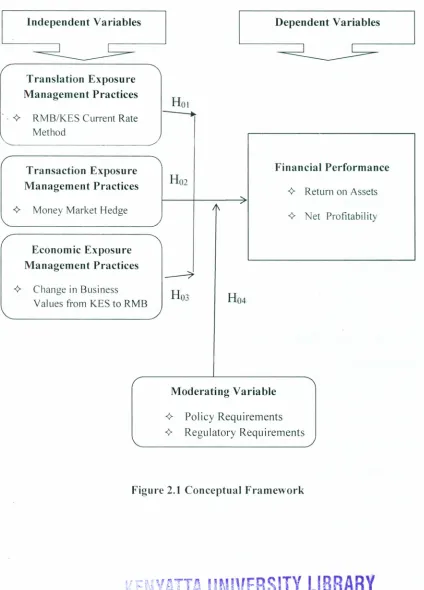
The conceptual framework is presented in figure 2.1
Dependent Variables
Independent Variables
Moderating Variable
{> Policy Requirements
{> Regulatory Requirements
,'---~
Figure 2.1 Conceptual Framework
CHAPTER THREE: RESEARCH METHODOLOGY
3.1 Introduction
This chapter discusses the research methods used in conducting the research. It stipulates the research philosophy, the research design used, the population of the study, the sample as well as the procedures applied in data collection.
3.2 Research Philosophy
Research philosophy can be described as a paradigm which involves a broad
framework. which comprises perception, beliefs and understanding of several theories and practices that are used to conduct a research (Cohen. Manion and Morrison, 2000).
A paradigm is a way of thinking about and conducting a research it is important in the
development of the research background, research knowledge and its nature (Saunders, Lewis and Thornhill. 2009). The research philosophy adopted is positivism as per the
study. As a result of globalization and interdependence, China is strengthening her
cooperation with other world nations including Africa and is keen to strengthen her trade relations with Kenya. China-Kenya bi lateral cooperation has led to a fast
comprehensive and profound development in terms of the frequent exchanges of high
level and people-to-people visits as well as trade volume increased at an annual rate of
over 30% in recent years. In the research background, Chinese owned enterprises
operating in Kenya hedge foreign exchange risks using foreign exchange risk
3.3 Research Design
This study has employed a descriptive research design this is because according to
Cooper and Schindler (2003), a study concerned with finding out who, what, when,
where and how of a phenomenon is a descriptive study. Both Qualitative and
Quantitative research methods will be used in the study. Both primary data and
secondary data were used in this study. Primary data was collected using a pre-designed
questionnaire administered to the managers of the companies in charge of finance or
risk management. Secondary data was collected from the audited financial statements,
documents, records and reports of others.
3.4 Target Population
A population is a summation of all the organisms of the same group or species, which
live in the same geographical area, and have the capability of interbreeding. In
sociology, population refers to a collection of human beings. Demography is a social
science which entails the statistical study of human populations. This research refers
mainly the entire groups or individual, events or objects having common characteristics
about which the researcher wishes to make generations, international statistic indicates
the likelihood that what was true of the sample is also true for the population from
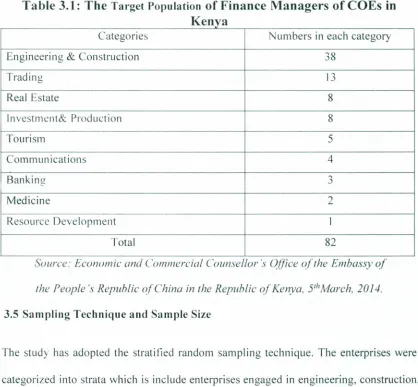
which it is drawn. Thus the target population for this research was the managers in
charge of finance and risk management of all the 82 Chinese Owned enterprises
Table 3.1: The
Target Populationof Finan
c
e Manag
er
s of
CO
Es
in
K
enya
Categories Numbers in each category
Engineering & Construction 38
Trading 13
Real Estate 8
Investment& Production 8
Tourism 5
Communications 4
Banking ,...,)
Medicine 2
Resource Development I
Total 82
Source: Economic and Commercial Counsellor's Office of/he Embassy oj
the People's Republic of China intheRepublic of Kenya, 5'hMarch, 2014.
3.5 Sampling Technique and Sample Size
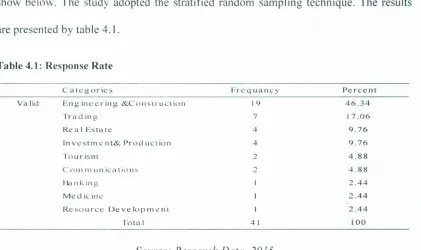
The study has adopted the stratified random sampling technique. The enterprises were
categorized into strata which is include enterprises engaged in engineering, construction,
tourism, real estate, investment, production, communications, banking, medicine,
resource development and trading as shown in the table 3.2 below. So for each stratum
(category) a sample or 50 percent was considered adequate as indicated on table 3.2. This is because according to Lewis & Thornhill (2009), statistically a sample of 30 items isconsidered as sufficient. The formula to be used for calculating the sample was:
Where: n isthe sample size
N isthe total population
Table 3.2: The
Sample Sizeof COEs in Kenya
Categories Sample size in each category
(50%)
Engineering &Construction 19
Trading 7
Real Estate 4
1nvestment& Production 4
Tourism 2
Communications 2
Banking 1
Medicine 1
Resource Development 1
Total 41
3.6 Data Collection Instruments
Data was collected in form of primary and secondary data. The primary data was
collected by a questionnaire administered to the managers of the companies incharge of
finance or risk management. The secondary data has constituted document analysis
3.7 Data Collection Procedure
Data collection is the process of gathering and measuring information on variables of
interest in an established systematic fashion that enables one to answer stated research
questions, test hypotheses, and evaluate outcomes. The goal for all data collection is to
capture liualit) c\ idcncc that then translates to rich data analysis and allows the building
of a convincing and credible answer to questions that have been posed. There are three
types of data collection: surveys. interviews and focus groups are used to a formal data
collection process (fielding, 200 I) , it is necessary as it ensures that data gathered are
both defined and accurate and that subsequent decisions based on arguments embodied
in the findings are valid. In order to yield consistent results and applies to a measure
when similar results, therefore survey was used in process of this research after
development of the data collection instruments. This method of collecting data from
multiple sources. termed data triangulation. assists the researcher not only to collect
more comprehensive relevant information but also to cross-check their consistency in
order to enhance the robustness of findings.
3.8 Data Analysis
Data collected from the survey has been sorted, edited and corded to have the required
quality and accuracy. The study has used both qualitative and quantitative data.
Qualitative data has been analyzed using the descriptive statistics while inferential
statistics of correlation and regression analysis has used to analyze quantitative data.
Statistical package for social studies (SPSS) has been used to generate information.
dependent and the independent variables. The independent variables have been the
extent of use of futures, options. swaps and forward contracts in the foreign exchange
transactions. The dependent variable has been financial performance. Multiple linear
regression analysis has been used to examine the magnitude of influence of the
independent variables on the respective dependent variable. The goal for all data
collection is to capture quality evidence that then translates to rich data analysis and
allows the building of a convincing and credible answer to research questions of the
study. Below isthe analytical model that has been used.
Where:
Y> Financial Performance
X,
=
Translation Exposure Management PracticesX2 = Transaction Exposure Management Practices
X3 = Economic Exposure Management Practices
£= Error Term
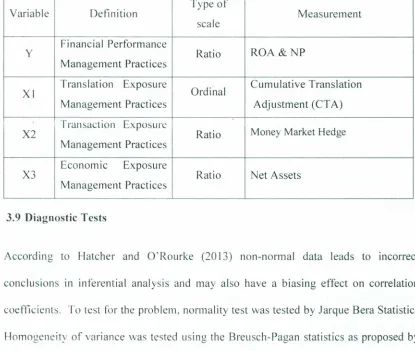
The independent and dependent variables were calculated as shown in the table 3.3
Table 3.3: Variable Definition and Measurement
Variable Definition Type of Measurement
scale
Financial Performance
y Ratio ROA & NP
Management Practices
Translation Exposure
Ordinal Cumulative Translation XI
Management Practices Adjustment (CTA)
Transaction Exposure
Money Market Hedge
X2 Ratio
Management Practices
Economic Exposure
X3 Ratio Net Assets
Management Practices
3.9 Diagnostic Tests
According to Hatcher and 0'Rourke (2013) non-normal data leads to incorrect
conclusions in inferential analysis and may also have a biasing effect on correlation
coefficients. To test for the problem, normality test was tested by Jarque Bera Statistics.
Homogeneity of variance was tested using the Breusch-Pagan statistics as proposed by
(Madansky. 2012), whereby the 13reusch-Pagan null hypothesis states that there is
constant variance. Multicollinearity of the independent variables increases the standard
error of coefficients also making them less efficient. It also limits the size of Rand
makes it difficult to assess the individual importance of a predictor. Multicollinearity
was tested using correlation tables. Lastly Autocorrelation was tested using Durbin