Available online: https://edupediapublications.org/journals/index.php/IJR/ P a g e | 312
Data Routing Analysis Of Conceal Data Messaging Services: Im
K.SRIDHAR, Assistant Professor,
Dept of CSE.
ABSTRACT: Instant messaging services are quickly becoming the most dominant form of communication among consumers around the world. Apple iMessage, for example, handles over 2 billion messages each day, while WhatsApp claims 16 billion messages from 400 million international users. To protect user privacy, many of these services typically implement endto-end and transport layer conceal data, which are meant to make eavesdropping infeasible even for the service providers themselves. In this paper, however, we show that it is possible for an eavesdropper to learn information about user actions, the language of messages, and even the length of those messages with greater than 96% accuracy despite the use of state-of-the-art conceal data technologies simply by observing the sizes of encrypted packets. While our evaluation focuses on Apple iMessage, the attacks are completely generic and we show how they can be applied to many popular messaging services, including WhatsApp, Viber, and Telegram. Keywords: privacy; conceal; data routing analysis
I.INTRODUCTION
Over the course of the past decade, instant messaging services have gone from a niche application used on desktop computers to the most prevalent form of communication in the world, due in large part to the growth of Internet enabled phones and tablets. Messaging services, like Apple iMessage and WhatsApp, handle tens of billions of messages each day from an international user base of over one billion people [13, 14]. Given the volume of messages traversing these services and ongoing concerns over widespread eavesdropping of Internet communications, it is not surprising that privacy has been an important topic for both the users and service providers. To protect user privacy, these messaging services offer transport layer conceal data technologies to protect messages in transit, and some services, like iMessage and Telegram, offer end-to-end conceal data to ensure that not even the providers themselves can eavesdrop on the messages [2, 9]. As previous experience with Voice-over-IP (e.g., [18, 19]) and encrypted HTTP tunnels (e.g., [5, 15]) has shown us, however, the use of state-of-the-art conceal data technologies is no guarantee of privacy for the underlying message content. In this paper, we analyze the network data routing of popular encrypted messaging services to (1) understand the breadth and depth of their information leakage, (2) determine if attacks are generalizable across services, and
(3) calculate the potential costs of protecting against this leakage. Specifically, we focus our analysis on the Apple iMessage service and show that it is possible to reveal information about the device operating system, fine-grained user actions, the language of the messages, and even the approximate message length with accuracy exceeding 96%,
Table 1: Summary of attack results for Apple iMessage.
as shown in the summary provided in Table 1. In addition, we demonstrate that these attacks are applicable to many other popular messaging services, such as WhatsApp, Viber, and Telegram, because they target deterministic relationships between user actions and the resultant encrypted packets that exist regardless of the underlying conceal data methods or network protocols used. Our analysis of countermeasures shows that the attacks can be completely mitigated by adding random padding to the messages, but at a cost of over 300% overhead, which translates to at least a terabyte of extra data per day for the service providers. Overall, these attacks could impact over a billion users across the globe and the high level of accuracy that we demonstrate in our experiments means that they represent realistic threats to privacy, particularly given recent revelations about widespread metadata collection by government agencies [4].
II. BACKGROUND
Before we begin our analysis, we first provide an overview of the iMessage service, and discuss prior work in the analysis of encrypted network data routing. Interested readers should refer to documentation from projects focused on reverse engineering specific portions of the iMessage service [6, 7, 8], or the official Apple iOS security white paper [2].
2.1 iMessage Overview
iMessage uses the Apple Push Notification Service (APNS) to deliver text messages and attachments to users. When the device is first registered with Apple, a client certificate is created and stored on the device. Every time the device is connected to the Internet, a persistent APNS connection is made to Apple over TCP port 5223. The connection appears to be a standard TLS tunnel protecting the APNS messages.
Available online: https://edupediapublications.org/journals/index.php/IJR/ P a g e | 313
earlier TLS connections, this one is authenticated using the client certificate generated during the registration process1 . Once the keys are established, there are five user actions that are observable through the APNS and TLS connections made by the iMessage service. These actions include: (1) start typing, (2) stop typing, (3) send text, (4) send attachment, and (5) read receipt. All of the user actions mentioned follow the protocol flow shown in Figure 1, except for sending an attachment. The protocol flow for attachments is quite similar except that the attachment itself is stored in the Microsoft Azure cloud storage system before it is retrieved, rather than being sent directly through Apple.
Figure 1: High-level operation of iMessage.
Over the course of our analysis, we observed some interesting deviations from this standard protocol. For instance, when TCP port 5223 is blocked, the APNS message stream shifts to using TCP port 443. Similarly, cellular-enabled iOS devices use port 5223 while connected to the cellular network, but switch to port 443 when WiFi is used. Moreover, if the iOS device began its connection using the cellular network, that connection will remain active even if the device is subsequently connected to a wireless access point. It is important to note that payload sizes and general APNS protocol behaviors remain exactly the same whether port 5223 or 443 are used, and therefore the attacks we present in this paper are equally applicable in both cases.
2.2 Related Work
To date, there have been two primary efforts in understanding the operation of the iMessage service and the APNS protocol. Frister and Kreichgauer have developed the open source Push Proxy project [6], which allows users to decode APNS messages into a readable format by redirecting those messages through a man-in-the-middle
proxy. In another recent effort, Matthew Green [8] and Ashkan Soltani [7] showed that, while iMessage data is protected by end-toend conceal data, the keys used to perform that conceal data are mediated by an Apple-run directory service that could potentially be used by an attacker (or Apple themselves) to install their own keys for eavesdropping purposes. More broadly, the techniques presented in this paper follow from
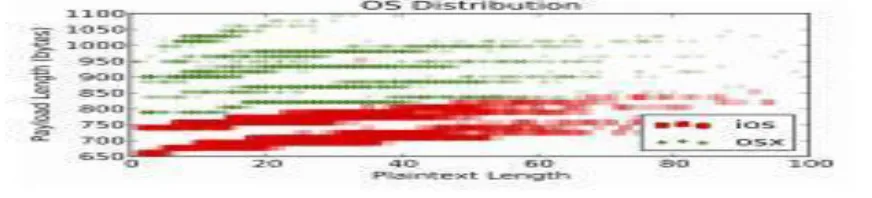
Figure 2: Scatter plot of plaintext message lengths versus ciphertext lengths for packets containing user content. a long line of attacks that use only the timing and size of encrypted network data routing to reveal surprising amounts of information. In the past, data routing analysis methods have been applied in identifying web pages [5, 11, 12, 15, 16], and reconstructing spoken phrases in VoIP [18, 19]. To the best of our knowledge, this is the first paper to examine the privacy of encrypted instant messaging services, particularly those used by mobile devices. We distinguish ourselves from earlier work in both the broad impact and realistic nature of our attacks. Specifically, we demonstrate highly-accurate attacks that could affect nearly a billion users across a wide variety of messaging services, whereas previous work in other areas of encrypted data routing analysis have relatively small impact due to limited user base or poor accuracy. When compared to earlier work in analyzing iMessage, we focus on an eavesdropping scenario that requires no cooperation from service providers and has been demonstrated to exist in practice [4].
III. ANALYZING INFORMATION
LEAKAGE
In this section, we investigate information leakage about devices, users, and messages by analyzing the relationship between packet sizes within the persistent APNS connection used by iMessage and user actions. For each of these categories of leakage, we first provide a general analysis of the data to discover trends or distinguishing features, then evaluate classification strategies capable of exploiting those features.
3.1 Data and Methodology
Available online: https://edupediapublications.org/journals/index.php/IJR/ P a g e | 314
images, and send/read messages on a Macbook Pro running OSX 10.9.1, and a combination of VNC remote control software and AppleScript to control the same actions on a jailbroken iPhone 4 (iOS 6.1.4). For each user action, we collected 250 packet capture examples on both devices and in both directions of communications (i.e., to/from Apple) for a total of 5,000 samples. This allows us to simulate an adversary that can passively monitor streaming iMessage data routing to or from Apple servers (steps 3 and 4 in Figure 1, respectively). In addition, we also collected small samples of data using devices running iOS 5, iOS 7, and OSX Mountain Lion to verify the observed trends. The underlying text data is drawn from a set of over one million sentences and short phrases in a variety of languages
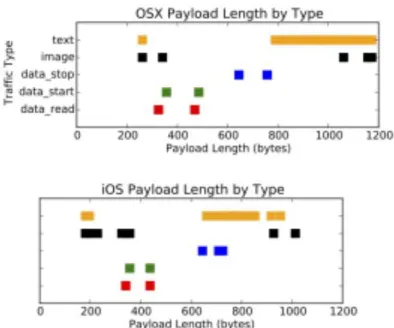
Figure 3: Distribution of payload lengths for each message type separated by operating system without control packets. from the Tatoeba parallel translation corpus [17]. Languages used in our evaluation include Chinese, English, French, German, Russian, and Spanish. For attachment data, we randomly generated PNG images of exponentially increasing size (64 x 64, 128 x 128, 256 x 256). Throughout the remainder of the paper, we simply refer to attachments as “image” messages. Although the Tatoeba dataset does not contain typical text message shorthand, it is generated through a community of non-expert users (i.e., crowd-sourced) and so actually contains several informal phrases that are not found in a typical language translation corpus. In fact, the distribution of English message lengths in our data, as shown in Table 2, is quite close to those reported in recent studies of text messaging behavior by Battestini et al. [3], with our data exhibiting a slightly shorter average message length and less variability. Each experiment in this section used 10-fold cross validation testing, where the data for each instance in the test was constructed by sampling TCP payload lengths and packet directions (i.e., to/from Apple) from the relevant subset of the packet capture files. Cross-validation testing was performed such that the classes were equally represented in the sampled data (i.e., uniform prior probability across all classes). The only preprocessing that was performed on the data was to remove duplicate
packets that occur as a result of TCP retransmissions and those packets without TCP payloads. Performance of our
classifiers is reported with respect to overall accuracy, which is calculated as the sum of the true positives and true negatives over the total number of samples evaluated. Where appropriate, we also use confusion matrices that show how each of the test instances was classified and use absolute error to measure the predictive error in our regression analysis.
3.2 Operating System
Our first experiment examines the difference in the observable packet sizes for the iOS and OSX operating systems. The scatterplot of iMessage packet sizes in Figure 2 shows how iOS appears to more efficiently compress the plaintext, while OSX occupies a much larger space. These two classes of data are clearly separable, but the figure also shows five unique bands of plaintext/ciphertext relationship, which hints at leakage of finer-grained information about the individual messages (which we examine in Section 3.4). Additionally, when we break down the distributions based on their direction (i.e., to/from Apple), we see that there is a deterministic relationship between the two. That is, as messages pass through Apple, 112 bytes of data are removed from OSX messages and 64 bytes are removed from iOS messages. Aside from the ability to fingerprint the OS version, the deterministic nature of these changes indicates that it is also possible to correlate and trace communications as it passes through Apple on the way to its
destination, thereby allowing us to develop a
communications graph. To identify the OS of observed devices, we use a binomial na¨ıve Bayes classifier from the Weka machine learning library [10] with one class for each of the four possible OS, direction combinations. The classifier operates on a binary feature vector of packet length, direction pairs, where the value for a given dimension is set to “true” if that pair was observed and “false” otherwise. To determine the number of packet observations necessary for accurate classification, we run 10-fold cross-validation experiments where the 1,024 instances used for each experiment are created with N = 1, 2, . . . , 50 packets sampled from the appropriate subset of the dataset for each OS, observation point class. The results indicate that we are able to accurately classify the OS with 100% accuracy after observing only five packets regardless of the operating system. A cursory analysis of iOS 5 and 7 indicates that they also produce messages with lengths that are unique from both the OSX and iOS 6.1.4 device, which indicates that this type of device fingerprinting could be refined to reveal specific version information when the size of the APNS messages changes between OS versions.
3.3 User Actions
Available online: https://edupediapublications.org/journals/index.php/IJR/ P a g e | 315
distribution of payload lengths for each of these actions separated by the OS of the sending device after removing control packets (i.e., packet sizes that occur within multiple classes). Most classes have two distinctive packet lengths – one for when the message is sent to Apple and one when it is received from Apple. The only classes that overlap substantially are the read receipt and start messages in the iOS data going to Apple. The stability and deterministic nature of the lengths in most classes makes the use of probabilistic classifiers unnecessary. Instead of using heavyweight machine learning methods, we create a hash-based lookup table using each
Figure 4: Scatter plots of plaintext message lengths versus payload lengths for three languages in our dataset.
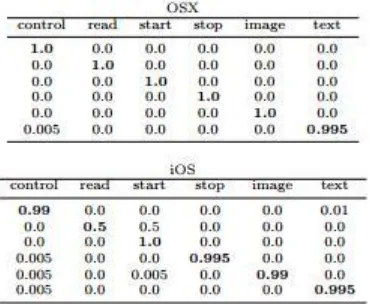
Table 3: Confusion matrix for message type classification observed length in the training data as a key and store the associated class labels. In addition to creating classes for the
five standard message types derived from user actions, we also create a class for the payload lengths of identified control packets. When a new packet arrives, we check the lookup table to retrieve the class label(s) for its payload length. If only one label is found, the packet is labeled as that message type. In the case where two class labels are returned, we choose the class where that payload length occurs most frequently in the training data. In an effort to focus our evaluation, we assume that the OS has already been accurately classified such that we have four separate message-type classifiers, one for each combination of OS and direction. Each of the classifiers is evaluated using 10-fold cross validation with instances drawn from the respective subsets of the dataset, for a total of 1,250 instances per classifier. Confusion matrices showing the results for OSX and iOS are presented in Table 3. The accuracy is surprisingly good for both iOS and OSX given such a simple classification strategy. As it turns out, all message types can be classified with accuracy exceeding 99%, except for iOS read messages that are easily confused with start messages, as was suggested by Figure 3.
3.4 Message Attributes
Available online: https://edupediapublications.org/journals/index.php/IJR/ P a g e | 316
100% accurate in order to focus specifically on this area of leakage.
Figure 5: Language classification accuracy.
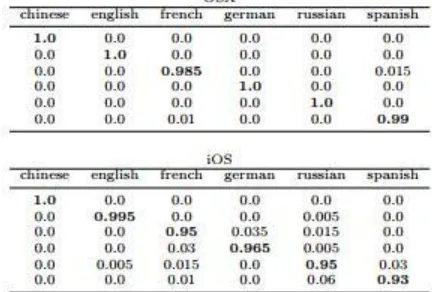
The results from 10-fold cross validation on 1,024 instances generated from N = 1, 2, . . . , 50 text message packets are shown in Figure 5. Classification of languages in OSX data is noticeably better than iOS, as we might have expected due to compression. On the OSX data, we achieve an accuracy of over 95% after 50 packets are observed. When applied to the iOS data, on the other hand, accuracy barely surpasses 80% at the same number of packets. However, as the confusion matrices in Table 4 show, by the time we sample 100 packets all languages are achieving classification accuracies of at least 93% regardless of the dataset.
Table 4: Confusion matrix for language classification. Given that language classification can be achieved with high accuracy after a reasonable number of observations, we now
move on to determining how well we can predict message lengths within those languages. For this task, we apply a simple linear regression model using the payload length as the explanatory variable and the message length as the
dependent variable. The models are fitted to the training data using least squares estimation. Again, we performed 10-fold cross validation with 1,024 instances and calculated
the resultant absolute error. In general, the values are small – an error of between 2 and 11 characters – when we consider that the sentences in the language dataset range from two characters to several hundred, with an average error of 6.27 characters. This is equivalent to an 18.4% average error rate based on the statistics from Table 2. Those languages with multiple clusters, like French and Spanish, fared the worst since the linear regression model could not handle the bimodal behavior of the distribution for
the multiple character sets. For completeness, we also applied a regression model to the image transfers to and from the Microsoft Azure cloud storage system. The regression model was extremely accurate for the attachments, with an absolute error of less than 10 bytes.
IV. BEYOND IMESSAGE
Available online: https://edupediapublications.org/journals/index.php/IJR/ P a g e | 317
Apple iMessage data, the random padding methodology reduced all of our attacks to an accuracy of 0% at the cost of 613 bytes (328%) of overhead per message for iOS and 596 bytes (302%) for OSX. Although the absolute increase in size is rather small, we must consider that services like iMessage handle upwards of 2 billion messages every day, which translates to an additional terabyte of network data routing daily. For the more popular WhatsApp service, a similar increase would incur at least 4 terabytes of overhead. Other countermeasure methods, such as data routing morphing [20], may actually provide a more palatable trade-off between overhead and privacy, though further analysis is beyond the scope of this initial study.
V. CONCLUSION
Overall, the attacks that we have demonstrated raise a number of very important questions about the level of privacy that users can expect from these services. While the exact plaintext content cannot be revealed, the results of our study indicate that rich metadata can be learned about a user and their social network with high accuracy. At the same time, it is important to keep in mind that this is a closed-world study and, while we believe it realistically represents a serious privacy threat, there are aspects of realworld usage that may impact the results, such as texting shorthand or previously unobserved languages. However, in the wake of recent reports of widespread metadata gathering [1, 4] and given the unusually broad impact of these attacks on an international user base, it seems reasonable to assume that the issues raised in this paper pose a realistic threat that should be taken seriously by messaging services.
REFERENCES
[1] Spencer Ackerman and James Ball. Optic Nerve:
Millions of Yahoo Webcam Images Intercepted by GCHQ. http://www.theguardian.com/world/2014/feb/27/gchqnsa-webcam-images-internet-yahoo, February 2014.
[2] Inc. Apple. iOS Security. http://images.apple.com/ iphone/business/docs/iOS_Security_Feb14.pdf, February 2014.
[3] Agathe Battestini, Vidya Setlur, and Timothy Sohn. A Large Scale Study of Text-Messaging Use. In Proceedings of the 12th Conference on Human Computer Interaction with Mobile Devices and Services, pages 229–238, 2010.
[4] Marjorie Cohn. NSA Metadata Collection: Fourth
Amendment Violation.
http://www.huffingtonpost.com/marjorie-cohn/nsametadata-collection-f_b_4611211.html, January 2014.
[5]K.P. Dyer, S.E. Coull, T. Ristenpart, and T. Shrimpton. Peek-a-Boo, I Still See You: Why Efficient Data routing Analysis Countermeasures Fail. In Proceedings of the 33rd IEEE Symposium on Security and Privacy, pages 332–346, May 2012.
[6]Michael Frister and Martin Kreichgauer. PushProxy: A Man-in-the-Middle Proxy for iOS and OS X Device Push
Connections. https://github.com/meeee/pushproxy, May
2013.
[7] Dan Goodin. Can Apple Read Your iMessages? Ars
Deciphers End-to-End Crypto Claims.
http://arstechnica.com/security/2013/06/can-appleread-your- imessages-ars-deciphers-end-to-endcrypto-claims/, June 2013.
[8] Matthew Green. Can Apple read your iMessages?
http://blog.cryptographyengineering.com/2013/06/canapple-read-your-imessages.html, June 2013.
[9] Andy Greenberg. Apple Claims It Encrypts iMessages
And Facetime So That Even It Can’t Decipher Them. http://www.forbes.com/sites/andygreenberg/2013/06/ 17/apple-claims-it-encrypts-imessages-and-facetimeso-that-even-it-cant-read-them, June 2013.
[10] Mark Hall, Eibe Frank, Geoffrey Holmes, Bernhard Pfahringer, Peter Reutemann, and Ian H. Witten. The WEKA Data Mining Software: An Update. SIGKDD Explorations, 11(1), 2009.
[11] Dominik Herrmann, Rolf Wendolsky, and Hannes
Federrath. Website Fingerprinting: Attacking Popular Privacy Enhancing Technologies with the Multinomial Naive-Bayes Classifier. In Proceedings of the ACM Workshop on Cloud Computing Security, pages 31–42, November 2009.
[12] M. Liberatore and B. Levine. Inferring the Source of Encrypted HTTP Connections. In Proceedings of the 13th ACM Conference on Computer and Communications Security, pages 255–263, October 2006.
[13]Ben Lovejoy. Massive Growth in Apple’s Cloud-Based
Services Eclipsed by Debate on Financials.
http://www.macrumors.com/2013/01/24/massive-growthin-
apples-cloud-based-services-eclipsed-by-debateon-financials, January 2013.
[14]Parmy Olson. Watch Out, Facebook: WhatsApp Climbs Past 400 Million Active Users. http://www.forbes.com/ sites/parmyolson/2013/12/19/watch-out-facebookwhatsapp-climbs-past-400-million-active-users/, December 2013.
[15] Andriy Panchenko, Lukas Niessen, Andreas Zinnen,