Available online: https://edupediapublications.org/journals/index.php/IJR/ P a g e | 1
Design & Development an Interpretive Paradigm for
Managment Of Information Security
Prof.Dr.G.Manoj Someswar
1, SSN Anjaneyulu
21.Research Supervisor, Dr.APJ Abdul Kalam Technical University, Lucknow,U.P.,
India
2.Research scholar, Dr.APJ Abdul Kalam Technical University, Lucknow,U.P., India
Abstract
This research work is concerned about issues of identifying with the administration of information
security in associations, accompanied by the requirement for cost efficient data security. It depends on the
suspicion that: with a specific end goal to accomplish cost efficient data security, the purpose of takeoff
must be learning about the exact reality in which the administration of data security happens. The
information gathering instruments employed are surveys with open-finished inquiries and unstructured
research interviews. The observational material is broke down and conclusions are drawn after the
standards of Grounded Theory. Information sources are experts in the zone of data security
administration, including data security specialists (n=13), affirmation evaluators (n=8) and data security
supervisors (n=8). The primary commitments are: an incorporated model outlining the specialists'
observations concerning the destinations, performing artists, assets, dangers and countermeasures of
information security administration; a structure for the assessment, arrangement and usage of data
security administration frameworks; another approach for the assessment of data security in
associations; an arrangement of progress factors concerning the development of data security
administration frameworks; and an issue stock concerning the esteem and evaluation of data security
instruction and preparing.
Keywords:
“Info security Assessment Using SBA Check”, legitimize the examination, The InformationSecurity Management Process ISMS Process), Credibility angles, foreseeing issues
INTRODUCTION
Research strategy and methods
The choice of a research strategy
Available online: https://edupediapublications.org/journals/index.php/IJR/ P a g e | 2
results that are mostly of an inductive nature. The purpose of flight is the issues that Refer to supplement A for an exhibition and discourse of different methodologies and research foci in data security.
#
Research problem and objective
'$ "!
Research strategy Research setting and unit of analysis &%
iP#
"!
PPPPPP
Epistemological and ontological assumptions "
!
Figure 1: Factors affecting the choice of a research strategy
Organisations face, and the processes they go through, as they are aiming to establish a balanced information security management system. The approach is essentially explorative and descriptive, aiming to discern and understand these problems and processes. Research setting and unit of analysis. Empirical materials (data) are elicited from project groups formed with the purpose of discussing, understanding and suggesting answers to these problems for practitioners. The findings presented in this part of the thesis are based on our participation in these groups over the course of circa two years.[2] The nature of our partaking - i.e. to participate as researchers - was explicated and agreed upon at the outset. The participation has - with intent - been one of active involvement, not only as observers, but also as active group members. Fundamental epistemological and ontological assumptions. This research is built on an underlying interpretive epistemology, in that we assume that the management of information security in organisations ideally should be explored from the frame of reference of those who are directly involved in these processes. Hence, this research
could be classified within what Burrell and Morgan (1979) would call the interpretive paradigm:[3]
The interpretive worldview is educated by a worry to understand the world as it may be, to comprehend the basic idea of the social world at the level of subjective experience. It looks for clarification inside the domain of individual awareness and subjectivity, inside the edge of reference of the member instead of the spectator of activity. Bramble ell and Morgan (1979, 28) Our ontological position is that the social world, which frames considerable parts of an association, does not exist autonomously of the spectator. Overseeing data security in associations is mostly about attempting to control certain parts of the social world, through impacting human conduct a propos data security. Moreover, a choice to change the security of a PC based data framework must be deciphered and completed by a human,[4] and it is accordingly reliant on conditions in the social world.
Available online: https://edupediapublications.org/journals/index.php/IJR/ P a g e | 3
The issues depicted in the previous area shape the picked re-look methodology. At first, we didn't name the procedure. Simply after the investigations were completed was it discovered that the system utilized in a few regards took after what in the technique writing is alluded to as an activity look into methodology. By and by, there are critical deference’s between the
embraced technique and activity investigate. "Activity explore means to contribute both to the useful worries of individuals in a prompt tricky circumstance and to the objectives of sociology by joint cooperation inside a commonly adequate moral system" (Rapport, 1970, 499). An activity examine methodology is basically characterized by four attributes; it manages a:
(i) Commonsense research issue in a (ii) Participatory style. Likewise, the quest for (iii) change, however a (iv) cyclical research and criticism process, is viewed as a fundamental part of research (Denscombe, 1998, 57). The following paragraphs briefly examine these defining characteristics in relation to this study:
Figure 2: The di
ff
erence between the adopted research strategy and familiar action
research
Commonsense research issue: For this
situation, the examination is concerned with the issues that associations confront, and the procedures they experience, as they are meaning to build up an adjusted data security administration framework. In Sweden, more than 40 associations have framed a gathering under the Swedish Standards Institute, named Project Information Security Management
Available online: https://edupediapublications.org/journals/index.php/IJR/ P a g e | 4
obviously of a reasonable character. Be that as it may, in real life look into writing it is frequently accepted that the critical thinking and research process happens at the level of one association, and that it manages a problem in that very association. This isn't the situation here, as showed in figure 2. This implies the cycles of data social occasion and input to/from the key sources - the associations confronting the issues considered - of observational materials have been backhanded. In this way, this approach is marginally different from that utilized as a part of "normal" activity examine. This has without a doubt affected the exploration comes about since some level of analytical speculation has just been finished by the members in these two industry gatherings (figure 2). As specialists in these gatherings, we – and our sources - have been easily situated with some separation from associations really confronting the issues. That has opened up the likelihood to see the world as not so much disorderly but rather more organized – abandoning us with a more romanticized perspective of reality for better and in negative ways.[5]
Participative: The pilot accreditation work
gather is one of a kind in that it unites affirmation reviewers, data security advisors, government offices, associations intrigued by data security confirmation and specialists (us). These gatherings have been working together with the intend to produce and offer the information made. The respondents – the professionals – have shared their own particular encounters and bits of knowledge; we have simply condensed them in this investigation. They required the learning themselves, which is the reason they chose to take an interest in the pilot confirmation gathering. We have taken an
interest in the pilot affirmation work aggregate throughout two years. Moreover, the Swedish Information Processing Society and the data security specialists, together with whom we built up the assessment device and strategy introduced later in this piece of the postulation, were likewise taking part to learn themselves and to help different associations in their assessment efforts.
Change: The third characterizing normal for
activity investigates is change, and reflection on the effects of progress. Likewise here, the change ingrained is backhanded – on the level of the business gatherings, so there is almost no impression of the sort "benefited this change do in any way in the association?",[6] and all the more a change and alignment of perspectives and thoughts. For instance, the pilot accreditation aggregate needed to achieve a typical comprehension of what is required for the fruitful usage and affirmation of data security administration frameworks as indicated by the 7799 standard – they were looking for a technique of how this should be possible. The gatherings needed to change - or align - their perspectives on these issues in order to achieve accord.[7]
Repetitive input: The outcomes were (and still
Available online: https://edupediapublications.org/journals/index.php/IJR/ P a g e | 5
Limitations of activity examine
There are no investigation methods without obstructions – this is in like manner substantial for movement investigate. The rule sensible protest to this kind of research strategy is that it can affect the "representativeness of the disclosures and how much hypotheses can be made on the commence of the results" (Denscombe, 1998, : 65), which is moreover noted by Baskerville (1999). This is authentic moreover for this examination, however the grumbling expect that the ventilation system ion investigate wander occurs in only a solitary affiliation (a "work-site approach"). On the other hand, this examination is stressed over experiences and bits of information from various affiliations and various different settings, which may make the results more far reaching. Another protestation to movement re-look for is that the investigator more then likely can't be totally isolated and objective in association with the subjects under examination, since s/he is so immersed. This is against the positivistic musings of research, as pointed out by for example Susman and Evered (1978). Be that as it may, this reality can likewise be seen as a logical preferred standpoint since it gives the specialist a closer and more profound perspective of what is contemplated.
Data accumulation and investigation
strategies
The particular research technique utilized - inside the characterized activity look into system - differs from paper to paper (section to section) contingent upon the most appropriate strategy for the current issue. Where pertinent, every section portrays the exploration procedure, standards and strategies for the particular examination.[8] Among the information gathering strategies utilized are questionnaires,
coordinate perception, interest, and narrative audit. Techniques for examination of information connected are different sorts of subjective investigation,[9] for example, the Grounded Theory-based examination strategy offered by the product instrument Atlas.ti (Muhr, 2004).
ISMS framework
Framework introduction
Any association that needs to work deliberately with data security should experience certain phases in quest for the objective of enhanced data security. Basically, these look like the normal diagnostic stages we know from a perfect hierarchical or even programming improvement process:
• It is normal to begin with some sort of
investigation of where we are today and what we have to do to get where we need to be tomorrow.
• The subsequent stage is regularly to begin
portraying or planning the thoughts or arrangements that will take us from the present circumstance to the distinguished perfect circumstance.
• Once these thoughts or arrangements are
framed and explained, they ought to be put into utilization in the association by some sort of implementation methodology.
Available online: https://edupediapublications.org/journals/index.php/IJR/ P a g e | 6
– that portray these or practically identical
stages. For instance the PDCA cycle, initially created by analyst Shewhart and portrayed in the quality administration writing by Deming (1986). The PDCA cycle comprises of the four phases: design, do, check and act (Deming, 1986):
• Plan: Analyze the present circumstance to
recognize space for enhancement and promising arrangements.
• Do: Test the arrangements on a little scale first
all together not to upset basic procedures. • Check: Find out if the arrangements are giving
the normal outcomes, and on the off chance that they do:
• Act: Implement the arrangements on a more
extensive scale.
Models like these let us express the real exercises required all the way, or for this situation from 'issue confronted' to 'issue explained'. The PDCA cycle is regularly used to portray hierarchical change forms. Of late it has regularly been utilized – at industry gatherings and even in standardisation archives, for example, 7799 section 2 under amendment (Humphreys, 2001) – to depict the exercises associated with data security overseement ventures. In any case, since the PDCA demonstrate was created principally to take into account the need of a deliberate procedure while streamlining auto-mated assembling forms in the 1950s, it isn't suited to portray the real exercises in the ISMS procedure. For instance, the arrangement organize incorporates the two examinations of the present circumstance and
additionally outlining arrangements. In data security administration, these two are regularly appropriately observed as two discrete exercises. What's more, the do, check, and act organizes obviously assume – in spite of the fact that not unequivocally - that it is conceivable to actualize one little change and after that measure its effect. This approach will function admirably for single, ceaseless upgrades in an association (in line with the Japanese aggregate quality administration rationality, Kaizen1). While executing another data security administration framework, notwithstanding, we are regularly endeavouring to bring more than a couple of significant changes to the association without a moment's delay. In these cases, we need to hold up with the check exercises until the point that the administration framework is now brought into play – when we can record criticism data from the ISMS in operation. For this, we require our own PDCA show that is carefully fit for data security administration.[11]
The following couple of segments will portray such a model, including its air conditioning activities, the related information sources and yields, and significant issues relating to every action. The model will shape the abnormal state structure for this piece of the postulation.
Proposed ISMS process demonstrate
The requirement for a procedure display
Available online: https://edupediapublications.org/journals/index.php/IJR/ P a g e | 7
dangers its data resources confront.[12] What isn't explained in the standard however, is the means by which these necessities can be come to. Numerous associations here in Sweden, and in different nations too, have been slowed down in their plans to cling to the necessities of the standard, since they essentially did not recognize what ventures to take to fulfil those. This was clear for most associations in the Swedish pilot confirmation conspire. Albeit numerous associations are delaying to real accreditation, many try to 1The quintessence of the Japanese quality administration logic Kaizen is to enhance an association or a procedure consistently in little incremental advances. adhere to the standard anyway, as it is seen to represent best practise in information security management. By proposing an ISMS process, and describing the activities involved, we take a first step toward resolving the problem depicted above. As always with process models, they can never be applied fully to any real world situation without first adapting them to the context at hand.
The ISMS process model evolution
This ISMS procedure demonstrate has been produced steadily through standard participation, perception, and communication with data security consultants and different people working in ventures attempting to fulfil the necessities of the standard. On occasion, we have been inundated in one of the stages, and at different circumstances, we have been worried about the totality of the ISMS procedure and what it would seem that. All associations have their own particular techniques and perspectives. In any case, cooperating with about thirty people endeavouring to decipher the standard, after over two years of exchanges and assertions and contradictions, we trust that the ISMS procedure demonstrate introduced here is one that numerous professionals and scholastics will subscribe to. The ISMS procedure display depicts the stages and the critical exercises required on a level of detail which still leaves space for situational adjustment.[13]
High level view of the ISMS process model
The model divides the ISMS process into its sub-processes (figure 1).
-
evaluation
-formation
-implementation
feedback-operation
Figure 1: The Information Security Management Process (ISMS Process)
The assessment arrange incorporates all that it takes to evaluate the present circumstance vis-a`-vis data security administration in the association. It considers not just the authoritative/hierarchical security issues, yet in addition the specialized (IT) security issues.[14]
Available online: https://edupediapublications.org/journals/index.php/IJR/ P a g e | 8
and so on. The objective is to outline and create arrangements customized to the association that will cure any vulnerabilities and insufficiencies in the present circumstance. The development organize is generally scientific in that these arrangements are still "on the planning phase".
The usage arrange takes the arrangements from the reasonable level and influences them to work in the association. It involves for example introducing and designing specialized security systems and in addition data security instruction and preparing to representatives.[15]
Once actualized, the ISMS is in operation and it begins to generate criticism data to the following cycle – as contribution to the new assessment stage. Presently, let us look at each of the stages all the more nearly.
Evaluation phase
This area intends to talk about and clear up issues relating to the evaluation phase of the ISMS procedure. By doing this, it additionally establishes a framework for the coming sections by giving unequivocal responses to inquiries, for example, What is the subject of assessment? What sorts of exercises are generally connected with an assessment? What does an assessment result in?
Unit of assessment
Data security assessment techniques (or, in same cases, structures) can go up against numerous different structures and concentrate on a scope of different perspectives: The IT Baseline Protection Manual (Bundesamt Sicherheit infer
Information stechnik, 2001), Orion (Fillery-James, 1999) and Odessa (Warren et al., 1997) can help assessing the security of information or IT in an association. So can CRAMM (Insight Consulting, 2001) and SBA Scenario (Swedish Information Processing Society, 2001b), yet from a strict hazard/risk point of view. The SSE-CMM (SSE-SSE-CMM Project, 1999) can help assessing a designers' frameworks security building ability, and the CEM/CC (NIST, 1997) the security functionality in (e.g.) an application framework. In the event that directing an assessment utilizing CobIT (ISACF, 1996, 2000), the attention will be on administration control over all exercises in the IT office – some lone in a roundabout way identified with data security. Obviously, there are numerous different security assessment techniques, and every one of
Available online: https://edupediapublications.org/journals/index.php/IJR/ P a g e | 9
portray specialized and managerial controls that exist as a general rule that can – and should – be
assessed.
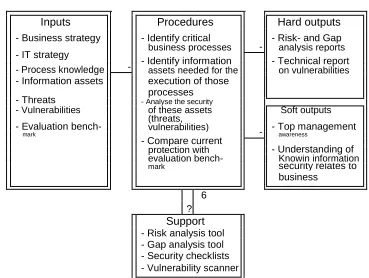
An overview of the evaluation stage
Inputs
Procedures
Hard outputs
- Business strategy
- Identify critical
- - Risk- and Gap
- IT strategy business processes analysis reports
- - Identify information
- Technical report
- Process knowledge assets needed for the on vulnerabilities
- Information assets execution of those
- Threats - Analyse the security processes
- Vulnerabilities of these assets Soft outputs
- Evaluation bench- (threats, vulnerabilities) - Top management
-
mark
- Compare current awareness
- Understanding of
protection with
evaluation bench- Knowin information
mark security relates to
business
6
?
Support
- Risk analysis tool
- Gap analysis tool
- Security checklists
- Vulnerability scanner
Figure 2: The evaluation stage
The objective of the assessment arrange: is to
survey the present data security circumstance of the association (figure 2). This assessment considers the regulatory/hierarchical security issues, as well as the specialized (IT) security issues. Before any productive assessment can happen, we have to accumulate some data:
Business and IT methodologies: All
associations have a system, and many have it formally reported. In either case, here we can hope to discover data about where the association is today (e.g. SWOT-investigations) and what it is endeavouring to accomplish (e.g. business destinations, for example, piece of the
overall industry and benefit), and how to arrive (i.e. the technique itself). In the assessment arrange we have to butt-centric the two sorts of techniques (IT and business), with the goal that we can evoke what business forms are basic in connection to the associations' present methodology and destinations.
Process information: Once the basic
procedures are recognized, we require – as info – data about how these procedures work in all
Available online: https://edupediapublications.org/journals/index.php/IJR/ P a g e | 10
organisations won't not have this reported, so now and again this must be done as a piece of the assessment arrange. It is important to include individuals with great information of the procedure to be archived.
Data resources: We need a grip of the
associations' in-arrangement resources (e.g. data, databases, application frameworks, archives, and so on.). There is no compelling reason to list all data resources in the association – this would be several thousands even in little associations. It is just the data resources that are vital to the effective execution of the recognized basic business forms that ought to be incorporated into the examination.
Dangers and vulnerabilities: Dangers –, for
example, fire, surge, and hackers – against the data resources ought to be considered. This should be possible utilizing a situation system ("What might happen if. . . "). Known specialized vulnerabilities ought to likewise be utilized as contributions to the assessment organize.[16]
Assessment benchmark: We require some
reference to assess against. When we know
where we are today, we likewise should have the capacity to contrast this with some perfect circumstance (where we need to be). This assessment benchmark can be either the present data security tenets of the association or an accumulation of best practices for comparative associations.
While portraying the information sources, we have additionally begun to express the procedures of the assessment arrange. To begin with, we have to recognize basic business forms and distinguish vital data resources required for the execution of those. At that point we have to consider the outcomes for the organisation if a risk against a specific resource would appear. Also, we have to take a gander at the present assurance for every benefit and contrast this and current standards or best practices. To help in this work we can utilize various help apparatuses,[17] for example, computerized hazard/hole examination delicate product, security agendas, and (IT) organize/framework security scanners. These help devices can help in archiving and detailing discoveries, and in addition consequently scan huge PC systems for defenceless IT frameworks (all instruments have genuine confinements however).
The consequence of the assessment arrange is some sort of assessment documentation, e.g. a report demonstrating the consequence of the hazard/hole examination efforts and archives indicating vulnerabilities found in the present IT framework. Notwithstanding these "hard" unmistakable yields, there are some imperative impalpable or "delicate" ones: By conveying the evaluation result to top administration, their
Available online: https://edupediapublications.org/journals/index.php/IJR/ P a g e | 11
Formation stage
Inputs
Procedures
Hard outputs
- All outputs from
- Identify external
- - Information security
the evaluation stage requirements on the policy
- Cultural knowledge
- ISMS
- Information security
- Business- and IT - Identify internal
management system
requirements on the - Countermeasure
knowledge ISMS using a ref- design document
- Countermeasure /
erence group
control knowledge - Write policy and
Soft outputs
(efficiency, cost, etc. procedures (ISMS)
- Partial organis-
- Legal requirements - Design and document -
- Current ISMS / any technical counter- ational acceptance
existing information measures via the reference
security rules group
6
?
Support
- Information security
standards
- Electronic forum
- ISMS templates
Figure 3: The formation stage
The objective of the arrangement organize is to plan a specialized and organisational foundation for data security that suits the business (figure 3). Such a foundation is reported as a data security administration framework – regularly displayed as a security handbook for the association. The composed reports contain arrangements, standards and methodology with respect to how workers should deal with in-development safely. Notwithstanding rules went for people, there is a need to make rules for some IT frameworks, e.g. "Just permit access from PC X" or "Require that all clients change passwords inside a 42 day cycle". In the arrangement organize, we just outline the arrangements – they are still just on the planning phase and not in the truth (that is for the following stage). While shaping the ISMS, we require data from different sources, with the goal
that we can make ISMS that is appropriate for the association: Hazard/Gap-examination reports, Technical security reports. These reports give us a perspective of the present condition of data security, with the goal that we comprehend what we as of now have and where we begin from.[18]
Social, business and IT learning: The current
Available online: https://edupediapublications.org/journals/index.php/IJR/ P a g e | 12
may set restrictions on what we can do as far as system security.
Countermeasure/control learning: We have to
know: what is accessible, to what cost, and what will it improve the situation us? Countermeasures extend from specialized controls, for example, firewalls and access control and interruption identification frameworks to data classification rules.
Legitimate prerequisites: Most nations have an
information assurance act, a le-lady structure for corporate administration (for monetary bookkeeping, and so forth.), et cetera. Important laws must be distinguished and the requirements on the ISMS from every law must be taken into air conditioning check.
Current ISMS/existing data security rules:
On the off chance that the organisation as of now has controls about data and IT security, these must be mulled over as well, as they are the formal purpose of takeoff for the new ISMS. Some of this data will be found in auxiliary sources like reports and existing strategies, however most data should be brought into the development organize through the association of individuals with that knowledge. When we have
the current data, we can list all the outside and inner prerequisites on the ISMS, and afterward begin to compose the documents and outline the specialized controls considered cost - effective or required for different reasons. While doing this, it is useful to have assistance from information security models and formats, as they regularly incorporate thoughts of normal countermeasures. In the event that the venture includes numerous people or if the geographic appropriation of the people included is wide, at that point it may be a smart thought to do a portion of the dialogs by means of an electronic gathering particularly set up for the task.
Available online: https://edupediapublications.org/journals/index.php/IJR/ P a g e | 13
Implementation stage
Inputs
Procedures
Hard outputs
- All outputs from
- Communicate the
- - Signed information
the formation new rules throughout security agreements
stage
- the organisation - Audit information
- Cultural knowledge - Educate employees
- Profound technical to create security
knowledge awareness
Soft outputs
- Install and config- - Employees motiva-
ure technical ted to follow
countermeasures
- policies
- Balanced informa-
- Market information
tion security
security - Cost reductions
and/or increased
revenue
6
?
Support
- Reference card
- Intranet
- Login message
Figure 4: The implementation stage
The objective of the execution arranges is to take the ISMS, including additionally the specialized controls, from the planning phase to reality (figure 4). This is the most difficult of the considerable number of stages, and it is additionally here that it will be obvious if alternate stages – the assessment and arrangement stages – were done appropriately. The principles in the ISMS must be conveyed to pertinent gatherings all through the association, workers must be spurred and taught and prepared in utilizing new specialized security controls and following the standards consented to in the ISMS. Additionally, all the IT-related arrangements must be introduced or (re-)designed. Data security must be promoted with the goal that the association acknowledges adherence to the standards laid out in the ISMS.
This work can be helped by utilizing a reference card or a handout conveying the most imperative standards and clarifying the most widely recognized specialized controls (e.g. "This is the manner by which you utilize the counter infection application"). On the off chance that all goes well, the representatives will sign off on and feel propelled to take after the principles in the ISMS. All things considered, the outcome is that the association will have diminished the cost from security ruptures and at times even empowered new floods of income later on.
Evaluation stage – Paper A: “Info
security Assessment Using SBA Check”
Available online: https://edupediapublications.org/journals/index.php/IJR/ P a g e | 14
Available online: https://edupediapublications.org/journals/index.php/IJR/ P a g e | 15
Figure 5: SBA Check main evaluation interface
The software tool
Introducing SBA Check
Available online: https://edupediapublications.org/journals/index.php/IJR/ P a g e | 16
instance, data with respect to the present circumstance, potential enhancements, appraisal, any recognized insufficiencies for every security control exhibit in the utilized agenda can be recorded. Evaluators can figure out how different associations have tackled comparative security issues by turning their thoughtfulness regarding the "accepted procedures" database in the instrument. One of the fundamental thoughts with this sort of hardware is to empower the programmed age of important reports to different partners (figure 5). For instance, graphical reports including expressive insights for top
administration and point by point reports for IT experts in charge of creating and actualizing answers for resolve distinguished vulnerabilities and insufficiencies are accessible.
Figure 2: SBA Check report example
Historic development of SBA Check
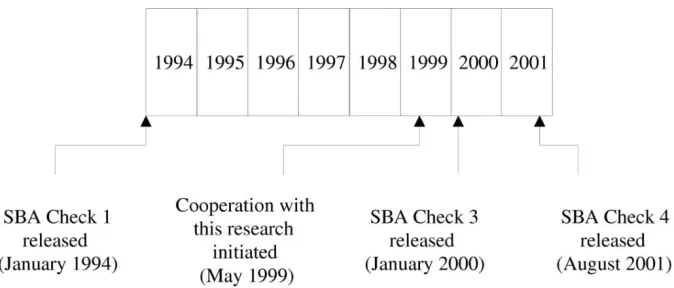
The Swedish Information Processing Society (SIPS) first discharged a device called SBA Check in 19942. This was never broadly utilized since it was not saw to be exceptionally easy to understand, despite the fact that it was magnificent in principle. This form – 1 – concentrated on IT frameworks security, so it was an absolutely different instrument than the present adaptation. In 1999, SIPS had plans to re-examine the device, and this is the place we joined the advancement of SBA Check (figure 5). The after effect of the amendment procedure was an absolutely different instrument now concentrating on
Available online: https://edupediapublications.org/journals/index.php/IJR/ P a g e | 17
stands for 'Sar Barhets Analysis', the Swedish expression for defencelessness examination, and was started in the mid 1980s. Another related and surely understood apparatus and strategy in a similar family is that for hazard investigation called 'SBA Scenario'.
Figure 6: Historical development of SBA Check
This research’s contribution to the
development of SBA Check
As the proprietor of the SBA Methods, the Swedish Information Processing Society started, financed and regulated the correction of SBA Check. Numerous associations and people were engaged with the procedure – from starting thoughts, by means of prerequisites details and programming, to testing and later promoting. As the main scholastic delegate in this gathering of data security specialists and framework designers, we accepted a key part in the improvement of SBA Check. Our particular commitment was the:
• Formulation of the working assessment
standards on which the instrument is as of now based and showing these by methods for a first form of the principle UI, and a primitive working model (see reference section D for points of interest)
• Crafting of the prerequisite detail for the
substance of the apparatus, to be trailed by content deliverers and the software engineers.
• Development and documentation of an
approach for the evaluation process. This technique is made express later in this section.
SBA Check was made as a genuine group effort, and there were numerous different exercises in the improvement of the product instrument that are not recorded here.
The assessment approach
Introduction to the assessment approach
Available online: https://edupediapublications.org/journals/index.php/IJR/ P a g e | 18
security related strategies and methods. Basic specialized security instruments are likewise evaluated.
The rationality behind the SBA Check apparatus
and this approach is simplicity and efficiency. The product device will manage the client through the assessment by soliciting a set from bespoke inquiries, each speaking to potential data security controls (countermeasures). The approach brings about a depiction see with respect to the data security situation in the broke down association. This approach additionally distinguishes conceivable changes that would help lessen or take out recognized powerlessness’s. The difference between this
approach and established hazard investigation is that in chance examination the beginning stage is to recognize risk situations that can contrarily affect data resources. At that point one tries to set up the likelihood for a situation to emerge and its conceivable outcomes in money related
terms. When this is done countermeasures are recognized to reduce the distinguished hazard. Utilizing the approach introduced here, the beginning stage is oppositely inverse – it begins with a rundown of countermeasures (alluded to as "controls") that are by and large acknowledged as best practice, and along these lines reasonable for generally associations. By coordinating these controls against the association's business needs and necessities, we wind up with a speedier and more efficient assessment approach. Notwithstanding, there are application ranges where an established hazard examination can be productively utilized additionally inside data security, yet issues with e.g. monetarizing danger and evaluating data resources and marking down money related streams to net present esteems are regularly excessively extraordinary, making it impossible to make it an advantageous exercise.
Overview of the approach
The evaluation approach entails three stages (figure 4):
Initiate
-Analyse
-Report
Available online: https://edupediapublications.org/journals/index.php/IJR/ P a g e | 19
1. Initiate: Set-up the assessment
2. Analyse: Gather data and perform assessment
3. Report: Communicate the discoveries
The accompanying areas will depict each of these phases thusly, and finish up with an exchange about the introduced assessment approach and the related programming instrument.
Stage 1: Initiate
Objective: To assemble a strong establishment for the assessment procedure resulting in a reported assessment design and assertion. Figure 8 demonstrates a review of the start arrange.
Figure 8: Overview of the initiation stage
Expectations
A standout amongst the most imperative issues is to distinguish partners' (customers' or different promoters') desires with respect to the assessment comes about as ahead of schedule and as precisely as would be prudent. By distinguishing and co-building up these desires at the beginning of the assessment, the outcome will probably be seen as significant and valuable. The perfect strategy for distinguishing and co-creating desires differs from circumstance to circumstance. Nonetheless, a meeting face to face with imperative partners to examine the approaching assessment has ended up being an extremely efficient approach to get out any false impressions and to recognize and talk about any verifiable and express desires. Desires can identify with all parts of the evaluation (figure 9). Activity point: Stakeholder desires ought to if conceivable be conceded to and archived in the assessment design and understanding.
Available online: https://edupediapublications.org/journals/index.php/IJR/ P a g e | 20
The reason for the assessment ought to likewise be built up at a beginning period, since this will decide how the assessment in a perfect world ought to be directed. The centre inquiries here are:
• Who will be the recipient(s) of the assessment comes about? • How and for what are they wanting to utilize the discoveries?
Data assembled and examined in the assessment procedure must be in accordance with the general reason for the assessment. For example, the reason oversees the required exactness and accuracy with which the inquiries preferably ought to be replied, and if any sort of check is required or not.
Figure 9: Example of expectations on the evaluation
Case – reason and suggestions for the assessment procedure:
• A customer requests a SBA Check assessment of the data security circumstance in the association.
• The reason for existing is to distinguish current insufficiencies and to pinpoint arrangements that could
be executed to fathom these inadequacies.
• Therefore, potential enhancements should be archived with additional points of interest, so the
Available online: https://edupediapublications.org/journals/index.php/IJR/ P a g e | 21
Activity point: Document the motivation behind the assessment in the assessment design and understanding.
Degree
The extent of the assessment ought to be set up to guarantee that the assessment truly investigations the chose unit of examination. This is particularly critical if the assessment result is to be utilized as a reason for affirmation as indicated by some data security standard, for example, ISO/IEC 17799 ISO (2000). Some regular delimitations of degree include:
• Which IT frameworks and correspondence systems ought to be included in the assessment? (Just those
in-house or additionally outsourced?)
• Which parts of the association ought to be incorporated into the evaluation? (Which geological,
juridical, or utilitarian units? Just the head office? Backups?)
In extensive associations, for instance, it is regular to direct numerous little assessments on authoritative units and afterward accumulate the discoveries. Activity point: Document the extent of the assessment in the assessment design and understanding.
Controls
The last action of the start organize is to build up the arrangement of controls to play out the assessment against. The selection of controls relies upon the greater part of the three past exercises (desires, reason and degree). This is basically picking which agenda to use for the current assessment. SBA Check is conveyed with three arrangements of controls:
• Check
• ISO/IEC 17799
• FA22
Available online: https://edupediapublications.org/journals/index.php/IJR/ P a g e | 22
standard, and FA 22 contains all controls identified with the principles about PC systems security as expressed in the Swedish direction. This control is just appropriate to society-basic frameworks, however may even now be of enthusiasm for a few evaluators.
Most evaluators are probably going to assess against either the 'check' set of controls or ISO/IEC 17799, as they speak to Swedish and worldwide "best practice" (individually) for data security administration. Be that as it may, it is likewise conceivable to embrace a different set of controls to assess against, as there is bolster
for this in the SBA Check programming.
Activitypoint: Record the selection of controls in the assessment design and assertion.
Assessment design and assertion
Partners' desires, assessment reason and scope, and the selection of controls are currently settled. These ought to be recorded in an assessment design and understanding (Figure 10). The goal with such a report is:
• To ensure that stakeholders have a good grasp of what they can expect with regards to the
evaluation results,
• To ensure that all individuals involved in the evaluation in any way understand its purpose
and scope if required,
• To help the evaluator to focus on the agreed scope during the evaluation process, and
• To aid the evaluator’s and stakeholders’ recollections in any discussions and potential
Available online: https://edupediapublications.org/journals/index.php/IJR/ P a g e | 23
Evaluation plan
and -agreement
- Stakeholders expectations - Purpose of the evaluation - Evaluation scope
- List of controls to evaluate against
- Time management issues
Figure 10: Typical contents of an evaluation plan and agreement
Stage 2: Analyse
Available online: https://edupediapublications.org/journals/index.php/IJR/ P a g e | 24
Figure 11: Analysis stage
Accumulate and dissect data: This stage can be exceptionally mind boggling if managing an expansive or geologically scattered association, or if the IT frameworks are extremely perplexing and heterogeneous. Testing is frequently important as it isn't monetarily achievable to, for instance, talk with all clients about their familiarity with the data security approach.
Report current circumstance/Document potential enhancements: Once data is assembled and investigated, the current situation concerning the
current control can be archived in the product instrument. Subtle elements of the present circumstance may incorporate, for example, references to existing data security records and consequences of meetings. Potential enhancements can be founded on either the evaluators' immediate information or be propelled by the prescribed procedures depicted in the apparatus.
Available online: https://edupediapublications.org/journals/index.php/IJR/ P a g e | 25
• Yes, control exists and capacities satisfactorily
• Yes, remunerating control exists and capacities
sufficiently
• No, control not relevant for exceptional reason
• No, control does not exist or does not work
sufficiently
What is satisfactory is a multi-dimensional judgment – it relies upon the association's business, its dependence on data and IT frameworks, and the
apparent efficiency (expenses and advantages) of the introduced control.
Confirm presence and capacity: If one of the initial two options is picked, one can alternatively archive if any check of this has been done, for example, a genuine specialized test, or if the evaluation depends on, for instance, gossip.
Archive explanation behind non-materialness: If the third option is picked – "No, control not relevant for extraordinary reason", at that point this reason must be reported. For instance, an inquiry concerning a firewall shielding the association from dangers by means of the Internet won't not be material to associations and frameworks that are not associated with the Internet by any stretch of the imagination.
Survey level of introduction: If the fourth option is picked, it implies that some sort of shortcoming is recognized. In these cases, one can survey the level of presentation on a scale running from "low" by means of "low" and "high" to "high".
Completed: This was the entire procedure for each control, so now one can begin once again with the following control in line. A normal assessment contains around 100 or so controls, contingent upon the set up set of controls to assess against.
Stage 3: Report
One of the thoughts behind a device like SBA Check is the ability of automatic revealing toward the finish of the assessment. The report generator can sort the assessment result as indicated by any criteria, including level of introduction (to see the vulnerabilities with high hazard first), appraisal choice (to see e.g., all controls that flopped by any stretch of the imagination). What's more, graphical reports can be created with measurements of how the association is getting along in different ranges of data security. It is basic to convey the discoveries face to face to assessment partners, and furthermore to consider the need to keep assessment comes about classified where required.
Discussion and confinements
The device and strategy's part in this examination:
At this stage, SBA Check and the assessment
Available online: https://edupediapublications.org/journals/index.php/IJR/ P a g e | 26
consequently be seen as one method for leading this sort of assessment. Assessment of the assessment instrument and approach. The formal assessment from a client point of view of the apparatus is in the outline stage at this moment. This assessment will be done by methods for a study of every authorized client of the apparatus. In any case, the device is casually tried in two ways as of now:
1. At courses held by the creator of this proposition for data security chiefs: Circa 100 data security supervisors and experts have been going to 2-day courses about the proposed apparatus and its down to earth utilize. The whole course was composed and authorised out by the creator of this theory. Each course was assessed utilizing reviews, and the outcomes were great. In the last course held, 100% of the members assessed the course as "great" or "great". In spite of the fact that this assessment was not about the evaluation approach straightforwardly, it can be viewed as demonstrative of the estimation of the approach since the course was concentrating on this.
2. At genuine assessments in Swedish and International associations: Circa 200 authorized clients of SBA Check utilize the instrument to assess the data security in associations. Once more, this does not imply that the technique and apparatus are great, however it is no less than a sign that associations are anxious to utilize it.
Confinements to the device and assessment
approach
When assessing data security in one way, that decision likewise implies different ways are not picked. Every product apparatus and way to deal with assessment has its advantages, yet additionally its negative sides. These are the most imperative restrictions to this approach:
Money saving advantage investigation not upheld. In SBA Check, financial values are forgotten, so there is no real way to examine the potential expenses and advantages of a current or recommended data security control. As an option, the choice of judging a control as satisfactory or not involves considering the monetary effects on an abnormal state.
Agenda based approach. Methodologies in view of formalized agendas are regularly, and which is all well and good, censured for the firmness and unbending nature inherent in the approach. For instance, a hazard or a danger situation that would require some safety efforts to be viewed as that is excluded in the arrangement of controls recorded in the agenda (or in the assessment database as in SBA Check) can't be recognized and managed. Hence genuine dangers, pundits contend, may be ignored. This is one noteworthy shortcoming of SBA Check and the assessment approach portrayed here. To limit the effect of this shortcoming, we have taken the accompanying measures:
• A assortment of agendas: Three different agendas are
Available online: https://edupediapublications.org/journals/index.php/IJR/ P a g e | 27
more centred around IT frameworks security)
• Open structure: Third gathering engineers can create
and showcase agendas for particular purposes (e.g. a particular Windows XP registration could be utilized for security assessment of a XP based PC arrange)
• End-client adaptability: Each client can, through an
editorial manager incorporated with the product instrument, correct the agendas to suit their condition, organisation, culture, lawful framework, IT foundation, and so on. In this way, we have at least reduced the effects of these serious weaknesses of checklist-based approaches.
References
1. J. Adams. Risk. Routledge, New York NY, USA, 1995.
2. R. Baskerville. Investigating information systems with action research. Communications of the Association for Information Systems, 2(19), 1999. Tutorial.
3. D. Bell and L. LaPadula. Secure computer systems: Mathematical foundations and model. Technical Report M74-244, MITRE Corporation, Bedford MA, USA, 1974.
4. F. Bj¨orck. The economics of information systems security. London School of Economics, Department of Information Systems, 1996.
5. F. Bj¨orck. Information security survey sverige 1997. Technical report, Ernst & Young AB, Stockholm, Sweden, 1997. Based on 541 survey responses from Swedish IT- and Information security managers.
6. F. Bj¨orck. Information security survey sverige 1998. Technical report, Ernst & Young AB, Stockholm, Sweden, 1998. Based on 428 survey responses from Swedish IT- and Information security managers.
7. F. Bj¨orck. Auditing information security management systems - towards a practical method. In
Q. S. and J. Eloff, editors, IFIP/SEC2000: Information
Security - Information Security for Global Information Infrastructures, pages 102–104, Beijing, China, August 2000. International Federation for Information Processing, International Academic Publishers.
8. F. Bj¨orck. Implementing information security management systems - an empirical study of critical success factors. In J. Eloff, L. Labuschagne, R. von
Solms, and G. Dhillon, editors, Advances in Information Security Management & Small Systems Security, pages 197–211, Hingham MA, USA, September 2001a. International Federation for Information Processing, Kluwer Academic Publishers.
Available online: https://edupediapublications.org/journals/index.php/IJR/ P a g e | 28
Security in Organisations. Stockholm University / Royal Institute of Technology, Stockholm, Sweden, 2001b. Licentiate thesis.
10. F. Bj¨orck and L. Yngstr¨om. Ifip world computer congress / sec 2000 revisited. In H. Armstrong and L. Yngstr¨om, editors, WISE 2 - Proceedings of the IFIP TC11 WG 11.8 Second World Conference on In-formation Security Education, pages 209–223, Perth, Australia, July 2001. International Federation for Information Processing.
11. D.Brewer Web site of gamma secure systems limited http://www.gammassl.co.uk, 2000.
12. British Standards Institute. Information security management, part 2: Specification for information security management systems. Technical Report BS 7799-2, British Standards Institute, London, United Kingdom, 1995.
13. British Standards Institute. Information security management, part 2: Specification for information security management systems. Technical Report BS 7799-2, British Standards Institute, London, United Kingdom, 1999.
14. G. Burrell and G. Morgan. Sociological Paradigms and Organisational Analysis. Heinemann, London, United kingdom, 1979.
15. P. Checkland. Systems Thinking, Systems Practice. John Wiley & Sons, Chichester, United Kingdom, 1981.
16. F. Cohen. Viruses, corruption, denial, disruption and information assurance. In L. Yngstr¨om, editor, Information Security - the Next Decade, Proceedings of the IFIP TC11 11th annual working conference on in-formation security, Amsterdam, Netherlands, 1995. Kluwer Academic Publishers.
18. Computer Economics. Computer economics virus impact update. Technical report, Computer Economics, San Diego CA, USA, 2001.
19. Computer Security Institute. Computer crime and security survey. Tech-nical report, Computer Security Institute, San Fransisco CA, USA, 2001.
20. C. Cresson Wood. Using information security to achieve competitive advantage. Journal of Computers and Security, 10:309–404, 1991.