New Robust Adaptive Beamforming Method for Multipath Coherent
Signal Reception
Min Tang*, Dong Qi, Chengcheng Liu, and Yongjun Zhao
Abstract—In this paper a novel robust beamforming method is devised to receive multipath signals
effectively. The new algorithm constructs a transformation matrix derived through high-order angle constraint to suppress the interferences with the directions of arrival (DOA) of interference signals. Using the transformed data, the composite steering vector of the multipath signals is estimated as the principal eigenvector of the signal subspace, and then is utilized in minimum variance distortionless response (MVDR) beamforming to compute the optimal weight vector. The new algorithm is improved in robustness to DOA error by forming wide nulls in incident directions of the interferences, and keeps effective in the presence of coherent interferences. Simulations analyses are provided to illustrate the robustness and effectiveness of the new beamformer.
1. INTRODUCTION
Adaptive beamforming technique, which implements adaptive enhancement of the desired signal and suppression of the interferences and noises, has been utilized in numerous domains [1, 2]. In filed engineering, the presence of coherent signals always causes rank-deficiency of the covariance matrix which leads to signal cancellation in conventional adaptive beamformers [3, 4]. Common in practice, multipath propagation is one of the main causes of coherent signals, which implies that the received data contain direct, reflected and refracted of the desired signal. Meanwhile interference on the same frequency is the other main source of the coherent interferences. To eliminate the signal cancellation, varieties of beamforming techniques are proposed, most of which regard the multipath signals as interferences to be suppressed, such as spatial smoothing [5, 6], Toeplitz matrix reconstruction [7], and Duvall algorithm [8, 9]. However from another perspective, multipath signals all contain useful information of the desired signal to be exploited [10]. So theoretically, an effective receiver should combine the desired signals from different paths to maximize the output signal to interference plus noise ratio (SINR) [11]. Related studies have been developed in recent years that are summarized below.
So far most of the multipath beamforming algorithms assume that the incident directions of signals from each path are obtained as prior information. A linearly constrained minimum variance (LCMV) beamforming technique based on complex vector estimation has been proposed in [12]. In this algorithm the complex envelope vector is computed with the directions of arrival (DOA) of multipath signals which have been estimated already. Then the optimum beamforming is performed with the LCMV principle. In [13], a main-lobe-amplitude-constraint based adaptive beamforming algorithm has been introduced. Using the DOAs of multipath signals, this technique optimizes the received data covariance matrix with uncertainty set and the main lobe amplitude constraint is applied in the computation of the optimal weight vector. Both of these algorithms rely on the DOA prior information of the multipath
Received 7 October 2018, Accepted 26 December 2018, Scheduled 8 January 2019 * Corresponding author: Min Tang ([email protected]).
signals, making them sensitive to the angle error. In engineering, the exact incident directions of all the multipath signals are generally unavailable, which limits the application of these techniques. Different from the former ones, the algorithm in [14] estimates the DOAs of multipath signals through the maximum likelihood technique with DOA of the desired signal. The iterative quadratic maximum likelihood (IQML) algorithm is utilized to deduce the orthogonal projection matrix of all incident signals. On this basis, the estimation values of DOAs of multipath signals are drawn, after which the optimal weight vector is computed via the minimum mean square error (MMSE) beamformer. However, this method suffers from high computational complexity and fails in the presence of coherent interferences. On the other hand, a three stage blind beamforming method for receiving multipath signal has been developed in [15]. Firstly the covariance matrix of the coherent signals is constructed with the received signals. Then the composite steering vector of the coherent signals is estimated based on the theorem that the composite steering vector of the multipath signal is orthogonal to its noise subspace. Finally the optimum beamforming is performed through the minimum variance distortionless response (MVDR) principle. This method does not require the DOAs of multipath signals, but the output SINR is low, which is caused by the low accuracy in the estimation of composite steering vector. In [16] the scholars proposed an eigenspace based multipath signal beamforming method. Assuming that the DOA of direct signal is known, the algorithm estimates the direct wave of the desired signal by spatial smoothing technique. Then the cross-correlation between it and the received signals is computed, with which the MMSE beamformer is applied to obtain the optimum weight vector. This method needs less prior information of incident directions but its robustness is low. Moreover, the algorithms above cannot suppress the coherent interferences.
To solve the problems in the existing methods, a new beamformer for multipath signal reception based on high order angle constraint is proposed in this paper. In general, it is more difficult and computationally expensive to estimate the incident directions of coherent signals than the uncorrelated signals which can be realized by conventional methods [17]. So in this technique the DOAs of the interferences are assumed to be obtained in advance. In order to form wide nulls in the incident directions of interferences, firstly a transform matrix is constructed based on high order angle constraint with the principle that the interferences are suppressed with low distortion of the multipath signals. In an ideal case the transformed signals only consist of multipath signals and Gaussian noise. So through eigen-decomposition of its covariance matrix, the composite steering vector of the multipath signal is estimated as the eigenvector corresponding to the maximum eigenvalue. Finally the optimum beamforming is performed by MVDR beamformer with the estimated composite steering vector. The new method is improved in robustness of angle error and is able to suppress coherent interferences.
2. DATA MODELING AND MVDR BEAMFORMING
Consider a uniform linear array composed of M identical sensors, on which P narrowband coherent signals andQnarrowband uncorrelated plane waves impinge at thetth time instant. Despite the array error caused by element coupling and channel uncertainty, the output of the beamformer can be written as
y(t) =wHx(t) (1)
where{·}H represents the complex conjugate transpose, andw= [w1, w1, . . . , wM]T is the array weight
vector. y(t) denotes the output signal of the array, while x(t) is the M ×1 received signal vector. In addition,x(t) can be expressed as the superposition of the signals
x(t) =
P
p=1
βpa(θp)sd(t) + Q
q=1
a(ϕp)sq(t) +n(t) (2)
where sd(t), sq(t), q = 1,2, . . . , Q and n(t) indicate the direct wave of the desired signal, the qth
uncorrelated interference and white Gaussian noise, respectively. Moreover, βp, p = 1,2, . . . , P is the
complex coefficient of thepth coherent signal. θp,p = 1,2, . . . , P and ϕq, q = 1,2, . . . , Qrepresent the
DOAs of coherent signals and uncorrelated interferences respectively. a(θ) = [1,2, . . . ,exp(−j2π(M −
1)ρsinθ)]T is used to illustrate the steering vector of signal from incident direction θ with ρ = d
λ, in
For simplification, β = [β1, β2, . . . , βP]T is used to denote the matrix of the complex coefficient
vectors of multipath signals, resulting in
x(t) =Adsd(t)β+AIsI(t) +n(t) (3)
where sI(t) = [s1(t), s2(t), . . . , sQ(t)]T is the matrix of data vectors of the uncorrelated interferences. Ad = [a(θ1), a(θ2), . . . , a(θP)] and AI = [a(ϕ1), a(ϕ2), . . . , a(ϕQ)] indicate the matrices of steering
vectors of the multipath signals and interferences respectively.
Rx(t) =E[x(t)xH(t)] =σ2dAdββHAHd +AIRIAHI +σ2nIM (4)
is the covariance matrix of x(t) with RI = E[sI(t)sHI (t)] the covariance matrix of uncorrelated
interferences. In addition, σd2 = E[sd(t)sHd(t)] is the power of the direct wave of the desired signal, σn2 the power of Gaussian white noises, and IM theM×M identity matrix. UsingRI+n to denote the
covariance matrix of interference plus noise, it can be written as
RI+n=E[x(t)xH(t)] =AIRIAHI +σn2IM (5)
Inspired by this, the output synthetic signal of multipath signals to interference plus noise ratio is
SINR = w
Hσ2
dAdββHAHdw
wHRI+nw (6)
The problem of maximizing the output SINR is equivalent to the constraint model below
minwHRI+nw s.t. wHas= 1 (7)
whereasis the composite steering vector of multipath signal. With the MVDR beamforming technique,
the optimal weight vector is obtained as
w= R
−1
x as
aH
s Rx−1as
(8)
In practical engineering, the covariance matrix Rx can be estimated as follows with data of L
snapshots
ˆ
Rx=
1
L L
t=1
x(t)xH(t) (9)
According to Eq. (8), the optimal weight vector is
w=
ˆ
R−x1as
aH
s Rˆx−1as
(10)
3. PROPOSED APPROACH
3.1. The New Algorithm
In the absence of coherent interferences, the estimated value of the incident direction of the qth uncorrelated interference is denoted as ˆϕq, q= 1,2, . . . , Q. The corresponding steering vector isa( ˆϕq),
making ˆAI = [a( ˆϕ1), a( ˆϕ2), . . . , a( ˆϕQ)] the matrix of steering vectors of the uncorrelated interferences.
Denote the transformation matrix as T. To suppress the interferences in the received signal and reduce the distortion of multipath signals in the meantime, the construction of T can be transformed into the following optimization problem based on angle constraint
minE[T x(t)−x(t)2] s.t. TAˆI = 0 (11)
where · represents the Euclid norm of the vector, and 0 is a M ×Q zero matrix. To suppress the interference with low estimation accuracy of ˆϕq effectively, the derivative constraint could be applied to
widen the nulls. So the new constraint matrix is written as
wheredAˆI = [dad( ˆϕˆϕ11),
da( ˆϕ2)
dϕˆ2 , . . . ,
da( ˆϕQ)
dϕˆQ ]. Inspired by this, the angle constraint model in Eq. (11) changes
into
minE[T x(t)−x(t)2] s.t. T BI= 0 (13)
With analysis of the objective function, the following formula is derived
E[T x(t)−x(t)2] =σd2T as−as2+σn2tr[(T −IM)(T −IM)T] + tr[AIsI(t)AHI ] (14)
Since tr[AIsI(t)AHI ] does not involve the transformation matrix T, the objective function is
transformed into
minσd2T as−as2+σn2tr[(T −IM)(T −IM)T] (15)
Using the Lagrange multiplier method to solve the optimization problem, the following conclusion is drawn
T =IM −BI(BIHRx−1BI)−1BIHR−x1 (16)
With estimation of the sample covariance matrix in Eq. (9), T is written as
T =IM −BI(BIHRˆx−1BI)−1BIHRˆ−x1 (17)
The covariance matrix of the transformed signal is
Rxt=E[T x(t)xH(t)TH] =T E[x(t)xH(t)]TH =T RxTH (18)
In the presence of coherent interferences, the algorithm above is still effective in multipath signal beamforming if the rough estimation of the incident directions of the coherent interferences is available. It is assumed that there exist K multipath signals in the P coherent signals, and the remaining P −K ones are coherent interferences. ˆθp, p = K + 1, . . . , P −K denotes the estimated
DOAs of the coherent interferences, so the matrix of steering vector of the interferences is written as ˆ
AII = [a(ˆθK+1), . . . , a(ˆθP), a( ˆϕ1), . . . , a( ˆϕQ)]. Construct the new constraint matrix
BII = [ ˆAII, dAˆII] (19)
and solve the new optimization problem with Lagrange multiplier method similarly.
T =IM −BII(BIIHRˆx−1BII)−1BIIHRˆ−x1 (20)
is obtained, with which the coherent interferences and the uncorrelated interferences are suppressed. The study above proves that the transformation can achieve an effective blocking of the interferences. As a result, the processed signals mainly consist of the multipath signals and white Gaussian noise. So if eigen-decomposition is adopted to the covariance matrix of the transformed signals, the eigenvector that corresponds to the largest eigenvalue could be regarded as the principal eigenvector of the signal subspace, which means it can be used as an estimation of composite steering vector of multipath signal.
Eigen-decompose the covariance matrixRxt
Rxt=
M
i=1
λiuiUiH (21)
whereλi,i= 1,2, . . . , M is theith eigenvalue ofRxt, andλ1> λ2 ≥. . .=λM =σ2n. ui denotes theith
eigenvector corresponding to λi. So the composite steering vector is estimated as ˆas =u1. Substitute
ˆ
as into Eq. (10) and the optimal weight vector is
wopt=
ˆ
R−1
x ˆas
ˆ
aH
s Rˆx−1aˆs
(22)
To conclude, the procedure of the algorithm is as follows:
(2) i) In the absence of coherent interferences, use the DOAs of uncorrelated interference signals to construct the matrix of steering vectors BI, and calculate the transformation matrix T. ii) If the
received signal contains coherent interference, then construct the matrix of steering vectors BII,
and calculate the transformation matrix T.
(3) Preprocess the received signal with the transformation matrix, and compute the covariance matrix
Rxt that only consists of multipath signals and noises.
(4) Eigen-decompose the matrixRxt, and estimate the composite steering vector ˆas as the eigenvector u1 corresponding to the largest eigenvalueλ1.
(5) Calculate the optimal weight vectorwoptwith the sampling covariance matrix ˆRxand the estimation
of composite steering vector ˆas.
3.2. Computational Complexity Analysis
According to the theoretical derivation, the proposed method could be divided into three parts: transformation matrix construction, composite steering vector estimation and the MVDR beamforming. In this section, the computational complexity is measured by the amount of complex multiply (CM). Firstly the computational complexity in calculating the sample matrix is O(LM2), where L and M
denote the number of snapshots and array elements. The computational complexity in transformation matrix construction is O((M +P +Q)3), whereP and Qdenote the number of coherent interferences
and uncorrelated interferences respectively. As for the estimation of composite steering vector, as it is completed by eigen-decomposition, the computational complexity is O(M3). And the computational complexity of MVDR beamforming isO(3M3+M2+M). Therefore the total computational complexity of the proposed method is O(4M3+ (3P+ 3Q+L+ 1)M2+ (3(P +Q)2+ 1)M + (P +Q)3). Table 1 demonstrates the computational complexity of the three algorithms, where m denotes the number of sub-arrays in the eigen-based beamformer.
Table 1. Computational complexity of the algorithms.
Algorithm Computational Complexity in CM LCMV O(2(M)3+ (P+Q)M2+ (P+P2)M+P3)
Eigen-based O((m+ 1)(M)3+ (P+Q+m+ 1)M2+ (m2−m3)M+ 3m3+m2+m) Proposed O(4M3+ (3P + 3Q+L+ 1)M2+ (3(P +Q)2+ 1)M+ (P +Q)3)
With the table above, it is known that the LCMV beamformer is not computationally expensive at the cost of lower beamforming performance. Since the eigen-based beamformer is realized with sub-array technique, it is deduced from the forward and backward spatial smoothing that m >3(P +Q+ 1)/2. As a result the computational burden of the proposed method falls in between those of the two former beamformers.
4. SIMULATION RESULTS
Simulations are proposed in this section to evaluate and contrast the beamforming performance with the LCMV algorithm in [12] and eigen-based algorithm in [16]. Consider a uniform linear array composed of 16 sensors (M = 16). One desired signal, two coherent signals and two uncorrelated interferences are presented at [10◦,−30◦,40◦,−50◦,60◦] respectively. The complex correlation coefficient vector is
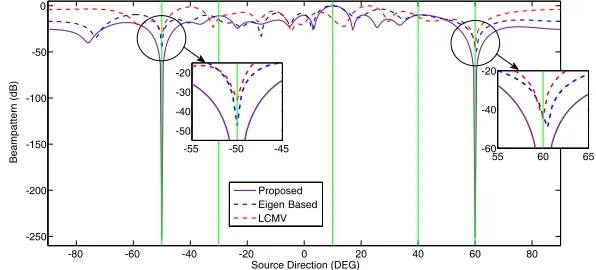
Example 1: In this example the beam pattern of the three algorithms under different interference circumstances is simulated. Firstly regard the two coherent signals as multipath signals, and the simulated beam pattern is shown in Fig. 1; then regard the coherent signal at −30◦ as multipath signal while the coherent signal at 40◦ as coherent interference, and the simulated beam pattern is shown in Fig. 2. In addition, the null depth of all interferences on different conditions is summarized in Table 2 and Table 3 to compare the effectiveness of algorithms in interferences suppression.
-80 -60 -40 -20 0 20 40 60 80
-250 -200 -150 -100 -50 0
Source Direction (DEG)
Beampattern (dB)
Proposed Eigen Based LCMV
-55 -50 -45
-50 -40 -30 -20
55 60 65
-60 -40 -20
Figure 1. Beam pattern in the absence of coherent interference.
-80 -60 -40 -20 0 20 40 60 80
-250 -200 -150 -100 -50 0
Source Direction (DEG)
Beampattern (dB)
Proposed Eigen Based LCMV -55 -50 -45 -40
-30 -20
35 40 45
-40 -20 0
55 60 65
-50 -40 -30 -20 -10
Figure 2. Beam pattern in the presence of coherent interference.
Figure 1 indicates that when the received signal contains no coherent interferences, all the three algorithms can achieve effective beamforming. LCMV algorithm forms nulls at the directions of uncorrelated interferences, but its main lobe shifts resulting in low gain of the direct wave signal. Eigen-based algorithm is able to form gain peaks at the DOAs of multipath signals, but its gain of side lobe is relatively high. For the proposed technique, the main lobe is at the direction of the direct wave and it has higher gains of the multipath signals with lower gain of the side lobe.
In Fig. 2 it is obvious that in the presence of coherent interferences, LCMV algorithm and eigen-based algorithm are still able to enhance the multipath signals, but they fail to suppress the coherent interferences, which means they are invalid. Compared with the two beamformers, the proposed technique can still keep its effectiveness, forming a wide null at the DOA of coherent interference, which verifies its effectiveness in suppressing coherent interferences.
Table 2. Null depth of the interferences in the absence of coherent interference.
DOA Null depth of LCMV Null depth of Eigen-based Null depth of the proposed
−50◦ −33.89 dB −47.22 dB −253.20 dB 60◦ −44.40 dB −43.36 dB −251.30 dB
Table 3. Null depth of the interferences in the presence of coherent interference.
DOA Null depth of LCMV Null depth of Eigen-based Null depth of the proposed
−50◦ −32.16 dB −35.17 dB −251.40 dB 40◦ −17.54 dB −14.53 dB −214.80 dB 60◦ −33.65 dB −38.34 dB −239.10 dB
error can be drawn, which is further simulated in Example 3.
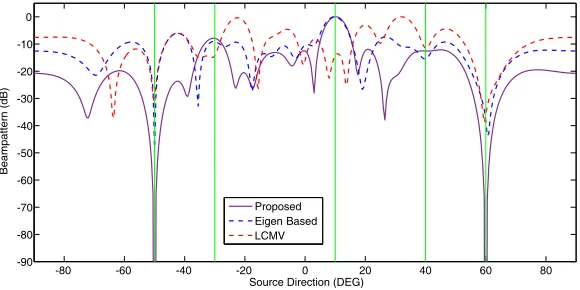
Example 2: This example considers the influence of different SNRs of the multipath signals. In
Fig. 3, we set SNR of the direct wave signal at 10 dB, and SNR of the other multipath signals at 5 dB. Then change the SNR of the direct wave to 5 dB, and SNR of the multipath signal impinging from−30◦ to 10 dB. And the beam pattern is obtained in Fig. 4.
-80 -60 -40 -20 0 20 40 60 80
-90 -80 -70 -60 -50 -40 -30 -20 -10 0
Source Direction (DEG)
Beampattern (dB)
Proposed Eigen Based LCMV
Figure 3. Beam pattern with strong direct wave signal.
-80 -60 -40 -20 0 20 40 60 80
-90 -80 -70 -60 -50 -40 -30 -20 -10 0
Source Direction (DEG)
Beampattern (dB)
Proposed Eigen Based LCMV
Ignoring the LCMV beamformer whose main lobe still shifts, with the comparison of Fig. 3 and Fig. 4 it is noticed that the main lobe of the eigen-based beamformer is always at the DOA of direct wave signal while the main lobe of the proposed beamformer is at the incident direction of the multipath signal with the highest input SNR. This is because the beamforming in eigen-based algorithm is completed with the steering vector of the direct wave signal. However, for the proposed method, the new beamformer utilizes the estimated composite steering vector of the multipath signals obtained by eigen-decomposition. The higher SNR, the more the multipath signal contributes to the composite steering vector. So the gain of the stronger multipath signal is higher than that of the direct wave. And this characteristic could be made use of to improve the output performance when there exists strong multipath signals caused by reflection to achieve higher output SINR.
Example 3: In this example the performance of the proposed algorithm is investigated with
different DOA errors. For the proposed technique, vary the DOA error of interferences from 0◦ to 3◦; for the other two algorithms, vary the DOA error of the direct wave signal from 0◦ to 3◦ without changing other simulation conditions.
0 0.5 1 1.5 2 2.5 3
-30 -20 -10 0 10 20 30 40
DOA Error (DEG)
Output SNR (dB)
Proposed Eigen Based LCMV
Figure 5. Output SINR versus the error of DOA.
Figure 5 shows that the output SINRs of LCMV and eigen-based beamformer are lower than that of the proposed technique and decrease rapidly as the DOA error increases. However, for the presented algorithm, when the DOA error is small the output SINR remains nearly constant. With increase of the estimation error, the decrease of SINR of the proposed method is small confirming its improved robustness to DOA error. The conclusion is identical to the theoretical analysis and the simulation result in Example 1.
Example 4: In this example the performance of the proposed algorithm is investigated with
different input SNRs. Set the estimation error of DOA at 0◦ with the two coherent signals as multipath signals and vary the SNR of the desired signal from 5 dB to −15 dB without changing other simulation conditions.
In Fig. 6, the consequence indicates that the output SINR of LCMV beamformer is the lowest and almost stays constant with the increase of input SNR. For eigen-based beamformer, the output SINR increases with the increase of input SNR, and barely changes after the SNR is above 12 dB. Differently, the proposed technique could keep high output SINR because the beamformer forms higher gains at the directions of reflection and refraction of the direct wave when the SNR of the desired signal is low. Moreover when the SNR is above 5 dB, the output SINR increases. The result confirms the conclusion in Example 3 that the output performance of the presented method is better as its output SINR is higher on the most conditions.
Example 5: In this example the performance of the proposed algorithm is investigated with
different numbers of snapshots. Set the estimation error of DOA at 0◦ with the two coherent signals as multipath signal. Vary the number of snapshots from 1 to 2×10⁵ without changing other simulation conditions.
-55 0 5 10 15 20 10
15 20 25 30 35 40 45 50 55
Input SNR (dB)
Output SNR (dB)
Proposed Eigen Based LCMV
Figure 6. Output SINR versus input SNR of the desired signal.
101 102 103 104 105
-10 -5 0 5 10 15 20 25 30 35
Number of Snapshots
Output SNR (dB)
Proposed Eigen Based LCMV
Figure 7. Output SINR versus the number of snapshots.
proposed beamformer is lower than that of the eigen-based method under scenario of small snapshots as the estimation accuracy of the sample covariance matrix is low under scenario of small snapshots. However, as the number of snapshots increases, the SINR curve of the new method has fast convergence and larger steady value. The eigen decomposition in the proposed algorithm improves its convergence.
5. CONCLUSION
In engineering, multipath propagation is an inevitable problem for array signal processing. In order to make full use of the signal source related information from different paths, a robust beamforming method for multipath signal reception is proposed in this paper. Based on the knowledge that the incident directions of the uncorrelated signals are easier to obtain, the proposed approach constructs a high order angle constraint model to form wide nulls at the direction of interferences, which improves the robustness to DOA estimation error. In addition this method achieves a significant improvement over the existing algorithms in its ability of suppressing coherent interferences with better output performance. Simulation results have demonstrated the effectiveness of the new method.
ACKNOWLEDGMENT
REFERENCES
1. Gabriel, W. F., “Adaptive arrays: An introduction,” Proceedings of the IEEE, Vol. 64, No. 2, 239–272, 2005.
2. Hang, R. and R. C. Lamare, “Robust adaptive beamforming based on low-rank and cross-correlation techniques,” IEEE Trans. Signal Process., Vol. 64, No. 15, 3919–3932, 2016.
3. Anu, Y. and M. Wax, “Performance analysis of the minimum variance beamformer,”IEEE Trans. Signal Process., Vol. 44, No. 4, 938–947, 1995.
4. Bresler, Y., V. U. Reddy, and T. Kailath, “Optimum beamforming for coherent signal and interferences,”IEEE Trans. Acoust Speech and Signal Process., Vol. 36, No. 6, 833–843, 1988. 5. Liu, C. L. and P. P. Vaidyanathan, “Remarks on the spatial smoothing step in coarray MUSIC,”
IEEE Signal Process. Lett., Vol. 22, No. 9, 1438–1442, 2015.
6. Zhang, L. and W. Liu, “Robust beamforming for coherent signals based on the spatial-smoothing technique,”Signal Process., Vol. 92, No. 11, 2747–2758, 2012.
7. Zhan, X., X. Liu, and H. Yu, “Improved MUSIC algorithm for DOA estimation of coherent signals via toeplitz and fourth-order-cumulants,”Russian Academy Sciences Sbornik Mathematics, Vol. 200, No. 11, 3–14, 2015.
8. Widrow, B., K. Duvall, and R. Gooch, “Signal cancellation phenomena in adaptive antennas: Causes and cures,”IEEE Trans. Antennas and Propagation, Vol. 30, No. 3, 469–478, 2003. 9. Choi, Y. H., “Adaptive nulling beamformer for rejection of coherent and noncoherent interferences,”
Signal Process., Vol. 92, No. 2, 607–610, 2012.
10. Setlur, P., M. Amin, and F. Ahamd, “Multipath model and exploitation in through-the-wall and urban radar sensing,” IEEE Trans. Geoscience and Remote Sensing, Vol. 49, No. 10, 4021–4035, 2011.
11. Leigsnering, M., M. Amin, and F. Ahamd, “Multipath exploitation and suppression for SAR imaging of building interiors: An overview of recent advances,” IEEE Signal Process Magazine, Vol. 31, No. 4, 110–119, 2014.
12. Zhang, L., H. C. So, and L. Ping, “Adaptive multiple-beamformers for reception of coherent signals with known directions in the presence of uncorrelated interferences,”Signal Process., Vol. 84, No. 10, 1861–1873, 2004.
13. Wu, R. F., Y. Q. Jing, and Z. Liu, “Robust adaptive beamforming algorithm for multiple coherent signals reception,” Journal of Signal Process., Vol. 30, No. 4, 470–476, 2014.
14. Zhang, L., H. C. So, and L. Ping, “Adaptive multiple-beamformers for reception of coherent signals with known directions in the presence of uncorrelated interferences,”Signal Process., Vol. 84, No. 10, 1861–1873, 2004.
15. Deng, J. H. and J. L. Xie, “A blind beamforming method for receiving coherent signals,” Radar Science and Technology, Vol. 13, No. 6, 567–571, 2015.
16. Wang, C., J. Tang, and Y. Wu, “Eigenspace-based beamforming technique for multipath coherent signals reception,” Signal Process., Vol. 128, 150–154, 2016.