Development of E-Scholarship System
Mohammed Abdullahi Jibrin#1, Muhammad Ndagie Musa*2, Shittu Tahir#3
Dep’t of Computer Science, Dep’t of Computer Science, Dep’t of Computer Science, Federal College of Education, Federal College of Education, Federal College of Education,
Kontagora, Nigeria. Kontagora, Nigeria. Kontagora, Nigeria.
Abstract— Scholarship is a critical tool to facilitate education for eligible students, especially those who are socially and economically challenged in the state, and bring them on to the mainstream development track. Niger State Scholarship Board processes large amount of scholarship applications every year. Processing these applications is always time-consuming and prone to errors due to their current paper-based system of processing. In this paper, an e-Scholarship System was designed and implemented in order to allow students of Niger state indigene across the country apply for scholarship online with the Niger State Scholarship Board. The system was designed Using Object Oriented Analysis and Design (OOAD) methodology. The application was developed using Hypertext pre-processor (PHP), AJAX, JavaScript, Hyper Text Mark-up Language (HTML) as the front end and MySQL database as the backend. The E-scholarship system provides online application solutions that save time, and sends notifications using SMS alerts and emails on the progress of application in a timely and transparent manner.
Keywords— Scholarship, Application, E-Scholarship, Scholarship Application
I. INTRODUCTION
Supporting education through scholarships to students of higher learning is an important aspect of government’s effort to assist students at all levels of learning to allow them afford the basic needs that accrue during their studies. It’s a government plan to develop a critical mass of professionals who would serve as catalysts of change and agents of scientific and technological advancement, as well as sustainable economic development. However, the cost of education has risen drastically over the past few years hindering the families of low income earners to send their children to school as they can barely afford the cost. Scholarship as defined by [1] is a grant or payment made to support a student's education, awarded on the basis of academic or other achievement. Many scholarships are awarded based on merit. However, some also take into account financial need. Scholarships do not have to be repaid. As a result, Niger State Scholarship Board invites applications from qualified candidates for sponsorship of outstanding students at undergraduate and postgraduate studies levels as part of it effort to develop professionals who would serve as catalysts of change and agents of scientific and technological advancement. Currently, the procedures of applying for scholarships, managing scholarship and evaluating application forms at Niger State Scholarship Board are all done manually using paper-based processing. Applicants have to fill out their application forms and submit them manually to the office. If there is any problem with their applications while they are processed, it will also take an extra time for both the reviewing committee as well as the applicant to
communicate and correct the errors. Therefore, additional paperwork for the review may cause a delay in the entire procedure. The processes of screening the applicant’s credentials, evaluation of applicant’s form, conducting aptitude test and oral interview are also tedious. This informed the development of an online web-based system (e-scholarship system) which can facilitate the processes of various scholarship applications..
II. REVIEW OF RELATED LITERATURE
increase the efficiency of a community college scholarship program. The research was developed in response to a desire to increase numbers of scholarship applications from students and to streamline the selection and financial reconciliation processes at the research site. Data was gathered through surveys, interviews, and observations. The data analysis suggests that passive information on the part of colleges, lack of student confidence in qualifications, and lack of student awareness of the differences in scholarship criteria are significant contributing factors leading to low rates of application. Data related to recipient selection processes show that committee training, the use of multiple reviewers, and the use of consistently-applied scoring rubrics increase selection efficiency. Results suggest further research possibilities to determine the extent to which various scholarship marketing strategies, and the manner in which individual scholarship criteria are presented, influence application rates. Further research is suggested to determine the factors influencing student confidence and motivation related to scholarship application. Similarly, [8] conducted a study at a Canadian university to determine the effects of aid in conjunction with academic support on retention from one year to the next. Using an experimental design, the researcher randomly assigned a sample of 650 first-year students to one of three groups: (a) students receiving a large scholarship in Year 2 if they met designated academic performance outcomes; (b) students receiving extensive academic support and tutoring services; and (c) students who were offered both. A remaining group of first-year students who received none of the three offers served as a control group against confounding variables. The findings showed that although the financial incentive alone served as a better motivator for persistence than academic support alone, students receiving both offers persisted as the highest rate. The fact that the financial intervention in this study was merit-based and not need-based in nature suggests that money simply served as a catalyst for students already possessing the skills necessary to perform in college. However, the study does not contribute to the argument that academic performance plays a key role in student persistence patterns.
In addition, [9] develops “An Online Scholarship Application System” for a foundation at University of Wisconsin-La Crosse. The foundation deals with a large number of scholarship applications as the foundation uses paper-based processing. In order to automate the task performed by this foundation, a re-engineering approach named “Evolutionary Re-engineering Approach” was used to identify all critical functionalities from the existing system. This evolution focuses on replacement in which portions of the existing system is substituted for re-engineered system portions. The system was developed under java development platform using java in the business logic layer, JSP in the presentation layer and Oracle 10g Express Edition in the database layer. It was run under IIS application server.
Some basic applications areas like e-exams that are related to E-scholarship System were also reviewed. In a paper titled "An Arabic Web-Based Exam Management System" [10] proposed a web based online examination
system. The system helps to carry out examination and auto-grading for students exams. The system facilitates conducting exams, collection of answers, auto marking the submissions and production of reports for the test. It supports many kinds of questions. It was used via Internet and is therefore suitable for both local and remote examination. The system could help lecturers, instructors, teachers and others who are willing to create new exams or edit existing ones as well as students participating in the exams. The system was built using various open source technologies AJAX, PHP, HTML and MYSQL database are used in this System. An auto-grading module was generalized to enable different exam and question types. The System was tested in the Mansoura university quality assurance center. The test proved the validity of using this kind of Web Based Systems to evaluate students in the institutions with high rate of students. Another model was Proposed by [11] for e-Examination in Nigeria where all applicants are subjected to online entrance examination as a way of curbing the irregularities as proposed by the Joint Admissions Matriculation Board (JAMB), the body saddled with the responsibility of conducting entrance examinations into all the Nigerian universities. This model was designed and tested in Covenant University, one of the private universities in Nigeria. Their findings revealed that the system has the potentials to eliminate some of the problems that are associated with the traditional methods of examination such as impersonation and other forms of examination malpractices..
III. METHODOLOGY
The idea of developing an e-scholarship system was born out of the fact that the methodologies of the existing system is a manual process hence the adoption of a new system to help the scholarship board better manage its processes of application and awarding scholarship which makes it possible for applicants to apply for scholarship anytime, anywhere and receive feedbacks with the use of their internet enabled devices.
A. Problems Identified With the Existing System
Paper-based method is what is used in the entire procedures of applying for scholarships and managing scholarship applications. This manual method is faced with the following challenges:
Waste of time: A proper evaluation of the paper-based processing method currently in use reveals that lots of time is wasted during the processes involved in processing student’s application. This includes the communication between various parties (applicant, screening committee members and committee chairman) which involve a lot of paper work. Sometimes, an error in the application may cause the paper to be sent back to the previous processing step which may further delay the processing of the application.
in the entire process of awarding the scholarship and disbursement of funds to beneficiaries.
Fraud: There is also the case of fraud whereby some unscrupulous staff of the board guarantee that they can get the scholarships for the applicants or award them scholarship in exchange for an advance fee. With these, many applicants have fallen victims of these corrupt officials. Paying no attention to all these problems could sabotage the effort of government to support professionals and outstanding students in the state.
After the analysis of the existing system was conducted; problems in the existing system were identified and use the information to design a new system. Object Oriented Analysis and Design (OOAD) methodology was employ and Unified Modeling Language (UML) tools are used in the analysis to show specifications for the proposed system..
B. Analysis of the Proposed System
The software development approach that has been employed for this project is the Object-Oriented Analysis and Design (OOAD) methodology. After careful analysis of the user requirements the following application scenarios that would be handled by the system were identified.
1) Student/Applicant log in to the website to create an account. Log in with account details, upload passport, fill the application form and upload qualifications. The
applicants also can view feedback to enable her/him know the progress of their applications
2) Admin Officer Log in to website, the officer verifies the documents uploaded by each applicant. The officer view the evaluation report of applicant; can carry out shortlisting of qualified applicants and sends invitation for interview. The Admin officer also sends a notification to qualified applicants via email and SMS on their success and the award of the scholarship. The officer generates reports e.g. list of shortlisted candidate for interview.
3) The System Administrator log in using his user name and password. The administrator configures the system and places various measures for updating the system and maintenance of the server. He creates log in for Admin Officer and always initiate backup for the system.
C. Design of the Proposed System.
System design describes how the proposed system will operate. Unified Modeling Language (UML) tools are used in the system design. The tools used include Use case, class and sequence diagrams.
1) Use Case Diagram: A use case diagram is a diagram that shows the relationships among actors and use cases within a system. Below is the use case diagram of the system.
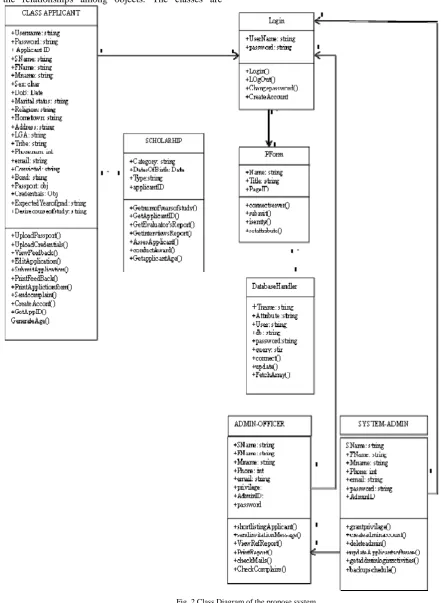
2) Class Diagram: A class diagram in the Unified Modelling Language (UML) is a type of static structure diagram that describes the structure of a system by showing the system’s classes, their attribute, operations (or method), and the relationships among objects. The classes are
analyzed below with the aid of a class diagrams. The class diagram shows the major components of the classes. In the object modelling, the attributes and method (actions) are discussed and represented in the diagram.
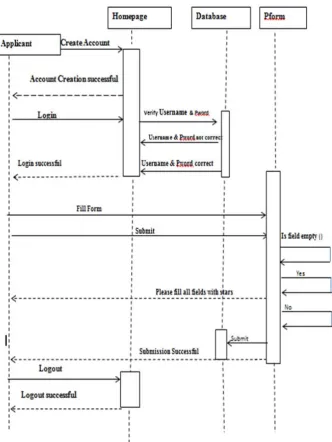
3) Sequence Diagram: Sequence diagrams are often used to illustrate the processing described in the use case scenarios. They can be used to illustrate a succession of interactions between classes or object instances over time. In practice, sequence diagrams are derived from use case analysis and are used in systems design to drive the
interactions, relationships, and methods of the objects in the system.
4) System Architecture: The architecture of the system design is a three-tier. The tiers are presentation tier, middle tire, and data tier. Figure 4 shows the System Architecture.
Fig. 3 Sequence Diagram of the Propose System
D. Implementation
This is the stage where all the system designs were implemented, before our new system was fully implemented, the new system procedures were thoroughly tested. Individual parts was checked and accepted the process of preparation called conversion plan is followed where placing the new system into operation began. The operation strategy used was Parallel conversion. Parallel conversion involves the concurrent use of both the old and
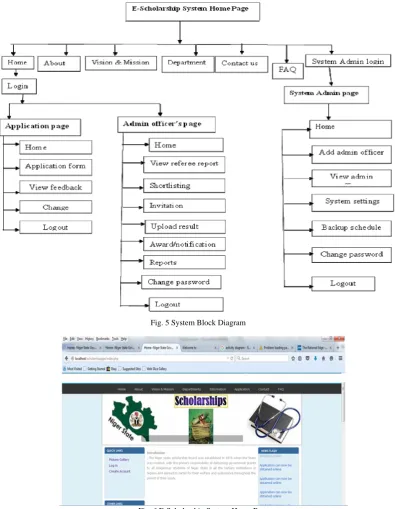
new system at the same time while to ensure that all major problems in the system have been solved before the old system is totally removed and discontinued. This strategy was used in implementing our new system because of the sensitivity of the information involved. The diagram below shows the various components of the software modules
1) Implementation Architecture
Fig. 5 System Block Diagram
Fig. 6 E-Scholarship System Home Page
2) Homepage
e homepage or FrontPage serves as landing page to all the users of the system. For an applicant to use the system
3) Application Form
Fig. 7 Application form
Once the user name and password is entered correctly by the applicant, he/she is provided with next screenshot which is the applicant homepage. Now, the applicant can fill the application form, upload qualifications. The above figure shows the screenshot of an application form.
4) System Administrator Home Page
5)
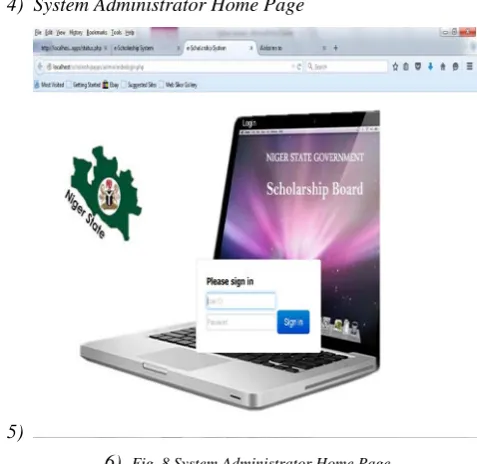
6) Fig. 8 System Administrator Home Page
System Administrator needs to be verified by the system. This can be achieved as Administrator enters the correct user id and password, when successful, he/she can make use of the system proper. The above screenshot is the System Administrator sign in homepage.
7) Report Generating View
Fig. 9 the Snapshot of the Scholarship Award Report Sheet
Several forms of reports can be generated from the application which varies from individual authorization level. The list of successful applicant report sheet for the award of scholarship as shown below in Fig 9; the report shows the comprehensive list of the applicants that were awarded with scholarship.
E. Summary of Achievements
The existing system was successfully studied and the weaknesses of the studied system were identified and areas of improvements were recommended. The online web-based system (e-Scholarship System) software that was developed in the project was able to automate processes of scholarship applications. Applicants successfully fill and submit their application forms online irrespective of their geographical location. The System also was able to provide the scholarship board with an application that was used for screening scholarship applications and successful applicants were issued with scholarship award letter. Furthermore, the System also was able to provide applicants with feedback services, such that applicants were able to check for their status and even get response on questions asked in order to seek for clarification on issues.
IV.CONCLUSIONS
In this work, an online web-based system e-scholarship was implemented that replaces the paper-based method. The online web-based application allowed students to apply for scholarship online irrespective of their geographical locations and also provide them with feedback services. The software was develop using object oriented analysis and design. It is hoped that effective implementation of this software product would eliminate many problems discovered during system’s investigation. We therefore make the following recommendations.
online should endeavor to adopt the e-Scholarship System software develop in this research work in order to automate their various scholarship application processes. So that the workload associated with the manual system can be reduced considerably.
It is known that for any meaningful Computer Based Information Management to be integrated into any organization, proper training and orientation has to be given both to the staff and management. Government should create Information Technology unit (IT) within scholarship board. Staff of this unit should receive intensive training on how to use the new system so that they can acquire the basic knowledge that is necessary for the effective implementation of the new system.
ACKNOWLEDGMENT
My thanks go to Prof. F.S. Bakpo of the Department of Computer Science, University Of Nigeria, Nsukka, for supervising this work. My appreciation also goes to Mr Eli Jiya A. for his numerous contributions towards the success of this work.
REFERENCES
[1] Oxford Dictionary, “Oxford Dictionary Language matters”. Oxford: Oxford University Press, 2014. [Online]. Available: http://www.oxforddictionaries.com/definition/english/scholarship. [2] C.W. F. Anthony, S. Andrea, G. Kappel, R. Werner, E. Kimmerstor,
et al, “Ubiquitous Web Application Development – A Framework
http://www0.cs.ucl.ac.uk/staff/A.Finkelstein/papers/uwa.pdf. [3] D. Ernst, “The Internet’s Effect on Business Organization: Bane or
Boon for Developing Asia?” Asia pacific issues. No. 48, 2001, pp.1-8.Available:
http://www.eastwestcenter.org/fileadmin/stored/pdfs/api048.pdf. [4] K. Peterson, “Financial Aid Glossary”, A Nelnet Network, 2013.
[Online]. Available At: http://www.fastweb.com/financial-aid/articles/financial-aid-glossary.
[5] A. Exforsy, “Difference between Scholarship and Grant” Blog, 28 November, 2014; http://www.exforsys.com/career-center/scholarships/difference-between-scholarship-and-grant.html. [6] B. Sanothimi, “A Study on Scholarship Management and its
Effectiveness in terms of Enrolment and Retention Final Report” Kuleswar, Kathmandu, 2010. Pp 3-5.
[7] M. Brumbaugh, “Increasing Efficiency in a Community College Scholarship Program”, M.Sc. Thesis, Concordia University, Portland, 2011.
[8] R. H. Michael, “The Impact of Financial Aid on Postsecondary Persistence: A Review of the Literature”, Nasfaa Journal of Student Financial Aid, Vol. 37, No. 3, 2008. pp 30-34.
[9] S. Wen-Kai, “An Online Scholarship Application System”, M.Sc. Thesis, University of Wisconsin-La Crosse, La Crosse, Wisconsin, 2011.Pp.2-10.Available:http://www.google.com.ng/url?url= http://minds.Wisconsin.edu/bitstream/handle/1793/52484/Wen-Kai%2520Shen.pdf
[10] M. Z. Rashad, M. S. Kandil, A. E. Hassan, and M. A. Zaher, “An Arabic Web-Based Exam Management System”, International Journal of Electrical & Computer Sciences (IJECS-IJENS) vol.10 no.1. 2010. pp 48-55.