_____________________________________________________________________________________________________ www.sciencedomain.org
Comparison of APACHE II, MPM and CPIS Scoring
Systems with Regard to Determine of Mortality at
Ventilator-Associated Pneumonia
Ismail Sırıt
1, Hülya Sungurtekin
1*, Simay Serin
1, Ercan Gürses
1,
Turan Evran
1, Asli Mete
1and Ibrahim Öztürk
11
Department of Anesthesiology and Reanimation, Medical Faculty, Pamukkale University, Turkey.
Authors’ contributions
This work was carried out in collaboration between all authors. Author HS designed the study, wrote the protocol, wrote the first draft of the manuscript and approved finial submission.Authors IS, SS, ES, TE, AM and IO managed the literature searches, analyses of the study. All authors read and approved the final manuscript.
Article Information
DOI: 10.9734/BJMMR/2015/18180
Editor(s):
(1) Roberto Manfredi, Department of Medical and Surgical Sciences, University of Bologna, Bologna, Italy.
Reviewers:
(1) Arturo Abdelnour, Departments of Pediatrics, National Children´s Hospital, San José, Costa Rica. (2)Anonymous, Mexico. (3)Masaaki Minami, Department of Bacteriology, Nagoya City University, Japan. (4)Mujibul Hoque, Department of Paediatrics, Sylhet MAG Osmani Medical College, Bangladesh. Complete Peer review History:http://www.sciencedomain.org/review-history.php?iid=1124&id=12&aid=9651
Received 8th April 2015 Accepted 18th May 2015 Published 8th June 2015
ABSTRACT
Aims: Ventilator-associated pneumonia (VAP) due to mechanical ventilation is an important issue that increases mortality and cost of treatment. In this study, we aimed to compare the effectiveness of three scoring models for estimation of mortality and morbidity in patients with ventilator associated pneumonia.
Study Design: Prospective research.
Place and Duration of Study: Patients with VAP who were admitted into intensive care unit Pamukkale University Hospital prospectively included in the study between January 2012 and June 2012.
Methodology: Demographical data, diagnosis on admission, departments from where admitted, APACHE II, Mortality Probability Model II0 (MPMII0) and Mortality Probability Model II24 (MPMII24) scores on admission, length of stay in intensive care and hospital, duration of mechanical
ventilation, microbiological data for pneumonia, outcome and Clinical Pulmonary Infection Score values on day 1, 3, 5 and 7 were recorded.
Results: Eighty patients (F/M: 37/43) were included study. Mortality was 67.5%. MPM II0, MPMII24 values were significantly high in patients who has died but ROC curves were not significant for any of the scoring systems. In addition, relationship between scoring models and mortality, duration of mechanical ventilation, length of stay in intensive care and hospital was not statistically significant (P=.05).
Conclusion: We concluded that each of the three scoring systems for the prediction of mortality in VAP was not superior to each other.
Keywords: Ventilator-associated pneumonia; mortality probability model II; APACHE II; clinical pulmonary infection score.
1. INTRODUCTION
Patients who have admitted intensive care unit (ICU) have concomitant diseases and invasive interventions that increase morbidity and mortality. Therefore, various scoring models have been developed to estimate prognosis and to direct the treatment [1]. While most of them are intended to general population, some of them were developed for subgroups of patients.
Ventilator associated pneumonia (VAP) due to mechanical ventilation is an important issue that increase mortality and cost of the treatment [2]. It is thought that VAP is an important variable for decreasing of mortality, in a condition in which VAP was eliminated. However, Esperatti et al. [3] reported that there were no significant difference between VAP and pneumonia unallied with mechanical ventilation.
Development of scoring system for diagnosis and prognosis of VAP has been an interesting research area for clinicians. Clinical pulmonary infection score (CPIS) was first described by Pugin et al. [4] to aid in VAP diagnosis by combining clinical and radiological findings with laboratory investigations. However, there are trials that question suitability of CPIS model, though it is usually used [2,5-7].
Therefore, we hypothesized that general prognostic models are successful for estimating mortality at VAP and it is not necessary to develop a special model. In this study, we aimed to compare CPIS with usually performed prognostic models, Acute Physiology and Chronic Health Evaluation (APACHE II) and Mortality Probability Model (MPM II).
2. MATERIALS AND METHODS
Patients with VAP who were admitted into
prospectively included in the study between January 2012 and June 2012. The study comprised 80 patients older than 18 years treated in ICU for at least 24 hours. Patients with a history of coronary artery surgery or a major burn, recipients of organ transplants, and patients referred from other ICUs were excluded from the study. Moreover, only the first data set of patients with a history of twice or more admittance in ICU was included in data analysis.
Demographical data (age, weight, gender), diagnosis on admission, concomitant disease and clinical services from which the patients were taken, were recorded. APACHE II, MPM II0 and MPM II24 scores were calculated at ICU admission. CPIS scores were calculated according to six variables (temperature, white blood cells, secretions, oxygenation, chest X ray, sputum culture) (Table 1) and recorded on day 1, 3, 5 and 7. Ventilator-associated pneumonia was defined according to guidelines of The American Thoracic Society and The Infectious Diseases Society of America. Length of stay in ICU, length of stay in hospital, length of mechanical ventilation, outcome of treatment (excitation, referral to another clinic, or discharge) and microbiological factors of VAP were recorded.
2.1 Statistical Analysis
Mann-performed for the relationship between variables and the outcome. The obtained scoring data with all scoring systems were standardized by normal distribution curve in 0-1 probability intervals. Receiver operating characteristic (ROC) curve was used to determine a cut-off value for mortality and sensitivity and specificity of each scoring system for prediction of mortality. P<0.05 was accepted as the level of statistically significance.
3. RESULTS AND DISCUSSION
Eighty patients were included into study (46.3% female, n=37; 53.8% male, n=43). Mean of age was 67.4±16.68 (range: 19-95) and mean of weight was 69.2±14.1 (range: 40-105). There was no significant difference between survivors and exitus, with respect to demographical data (P=.05, Table 2).
When the outcome was evaluated, 26 patients were found to be discharged from the ICU (32.5%) and 54 died (67,5%) in this period. Mean of duration of mechanical ventilation was 34.2±27.4 and means of LOS in ICU and hospital were 36.2±27.8 and 39.4±28.5, respectively.
Diagnosis on admission were lung cancer (n=4, 5.0%), cardiac diseases (n=18, 22.5%), postoperative diseases (n=13, 16.25%), neurological diseases (n=17, 21.25%), hematological diseases (n=4, 5.0%), genitourinary diseases (n=7, 8.75%), respiratory diseases (n=14, 17.5%) and other (n=3, 3.75%).
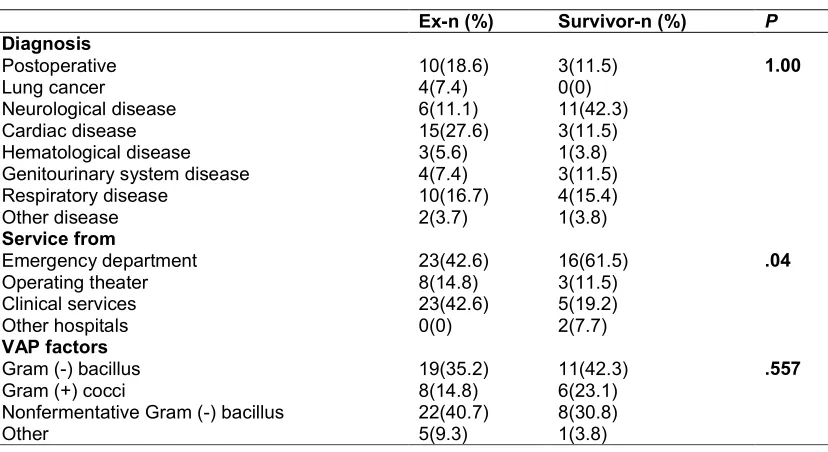
Most of the patients were referred from emergency department (n= 39, 48.8%) and others were admitted from operating room (n=11, 13.8%), clinical services (n=28, 35.0%), other hospitals (n=2, 2.5%). Microbiological factors of VAP were gram negative bacillus (Pseudomonas aeruginosa, Klebsiella pneumonia, n=30, 37.5%), nonfermentative gram negative bacillus (Acinetobacter baumannii, Stenotrophomonas maltophilia, n=30, 37.5%), gram positive cocci (Staphylococcus aureus, Streptococcus pneumonia) and enterobacteriaceae (n=14, 17.5%) and others (Candida albicans, n=6, 7.5%). There were no significant differences between died and survivor patients according to diagnosis on admission, microbiological factors of VAP (Table 3). However, the mortality rate was significantly lower in patients referred from other clinics (11.8%) than those referred from the emergency department (P=.04).
There were no significant differences between exitus and survivor patients for APACHE II and CPIS scores on day 1, 3, 5 and 7 (p>0.05). MPM II0 ve MPM II24 scores of exitus patients were significantly higher than the survivor ones (P<.05, Table 2). In addition, the differences of duration of mechanical ventilation, length of stay (LOS) in ICU and hospital were not statistically significant (P =.05, Table 4). Relationship between estimation of mortality rate, duration of mechanical ventilation, LOS in ICU and hospital and scoring models was not statistically significant (Table 4).
Table 1. Clinical pulmonary infection score
Day Parameter Value for score of
1 point 2 points
1 Temp (ºC) 38.5 to 38.9 ≥39 or ≤36
White blood cells/mm3 <4,000 or >11,000 <4,000 or >11,000 and ≥50% bands
Secretions Nonpurulent Purulent
PaO2/FiO2 ≤240 and no ARDS
Chest X-ray infiltrates Diffuse or patchy Localized
3 Temp (ºC) 38.5 to 38.9 ≥39 or ≤36
White blood cells/mm3 <4,000 or >11,000 <4,000 or >11,000 and ≥50% bands
Secretions Nonpurulent Purulent
PaO2/FiO2 ≤240 and no ARDS
Chest X-ray infiltrates Diffuse or patchy Localized Progression of chest
X-ray infiltrates
Yes (no ARDS or congestive heart failure)
Sputum Culture >1+ Culture >1+ and same organism on Gram staining
Table 2. Demographical data, scores and outcome of patients
Exitus
(n=54)
Survivors (n=26)
P
N(%) N(%)
Gender Female 26(48%)
28(52%)
11(42%) 15(58%)
.624 Male
Mean±SD Mean±SD
Age (years) 69.3±14.1
70.8±13.8 27.815±5.962 0.831±1.389 0.487±1.518 6.574±0.944 5.148±1.053 3.611±1.309 2.926±1.211 28.56±20.20 28.93±20.36 31.98±20.70
63.3±20.8 66.0±14.5 25.500±6.370 0.146±1.230 -0.252±1.364 6.462±0.811 4.769±1.107 3.346±0.977 2.500±0.906 45.96±36.04 66.00±94.89 69.35±94.81
.168
Weight (kg) .081
APACHE II score .116
MPM II0 score .035
MPM II24 score .039
CPIS (day 1) .603
CPIS (day 3) .142
CPIS (day 5) .363
CPIS (day 7) .116
Duration of MV .105
LOS in ICU .059
LOS in hospital .058
MV: mechanical ventilation, LOS: lenght of stay, ICU: intensive care unit.
Table 3. Effects of diagnosis, prior clinical departments and microbiological factors of VAP to mortality rate
Ex-n (%) Survivor-n (%) P
Diagnosis
Postoperative 10(18.6) 3(11.5) 1.00
Lung cancer 4(7.4) 0(0)
Neurological disease 6(11.1) 11(42.3)
Cardiac disease 15(27.6) 3(11.5)
Hematological disease 3(5.6) 1(3.8)
Genitourinary system disease 4(7.4) 3(11.5)
Respiratory disease 10(16.7) 4(15.4)
Other disease 2(3.7) 1(3.8)
Service from
Emergency department 23(42.6) 16(61.5) .04
Operating theater 8(14.8) 3(11.5)
Clinical services 23(42.6) 5(19.2)
Other hospitals 0(0) 2(7.7)
VAP factors
Gram (-) bacillus 19(35.2) 11(42.3) .557
Gram (+) cocci 8(14.8) 6(23.1)
Nonfermentative Gram (-) bacillus 22(40.7) 8(30.8)
Other 5(9.3) 1(3.8)
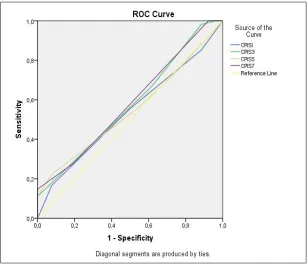
ROC curve was not significant for getting a cutoff point with respect to estimation of mortality (Figs. 1 and 2). The values of area under curve of the scoring models were between 0.537 and 0.648 and estimation of mortality was poor for each models.
4. DISCUSSION
While APACHE and MPM scoring models are
model for estimation of morbidity and mortality. We defined VAP according to guidelines of The American Thoracic Society and The Infectious Diseases Society of America [24].
CPIS doesn’t have full appropriate properties for a prognostic model. Because it also includes variables (microbiological data) which can’t be got easily [25]. Although the microbiological variables are usually used [15], Rea-Neto et al. [14] found that those data have not contributed to diagnosis of VAP. However, Lauzier et al. [16] showed that CPIS has had limited feasibility when the results of microbiological culture have been ignored. In our study, we used the microbiological culture of tracheal aspirate. We calculated the scores at the original time for each models, because we tried to observe feasibility of initial forms.
CPIS model has been performed at different populations: trauma [6], pediatric [26], brain injury [27], medical ICU [11] and surgical ICU (7).
We observed the mix (medical-surgical) ICU patients in contrast to these trials.
Six points is usually accepted as threshold for CPIS [12,19]. Sachdev et al. [26] observed that CPIS>8 points was correlated with the outcome in pediatric population. Sensitivity of CPIS has ranged from 60% to 89% and specificity of CPIS has ranged from 43% to 59% for level of CPIS>6 points [11,15,17]. Schurink et al. [9] found sensitivity as 83% and specificity 17% for CPIS>5 points. In our study, ROC curve was not significant to determine a cut off value in our mix ICU patients.
Gursel et al. [17] demonstrated that discrimination of APACHE II was better than CPIS and SOFA and APACHE II>16 was an independent predictor of mortality. Huang et al. [18] showed that APACHE II >27 (not CPIS) was an independent and early predictor of mortality. Kollef et al. [20] also concluded APACHE II was more valuable than CPIS. However,
Table 4. Relationship between scores and MV duration, LOS in ICU and hospital
Scores P
Length of stay in hospital APACHE II 0.966
MPM 0 0.482
MPM 24 0.811
CPIS (day 1) 0.488
CPIS (day 3) 0.872
CPIS (day 5) 0.836
CPIS (day 7) 0.655
Length of stay in intensive care unit APACHE II 0.888
MPM 0 0.397
MPM 24 0.846
CPIS (day 1) 0.417
CPIS (day 3) 0.822
CPIS (day 5) 0.863
CPIS (day 7) 0.708
Duration of mechanical ventilation APACHE II 0.861
MPM 0 0.370
MPM 24 0.833
CPIS (day 1) 0.399
CPIS (day 3) 0.818
CPIS (day 5) 0.932
CPIS (day 7) 0.794
Mortality APACHE II 0.315
MPM 0 0.534
MPM 24 0.902
CPIS (day 1) 0.199
CPIS (day 3) 0.176
CPIS (day 5) 0.557
Fig. 1. Specificity and sensitivity of APACHE II, MPM0 and MPM24 for estimation of mortality
Fig. 2. Specificity and sensitivity of CPIS for estimation of mortality
Ntoumenopoulos et al. [21] found neither APACHE II nor CPIS were successful models. In our study, none of the scoring models (MPM II,
The result of our study was similar with Ntoumenopoulos et al. [21].
Yang et al. [19] found positive correlation between CPIS model and duration of mechanical ventilation, LOS in ICU and hospital. Xiao-Yu Zhou et al. [28] reported that APACHE II is useful for predicting 30-day mortality in patients with VAP, but that the CPIS does not have good discrimination and calibration for predicting mortality in mechanically ventilated intensive care patients. However, we could not find a relationship of CPIS with those parameters. The single use of the Clinical pulmonary infection score is questionable but it may be useful as a monitoring issue and in combination with diagnostic approach [29].
5. CONCLUSION
In conclusion, MPM II0 and MPM II24 scores were significantly higher in died patients. However, none of the scoring models showed significant relationship with mortality, duration of mechanical ventilation, LOS in ICU and hospital in subgroup of ICU patients with VAP.
CONSENT
All authors declare that ‘written informed consent was obtained from the patient (or other approved parties) for publication of this case report and accompanying images.
ETHICAL APPROVAL
All authors hereby declare that all experiments have been examined and approved by the appropriate ethics committee and have therefore been performed in accordance with the ethical standards laid down in the 1964 Declaration of Helsinki.
COMPETING INTERESTS
Authors have declared that no competing interests exist.
REFERENCES
1. Vincent JL, Moreno R. Clinical review: Scoring systems in the critically ill. Crit Care. 2010;14:207.
2. Rosbolt MB, Sterling ES, Fahy BG. The utility of the clinical pulmonary infection
score. J Intensive Care Med. 2009;24:26-34.
3. Esperatti M, Ferrer M, Theessen A, Liapikou A, Valencia M, Saucedo LM, et al. Nosocomial pneumonia in the intensive care unit acquired by mechanically ventilated versus nonventilated patients. Am J Respir Crit Care. 2010;182:1533-39. 4. Pugin J, Auckenthaler R, Mili N, Janssens
JP, Lew PD, Suter PM. Diagnosis of ventilator-associated pneumonia by bacteriologic analysis of bronchoscopic and nonbronchoscopic "blind" bronchoalveolar lavage fluid. Am Rev Respir Dis. 1991;143(5):1121-9.
5. Zilberberg MD, Shorr AF. Ventilator-associated pneumonia: The clinical pulmonary infection score as a surrogate for diagnostics and outcome. Clin Infec Dis. 2010;51(S1):131–5.
6. Patel CB, Gillespie TL, Goslar PW, Sindhwani M, Petersen SR. Trauma-associated pneumonia in adult ventilated patients. Am J Surg. 2011;202:66–70. 7. Pugin J, Auckenthaler R, Mili N, Janssens
JP, Lew PD, Suter PM. Diagnosis of ventilator-associated pneumonia by bacteriologic analysis of bronchoscopic and nonbronchoscopic ‘‘blind’’ bronchoalveolar lavage fluid. Am Rev Respir Dis. 1991;143:1121-9.
8. Tejerina E, Esteban A, Fernández-Segoviano P, Frutos-Vivar F, Aramburu J, Ballesteros D, et al. Accuracy of clinical definitions of ventilator-associated pneumonia: Comparison with autopsy findings. J Crit Care. 2010:25;62–8. 9. Schurink CAM, Nieuwenhoven CAV,
Jacobs JA, Rozenberg-Arska M, Joore HCA, Buskens E, et al. Clinical pulmonary infection score for ventilator-associated pneumonia: Accuracy and inter-observer variability. Int Care Med. 2004;30:217–24. 10. Bregeon F, Papazian L, Thomas P, Carret
V, Garbe1 L, Saux P, et al. Diagnostic accuracy of protected catheter sampling in ventilator associated bacterial pneumonia. Eur Respir J. 2000;16:969-75.
11. Fabregas N, Ewig S, Torres A. Clinical diagnosis of ventilator associated pneumonia revisited: Comparative validation using immediate post-mortem lung biopsies. Thorax. 1999;54:867-73. 12. Papazian L, Thomas P, Garbe L, Gurignon
of ventilator-associated pneumonia. Am J Respir Crit Car Med. 1995;152:1982-91. 13. Fartoukh M, Maitre B, Honore S, Cerf C,
Zahar JR, Brun-Buisson C. Diagnosing Pneumonia during Mechanical Ventilation The Clinical Pulmonary Infection Score Revisited. Am J Respir Crit Care Med. 2003;168:173–9.
14. Rea-Neto A, Youssef NCM, Tuche F, Brunkhorst F, Ranieri M, Reinhart K. Diagnosis of ventilator-associated pneumonia: A systematic review of the literature. Critical Care. 2008;12:56. 15. Luyt CE, Chastre J, Fagon JY. Value of the
clinical pulmonary infection score for the identification and management of ventilator-associated pneumonia. Intensive Care Med. 2004;30:844–52.
16. Lauzier F, Ruest A, Cook D, Dodek P, Albert M, Shorr AF. The value of pretest probability and modified clinical pulmonary infection score to diagnose ventilator-associated pneumonia. J Critical Care. 2008;23:50–7.
17. Gursel G, Aydogdu M, Ozyilmaz E, Ozis TN. Risk factors for treatment failure in patients with ventilator-associated pneumonia receiving appropriate antibiotic therapy. J Crit Care. 2008;23:34–40. 18. Huang KT, Tseng CC, Fang WF, Lin MC.
An Early Predictor of the Outcome of Patients with Ventilator-associated Pneumonia. Chang Gung Med J. 2010;33: 274-82.
19. Yang GH, Wang GF. Value of the clinical pulmonary infection score for the prognosis of ventilator-associated pneumonia. Zhonghua Jie He He Hu Xi Za Zhi. 2006; 29(11):751-4.
20. Kollef KE, Schramm GE, Wills AR, Reichley RM, Micek ST, Kollef MH. Predictors of 30-day mortality and hospital costs in patients with ventilator-associated pneumonia attributed to potentially antibiotic-resistant gram-negative bacteria. Chest. 2008;134:281–7.
21. Ntoumenopoulos G, Presneill JJ, McElholum M, Cade JF. Chest
physiotherapy for the prevention of ventilator-associated pneumonia. Int Care Med. 2002;28:850–6.
22. Singh N, Rogers P, Atwood CW, Wagener MM, Yu WL. Short-course empiric antibiotic therapy for patients with pulmonary infiltrates in the intensive care unit. A proposed solution for indiscriminate antibiotic prescription. Am J Respir Crit Care Med. 2000;162:505–11.
23. Micek ST, Ward S, Fraser VJ, Kollef MH. A randomized controlled trial of an antibiotic discontinuation policy for clinically suspected ventilator-associated pneumonia. Chest. 2004;125:1791–9. 24. American Thoracic Society, Infectious
Diseases Society of America. Guidelines for the management of adults with hospital-acquired, ventilator-associated, and healthcare-associated pneumonia. Am J Respir Crit Care Med. 2005;171:388-416. 25. Torres A, Carlet J. Ventilator-associated
pneumonia. European Task Force on ventilator-associated pneumonia. Eur Respir J. 2001;17:1034–45.
26. Sachdev A, Chugh K, Sethi M, Gupta D, Wattal C, Menon G. Clinical pulmonary infection score to diagnose ventilator-associated pneumonia in children. Indian Pediatrics. 2011;48:949-54.
27. Pelosi P, Barassi A, Severgnini P, Gomiero B, Finazzi S, Merlini G, et al. Prognostic role of clinical and laboratory criteria to identify early ventilator-associated pneumonia in brain injury. Chest. 2008; 134:101–8.
28. Zhou XY, Ben SQ, Chen HL, Ni SS. A comparison of APACHE II and CPIS scores for the prediction of 30-day mortality in patients with ventilator-associated pneumonia. Int J Infect Dis. 2015;30:144-7.
29. Bickenbach J, Marx G. Diagnosis of pneumonia in mechanically ventilated patients: what is the meaning of the CPIS? Minerva Anestesiol. 2013;79(12):1406-14.
© 2015 Sırıt et al.; This is an Open Access article distributed under the terms of the Creative Commons Attribution License (http://creativecommons.org/licenses/by/4.0), which permits unrestricted use, distribution, and reproduction in any medium, provided the original work is properly cited.
Peer-review history: