Changes in grouping practices over primary and
secondary school.
Ed Baines*, Peter Blatchford* & Peter Kutnick**
*Institute of Education, University of London
** University of Brighton
Changes in grouping practices over primary and secondary school.
ABSTRACT
The research detailed in this paper provides a systematic description and analysis of grouping practices in primary and secondary schools in England. Practices are compared to main findings in developmental and educational literature with regard to effective contexts for learning and recent ideas about pedagogy.
The research is based on an analysis of 4924 groupings from 672 Reception, Year 2 and Year 5 classes in 331 primary schools and 248 Year 7 and Year 10 classes in 47 secondary schools. The data came from ‘classroom mapping questionnaires’ that were completed by teachers at a particular point in the school day. Completed questionnaires provided information about the nature and use of groupings within their classrooms and focused on the number and size of groupings, type of working interaction between pupils, the presence of adults, grouping composition and the type of task that groupings were engaged with.
Introduction
The research described in this paper provides a systematic analysis of grouping practices in English Reception, Year 2 and Year 5 primary school classrooms and Year 7 and 10 secondary school classrooms (ages 5, 7, 10, 12 and 15 at end of school year). Very little research on groupings in classrooms contexts has focused on how grouping practices change over primary and secondary education. However, experimental research and developmental theory emphasises that there are large changes in children’s social, cognitive and communicative development over this period which have implications for children’s ability to work in and as groups. Certain grouping contexts may be more supportive of learning at different ages. The current study goes beyond previous work by exploring the nature of the grouping context in relation to learning task, working interaction and adult involvement across different year groups in primary and secondary schools. In contrast to other papers in this volume, this study is deliberately descriptive of current practice. The study is informed by an ecological view of classroom life and current ideas concerning a pedagogic approach to teaching and learning.
The importance of grouping
All pupils in schools are grouped in some form or another. At a school level, pupils are organised into classrooms on the basis of decisions about age and ability mix (Dean, 1992; Dreeben, 1984). Classes can be viewed as nested contexts within a school (Bronfenbrenner, 1979) and within classrooms there are further nested contexts. Within the classroom the teacher is responsible for making decisions regarding these units or nested contexts for instruction and learning, that is, the unit to which learning tasks and working interactions are co-ordinated. This unit we have termed the ‘grouping’ and it can consist of anything from a single pupil to a whole class of pupils.
and with particular social, learning and physical constraints (e.g. such as class size) to bear in mind. Organising groupings in relation to just physical constraints and/ or for teaching efficiency is not sufficient because the teacher needs to take account of pupils’ learning and social needs. The grouping unit must therefore be strategically constructed in relation to working arrangements and learning purposes. There is thus a need for a social pedagogy of classrooms as suggested by Kutnick, Blatchford and Baines (2002).
Developmental basis
Decisions on the groupings to use for particular learning purposes should be partly dependent on the pupils themselves. The way children respond to the grouping contexts the teacher sets up and the interactive and learning benefits pupils take from them will depend on the skills and knowledge that they bring to these contexts. Of course, these skills and understandings will vary not only between pupils but also over time within pupils. During the twelve years that children spend in UK schools, between the ages of 4 and 16, large and dramatic developments are apparent in children’s social, cognitive and communication skills. Thus particular combinations of grouping structure, learning task, working interaction and adult assistance may be more, or less, supportive of learning and development at different points in childhood. A pedagogic approach to the teaching of, and learning by, pupils of different ages must take account of these interactions between grouping and learning.
Research on groupings used in classrooms
These studies have provided clear findings but they have not examined classroom groupings in any great depth and do not systematically examine within-class grouping practices relative to the age (or learning needs) of children. They have tended to focus exclusively on either infant or junior classrooms (and not on secondary classrooms – 11-16 years) and thus do not consider grouping contexts in relation to children’s development or consider how teachers treat children differently at different ages. This paper therefore seeks to examine groupings used within primary and secondary school classrooms in terms of a number of core dimensions and further to analyse them in relation to the effective practices suggested by developmental and educational research. The five core dimensions examined are: the size and number of groupings in the class; the working arrangement between grouping members; adult support of groupings; grouping composition; and the curriculum area and task type undertaken by the grouping.
Size and number of groupings
Galton & Williamson’s (1992) review identified four distinct types of classroom groupings: individuals, pairs, small and large groups and whole class. Yet their existence does not mean that teachers effectively co-ordinate their teaching and learning tasks with them. Research has examined the educational implications of grouping size for effective learning (Kutnick, 1994) and emphasises that small groups are the most effective for learning (Lou, Abrami, Spence, Poulsen, Chambers & d’Apollonia, 1996). However, this research did not relate grouping size to child development and has not examined actual grouping sizes used in classrooms. The number of groupings found in a classroom at any one time also has implications for the learning activity and adult involvement but has not been considered fully in relation to the age of pupils. An analysis of grouping size and number is also important in relation to the working arrangements of the grouping and the task that is undertaken.
Type of working arrangements
work with a teacher either as a whole class or as a group (Bennett & Dunne, 1992; Galton & Williamson 1992; Kutnick & Rogers, 1994).
The research literature on the ‘science’ of teaching and learning highlight the potential of different types of working interactions for learning. Piagetian, Vygotskyan, and socio-cultural theories have prompted much research into individual, adult-child and peer interactions in equal (cooperative and collaborative) and unequal (peer tutoring) relations. The general view is that learning is more likely and deeper when pupils are actively engaged in learning. Learning is often more active when pupils work in a shared social context involving interaction with others, whether with an adult or other pupils, rather than when working alone or just listening to the teacher (Wood, 1998; Rogoff, 1990; Doise & Mugny, 1984; Topping, 1994; Forman & Cazden, 1985; Slavin, 1990; Johnson & Johnson, 1987; Tolmie, Howe, Duchak & Rattray, 1998).
Research suggests that from at least 6 to 7 years children can begin to engage in and benefit from ‘collaborative’ interaction, though younger children do engage in social learning through co-ordination and cooperation as well as imitation and instructed learning (Azmitia & Perlmutter, 1989; Tomasello, Kruger & Ratner, 1993). Collaborative interaction requires the use of cognitive skills, perspective taking and particular conversational skills to compare other’s perspectives with one’s own (Baines, 1996; Miller, 1987; Piaget, 1959; Tomasello et al., 1993). Theorists and researchers from a Vygotskyan and socio-cultural tradition emphasise that interaction with others is productive prior to the age 6 to 7 years and they usually focus on interactions between a child and more able other (adult or child) (Rogoff, 1990; Hogan & Tudge, 1999) and peer interactive contexts where children scaffold each other’s learning, engage in the co-construction and elaboration of ideas or give and receive help (Forman & Cazden, 1985; Forman, 1992; Webb, 1989). These interaction types may be described as interactants co-ordinating and co-operating in interaction rather than being specifically collaborative (Baines, 1996; Tomasello et al., 1993).
is central to increasing the effectiveness of group work (see Blatchford, Baines, Galton & Kutnick, this volume). There are, of course, settings where individual work is necessary and more productive than group-work (Howe, Duchak-Tanner & Tolmie, 2000; Murphy & Messer, 1998) allowing children time to reflect on ideas and knowledge. These situations may be used to prepare for group work or to accommodate thinking after group work.
In classroom settings, small groupings may be more effective when pupils are expected to interact on a task (Bosert, Barnett & Filby, 1985; Nastasi & Clements, 1991). On the other hand, a few large groups may allow more control of behaviour and attention as well as enable the targeting of guidance and support. Equally, from a management point of view lots of small groupings may prove unwieldy for teachers, particularly when pupils have difficulties working together on tasks. However, there is little information available on relationships between working interaction type and group size relations at different points in pupils’ education.
Adult support of groupings
Adult support of groupings is essential with regard to guidance, instruction and support for learning, but also from a practical point of view in terms of effective management of behaviour and attention. The existence of an adult in a group will affect interactions between pupils and thus may be highly inappropriate under certain task and interactive activities. Theoretically driven research highlights the beneficial effects of an adult scaffolding an individual’s learning but holds little faith in the support or instruction of larger groupings where a teacher must know about, and adjust their teaching to, all children in their class (Tharp & Gallimore, 1991; Wood & Wood, 1996). When taught as a whole class, pupils will vary in their ability and learning needs, even when placed in classes ‘set’ by ability (where pupils are re-organised into new classes for one or more curriculum area on the basis of similarity in ability – also known as tracking in the US), and thus direct whole class teaching can be difficult. This is further compounded by the possibility that not all pupils will be actively engaged all of the time. Research by Galton and colleagues also illustrates the unfeasibility of adults scaffolding pupils’ learning. They found that while teachers spend most of their time interacting with pupils, each pupil on average received no more than ten minutes of focused teacher attention and support per day (Galton et al., 1980; Galton et al., 1999).
as they allow better quality input from an adult, allow better quality work from pupils, are better for pupils’ concentration, and are more manageable generally (Blatchford, Baines, Kutnick & Martin, 2001). But in large classes teachers feel driven to reduce the number of groupings and thus increase the size of groupings for ease of management and control.
Grouping composition
The composition of groupings may have implications for teaching and learning. From a teaching perspective, homogenous ability grouping is efficient but may not be as beneficial for pupils’ learning. Most experimental research has focused on whether grouping members should be of similar or mixed ability. During peer interaction, the process of cognitive conflict, which theory suggests underlies collaborative group work, requires a difference in perspective and ability (Doise & Mugny, 1984; Piaget, 1959). Furthermore, peer tutoring requires a large difference in ability (Rogoff, 1990; Vygotsky, 1978). However, similar ability peers may be able to scaffold each other during interaction (Forman & Cazden, 1985). Webb (1989), in her research on peer helping, recommends a compromise position such that high and middle ability pupils work together and low and middle ability pupils work together. This strategy overcomes the common problem of high ability pupils becoming annoyed with having to help low ability pupils, while maintaining differences in perspectives and knowledge to support learning such that pupils of all ability levels benefit. Homogenous ability grouping within classes is currently recommended by school inspectors in England and Wales (OFSTED, 1995), despite a scarcity of research into the effectiveness of this form of grouping (Hallam & Toutounji, 1996). Setting classes by ability is becoming ever more prevalent in UK primary schools and has been the norm for pupils above 13 years of age in secondary schools despite evidence emphasising negative social, emotional and academic outcomes (Benn & Chitty, 1996; Hallam & Toutounji, 1996). Yet little is known about its incidence in primary schools or the prevalence of within-class ability grouping in primary and secondary schools.
Curriculum area and task type
groupings but this has implications for the complexity of task types given to other groups where no adult support is available. This may be particularly problematic with young children that are less able to work independently.
The type of task undertaken has been conceived across many different dimensions (Alexander, Schallert & Hare, 1991; Bloom, 1956; Norman, 1978; Pica, Kanagy & Falodun, 1993). Norman (1978) suggested that tasks could either introduce new ideas, procedures or skills; demand that an individual discovers ideas; require the practising of new skills on familiar problems; require the application of old knowledge/ skills to new areas or problems; or revise or recap knowledge/ skill. In the experimental research literature there are clear indications that different types of task are more suited to different types of grouping and adult support of groupings (Kutnick, 1994). For example, the learning of new skills and procedural knowledge may be best conducted by a tutor (Howe et al., 2000; Rogoff, 1990); practice tasks may be better suited to working alone with adult support to clarify problems or as a whole class (Jackson & Kutnick, 1996); tasks involving the application of skills to new areas may be best suited to collaborative group working situations as individuals have already honed the necessary skills but need to develop new conceptual understandings (Howe et al., 2000). There is also an indication that the task needs to encourage ambiguity (Doyle, 1980), whether in terms of outcome or process, in order to be effective for group work. Different tasks may be evident at different age levels, especially as during the early years children are learning and developing new skills and knowledge. Bennett et al., (1984) found that tasks used in infant classrooms primarily involved the practising of skills. Few studies have examined the types of tasks that are given to different types of groupings in primary and secondary classrooms. If teachers are to be effective in their use of grouping strategies, they must be aware of the potential for learning and have the ability to co-ordinate task types with groupings in their classrooms.
This paper
This paper aims to provide a naturalistic and multidimensional description, in terms of the five core dimensions, of the nature of grouping practices as employed in primary and secondary school classrooms. Changes in grouping practices with pupil age will also be examined relative to the practices reported by teachers of Reception, Year 2 and Year 5 classes at the primary school level and teachers of Year 7 and Year 10 classes, at the secondary school level. A further aim is to consider how the description relates to developmental research and theory about the conditions for effective learning.
The data used in this paper come from three separately funded but parallel studies that used the same methodology. One project, the Primary Classroom Groupings Project, examined grouping practices in Year 2 (6-7 years) and Year 5 (9-10 years) classrooms. The focus of the second study was on the effects of class size on pupil learning experiences and involved data on grouping practices in Reception (4-5 years) classes. The third study examined grouping practices in secondary schools (11-12 years and 14-15 years). All three projects involved the use of a ‘grouping mapping questionnaire’ to collect quantitative data on the nature of groupings as used in classes at a specified time and day. This paper only reports part of the total data collected - other articles summarise other sections of the data (Blatchford et al., 2001a; Kutnick et al., 2002; Blatchford, Kutnick, Clark, McIntyre & Baines, 2001b).
The grouping mapping questionnaire
On an assigned day and sample time in the lesson, teachers were asked to make a quick note (on a predrawn map of their classroom) of the location of individual male and female pupils, the grouping that they were part of, the curriculum and task that groupings were working on, and the nature of the working interaction the grouping was engaged in. The teacher also noted the location of the adults working in the classroom. Later, at a convenient moment, teachers completed a questionnaire where they elaborated on the classroom map and provided further information on the class and themselves (such as whether the class was set by ability and class size). The advantage of this approach is that it utilises the benefits of a large scale questionnaire and an observational approach while avoiding many of the difficulties associated with these methods, such as the lack of detail and expense respectively. The grouping questionnaire completed by Reception class teachers was a simplified version of the questionnaire used with teachers of Years 2, 5, 7 and 10.
Sample
The Primary Classroom Groupings Project
when they were not overburdened (i.e. weeks where Standard Assessment Tasks and OFSTED inspections were taking place and the first and last weeks of term were avoided). Times were selected to avoid school assembly, break-times and the lunch hour. Returned questionnaires were evenly distributed across the five completion times.
Just less than half of the schools approached agreed to participate in the project and over half of these returned questionnaires. From the 111 schools that participated, 187 teachers returned questionnaires. About half of these teachers were of Year 2 classes and half taught Year 5 classes. Some teachers taught mixed age classes (always consisting of pupils from one year above or below), although all had a predominance of Year 2 or 5 pupils. Over 1000 groupings were described in the questionnaires of the 187 classes and there was a fairly even contribution from both Year 2 and 5 classes.
The Class Size Project: Reception class data on grouping practices
In the class size study, questionnaires were completed at 10:00 am on a specified day of the week. Questionnaires were returned by 485 Reception class teachers (from 220 schools which were randomly sampled from 8 LEAs). These questionnaires provided data on over 2000 groupings. Further information on this project can be found in Blatchford, Moriarty, Edmonds & Martin, (2002) and Blatchford, et al., (2001a).
Grouping Practices in Secondary Schools Project
The grouping practices in secondary schools project involved 47 schools in the collection of classroom mapping data, 36 were mixed sex schools, nine were all-girl schools and two were all-boy schools. Questionnaires were returned from 128 Year 7 and 120 Year 10 classes which were spread equally across the four subject areas of English, Mathematics, Science, and Humanities. Teachers were asked to complete questionnaires either towards the start, in the middle or towards the end of the lesson. Percentages of questionnaires returned were in the proportions 20%, 54% 26%, for the different timings of the lesson respectively; very close in number to those sent out. These questionnaires provided data on 1767 groupings. Further information on this project can be found in Blatchford et al., (2001b).
RESULTS
grouping practices over the years of primary and secondary school (see Blatchford et al., 2001a; Blatchford et al., 2001b; Kutnick et al., 2002, for further analyses).
Streaming and Setting classes by ability
All Reception classes and the vast majority of Years 2 and 5 classes were of mixed ability. Not one single class was streamed (i.e. where pupils are allocated to a class where they are taught all subjects on the basis of ability) and only a quarter of classes experienced any form of ‘setting’. Year 5 classes were more likely to be set by ability where as many as 44% were set for a subject compared to only 6% of Year 2 classes ( 2(1)= 35.98; p<0.001). Setting was mainly for Mathematics or Mathematics and English – only once was it found for English alone. However, only 18% of Year 5 classes actually worked as a set when the questionnaire was completed. At the secondary school level setting was much more frequent. At Year 7, 42% of classes were set by ability and this increased to 70% by Year 10 ( 2(4)= 20.38; p<0.001). Setting at Year 7 was primarily for Mathematics and Science where approximately 50% of classes were set by ability and 35% of classes studying English and Humanities (e.g. History, Geography, Art) were set. At Year 10 setting was even more prevalent for English, Mathematics and Science (69%, 100% and 83% respectively) but much less likely for Humanities subjects (19%) ( 2(3)= 48.40; p<0.001).
Classroom seating and working arrangements
Small group seating was the predominant classroom layout at both Year 2 and 5 levels (59%) (this was not coded at the Reception level). However, there were differences between Year 2 and 5 classrooms in the next most popular class layout ( 2(3)= 25.0; p<0.001). While at Year 2 there was more large group seating than at Year 5 (37% vs 14% respectively), at Year 5 there was more traditional row/pair class seating (0% vs 15% respectively). By secondary school, pair and row seating was the predominant classroom layout (67% at Year 7 and 75% at Year 10) with the remaining classrooms having layouts consisting of a combination of small, large, row and paired seating.
Number and Size of groupings within classrooms
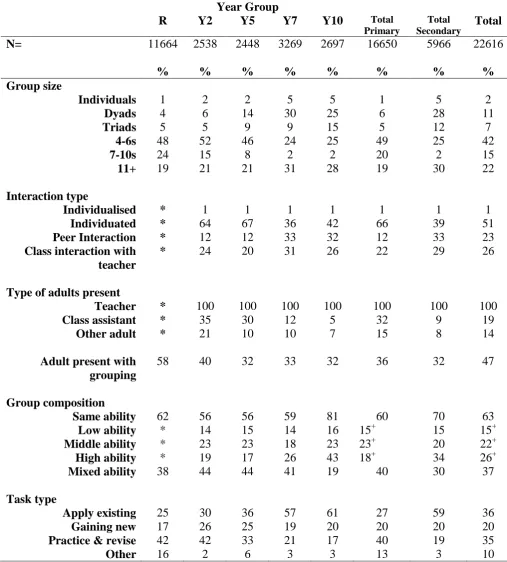
The prevalence of different grouping sizesi used in primary and secondary classes varied ( 2(20)= 4986; p<0.001) but the most common at the primary school level (around 50% of groupings) was small groups of 4-6 pupils (see Table 2). However at the secondary stage, small groups were used about a quarter of the time. In Reception classes, large groupings of 7-10 pupils were a common feature but became less frequent with age and were rare in secondary classrooms. Between Years 2 and 7, pairs were increasingly used to the point that in secondary school classrooms 25-30% of groupings were pairs. Very large groupings of pupils (usually the whole class) were more frequently experienced by pupils in secondary classrooms than in primary classrooms.
Working interactions within groupings
The types of working arrangements encouraged by teachers in classrooms varied with the age of the pupils ( 2(9)= 970; p<0.001). At the primary school stage (Years 2 and 5 only), individuated work was the most common working arrangement experienced by pupils followed by whole class interaction (see Table 2). Peer interactive work was experienced very infrequently. Individualised work was rare at both primary and secondary school levels and thus in subsequent analyses this category was combined with individuated work and termed ‘working alone’. At the secondary stage, pupils were less likely to experience individuated work but more likely to experience peer interactive work than in primary classrooms. These working arrangements, along with whole class interaction with the teacher, were much more evenly balanced in lessons in secondary classrooms.
Number of adults in classes and adult role in relation to groupings
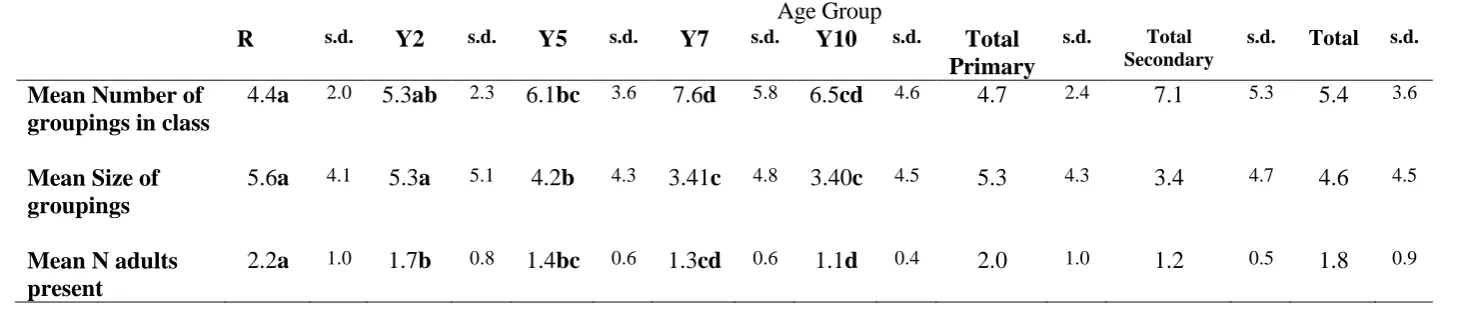
The number of adults present in classes (see Table 1) decreased with age (F(4,906)=65.6; p<0.001). Reception classes on average had more than 2 adults present in the class and Year 10 classes had only one adult present. When a second adult was present in a class this tended to be a teaching assistant (Table 2). Assistants were rarer in secondary classrooms than primary classrooms (F(3,431)=17.1; p<0.001). This demonstrates a strong preference for additional support to be available to classes consisting of the youngest pupils in school. This effect may have large implications for the practical use of groupings.
Grouping composition
Group composition varied across the age groups (Table 2) ( 2(4)= 433; p<0.001). While pupils of all ages, even Reception, were most likely to be in similar ability groupings, by Year 10 this had reached the point where virtually all pupils were grouped according to similarity in ability. The levels of low and middle ability groupings remained fairly constant across all year groups but during the secondary stage, levels of high ability groupings increased and mixed ability grouping decreased.
Curriculum area and task type
Age differences were evident in the types of task given to pupils ( 2(12= 2913; p<0.001). In Reception and Year 2 classrooms, practice and revision tasks were the most common task type (see Table 2) while in secondary classrooms pupils were most likely to be working on tasks involving the application of existing knowledge. There was an equal balance between these two task types at Year 5. Thus, as pupil age increased, groupings were more likely to be given tasks where they were expected to apply their existing knowledge to new areas and less likely to be practising or revising their skills. Tasks involving the introduction of new knowledge remained relatively constant over primary and secondary school levels.
Working interaction type in relation to grouping size
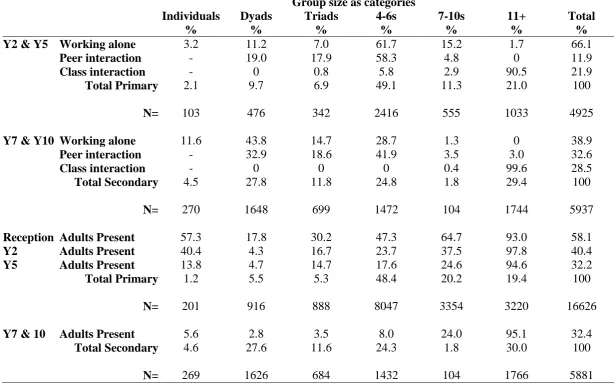
Both the primary (Years 2 and 5 only) and secondary school data show that working alone was common in all group sizes except groupings of 11 or more and in large groupings at the secondary school stage (see Table 3). In primary classrooms, peer interactive work was most often conducted in small groups but, proportionally, dyads and triads were more likely to involve peer interactive work than other types of working arrangement ( 2(10)= 4231; p<0.001). At the secondary level, individuated work was most often experienced in pairs and, proportionally, triads and small groups were more likely to be associated with peer interaction than other working arrangements ( 2(10)= 6102; p<0.001). At both primary and secondary school stages, groups of 11 or more pupils (usually whole classes) were most likely to be listening to and interacting with the teacher than other group sizes.
Adult presence in relation to the number and size of groupings
classes increased with the number of groupings at Reception (r=0.36; n=476; p<0.001) and Year 2 (r=0.24; n=92; p<0.05) but not at Years 5, 7 or 10. At both primary and secondary school levels, adults were most likely to be present with very large groupings (see Table 3) and large groups of 7-10 (Primary - 2(5)= 3772; p<0.001; Secondary - 2(5)= 4558; p<0.001). Small groups, triads and especially dyads were least likely to have an adult present and were thus the main grouping size where pupils work independently. However, as age increased adults were decreasingly likely to support individuals ( 2(4)= 128.9; p<0.001). Thus in Reception classes individual pupils were more likely to have an adult present than not, but by the Secondary stage very few individuals, dyads, triads, small or large groups were supported by an adult.
Task type in relation to grouping sizeii
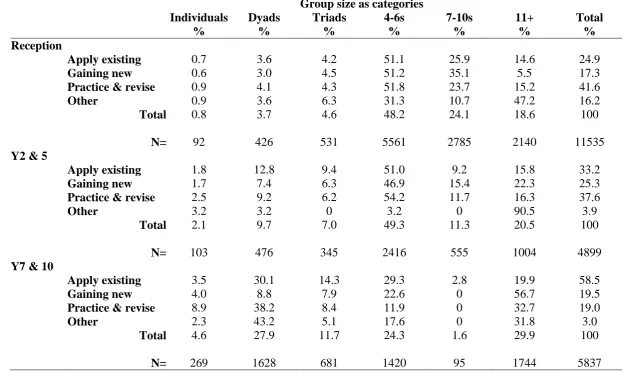
In primary classrooms most types of learning task were conducted in small groups (see Table 4) and thus there was no distinct relationship between grouping size and task type. However, some trends are apparent if the data are looked at within rather than across grouping sizes. At the Reception level, large groupings of 7-10 pupils were proportionally more likely to be engaged on tasks involving the introduction of new information ( 2(15)= 1463; p<0.001). At Years 2 and 5, dyads were more likely to work on tasks involving the application of skills than other task types and very large groupings were most likely to be gaining new knowledge than working on other task types ( 2(15)= 691.3; p<0.001).
The findings at the secondary school stage indicate a clearer relationship between task type and grouping size ( 2(15)= 884.9; p<0.001). Groupings of 11 or more pupils were most likely to be working on tasks involving the introduction of new knowledge. The application of existing knowledge was most connected to dyads (the most common grouping size at this level) but also small groups. Practice and revision tasks were most often conducted in dyads and very large groupings involving 11 or more pupils.
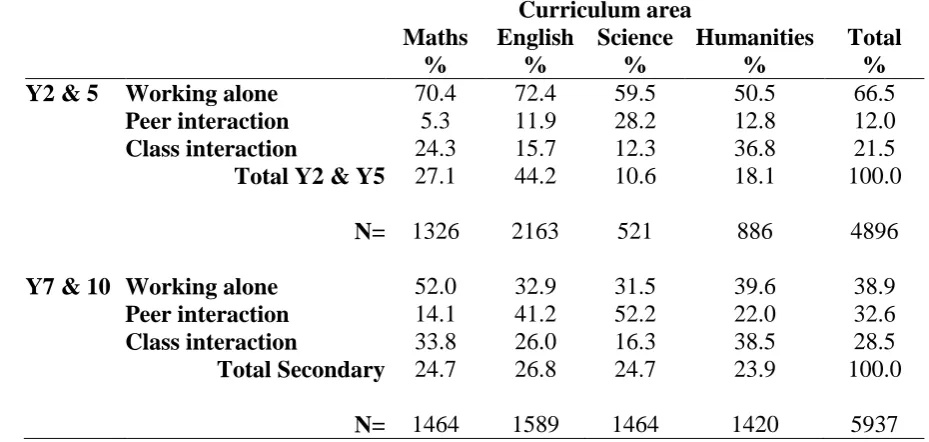
Working interaction type in relation to curriculum area
Working interaction type in relation to task type ii
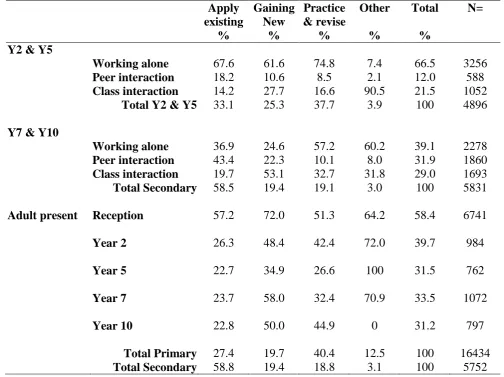
As can be seen in Table 6, data at both the primary (Years 2 and 5 only) and secondary school stages show that no single interaction type was used for a particular type of learning task. At the primary school level, working alone was used for all types of task. However, pupils in primary classrooms were slightly more likely to be working alone on practice and revision tasks. When pupils at this level worked together on a task this most often involved the application of existing knowledge, and when engaged as a class interacting with the teacher this often involved the gaining of new knowledge. At the secondary school stage, the patterns were similar but clearer. Working alone was most likely to involve the practice and revision of knowledge and other task types; peer interaction was associated with the application of existing knowledge and teacher-class interaction for the gaining new knowledge.
Adult presence in relation to task type
Although adult presence decreased with age there were some persistent patterns across the different year groups in terms of the data on the relation between adult presence and task type (Table 6). At all ages, adults were most likely to be present during tasks involving the development of new knowledge and skills ( 2(3)= 926.5; p<0.001). Teachers were also least likely to be present when pupils were applying existing knowledge and skills to new areas except at Reception level.
DISCUSSION
This paper examined the relationships between the age of pupils and the grouping practices employed by teachers within classrooms in primary and secondary schools. The findings reveal some interesting ways in which classroom organisation and grouping practices change over primary and secondary schooling. It is perhaps of little surprise that pupils were increasingly likely to experience more formal teaching and learning situations from Key Stage 2 (children aged between 7 and 11 years) onwards, seen in terms of a greater organisation of classes by ability into sets, particularly for Literacy/English and Numeracy/Mathematics, and row and pair seating arrangements and the reduced use of seating in groups. Primary school teachers most often used small groups but from Year 5 they used dyads increasingly. Primary teachers decreasingly used large groups of 7-10 pupils and secondary school teachers made greater use of very large groupings of 11+ pupils.
class interactions with the teacher and peer interactive work, and were less likely to experience individuated work.
A key finding was that the number of adults present in classes decreased as pupils got older. Primary classrooms often had additional adults present to support pupils yet by the secondary school stage this was rare. Grouping composition varied with pupil age, though only slightly. The high incidence of homogenous ability grouping was surprising, particularly in the early years of primary schooling, and there was only a slight increase in prevalence at Year 10. The main task type worked on varied according to the age of pupils. At Reception and Year 2, pupils were most likely to be practising and revising skills, a similar finding to that reported by Bennett et al., (1984). However from Year 5 onwards, tasks involving the application of existing knowledge to new problems became increasingly predominant. Gaining new knowledge remained relatively constant over primary and secondary school levels. The prevalence of practice tasks in early schooling reflects a greater emphasis by teachers and the curriculum on pupils getting to grips with basic skills.
Grouping size relative to working interaction type
Pupils in primary classrooms were most likely to be working alone yet were most often seated in groups. This is consistent with previous research (Galton et al., 1980; Galton et al., 1999) and the reason for concern is that when pupils are expected to work alone they are more likely to be drawn off-task by others sitting near to them (Hastings & Schweiso, 1995). At the secondary stage, the relationship between grouping size and type of working interaction was much clearer. Very large groupings of pupils were most frequently engaged in whole class interaction with an adult, pairs were most regularly engaged in individual work, and triads and small groups were most closely linked to peer interaction.
Number and size of groupings relative to adult presence
Grouping size and task type
The lack of a clear relationship between task type and grouping size at the primary school level suggests that primary teachers may not fully consider grouping size when allocating tasks to pupils. By contrast, data at the secondary stage are much clearer and when the more subtle patterns at the primary school level are considered some relationships are also evident. Large groups, particularly in Reception classes, and very large groupings across all other year groups, were most often involved the introduction of new information. At Years 2 and 5, pairs were most likely to be asked to apply existing knowledge and small groups undertook practise and revision tasks. This pattern was reversed at the secondary school stage. These findings suggest that secondary teachers, more than primary teachers, have a sense of the important relationship between grouping size and task type.
Working interaction type relative to curriculum area and task type
Results relating grouping practices to curriculum area revealed some surprising consistencies. At the primary school stage, grouping practices would not be expected to vary greatly across the curriculum since primary teachers teach the full curriculum. At the secondary level, differences between teachers in teaching and learning practices across different subjects have been attributed to teacher-curriculum subcultures (Goodson & Managan, 1995). However, in the current research, grouping practices were found to vary across curriculum subjects at both secondary and primary stages. Pupils were most likely to work together in Science and least likely in Mathematics which was most consistently related to individuated work and whole class interaction with the teacher. This suggests that grouping practices are believed to be more suited to teaching particular subjects. However, the reason for the reluctant use of group work in Mathematics is unclear since peer interactive work can be used effectively in all subjects. English was the only area to show changes with pupil age, peer interactive work being increasingly, and individual work decreasingly, used as pupils got older.
tasks involving new knowledge. When pupils worked alone they were most likely to be engaged in practice and revision tasks.
Changing grouping practices with development
Our findings therefore indicate a number of changes in grouping practices with pupil age. The key questions here are whether teachers adapt their practices to pupil development, what their practices reveal about their pedagogy, and to what extent they maximise pupils’ learning potential by using the effective practices suggested by developmental and educational research.
A number of changes in grouping practices with pupil age seem to be linked to the decreasing amount of extra adult support available. The availability of extra adult support is a decision made at the school level rather than by the teacher. Nevertheless, teachers seem to adapt their grouping practices and classroom organisation to the presence and absence of these additional adults rather than to the age of pupils per se. At Reception and Year 2, teachers organise their classrooms according to the number of additional adults present so that they can maximise adult-pupil interaction. Seating in these classes tends to be into a few large or small groups for this very purpose. This extra adult support for the youngest pupils in primary school makes some sense developmentally. Young children are less able to remain on-task, are easily distracted and may find it difficult to learn individually or independently together with peers. Further, research suggests that instructed learning may be more successful with young children than certain forms of group work (Tomasello et al., 1993). However, adult supported large and small group settings do not match the ideal of one to one support and tutoring by an adult (as recommended by Rogoff, 1990; Tharp & Gallimore, 1991; Wood & Wood, 1996).
From Year 5 into secondary schooling the presence of additional adult support was scarce and the number and size of groupings did not relate to the number of adults present. There is thus an expectation that pupils are more able to work independently and some evidence of this is reflected through the increasing use of smaller groupings to work individually rather than making greater use of larger groupings that are more easily controlled. However, there were also indications that teachers tried to maintain control of pupils’ behaviour and attention by using more formal row and paired seating, where pupils face the front of the class, and by directing teaching and support to very large groupings, usually whole classes. These practices seem to be aimed at promoting on-task attention and teacher-pupil interaction and individual work and may be considered good practice where the only aim is to encourage these working interactions.
ability and simplifies the teaching process. The widespread use of small groups in primary classes may also enable teachers to work effectively with small groups (see Blatchford et al., 2001a) and allows differentiation by task while allowing the teacher to support a number of pupils at a time. These practices may be seen as a crude effort to align pupils’ zones of proximal development (Vygotsky, 1978), such that a number of pupils can be taught simultaneously. This may be an efficient approach but it is also one which may not allow sufficient sensitivity to individual pupils’ learning needs.
Importantly, both didactic instruction and individual learning are limited in that they are only suitable for particular types of learning tasks and may not make the most of pupils’ learning potential as suggested by developmental and educational research. The reason for this is because both didactic and individual learning encourage passivity in learning, even when tempered with greater teacher-pupil interactivity. They also constrain pupil autonomy by preventing pupils from taking responsibility for their own learning, an important ingredient for encouraging pupils’ motivation to learn as well as metacognitive learning strategies. While the developmental research literature is somewhat limited in its applicability to classroom learning contexts, it emphasises the benefits of effective peer learning since it can encourage greater active learning, depth in understanding as well as independent thinking and responsibility in one’s own learning.
frequently associated with tasks involving the application of existing knowledge rather than practice tasks or tasks which introduced new knowledge. These findings suggest that secondary teachers have an awareness of the importance of creating the appropriate grouping and task contexts for peer interactive work. Future research should aim to examine these situations in more depth since the relationship between the nature and quality of the peer interactive work and the task is crucial for effective learning.
There may, however, be good reasons for absence of peer interactive work in primary classrooms and some secondary classes (e.g. in Mathematics). Throughout primary school, pupils are only just beginning to be able to engage in these forms of interaction and it may be the case that they are not able to do this without considerable support from an adult. These forms of working require pupils to take responsibility for their own learning, along with the presence of mind and complex communication skills to be able to resolve disputes and to reach a democratic consensus. This may be a challenge when they are used to being dependent on adults. Research evidence supports this view. Teachers and pupils often have concerns about group work. There is a general belief that children do not learn from peer interaction (Lewis & Cowie, 1993). Teachers also suggest that group work can often mean increased disruption, increased pupil conflict and that it is only useful for high or low ability pupils (Cowie, Smith, Boulton & Laver, 1994; Cohen & Intilli, 1981; Lewis & Cowie, 1993). Creating effective group working tasks and conditions is harder and more time consuming than a traditional didactic and independent learning approach. Teachers may not feel that they have the skill, time or resources to help them make peer interactive learning work. This may be especially the case since there has been a shortage of research examining how group work involving high level talk and learning can be used effectively in primary classrooms (though see Mercer, 2000). This is a task currently being undertaken by the current authors (see Blatchford et al., this volume).
Table 1: Shows year group means and standard deviations for the number of groupings in class, the size of groupings and the number of adults in classes
Age Group
R s.d. Y2 s.d. Y5 s.d. Y7 s.d. Y10 s.d. Total Primary
s.d. Total Secondary
s.d. Total s.d.
Mean Number of groupings in class
4.4a 2.0 5.3ab 2.3 6.1bc 3.6 7.6d 5.8 6.5cd 4.6 4.7 2.4 7.1 5.3 5.4 3.6
Mean Size of groupings
5.6a 4.1 5.3a 5.1 4.2b 4.3 3.41c 4.8 3.40c 4.5 5.3 4.3 3.4 4.7 4.6 4.5
Mean N adults present
2.2a 1.0 1.7b 0.8 1.4bc 0.6 1.3cd 0.6 1.1d 0.4 2.0 1.0 1.2 0.5 1.8 0.9
R=Reception; Y2=Year 2; Y5=Year 5; Y7=Year 7; Y10=Year 10.
Table 2: Group size, interaction type, adult presence, group composition and task type in relation to Year group
Year Group
R Y2 Y5 Y7 Y10 Total Primary
Total
Secondary Total
N= 11664 2538 2448 3269 2697 16650 5966 22616
% % % % % % % %
Group size
Individuals 1 2 2 5 5 1 5 2
Dyads 4 6 14 30 25 6 28 11
Triads 5 5 9 9 15 5 12 7
4-6s 48 52 46 24 25 49 25 42
7-10s 24 15 8 2 2 20 2 15
11+ 19 21 21 31 28 19 30 22
Interaction type
Individualised * 1 1 1 1 1 1 1
Individuated * 64 67 36 42 66 39 51
Peer Interaction * 12 12 33 32 12 33 23
Class interaction with teacher
* 24 20 31 26 22 29 26
Type of adults present
Teacher * 100 100 100 100 100 100 100
Class assistant * 35 30 12 5 32 9 19
Other adult * 21 10 10 7 15 8 14
Adult present with grouping
58 40 32 33 32 36 32 47
Group composition
Same ability 62 56 56 59 81 60 70 63
Low ability * 14 15 14 16 15+ 15 15+
Middle ability * 23 23 18 23 23+ 20 22+
High ability * 19 17 26 43 18+ 34 26+
Mixed ability 38 44 44 41 19 40 30 37
Task type
Apply existing 25 30 36 57 61 27 59 36
Gaining new 17 26 25 19 20 20 20 20
Practice & revise 42 42 33 21 17 40 19 35
Other 16 2 6 3 3 13 3 10
R=Reception; Y2=Year 2; Y5=Year 5; Y7=Year 7; Y10=Year 10.
* - data not available
+
Table 3: Interaction type and adult presence in relation to group size and year group
Group size as categories
Individuals Dyads Triads 4-6s 7-10s 11+ Total
% % % % % % %
Y2 & Y5 Working alone 3.2 11.2 7.0 61.7 15.2 1.7 66.1
Peer interaction - 19.0 17.9 58.3 4.8 0 11.9
Class interaction - 0 0.8 5.8 2.9 90.5 21.9
Total Primary 2.1 9.7 6.9 49.1 11.3 21.0 100
N= 103 476 342 2416 555 1033 4925
Y7 & Y10 Working alone 11.6 43.8 14.7 28.7 1.3 0 38.9
Peer interaction - 32.9 18.6 41.9 3.5 3.0 32.6
Class interaction - 0 0 0 0.4 99.6 28.5
Total Secondary 4.5 27.8 11.8 24.8 1.8 29.4 100
N= 270 1648 699 1472 104 1744 5937
Reception Adults Present 57.3 17.8 30.2 47.3 64.7 93.0 58.1
Y2 Adults Present 40.4 4.3 16.7 23.7 37.5 97.8 40.4
Y5 Adults Present 13.8 4.7 14.7 17.6 24.6 94.6 32.2
Total Primary 1.2 5.5 5.3 48.4 20.2 19.4 100
N= 201 916 888 8047 3354 3220 16626
Y7 & 10 Adults Present 5.6 2.8 3.5 8.0 24.0 95.1 32.4
Total Secondary 4.6 27.6 11.6 24.3 1.8 30.0 100
N= 269 1626 684 1432 104 1766 5881
Table 4: Task type in relation to group size and year group
Group size as categories
Individuals Dyads Triads 4-6s 7-10s 11+ Total
% % % % % % %
Reception
Apply existing 0.7 3.6 4.2 51.1 25.9 14.6 24.9
Gaining new 0.6 3.0 4.5 51.2 35.1 5.5 17.3
Practice & revise 0.9 4.1 4.3 51.8 23.7 15.2 41.6
Other 0.9 3.6 6.3 31.3 10.7 47.2 16.2
Total 0.8 3.7 4.6 48.2 24.1 18.6 100
N= 92 426 531 5561 2785 2140 11535
Y2 & 5
Apply existing 1.8 12.8 9.4 51.0 9.2 15.8 33.2
Gaining new 1.7 7.4 6.3 46.9 15.4 22.3 25.3
Practice & revise 2.5 9.2 6.2 54.2 11.7 16.3 37.6
Other 3.2 3.2 0 3.2 0 90.5 3.9
Total 2.1 9.7 7.0 49.3 11.3 20.5 100
N= 103 476 345 2416 555 1004 4899
Y7 & 10
Apply existing 3.5 30.1 14.3 29.3 2.8 19.9 58.5
Gaining new 4.0 8.8 7.9 22.6 0 56.7 19.5
Practice & revise 8.9 38.2 8.4 11.9 0 32.7 19.0
Other 2.3 43.2 5.1 17.6 0 31.8 3.0
Total 4.6 27.9 11.7 24.3 1.6 29.9 100
N= 269 1628 681 1420 95 1744 5837
Table 5: Interaction type in relation to curriculum area and year group
Curriculum area
Maths English Science Humanities Total
% % % % %
Y2 & 5 Working alone 70.4 72.4 59.5 50.5 66.5
Peer interaction 5.3 11.9 28.2 12.8 12.0
Class interaction 24.3 15.7 12.3 36.8 21.5
Total Y2 & Y5 27.1 44.2 10.6 18.1 100.0
N= 1326 2163 521 886 4896
Y7 & 10 Working alone 52.0 32.9 31.5 39.6 38.9
Peer interaction 14.1 41.2 52.2 22.0 32.6
Class interaction 33.8 26.0 16.3 38.5 28.5
Total Secondary 24.7 26.8 24.7 23.9 100.0
N= 1464 1589 1464 1420 5937
Table 6: Interaction type and adults present in relation to task type and year group
Apply existing
Gaining New
Practice & revise
Other Total N=
% % % % %
Y2 & Y5
Working alone 67.6 61.6 74.8 7.4 66.5 3256
Peer interaction 18.2 10.6 8.5 2.1 12.0 588
Class interaction 14.2 27.7 16.6 90.5 21.5 1052
Total Y2 & Y5 33.1 25.3 37.7 3.9 100 4896
Y7 & Y10
Working alone 36.9 24.6 57.2 60.2 39.1 2278
Peer interaction 43.4 22.3 10.1 8.0 31.9 1860
Class interaction 19.7 53.1 32.7 31.8 29.0 1693
Total Secondary 58.5 19.4 19.1 3.0 100 5831
Adult present Reception 57.2 72.0 51.3 64.2 58.4 6741
Year 2 26.3 48.4 42.4 72.0 39.7 984
Year 5 22.7 34.9 26.6 100 31.5 762
Year 7 23.7 58.0 32.4 70.9 33.5 1072
Year 10 22.8 50.0 44.9 0 31.2 797
Total Primary 27.4 19.7 40.4 12.5 100 16434
Total Secondary 58.8 19.4 18.8 3.1 100 5752
REFERENCES
Alexander, P., Schallert, D. & Hare, V. (1991). Coming to terms: how researchers in learning and literacy talk about knowledge, Review of Educational Research, 61(3) pp.315-343.
Azmitia, M. & Perlmutter, M. (1989). Social influences on children’s cognition: state of the art and future directions. In H. Reese (Ed.) Advances in Child Development and Behavior, 22, 89-144. New York:Academic Press.
Baines, E. (1996). Discourse Topic Management and Discussion Skills of 4-, 6- and 9-Year-Olds.
Unpublished PhD Thesis. University of Strathclyde.
Benn, C. & Chitty, C. (1996). Thirty Years on: Is Comprehensive Education Alive and Well or Struggling to Survive? London: David Fulton Publishers.
Bennett, N., Desforge, C., Cockburn, A. & Wilkinson, B. (1984). The quality of pupils’ learning
experiences. London: Lawrence Erlbaum Associates.
Bennett, N. & Dunne, E. (1992). Managing Groups. Hemel Hempstead: Simon & Schuster Education.
Blatchford, P., Baines, E., Kutnick, P. & Martin, C. (2001a). Classroom contexts: connections between class size and within-class grouping. British Journal of Educational Psychology,
71, 283-302.
Blatchford, P., Kutnick, P., Clark, H., McIntyre, H. & Baines, E. (2001b). The Nature and Use of Within-class Groupings in Secondary Schools. Final report to ESRC.
Blatchford, P., Moriarty, V., Edmonds, S. & Martin, C. (2002). Relationships between class size and teaching: a multimethod analysis of English infant schools. American Education Research Journal, 39(1) 101-132.
Bloom, B.S. (1956). Taxonomy of educational objectives: the classification of educational goals.
Handbook 1, Cognitive Domain. London: Longman
Bossert, S., Barnett, B. & Filby, N. (1985). Grouping and Instructional Organisation. In P. Peterson, L. Wilkinson & M. Hallinan (Eds.), The Social Context of Instruction. Orlando, Fla: Academic Press.
Bronfenbrenner, U. (1979). The Ecology of Human Development. Cambridge, MA: Harvard University Press.
Cohen, E.G. & Intilli, J.K. (1981). Interdependence and Management in Bilingual Classrooms.
Final Report No. NIE-G-80-0217). Stanford University, School of Education.
Cowie, H., Smith, P., Boulton, M. & Laver, R. (1994). Cooperation in the Multi-Ethnic Classroom.
London: David Foulton
Doise, W. & Mugny, G. (1984). The Social Development of the Intellect. Oxford: Pergamon.
Dorval, B. and Eckerman, C. O. (1984). Developmental trends in the quality of conversation achieved by small groups of acquainted peers. Monographs of the Society for Research in Child Development. 49 (2, Serial No. 206).
Doyle, W. (1980). Classroom Management. West Lafayette, IN: Kappa Delta Pi Doyle, W. (1983). Academic work. Review of Educational Research, 53, 159-199
Doyle, W. (1986). Classroom Organization and Management. In M.C. Wittrock (Ed.) Handbook of Research on Teaching, 3rd Edition. New York: Macmillan.
Dreeben, R. (1984). First grade reading groups: their formation and change. In P. Peterson, L. Wilkinson & M. Hallinan (Eds.) The Social Context of Instruction. Orlando, FL: Academic Press.
Foot, H. & Barron, A. (1990). Friendship and task management in children’s peer tutoring.
Educational Studies, 16(3), 237-250.
Forman, E. (1992). Discourse, intersubjectivity, and the development of peer collaboration: a Vygotskian approach. In L. Winegar & J. Valsiner (Eds.) Children’s Development within Social Context: Metatheory and Theory, Volume 1, London: Lawrence Erlbaum Associates. Forman, E. & Cazden, C. B. (1985). Exploring Vygotskian perspectives in education: the cognitive
value of peer interaction. In J.V. Wertsch (Ed.) Culture, communication and cognition.
Cambridge: Cambridge University Press.
Fuchs, L., Fuchs, D., Kazdan, S., Karns, K., Calhoon, M., Hamlett, C. & Hewlett, S. (2000). Effects of workgroup structure and size on student productivity during collaborative work on complex tasks. The Elementary School Journal, 100(3), 183-212.
Galton, M. & Williamson, J. (1992). Group Work in the Primary Classroom. London: Routledge. Galton, M., Hargreaves, L., Comber, C., Wall, D. & Pell, A. (1999). Inside the Primary Classroom
20 Years on. London: Routledge.
Galton, M., Simon, B. & Croll, P. (1980). Inside the Primary Classroom. London: Routledge & Kegan Paul.
Goodson, I. F. & Managan, J.M. (1995). Subject Cultures and the Introduction of Classroom Computers. British Educational Research Journal, 25(5), 613-628.
Hallam, S. & Toutounji, I. (1996). What Do We Know About the Grouping of Pupils by Ability?
London: Institute of Education.
Hastings, N. & Chantrey-Wood, K. (2002). Reorganizing Primary Classroom Learning. Open University Press.
Hogan, D. & Tudge, J. (1999). Implications of Vygotsky’s theory for peer learning. In A. O’Donnell & A. King (Eds.) Cognitive Perspectives on Peer Learning. London: Lawrence Erlbaum Associates.
Howe, C.J. (1997). Gender and Classroom Interaction: A Research Review. SCRE
Howe, C., Duchak-Tanner, V. & Tolmie, A. (2000). Co-ordinating support for conceptual and procedural learning in science. In R. Joiner, K. Littleton, D. Faulkner & D. Miell (Eds)
Rethinking Collaborative Learning. London: Free Association Books.
Jackson, A. & Kutnick, P. (1996). Group work and computers: the effects of type of task on children's performance, Journal of Computer Assisted Learning, 12, 162-71.
Johnson, D. & Johnson, R. (1987). Learning Together and Alone. Englewood Cliffs: Prentice-Hall. Kutnick, P. (1994). Use and Effectiveness of Groups in Classrooms. In P. Kutnick & C. Rogers
(Eds.), Groups in Schools. London: Cassell.
Kutnick, P. & Kington, A. (in preparation). Children’s Friendships and Learning in School; cognitive enhancement through social interaction?
Kutnick, P. & Rogers, C. (1994). Groups in Classrooms. In P. Kutnick & C. Rogers (Eds.), Groups in Schools. London: Cassell.
Kutnick, P., Blatchford, P. & Baines, E. (2002). Pupil groupings in primary school classrooms: sites for learning and social pedagogy? British Education Research Journal, 28(2) 188-206. Lewis, J. & Cowie, H. (1993). Cooperative Group Work: Promises and Limitations a Study of
Teachers’ Values. Education Section Review, 17(2), 77-84.
Lou, Y., Abrami, P.C., Spence, J.C., Poulsen, C., Chambers, B. & d’Apollonia, S. (1996) Within-Class Grouping: A Meta-Analysis, Review of Educational Research. 66(4), 423-458.
Murphy, N. & Messer, D. (1998). When it helps to work alone: the transfer of children’s ability between balancing tasks. Poster presented at BPS Developmental Psychology Section Annual Conference, Lancaster University, September 1998.
Mercer, N. (2000). Words and minds : how we use language to think together. London : Routledge. Miller, M. (1987). Argumentation and cognition. In M. Hickman (Ed.) Social and functional
approaches to language and thought. London: Academic Press
Mortimore, P., Sammons, P., Stoll, L., Lewis, D. & Ecob, R. (1988). School Matters, Wells: Open Books.
Nasasti, B. & Clements, D. (1991). Research on co-operative learning, implications for practice.
School Psychology Review, 20, 110-131.
Norman, D. A. (1978). Notes Towards a Complex Theory of Learning. In A.M. Lesgold (Ed.)
OFSTED (1995). The Annual Report of Her Majesty’s Chief Inspector of Schools, Standards and
Quality in Education 1993/94. London: HMSO.
Piaget, J. (1928, trans. 1959). Language and Thought of the Child. London: Routledge & Kegan Paul.
Pica, T., Kanagy, R. and Falodun, J. (1993). Choosing and using communication tasks for second language instruction and research. In G. Crookes and S. M. Gass (Eds.) Tasks and language learning. Clevedon: Multilingual Matters.
Pollard, A., Broadfoot, P., Croll, P. Osborn, M. & Abbott, D. (1994). Changing English Primary Schools? London: Cassell.
Rogoff, B. (1990). Apprenticeship in thinking: cognitive development in social context. New York: Oxford University Press.
Slavin, R. (1990). Co-operative Learning. In C. Rogers and P. Kutnick (Eds.) The Social Psychology of the Primary School. London: Routledge.
Smith, P. (1994). What children learn from playtime and what adults can learn from it. In P. Blatchford & S. Sharp (Eds.) Breaktime and the school: understanding and changing playground behaviour. London: Routledge
Tharp, R. & Gallimore, R. (1991). A theory of teaching as assisted performance In P. Light, S. Sheldon & M. Woodhead (Eds.) Learning to Think. London: Routledge.
Tizard, B., Blatchford, P., Burke, J., Farquhar, C. & Plewis, I. (1988). Young Children at School in the Inner City. Hove: LEA.
Tolmie, A., Howe, C., Duchak, V. & Rattray, C. (1998). Group Work and the Integration of Conceptual and Procedural Knowledge in Primary Science. Paper at BPS Developmental Section Conference, Lancaster University.
Tomasello, M., Kruger, A.C. & Ratner, H.H. (1993). Cultural Learning. Behavioral and Brain Sciences, 16, 495-552.
Topping, K. (1994). Peer tutoring. In P. Kutnick & C. Rogers (Eds.), Groups in Schools. London: Cassell.
Vygotsky (1978). Mind in Society: The Development of Higher Mental Processes. Cambridge, Mass: Harvard University Press.
Watkins, C. & Mortimore, P. (1999). Pedagogy: what do we know? In P. Mortimore (Ed.)
Understanding pedagogy and its impact on learning. London: Paul Chapman Publishing Ltd.
Webb, N. (1989). Peer interaction and learning in small groups. International Journal of Educational Research, 13, 1, 21-39.
Wood, D. (1998). How Children Think and Learn: The Social Contexts of Cognitive Development. 2nd Edition Oxford: Blackwell.
Wood, D. & Wood, H. (1996). Vygotsky, Tutoring and Learning. Oxford Review of Education, 22,
(1), 5-16.
Zajac, R.J. & Hartup, W.W. (1997). Friends as Co-workers: Research Review and Classroom Implications. Elementary School Journal, 98(1), 3-13.
i
A comparison of classes in terms of group size is difficult as classes vary in the number of groups they have. An examination of group size regardless of the number of pupils it contains leads to a bias in favour of small groups. That is, if groups are given equal weighting in an analysis, a class with 15 pairs will contribute more to the analysis than a class with one group of 30 pupils even though the same number of pupils may be involved. A consideration of group size in relation to the number of pupils that it contains gives a more accurate picture of the groupings that pupils are most likely to experience in classrooms and is thus the method used in the present analysis.
ii These data vary slightly from those reported in Kutnick et al., (2002) because in the current paper row totals are