No stable static spherically symmetric wormholes in
Horn-deski theory
Oleg Evseev1,2,∗and Oleg Melichev1,2,∗∗
1Institute for Nuclear Research of the Russian Academy of Sciences, 60th October Anniversary
Prospect 7a, Moscow, 117312, Russia
2Department of Particle Physics and Cosmology, Physics Faculty, M. V. Lomonosov Moscow State
University, Vorobyovy Gory, 1-2, Moscow 119991, Russia
Abstract. We consider the most general theory of a single scalar field with the second order field equations, the Horndeski theory, in four-dimensional space-time. We show that static, spherically symmetric, asymptotically flat, Lorentzian wormholes are unstable in this theory.
1 Introduction
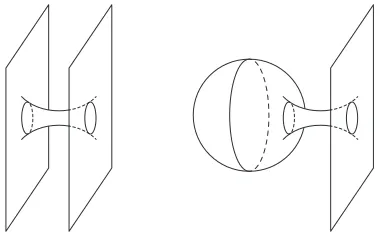
Wormholes [1–6] and semiclosed worlds [7–10] are spatial geometries with a throat which connects either two flat spaces or a flat space and a closed world, respectively.
Figure 1. A wormhole (on the left) and a semiclosed world (on the right). The static case; the third spatial dimension is omitted.
If they are traversable, they both have the trapped surface (see figure 1). This, combined with the noncompactness of the Cauchy hypersurface and the Null Energy Condition (NEC):
Gµνηµην≥0 for any null vectorηµ, (1)
whereGµν =Rµν−12Rgµνis the Einstein tensor, leads to the singularity in finite future: this is the result of the Penrose theorem [11]. The condition (1) for matter minimally coupled to
gravity reads
Tµνηµην≥0 for any null vectorηµ, (2) whereTµνis the energy-momentum tensor of matter. The NEC is hard to violate; it holds for all known forms of matter.
According to the Penrose theorem [11], there is a theoretical opportunity to construct a stable static spherically symmetric wormhole in theories violating NEC. We consider the most general scalar field theory with second-order field equations, the Horndeski theory (gen-eralised Galileons plus gravity):
S =
d4xL
2+L3+L4+L5, (3)
L2=K(φ,X), L3=−G3(φ,X)φ,
L4=G4(φ,X)R+G4X(φ)2−(∇µ∇νφ)2
,
L5=G5(φ,X)Gµν∇µ∇νφ− 1 6G5X
(φ)3−3φ(∇
µ∇νφ)2+2(∇µ∇νφ)3
,
whereX=−12∇µφ∇µφ,φ=∇
µ∇µφ,Ris the scalar curvature,Gµνis the Einstein tensor and metric signature is (−,+,+,+).
This class of theories is known to have order field equations despite the second-order derivatives in the Lagrangian. The most general scalar field theory with such property was first derived by Horndeski in 1974 [12] but stayed unnoticed until 1992 when it was reintroduced by Fairlie, Govaerts and Morozov [13–15] and became popular quite recently [16–32]. The point is that Horndeski theories are capable, at least in principle, of violating the NEC without obvious pathologies.
It has been shown, however, that both asymptotically flat, static, spherically symmetric wormholes [33, 34] and semiclosed worlds [35] are unstable in theories withG4 =MPl2/2=
const,G5=0.
The purpose of this paper is to extend this result to wormholes in the most general Horn-deski theory (3). The proof of the analogous (by interchanging time and radial coordinate) no-go theorem for bouncing cosmologies withinG3 theories plus gravity was given in [36] and generalised to the case of the interaction of the Galileon field with an extra scalar field in [37]. Afterwards, this proof was further extended to the full Horndeski theory in [38] and the multi-Galileon Horndeski theory in [39].
The paper is organised as follows. We give a brief review of the essential for our argument results obtained by Kobayashi, Motohashi and Suyama [40, 41] in Sec. 2, considering both odd (Subsec. 2.1) and even (Subsec. 2.2) sectors. Finally, we prove the instability in Sec. 3.
2 Stability conditions
The configuration to consider is static and spherically symmetric, so we use the most general form of metric for that case:
ds2 =−a2(r)dt2+ dr2
b2(r)+c2(r)
and use the gauge
a(r)=b(r). (5)
The asymptotic behaviour of metric functions asr→ ±∞is the following:
a(r)→1, c(r)→ |r|. (6)
As we are working with the spherically symmetric Ansatz, we can now consider the de-composition of any scalar under the rotations of a 2D sphere in spherical harmonicsYm
l θ, ϕ:
s(t,r, θ, ϕ)=
∞
l=0 l
m=−l
slm(t,r)Ym
l θ, ϕ. (7)
Any vectorVaand symmetric tensorTabcan be decomposed as follows:
Va(t,r, θ, ϕ)=
γ
∇aΦ1(t,r, θ, ϕ)+Eba γ
∇bΦ2(t,r, θ, ϕ), (8)
Tab(t,r, θ, ϕ)=
γ
∇a γ
∇bΨ1+γabΨ2(t,r, θ, ϕ)
+1
2
Eca
γ
∇c γ
∇bΨ3(t,r, θ, ϕ)+Ecb γ
∇c γ
∇aΨ3(t,r, θ, ϕ)
. (9)
γabhere denotes the metric onS2; γ
∇ais the covariant derivative1forγab;Eab = detγ εab, εab is the Levi-Civita symbol,εθϕ = 1;Φ1,Φ2,Ψ1,Ψ2,Ψ3 are arbitrary scalar functions;
Ym
l θ, ϕare spherical harmonics. We can now replaceΦ1,Φ2,Ψ1,Ψ2andΨ3with the cor-responding decompositions using (7) and obtain all scalars, vectors and symmetric second-order tensors in terms of spherical harmonics.
Notice that terms withEab get a factor (−1)l under parity transformationθ, ϕ → π− θ, π+ϕwhile terms withoutEab get a factor (−1)l+1 stipulating the names of modes: they are called even- and odd-parity modes, respectively.
2.1 Odd-parity sector
Odd-parity perturbations (terms withEab) read
δφ=0, htt=0, htr=0, hrr =0, (10)
hta=
∞
l=0 l
m=−l
h0,lm(t,r)Eab∂bYlmθ, ϕ, (11)
hra= ∞
l=1 l
m=−l
h1,lm(t,r)Eab∂bYlmθ, ϕ, (12)
hab =12 ∞
l=2 l
m=−l
h2,lm(t,r)
Ec
a γ
∇c γ
∇bYlmθ, ϕ+Ecb γ
∇c γ
∇aYlmθ, ϕ. (13)
The components of gauge functions in the odd-partity sector are
ξt=0, ξr=0, ξa= ∞
l=0 l
m=−l
Λlm(t,r)Eab∂bYlmθ, ϕ. (14)
1The symbol∇γashould not be confused with∇
We make use of this gauge freedom to eliminate unphysical degrees of freedom forl ≥ 2 (Regge-Wheeler approach,mis set equal to zero without loss of generality, see [40, 42] for details) and obtain the following Lagrangian for perturbations:
L(2)= l(l+1)
4(l−1)(l+2)
Aq˙2− Bq2−l(l+1)Cq2−V(r)q2, (15)
where
A=c
2
a2H 2
G , B=a2c2 H2
F , C=a2H, q=h˙1−h0+2 c
ch0, (16)
and
F =2
G4+a
2
2 φXG5X−XG5φ
, (17)
G=2G4−2XG4X+XaacφG5X+G5φ, (18)
H=2
G4−2XG4X+X
a2c
cφG5X+G5φ
. (19)
Here the background field equations are used,V(r) is the effective potential, which is
irrel-evant for our purposes,C-part corresponds to wave propagation along the angular direction. To obtain this Lagrangian,h0andh1were treated as auxiliary fields and were eliminated.
The stability conditions for this Ansatz (fist obtained by Kobayashi, Motohashi and Suyama [40]) are
F >0 for the stability along the radial direction, (20)
G>0 for abscense of ghosts, (21)
H >0 for the stability along the angular directions. (22)
2.2 Even-parity sector
The perturbations in the even-parity sector (terms withoutEab) read
δφ=
∞
l=0 l
m=−l
δφlm(t,r)Ylmθ, ϕ, htt=a2 ∞
l=0 l
m=−l
H0,lm(t,r)Ylmθ, ϕ,
htr=
∞
l=0 l
m=−l
H1,lm(t,r)Ylmθ, ϕ, hrr = 1
a2 ∞
l=0 l
m=−l
H2,lm(t,r)Ylmθ, ϕ,
hta= ∞
l=0 l
m=−l
βlm∂aYlmθ, ϕ, hra= ∞
l=0 l
m=−l
αlm∂aYlmθ, ϕ,
hab=c2 ∞
l=0 l
m=−l
Klm(t,r)γabYlmθ, ϕ+Glm(t,r) γ
∇a γ
∇bYlmθ, ϕ.
Note that in the even-parity sector, the scalar field is perturbed as well. We use the same procedure to fix the gauge and eliminate unphysical degrees of freedom (see details in [41, 42]) and derive the following Lagrangian for perturbations (once again,l≥2):
L= 1
2Ki jv˙i˙vj− 1 2Gi jvi
vj−12Qi jvivj−1
where i = 1,2, j = 1,2; v1 ≡ ψ, v2 ≡ δφ. Expressions for Ki j, Gi j, Qi j and Mi j are cumbersome; we write their combinations explicitly whenever we need them.
The absence of ghost is guaranteed whenK11 > 0 and detK > 0; we need the latter condition:
detK=4(l−1)(l+2)
2ccH+ Ξφ2F2P 1− F
l(l+1)a4H2φ22ccH+ Ξφ2 >0, (24) where
P1= (2cc
H+ Ξφ) 2c2H2 ·
d dr
c
4H4
2cc
H+ Ξφ2
,
andΞis defined as follows:
Ξ =2c2−XG3X+2a2c
cφ
G4X+2XG4XX−(XG5φ)X
+G4φ+2XG4φX− 1
c2XG5X+a2
c2
c2(3XG5X+2X2G5XX)
. (25)
In view of (20), the condition (24) becomes
2P1− F >0 (26)
3 No-go theorem
The stability conditions important for our purposes are (17) and (19) from the odd-parity sector and (26) from the even-parity sector. We introduce the new variable
Q=2cc
H+ Ξφ
c2H2 (27)
and integrate the inequality (26) fromrtor>r. In this way we obtain the stability condition in the following form:
Q−1(r)−Q−1(r)<−1 2
r
r
Fdr. (28)
LetQ−1(r) be negative at somer. Then we rewrite the inequality (28) as
Q−1(r)>Q−1(r)+1 2
r
r
Fdr (29)
and notice that if the integral in the right-hand side diverges asr → +∞, thenQ−1(r) is positive at larger, meaning thatQis singuar at some pointr∗.
LetQ−1(r) be positive at somer. Then we rewrite the inequality (28) as
Q−1(r)<Q−1(r)−1 2
r
r
Fdr. (30)
We now notice that the requirement that general relativity is restored away from the
worm-hole gives
G4→ MPl2/2
G5→0 asr→ ±∞,
leading toF → M2
Pl and thus to the divergent integrals in the right-hand sides of (29) and (30), asr→ +∞andr→ −∞, respectively. This means thatQhas to be singular. We now take a closer look at the definition ofQ, Eq. (27), and notice that:
• cis bounded from below andH>0, Eq. (22), so the denominator is non-zero for anyr;
• cis non-singular and ifH diverges, thenQ→0, notQ→ ∞;
• thus, singularQrequires either singularΞor singularφor both; in either case the solution is singular.
These statements complete the argument.
4 Acknowledgements
The authors are indebted to V. Rubakov, S. Mironov and V. Volkova for helpful discussions. This work has been supported by Russian Science Foundation Grant No. 14-22-00161.
References
[1] M.S. Morris, K.S. Thorne, Am. J. Phys.56, 395 (1988)
[2] M.S. Morris, K.S. Thorne, U. Yurtsever, Phys. Rev. Lett.61, 1446 (1988)
[3] M. Visser, Lorentzian wormholes: From Einstein to Hawking (1995), ISBN 1563966530, 9781563966538
[4] D. Hochberg, M. Visser, Phys. Rev.D58, 044021 (1998),gr-qc/9802046
[5] I.D. Novikov, N.S. Kardashev, A.A. Shatskiy, Phys. Usp.50, 965 (2007), [Usp. Fiz. Nauk177,1017(2007)]
[6] A. Shatskiy, I.D. Novikov, N.S. Kardashev, Phys. Usp.51, 457 (2008),0810.0468
[7] V.P. Frolov, M.A. Markov, V.F. Mukhanov, Phys. Rev.D41, 383 (1990) [8] E.I. Guendelman, Int. J. Mod. Phys.D19, 1357 (2010),1003.3975
[9] S.V. Chernov, V.I. Dokuchaev, Class. Quant. Grav.25, 015004 (2008),0709.0616
[10] V.I. Dokuchaev, S.V. Chernov, JETP Lett. 85, 595 (2007), [Pisma Zh. Eksp. Teor. Fiz.85,727(2007)],1208.5249
[11] R. Penrose, Phys. Rev. Lett.14, 57 (1965)
[12] G.W. Horndeski, Int. J. Theor. Phys.10, 363 (1974)
[13] D.B. Fairlie, J. Govaerts, A. Morozov, Nucl. Phys.B373, 214 (1992),hep-th/9110022
[14] D.B. Fairlie, J. Govaerts, Phys. Lett.B281, 49 (1992),hep-th/9202056
[15] D.B. Fairlie, J. Govaerts, J. Math. Phys.33, 3543 (1992),hep-th/9204074
[16] G.R. Dvali, G. Gabadadze, M. Porrati, Phys. Lett.B485, 208 (2000),hep-th/0005016
[17] M.A. Luty, M. Porrati, R. Rattazzi, JHEP09, 029 (2003),hep-th/0303116
[18] A. Nicolis, R. Rattazzi, JHEP06, 059 (2004),hep-th/0404159
[19] A. Nicolis, R. Rattazzi, E. Trincherini, Phys. Rev.D79, 064036 (2009),0811.2197
[20] C. Deffayet, G. Esposito-Farese, A. Vikman, Phys. Rev. D79, 084003 (2009),
0901.1314
We now notice that the requirement that general relativity is restored away from the
worm-hole gives
G4 →M2Pl/2
G5 →0 asr→ ±∞,
leading toF → M2
Pl and thus to the divergent integrals in the right-hand sides of (29) and (30), asr→+∞andr→ −∞, respectively. This means thatQhas to be singular. We now take a closer look at the definition ofQ, Eq. (27), and notice that:
• cis bounded from below andH >0, Eq. (22), so the denominator is non-zero for anyr;
• cis non-singular and ifHdiverges, thenQ→0, notQ→ ∞;
• thus, singularQrequires either singularΞor singularφor both; in either case the solution is singular.
These statements complete the argument.
4 Acknowledgements
The authors are indebted to V. Rubakov, S. Mironov and V. Volkova for helpful discussions. This work has been supported by Russian Science Foundation Grant No. 14-22-00161.
References
[1] M.S. Morris, K.S. Thorne, Am. J. Phys.56, 395 (1988)
[2] M.S. Morris, K.S. Thorne, U. Yurtsever, Phys. Rev. Lett.61, 1446 (1988)
[3] M. Visser, Lorentzian wormholes: From Einstein to Hawking (1995), ISBN 1563966530, 9781563966538
[4] D. Hochberg, M. Visser, Phys. Rev.D58, 044021 (1998),gr-qc/9802046
[5] I.D. Novikov, N.S. Kardashev, A.A. Shatskiy, Phys. Usp.50, 965 (2007), [Usp. Fiz. Nauk177,1017(2007)]
[6] A. Shatskiy, I.D. Novikov, N.S. Kardashev, Phys. Usp.51, 457 (2008),0810.0468
[7] V.P. Frolov, M.A. Markov, V.F. Mukhanov, Phys. Rev.D41, 383 (1990) [8] E.I. Guendelman, Int. J. Mod. Phys.D19, 1357 (2010),1003.3975
[9] S.V. Chernov, V.I. Dokuchaev, Class. Quant. Grav.25, 015004 (2008),0709.0616
[10] V.I. Dokuchaev, S.V. Chernov, JETP Lett. 85, 595 (2007), [Pisma Zh. Eksp. Teor. Fiz.85,727(2007)],1208.5249
[11] R. Penrose, Phys. Rev. Lett.14, 57 (1965)
[12] G.W. Horndeski, Int. J. Theor. Phys.10, 363 (1974)
[13] D.B. Fairlie, J. Govaerts, A. Morozov, Nucl. Phys.B373, 214 (1992),hep-th/9110022
[14] D.B. Fairlie, J. Govaerts, Phys. Lett.B281, 49 (1992),hep-th/9202056
[15] D.B. Fairlie, J. Govaerts, J. Math. Phys.33, 3543 (1992),hep-th/9204074
[16] G.R. Dvali, G. Gabadadze, M. Porrati, Phys. Lett.B485, 208 (2000),hep-th/0005016
[17] M.A. Luty, M. Porrati, R. Rattazzi, JHEP09, 029 (2003),hep-th/0303116
[18] A. Nicolis, R. Rattazzi, JHEP06, 059 (2004),hep-th/0404159
[19] A. Nicolis, R. Rattazzi, E. Trincherini, Phys. Rev.D79, 064036 (2009),0811.2197
[20] C. Deffayet, G. Esposito-Farese, A. Vikman, Phys. Rev. D79, 084003 (2009),
0901.1314
[21] C. de Rham, A.J. Tolley, JCAP1005, 015 (2010),1003.5917
[22] G. Goon, K. Hinterbichler, M. Trodden, Phys. Rev. Lett. 106, 231102 (2011),
1103.6029
[23] G. Goon, K. Hinterbichler, M. Trodden, JCAP1107, 017 (2011),1103.5745
[24] K. Kamada, T. Kobayashi, M. Yamaguchi, J. Yokoyama, Phys. Rev. D83, 083515 (2011),1012.4238
[25] T. Kobayashi, M. Yamaguchi, J. Yokoyama, Prog. Theor. Phys. 126, 511 (2011),
1105.5723
[26] E. Babichev, C. Deffayet, R. Ziour, Int. J. Mod. Phys.D18, 2147 (2009),0905.2943
[27] C. Deffayet, O. Pujolas, I. Sawicki, A. Vikman, JCAP1010, 026 (2010),1008.0048
[28] T. Kobayashi, M. Yamaguchi, J. Yokoyama, Phys. Rev. Lett. 105, 231302 (2010),
1008.0603
[29] O. Pujolas, I. Sawicki, A. Vikman, JHEP11, 156 (2011),1103.5360
[30] C. Charmousis, E.J. Copeland, A. Padilla, P.M. Saffin, Phys. Rev.D85, 104040 (2012),
1112.4866
[31] R. Kolevatov, Phys. Rev.D92, 123532 (2015),1508.00046
[32] R. Kolevatov, S. Mironov, V. Rubakov, N. Sukhov, V. Volkova, Phys. Rev.D96, 125012 (2017),1708.04262
[33] V.A. Rubakov, Teor. Mat. Fiz. 187, 338 (2016), [Theor. Math. Phys.187,no.2,743(2016)],1509.08808
[34] V.A. Rubakov, Theor. Math. Phys. 188, 1253 (2016), [Teor. Mat. Fiz.188,no.2,337(2016)],1601.06566
[35] O.A. Evseev, O.I. Melichev, Phys. Rev.D96, 024030 (2017),1607.01721
[36] M. Libanov, S. Mironov, V. Rubakov, JCAP1608, 037 (2016),1605.05992
[37] R. Kolevatov, S. Mironov, Phys. Rev.D94, 123516 (2016),1607.04099
[38] T. Kobayashi, Phys. Rev.D94, 043511 (2016),1606.05831
[39] S. Akama, T. Kobayashi, Phys. Rev.D95, 064011 (2017),1701.02926
[40] T. Kobayashi, H. Motohashi, T. Suyama, Phys. Rev.D85, 084025 (2012), [Erratum: Phys. Rev.D96,no.10,109903(2017)],1202.4893
[41] T. Kobayashi, H. Motohashi, T. Suyama, Phys. Rev.D89, 084042 (2014),1402.6740