Srikant Pimple*, Dr. Mukund Gurjar, Mahesh Shah, Akash Joshi, Pravin Maurya, Amit Jain, Ruby Singh
Formulation and Development (R & D), Department of Emcure Pharmaceuticals Ltd, Pune, Maharashtra, India.
*Corresponding author’s E-mail:[email protected]
Accepted on: 24-05-2014; Finalized on: 30-06-2014. ABSTRACT
Combination of chirally pure S (-) Amlodipine (Levoamlodipine) & Nebivolol provide a stable & effective dosage forms for the treatment of hypertension. The objective of present investigation was to formulate and optimize tablets of S (-) Amlodipine and Nebivolol as a single unit. Chirally pure S (-) Amlodipine have reduced side effects in comparison to its racemic mixture. In S (-) Amlodipine, drug action is stereo-specific and this enantiomer best fits in receptor and has highest therapeutic activity, leads to better patient compliance. In the present study formulation of tablets were done by wet granulation technique using rapid mixer granulator. Drug-excipients compatibility studies were performed and found well within limits. To obtain the desired dissolution pattern various trials had been taken with different excipients. Change in grade and quantity of Hypromellose was done, different concentration of Croscarmellose sodium was used but dissolution pattern was not in line with innovator. Further addition of water soluble ingredient like Mannitol was done and it results in desired drug release pattern in line with innovator. Final batch was taken with mannitol and dissolution was optimized and found satisfactory. Accelerated stability studies were also performed and results were within specifications.
Keywords: Combination therapy, % Drug release, Nebivolol Hydrochloride, S (-) Amlodipine Besilate (Levoamlodipine)
INTRODUCTION
ombination therapy of hypertension with separate agents or a fixed-dose combination pill offers the potential to lower blood pressure more quickly, obtain target blood pressure, and decrease adverse effects. Combination therapy improves rates of blood pressure control and requires less time to achieve target blood pressure with equivalent or better tolerability than higher-dose monotherapy. Additional benefits may include cost savings and better compliance. Combination therapies demonstrating synergistic or complementary mechanisms of action include beta blocker-diuretic; angiotensin receptor blocker - diuretic; ACE inhibitor-diuretic; calcium channel blocker-ACE inhibitor; calcium channel blocker diuretic; and a thiazide diuretic plus a
potassium-sparing diuretic.1
Nebivolol hydrochloride (1RS, 1’RS)-1, 1’-[(2RS, 2’SR) bis
(6-fluoro-3, 4-dihydro-2H-1-benzopyran-2-yl)]-2,
2’-iminodiethanol hydrochloride is a long acting, cardio selective beta blockers, for the treatment of hypertension. Nebivolol hydrochloride has half-life of about 12 hours; molecular weight 441.90 g/mol a highly
selective β1 -blocker with nitric oxide-mediated
vasodilatory actions and beneficial effects on vascular endothelial function. It has been clinically used for the treatment of hypertension and chronic heart failure. Nebivolol Hydrochloride is a drug with low water solubility and high membrane permeability included in class 2 of the Biopharmaceutical Drug Classification
System.2,3
S (-) Amlodipine Besilate is chemically 3-Ethyl-5-methyl (±)-2-[(2-aminoethoxy) methyl] (2-chlorophenyl)-1,
4-dihydro-6-methyl-3, 5-pyridinedicarboxylate, mono
benzenesulphonate. It is indicated for the treatment of essential hypertension. S (-) Amlodipine is a
dihydropyridine calcium antagonist (calcium ion
antagonist or slow-channel blocker) that inhibits the trans membrane influx of calcium ions into vascular smooth muscle and cardiac muscle. The S (-) enantiomer of Amlodipine is active and the R- enantiomer is inactive in terms of calcium channel blocking activity. S (-) Amlodipine has stronger calcium channel blocking activity than R- Amlodipine. S (-) Amlodipine is therefore responsible for all of the Calcium Channel Blocker- mediated pharmacodynamic action of S (-) Amlodipine
including its anti anginal activity.4-6 The aim of the present
study was to formulate and evaluate S (-) Amlodipine and Nebivolol Tablets and to optimize the drug release.
The process of drug product dissolution can be viewed as proceeding through several discrete steps. The first of these involves the wetting and penetration of the dissolution medium into the dosage unit. The second step, which generally occurs in many conventional dosage forms, but certainly not a prerequisite for dissolution, involves disintegration and / or de-aggregation into granules or fine particles of the drug substance. The third step involves solubilisation of the drug substance into solution.
The inactive ingredients (excipients) used in the formulation may also have an important effect on drug product dissolution. In the case of immediate release dosage forms, excipients are often used to enhance
Formulation Development and Evaluation of Novel Combination S (-) Amlodipine and
Nebivolol Tablets in Single Unit Dosage
C
dissolution rates.7 For example, Surfactants such as sodium laurel sulfate and polysorbate may also be used to accelerate dissolution rates. This effect of the surfactant is achieved by increasing the aqueous solubility of hydrophobic drugs by micelle formation, and / or by facilitating drug wetting, by decreasing the surface tension of the hydrophobic drug particle with the dissolution media and thereby creating a larger drug
-solvent surface interface for dissolution to occur.8-10
*S (-) Amlodipine is also known as Levoamlodipine
MATERIALS AND METHODS
Materials
S (-) Amlodipine Besilate was procured from Emcure pharmaceuticals Pvt. Ltd; Nebivolol Hydrochloride received from Hetero Labs, Microcrystalline cellulose and Croscarmellose sodium was received from FMC Biopolymer, Methocel was received from DOW Chemicals, Polysorbate 80 was received from Croda Chemicals, Mannitol was received from Roquette Pharma, and Pregelatinized starch was received from Colorcon.
Methods
Specified weighed quantity of Pregelatinised starch, Mannitol and Croscarmellose sodium were sifted through 40 # sieve and from these, fines generated through 100 # sieve. Fines mixed with the colour and co sifted through 100 # sieve twice. Nebivolol hydrochloride was mixed with above material and sifted through 40 # sieve and mixed in rapid mixer granulator for about 10 minutes. Granulation was done with binder solution of Methocel and Polysorbate 80 in purified water. Wet milling was done with suitable screen and wet granules were dried in rapid dryer for suitable time at inlet air temperature of about 60°C. Sizing of dried granules was done and fines were collected through 60 # sieve and S (-) Amlodipine Besilate was mixed with fines of dried granules. Microcrystalline cellulose and Croscarmellose Sodium were sifted through 40 # sieve and all above material was transferred to blender and mixing was done for about 10 minutes at 12 rpm. Above mixer was lubricated for about 1 minute with magnesium stearate which was already passed through 60 # sieve at 12 rpm.
Preformulation Studies
Preformulation is the first step in the rational development of dosage form of a drug substance and it is defined as an investigation of physicochemical properties of a drug substance alone and when combined with excipients. The overall objective of pre-formulation testing is to generate information useful to the formulator in developing stable and bioavailable dosage forms which can be mass-produced. No physical changes were obtained during Preformulation study.
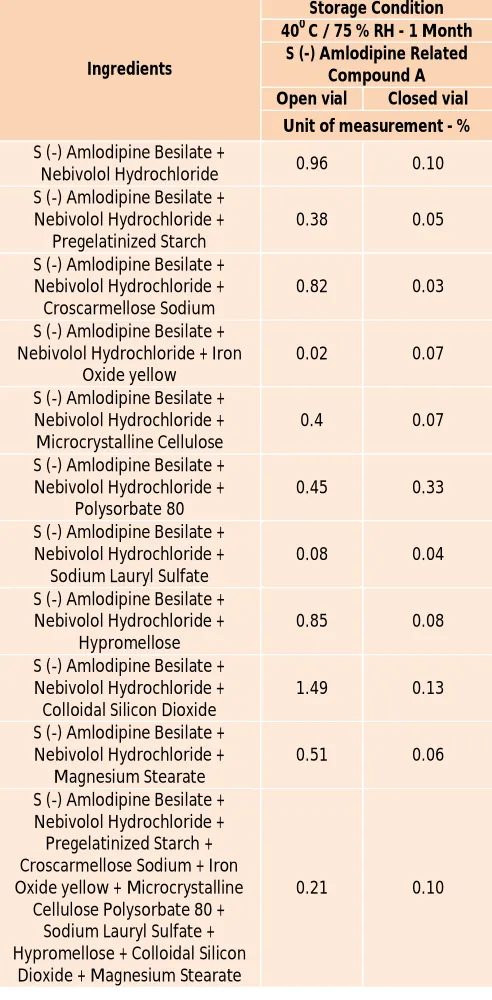
Table 1: Preformulation study of S (-) Amlodipine and
Nebivolol Tablets
Preformulation Study
Conditions Duration Test Performed 40ᵒC/75% RH (Open vials) 1 Month Related substances 40ᵒC/75% RH (Closed vials) 1 Month Related substances
Table 2: Preformulation study of S (-) Amlodipine and
Nebivolol Tablets
Ingredients
Storage Condition 400 C / 75 % RH - 1 Month
S (-) Amlodipine Related Compound A Open vial Closed vial
Unit of measurement - % S (-) Amlodipine Besilate +
Nebivolol Hydrochloride 0.96 0.10 S (-) Amlodipine Besilate +
Nebivolol Hydrochloride + Pregelatinized Starch
0.38 0.05
S (-) Amlodipine Besilate + Nebivolol Hydrochloride + Croscarmellose Sodium
0.82 0.03
S (-) Amlodipine Besilate + Nebivolol Hydrochloride + Iron
Oxide yellow
0.02 0.07
S (-) Amlodipine Besilate + Nebivolol Hydrochloride + Microcrystalline Cellulose
0.4 0.07
S (-) Amlodipine Besilate + Nebivolol Hydrochloride +
Polysorbate 80
0.45 0.33
S (-) Amlodipine Besilate + Nebivolol Hydrochloride + Sodium Lauryl Sulfate
0.08 0.04
S (-) Amlodipine Besilate + Nebivolol Hydrochloride +
Hypromellose
0.85 0.08
S (-) Amlodipine Besilate + Nebivolol Hydrochloride + Colloidal Silicon Dioxide
1.49 0.13
S (-) Amlodipine Besilate + Nebivolol Hydrochloride +
Magnesium Stearate
0.51 0.06
S (-) Amlodipine Besilate + Nebivolol Hydrochloride + Pregelatinized Starch + Croscarmellose Sodium + Iron Oxide yellow + Microcrystalline
Cellulose Polysorbate 80 + Sodium Lauryl Sulfate + Hypromellose + Colloidal Silicon
Dioxide + Magnesium Stearate
0.21 0.10
Evaluation of tablet properties
Weight variation test
The variation of the weight of individual tablets is a valid indication of the corresponding variation in the drug content. The average tablet weight was determined by weighing 20 units or tablets individually using an
analytical balance.11, 12
Thickness measurement
The thickness of a tablet was determined by the amount of fill permitted to enter the die and the amount of
pressure applied during compression 10 tablets were taken and their thickness was determined individually by Vernier calliper. Mean and standard deviation were
calculated.11, 12
Crushing strength or hardness determination
10 tablets were taken randomly and hardness was measured using Hardness Tester.
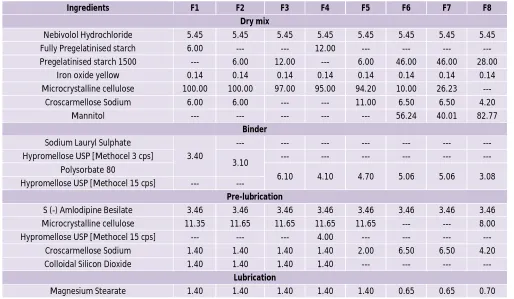
Table 3: Formulation of S (-) Amlodipine and Nebivolol Tablets
Ingredients F1 F2 F3 F4 F5 F6 F7 F8
Dry mix
Nebivolol Hydrochloride 5.45 5.45 5.45 5.45 5.45 5.45 5.45 5.45
Fully Pregelatinised starch 6.00 --- --- 12.00 --- --- --- ---
Pregelatinised starch 1500 --- 6.00 12.00 --- 6.00 46.00 46.00 28.00
Iron oxide yellow 0.14 0.14 0.14 0.14 0.14 0.14 0.14 0.14
Microcrystalline cellulose 100.00 100.00 97.00 95.00 94.20 10.00 26.23 ---
Croscarmellose Sodium 6.00 6.00 --- --- 11.00 6.50 6.50 4.20
Mannitol --- --- --- --- --- 56.24 40.01 82.77
Binder Sodium Lauryl Sulphate
3.40
--- --- --- --- --- --- ---
Hypromellose USP [Methocel 3 cps]
3.10 --- --- --- --- --- ---
Polysorbate 80
6.10 4.10 4.70 5.06 5.06 3.08
Hypromellose USP [Methocel 15 cps] --- ---
Pre-lubrication
S (-) Amlodipine Besilate 3.46 3.46 3.46 3.46 3.46 3.46 3.46 3.46 Microcrystalline cellulose 11.35 11.65 11.65 11.65 11.65 --- --- 8.00 Hypromellose USP [Methocel 15 cps] --- --- --- 4.00 --- --- --- ---
Croscarmellose Sodium 1.40 1.40 1.40 1.40 2.00 6.50 6.50 4.20
Colloidal Silicon Dioxide 1.40 1.40 1.40 1.40 --- --- --- ---
Lubrication
Magnesium Stearate 1.40 1.40 1.40 1.40 1.40 0.65 0.65 0.70
Friability testing
6.5 g equivalent tablets were taken randomly and placed on a sieve. Loose dust was removed with the aid of air pressure or a soft brush. Tablet samples were weighed accurately and placed in Friabilator. After the given number of rotations (100 rotations / 4 minutes) loose dust was removed from the tablets as before. Finally tablets were weighed. The loss in weight indicates the ability of the tablets to withstand this type of wear. The percent friability was determined by using following formula:
% Friability = (initial weight- final weight) x 100/Initial
weight.11, 12
Disintegration test
Disintegration is evaluated to ensure that the drug substance is fully available for dissolution and absorption from the gastrointestinal tract. Disintegration time was measured for 6 tablets by inserting disks using 900 ml
purified water at 37±2°C in Disintegration Apparatus.11, 12
Dissolution test
Dissolution of S (-) Amlodipine and Nebivolol Tablets was measured using paddle method, at a paddle speed of 75
rpm, in 900 mL of 0.01 N HCl solution at 37 ± 0.5°C.11, 12
RESULTS AND DISCUSSION
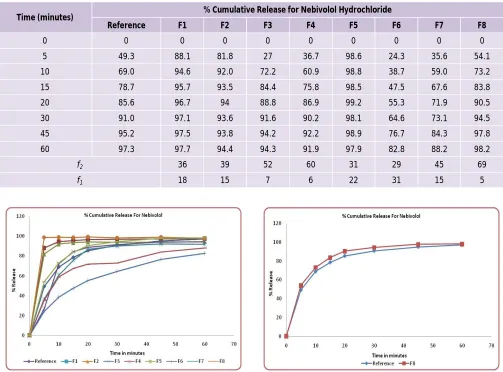
observed was slow but did not match with innovator. In further batches water soluble ingredient, like Mannitol was incorporated in the formulation while in innovator of Nebivolol, lactose monohydrate was used, but as we were formulating a combination product containing S (-) Amlodipine Besilate we cannot use lactose monohydrate as it will lead to Millard reaction. Initially concentration of mannitol was lower, then in final formulation
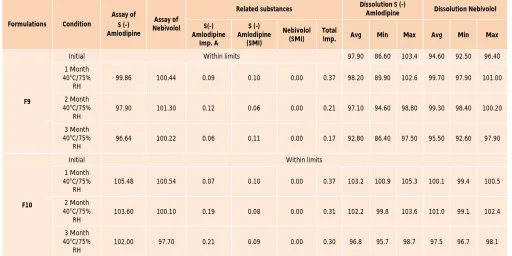
concentration was optimized and dissolution study was performed which leads to satisfactory results and in compliance with innovator. Similarity and dissimilarity factor (f2 and f1) was calculated for all formulations and best results were obtained with final formulation. Stability studies were performed for the reproducible batches {F9 and F10} according to final formulation (F8) and results were found satisfactory.
Table 4: Evaluation of immediate release tablet of S (-) Amlodipine and Nebivolol
Formulation Weight (mg) Thickness (mm) Hardness (Kp) Disintegration Time Friability (% w/w)
F1 140.7 3.07 8.9 1 minute 40 seconds 0.00
F2 140.6 3.08 9.6 1 minute 40 seconds 0.00
F3 142.4 3.08 10.8 5 minute 23 seconds 0.03
F4 142.4 3.06 10.9 5 minute 27 seconds 0.01
F5 140.0 3.08 7.7 1 minute 20 seconds 0.00
F6 140.7 3.10 4.2 2 minute 28 seconds 0.00
F7 140.7 3.12 5.0 2 minute 19 seconds 0.00
F8 140.3 3.13 5.2 3 minute 48 seconds 0.04
Table 5: Dissolution comparison of test sample with innovator in 0.01 N HCl
Time (minutes) % Cumulative Release for Nebivolol Hydrochloride
Reference F1 F2 F3 F4 F5 F6 F7 F8
0 0 0 0 0 0 0 0 0 0
5 49.3 88.1 81.8 27 36.7 98.6 24.3 35.6 54.1
10 69.0 94.6 92.0 72.2 60.9 98.8 38.7 59.0 73.2
15 78.7 95.7 93.5 84.4 75.8 98.5 47.5 67.6 83.8
20 85.6 96.7 94 88.8 86.9 99.2 55.3 71.9 90.5
30 91.0 97.1 93.6 91.6 90.2 98.1 64.6 73.1 94.5
45 95.2 97.5 93.8 94.2 92.2 98.9 76.7 84.3 97.8
60 97.3 97.7 94.4 94.3 91.9 97.9 82.8 88.2 98.2
f2 36 39 52 60 31 29 45 69
f1 18 15 7 6 22 31 15 5
Figure 1: Dissolution comparison of test samples with
innovator in 0.01 N HCl
Figure 2: Dissolution comparison of final test formulation
Table 6: Stability data of reproducible batches as per formulation F8
Formulations Condition
Assay of S (-) Amlodipine
Assay of Nebivolol
Related substances Dissolution S (-)
Amlodipine Dissolution Nebivolol S(-)
Amlodipine Imp. A
S (-) Amlodipine
(SMI)
Nebivolol (SMI)
Total
Imp. Avg Min Max Avg Min Max
F9
Initial Within limits 97.90 86.60 103.4 94.60 92.50 96.40
1 Month 40°C/75% RH
99.86 100.44 0.09 0.10 0.00 0.37 98.20 89.90 102.6 99.70 97.90 101.00
2 Month 40°C/75% RH
97.90 101.30 0.12 0.06 0.00 0.21 97.10 94.60 98.80 99.30 98.40 100.20
3 Month 40°C/75% RH
96.64 100.22 0.06 0.11 0.00 0.17 92.80 86.40 97.50 95.50 92.60 97.90
F10
Initial Within limits
1 Month 40°C/75% RH
105.48 100.54 0.07 0.10 0.00 0.37 103.2 100.9 105.3 100.1 99.4 100.5
2 Month 40°C/75% RH
103.60 100.10 0.19 0.08 0.00 0.31 102.2 99.8 103.6 101.0 99.1 102.4
3 Month 40°C/75% RH
102.00 97.70 0.21 0.09 0.00 0.30 96.8 95.7 98.7 97.5 96.7 98.1
SMI: Single Max Impurity
CONCLUSION
Single tablet combination antihypertensive therapy is effective consideration due to its complementary synergistic mechanism of action, lower side effects and better compliance. In present study combination tablets of S (-) Amlodipine and Nebivolol was prepared by wet granulation technique. The in-vitro studies were carried out for compressed tablets using dissolution apparatus type II. The cumulative percentage of drug release from the tablets varied and depends on the type and concentration of excipients used. To slow down the dissolution rate of the tablets, change in concentration of excipients was done. Final formulation was prepared with optimized concentration of Mannitol and Hypromellose and dissolution result was found satisfactory. Stability study data were also within specifications for reproducible batches of final formulation.
REFERENCES
1. Frank Jennifer, Managing Hypertension Using Combination Therapy, American Family Physician, 77(9), 2008, 1279-1286 .
2. Limbachiya Sonali, Nagar Hardik, Dodiya Hitesh, Mehta Dharmik, Development and Characterization of Fast Dissolving Mucoadhesive Microsphere of Nebivolol Hydrochloride Using Modified Methacrylate Polymer, International Journal of Pharma Sciences, 3(1), 2013, 136-141.
3. Purohit Rajkumar, Naruka Singh Puspendra, Chauhan Singh Chetan, Bhatt Deepak, Formulation, Development and Evaluation of Bilayer Tablet of Nebivolol and Indapamide, Indo American Journal of Pharmaceutical Research, 3(7), 2013, 5105-5117.
4. Kolasani A, Kumar GVS, Puranik SB, Sridhar KA, Stability Indicating HPLC Method for Estimation of S-Amlodipine Besilate and Nebivolol hydrochloride in Bulk Drugs and Marketed Formulation, International Journal for Pharmaceutical Research Scholars, V-1, I-3, 2012, 217-223.
5. Shaikh SA, Shaikh SS, Shahi SR, Shookur MA, Reddy LK, Padalkar AN, Thube Mahesh, Formulation and Evaluation of S-(-)-Amlodipine Besilate and Nebivolol Hydrochloride Tablets, Journal of Advanced Pharmaceutical Technology and Research, 1(2), 2010, 199-206. 6. Liu Fang, Qiu Meng, and Zhai -Di Suo, Tolerability and Effectiveness
of (S)-Amlodipine Compared With Racemic Amlodipine in Hypertension: A Systematic Review and Meta-Analysis, Current Therapeutic Research, 71(1), 2010, 1-29.
7. Peck GE, Baley GJ, McCurdy VE, Banker GS, Tablet formulation and design In: Lieberman HA, Lachman L, Schwartz JB, eds. Pharmaceutical Dosage Forms: Tablets, 1 New York: Marcel Dekker Inc, 1, 1989, 73-130.
8. Banaker UV, Pharmaceutical Dissolution Testing, New York: Marcel Dekker, Inc., 1991, 133-187.
9. Solvang S, Finholt P, Effect of tablet processing and formulation factors on dissolution rate of the active ingredient in human gastric juice, Journal of Pharmaceutical Sciences, 59(1), 1970.
10.Sathe M. Pradeep, Raw S. Andre, Ouderkirk A. Larry, Yu X. Lawrence, Hussain S. Ajaz, Drug Product Performance, In Vitro Center for Drug Evaluation and Research, U.S. Food and Drug Administration, Rockville, Maryland, U.S.A., 187-209.
11.Bushra Rabia, Shoaib Harris Muhammad, Aslam Nousheen, Hashmat Durriya, Rehman -Ur- Masud, Formulation Development and Optimization of Ibuprofen Tablets by Direct Compression Method, Pakistan Journal of Pharmaceutical Sciences, 21(2), 2008, 113-120. 12.K Satyavathi, KVSS Annapurna, P Gayathri, P Bhojaraju, LK Kanthal, T
Veerraju, Formulation and Evaluation of Immediate Release Tablets of Eprosartan Mesylate, International Journal of Pharmaceutical Sciences Review and Research, 25(1), Article No. 05, 2014, 36-40.