_____________________________________________________________________________________________________
*Corresponding author: E-mail: [email protected];
British Journal of Medicine & Medical Research
18(8): 1-11, 2016, Article no.BJMMR.25087 ISSN: 2231-0614, NLM ID: 101570965
SCIENCEDOMAIN international
www.sciencedomain.org
The Study of Uric Acid Levels in Primary
Hypertension without End Organ Damage
A. K. Badrinath
1, K. Suresh
1*and Harresh
11
Internal Medicine, Sri Manakula Vinayagar Medical College (SMVMCH), India.
Authors’ contributions
This work was carried out in collaboration between all authors. All authors read and approved the final manuscript.
Article Information
DOI: 10.9734/BJMMR/2016/25087
Editor(s):
(1) Alexander D. Verin, Vascular Biology Center, Georgia Regents University Augusta, Georgia.
Reviewers:
(1) Carlos Martínez-Salgado, University of Salamanca, Spain. (2) Bidita Khandelwa, Sikkim Manipal University, India. (3) Hairul Hisham Bin Hamzah, University of Southampton, UK. Complete Peer review History: http://www.sciencedomain.org/review-history/16773
Received 17th February 2016 Accepted 8th October 2016 Published 5th November 2016
ABSTRACT
Background: Hypertension is a major risk factor for cardiovascular events. Serum uric acid has
been implicated as a risk factor for development of cardiovascular diseases including hypertension. Previous studies have found association between raised serum uric acid levels and primary hypertension. There was always a debate if uric acid was raised due to complications of hypertension or if uric acid was an independent risk factor for development of hypertension.
Objective: To assess the relationship between serum uric acid and hypertension independent of
renal function, obesity, diabetes, stroke and alcoholism. To assess the relationship between serum uric acid and hypertension in whom the target organ damage has not yet appeared.
Methodology: This cross-sectional study was done in Sri Manakula Vinayagar Medical College
and Hospital. The study period was of 22 months from November 2012 to August 2014. The total study population was 300 patients, of which 150 were cases and 150 were controls. The patients were included if they satisfied the JNC 7 criteria for hypertension. And only those hypertensives without end organ damage were included. Patients with secondary hypertension and those having other conditions associated with hyperuricemia were excluded from the study.
Results: The study showed that serum uric acid levels were raised in patients with hypertension in
comparison to normotensives. The mean serum uric acid levels between patients with
Badrinath et al.; BJMMR, 18(8): 1-11, 2016; Article no.BJMMR.25087
hypertension and controls were 4.83 ± 1.72 and 3.92 ± 1.28 mg/dl respectively with p value < .001. The mean serum uric acid levels increased with the increase in the stages of hypertension. The mean serum uric acid levels in prehypertension, stage 1 hypertension and stage 2 hypertension were 3.99± 1.13, 4.57± 1.49, 5.50 ± 1.97 mg/dl respectively.
Conclusion: These results indicate that serum uric acid is independently associated with
hypertension without other comorbid conditions. Serum uric acid is elevated in hypertensives even in absence of target organ damage. Thus, in future it may be used as an early biochemical marker to predict the development of hypertension.
Keywords: Serum uric acid; primary hypertension; JNC 7; hyperuricemia.
1. INTRODUCTION
Hypertension as the name suggests is a chronic disease in which the blood pressure is elevated. The prevalence of hypertension is on an increasing trend worldwide. Currently the global prevalence of hypertension is estimated to be around 1 billion. And also as the prevalence of hypertension is increasing globally, its worldwide prevalence is estimated to touch 1.5 billion by 2025 [1].In other words, approximately with one-quarter of adult population suffering from hypertension, it can be said to have reached epidemic proportions.
Hypertension is a major risk factor for stroke, myocardial infarction, cardiac failure, aneurysm of the arteries and chronic kidney disease. In fact worldwide, hypertension can be considered the most important preventable risk factor for premature death. Current estimates indicate that 7.6 million premature deaths and 92 million disability adjusted life years are attributable to hypertension [2].
Around 8 decades back hypertension was an unknown entity outside Europe and America, but now in those regions the incidence of hypertension is around 15 – 30% [3].Earlier it was suspected that the rise in incidence of hypertension is due to ageing population. But since the incidence of hypertension has also risen in younger age groups, other factors are suspected. Primarily changes in lifestyle and associated environmental factors can be considered. Since increasing trend of hypertension is also associated with increasing incidence of obesity, Type 2 diabetes and end stage renal disease which also have the above mentioned risk factors. So their pathogenesis is suspected to be interrelated [4].
Uric acid is the end product of purine metabolism. It is a weak organic acid [5].In the body uric acid production is in balance with uric
acid excretion. Excessive deposition of uric acid in the form of monosodium urate monohydrate microcrystals the body leads to the development of gout [6].The enzymes that are involved in uric acid production are also responsible for oxidative stress. Research suggests that uric acid may independently also be elevated in different multifactorial disorders.
In various studies elevated serum uric acid was found to be associated with cardiovascular disease [7]. Serum uric acid is found to be elevated in patients of coronary artery disease usually associated with hypertension, diabetes mellitus, and other risk factors. Some foreign studies have shown that uric acid is elevated in hypertension [8-10].
But there always existed some uncertainty in those studies whether hyperuricemia in hypertension is caused due to hypertension per se, or due to complications of hypertension which in turn may lead to hyperuricemia. Therefore this study was done to see if uric acid levels were elevated in hypertensives who have not yet developed end organ damage.
1.1 Aim of the Study
1. To study the relationship between serum uric acid level and hypertension in those without hypertension induced end organ damage.
2. To see if elevated serum uric acid level is an independent risk factor for the development of hypertension.
2. METHODOLOGY
Badrinath et al.; BJMMR, 18(8): 1-11, 2016; Article no.BJMMR.25087
Pondicherry. Of these, 150 were cases and 150 were controls. The study was done over a period of 22 months from November 2012 to August 2014.
2.1 Data Collection Tool
• Questionnaire
• Laboratory blood tests
• Laboratory urine tests
• Electrocardiography (ECG)
• Fundoscopy
2.2 Methods
Study was done at Sri Manakula Vinayagar Medical College and Hospital, Pondicherry, a tertiary care hospital and a teaching institution. Informed consent was obtained from all patients.
2.2.1 Inclusion criteria
Adult male and female patients > 18 years of age diagnosed as hypertension according to JNC 7 classification for hypertension were included as cases.
2.2.2 Exclusion criteria
Patients were excluded if they have any of the following:
• Diabetes mellitus
• Ischaemic heart disease
• Stroke
• All cases of secondary hypertension
• Clinical Findings of gout or extra articular manifestations of hyperuricemia
• Obesity (BMI ≥ 30)
• Pre eclampsia
• H/o alcohol abuse
• H/o drugs known to cause hyperuricemia, e.g. thiazide diuretics
• H/o renal disease
2.3 Data Collection and Measurements
The clinical examination consisted of medical history, physical examination, blood pressure measurement, anthropometric measurements and fundoscopic examination. The laboratory tests included measurement of serum uric acid levels, blood sugar levels, renal function tests for blood urea, serum creatinine and urine protein
creatinine ratio. Chest X-ray and electrocardiogram were also used.
2.3.1 Blood pressure
Blood pressure was recorded after a 5 min rest in a quiet room. Systolic and diastolic blood pressures were measured in the sitting position twice at an interval of a few minutes on the right and left arms with a standard mercury sphygmomanometer on two separate occasions. Patients with complications due to hypertension were also excluded:
1) Hypertensive patients with LVH were excluded through ECG
LVH criteria: Sokolow-Lyon index
S in V1 + R in V5 or V6 (whichever is larger)
≥ 35 mm (or) R in aVL≥ 11 mm
2) Hypertensive patients with hypertensive nephropathy were excluded after laboratory tests
Blood urea > 40 mg/dl Serum creatinine > 1.2 mg/dl Urinary protein- creatinine ratio ≥ 0.3 3) Hypertensive patients with hypertensive
retinopathy were excluded after evaluating the patients through fundoscopy.
Reference Values for Serum Uric Acid Level In males : 3.4 – 7.0 mg/dl
In females : 2.4 - 5.7 mg/dl
Serum uric acid estimation was done by urease method using CHEMWELL fully auto analyser, USA.
2.4 Statistical Analysis
Badrinath et al.; BJMMR, 18(8): 1-11, 2016; Article no.BJMMR.25087
3. RESULTS
During the study period of 22 months from November 2012 to August 2014, a total of 300 patients were studied. Out of those 300, cases were 150 and controls were 150. The cases were 150 hypertensives but without any associated co-morbidities that are known to cause hyperuricemia. Also these hypertensives did not have any target organ damage. The 150 controls were patients without hypertension or any other condition known to cause hyperuricemia.
3.1 Demographic Characteristics and Laboratory Finding of Study Population
In Cases the age of patients ranged from 19 to 85. The mean age was 50.76. The mean systolic BP in cases was 136.84 mmHg, the mean diastolic BP in cases was 94.45 mmHg. The mean BMI in cases was 22.76 in controls the age of patients ranged from 19 to 76 years. The mean age was 48.34. The mean systolic BP in controls was 110.25 mmHg, the mean diastolic BP in controls was 71.60 mmHg. The mean BMI in controls was 22.03.
3.2 Age Distribution
The age group of the 300 patients studied ranged from 19 to 85 years. The age matched controls were taken. Listed below is the age distribution of cases and controls. The average age in cases was 50.76 ± 13.99. The average age in controls was 48.34±13.36. In both groups patients aged 36 to 65 years formed the bulk of the study population. There was no statistically significant difference seen in age distribution between case and control (p = 0.13) (Table 1).
Table 1. Age distribution in study population
Age (Mean ± SD) P value
Mean SD
Case 50.76 13.99 0.13* Control 48.34 13.09
* p value less than 0.05 is considered statistically significant
3.3 Serum Uric Acid and Mean
The total number of cases were 150 (both male and female), in that serum uric acid levels in males ranged from 2.3 mg/dl to 10.9 mg/dl and females ranged from 1.9 mg/dl to 8.6 mg/dl. The serum uric acid levels in male controls ranged
from 2.0 mg/dl to 8.9 mg/dl and female controls ranged from 1.8 mg/dl to 5.6 mg/dl.
The data analysis of the cases showed the mean SUA level to be 4.83 mg/dl with a standard deviation of 1.73 (4.83 ± 1.73). The total number of controls were 150 (both male and female), the data analysis shows a mean SUA level of 3.92 mg/dl with a standard deviation of 1.29 (3.92 ± 1.29). The difference in mean serum uric acid level between case and control is statistically significant [(p < 0.001), (Table 2 & Fig. 1)]. Therefore there is significant difference between serum uric acid in hypertensives and non-hypertensives.
3.4 Hyperuricemia in Cases and Controls
Hyperuricemia was defined as > 7.0 mg/dl in males and > 5.7 mg/dl in females. The number of hyperuricemic males and females were analysed. There were 15 males and 7 females who were hyperuricemic in hypertensive group. Whereas there were 7 hyperuricemic males in normotensive group and there were no hyperuricemic female in normotensive group. Their percentage distribution is shown below (Table 3 and Fig. 2).
3.5 Serum Uric Acid Levels in Male and Female Cases
The mean serum uric acid in female patients is 4.06 ± 1.41 mg/dl and in males is 5.42 ± 1.72 mg/dl. Serum uric acid level is higher in males than in females and it is statistically significant (p <0.001), (Table 4, Fig. 3). Since in our study there is no statistically significant difference seen in male female ratio of cases and controls, this difference in serum uric acid between males and females will not affect the result of the study.
3.6 Distribution of Cases in Various Stages of Hypertension
There were 150 hypertensives. They were classified according to JNC – 7 criteria into prehypertension, stage 1 hypertension and stage 2 hypertension. The distribution in each group is shown below (Table 5 and Fig. 4).
3.7 Mean Serum Uric Acid Level in Stages of Hypertension
Table 2. Comparison of serum uric acid levels in cases and controls
Number
Case 150 Control 150
Unpaired t test, t = 5.19, p = <0.001*
* p value less than 0.05 is considered
Fig. 1. Mean serum uric acid levels in cases and controls
Table 3. Percentage of hyperuricemics in cases and controls
Case No
Male 15 Female 7
Fig. 2. Percentage of hyperuricemic subjects in hypertensives and non hypertensives
0 0.5 1 1.5 2 2.5 3 3.5 4 4.5 5
Serum Uric Acid (mg/dl)
M
e
a
n
-
-->
0 2 4 6 8 10 12 14 16 18
Male
P
e
rc
e
n
ta
g
e
(
%
)
-->
Badrinath et al.; BJMMR, 18(8): 1-11, 2016; Article no.
Comparison of serum uric acid levels in cases and controls
Mean (mg/dl) Standard deviation Standard
4.83 1.73 0.14 3.92 1.29 0.10 Unpaired t test, t = 5.19, p = <0.001*
* p value less than 0.05 is considered statistically significant
Mean serum uric acid levels in cases and controls
Percentage of hyperuricemics in cases and controls
Control
Percentage (%) No Percentage (%)
17.6 4 4.5
10.7 0 0
Percentage of hyperuricemic subjects in hypertensives and non hypertensives
Case Control
4.83 3.92
Male Female
Case
Control
; Article no.BJMMR.25087
Comparison of serum uric acid levels in cases and controls
Standard error
0.14 0.10
Percentage (%)
Table 4. Mean serum uric acid levels in male and female hypertensives
Cases
Male Female
* p value less than 0.05 is considered statistically significant
Fig. 3. Mean serum uric acid levels in male and female hypertensives
Table 5. Distribution of cases in various stages of hypertension
Prehypertension Stage 1
Stage 2 Total
Fig. 4. Distribution of cases in various stages of hypertension
0 1 2 3 4 5 6
Serum Uric Acid (mg/dl)
M
e
a
n
-->
Hypertensive stage 2
38%
Badrinath et al.; BJMMR, 18(8): 1-11, 2016; Article no.
Mean serum uric acid levels in male and female hypertensives
Serum uric acid (Mean ± SD) (mg/dl)
5.42 ± 1.72 4.06 ± 1.41
* p value less than 0.05 is considered statistically significant
Mean serum uric acid levels in male and female hypertensives
Distribution of cases in various stages of hypertension
Number Percentage (%)
23 15
70 47
57 38
150 100
Distribution of cases in various stages of hypertension
Male Female
5.42 4.06
Pre Hypertensive 15%
Hypertensive stage 1
47%
; Article no.BJMMR.25087
Mean serum uric acid levels in male and female hypertensives
p value
< 0.001
Mean serum uric acid levels in male and female hypertensives
Badrinath et al.; BJMMR, 18(8): 1-11, 2016; Article no.BJMMR.25087
Table 6. Serum uric acid in stages of hypertension
N Mean (mg/dl) Standard deviation
Prehypertensive patients 23 3.99 1.13 Stage I hypertensive patients 70 4.57 1.49 Stage II hypertensive patients 57 5.5 1.97 Since there was difference in mean serum uric
acid level among three groups, we have done post hoc tests to find out among which groups the difference in mean serum uric acid level is seen. The results show that there is a significant difference between prehypertension and stage 2hypertension patients (p = 0.001) and between stage 1hypertension and stage 2 hypertension patients (p = 0.005). The difference seen between prehypertension and stage 1hypertension patients was not statistically significant (p = 0.45) (Table 7).
3.8 Serum Uric Acid and Duration of Hypertension
We now know that serum uric acid level is significantly elevated in hypertensives compared to non-hypertensives. The correlation of duration of hypertension with serum uric acid levels was analysed. Out of the total 150 hypertensives, 7 were newly diagnosed. So the remaining 143 hypertensives were analysed.
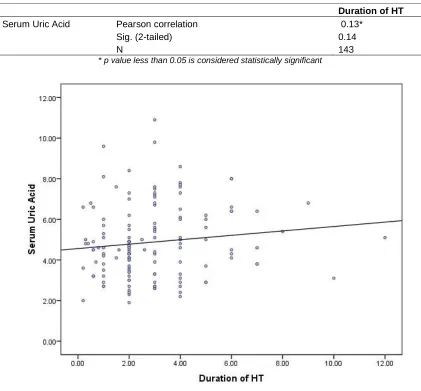
As shown in Table 8 and Fig. 5, the correlation between serum uric acid levels and
the duration of hypertension was positive r =
0.13; p = 0.13. This implies that as the duration of hypertension increases, the serum
uric acid level also increases, though it was not significant.
3.9 Effect of Treatment on Serum Uric Acid Levels
Out of 150 hypertensives, 7 were newly diagnosed. The remaining 143 were known
hypertensives, 97 were on regular treatment and 46 were not on treatment (Fig. 6). The serum uric acid level of the group who were on treatment was compared with the group who were not on treatment. The mean
serum uric acid level of those on treatment was 4.45 ± 1.50 mg/dl. The mean serum uric acid level of those without treatment was
5.76 ± 1.90 mg/dl and the difference was found
to be statistically significant [(p < 0.001), (Table 9).
4. DISCUSSION
Hypertension is the most common cardiovascular disease worldwide. It affects approximately 20% of the adult population globally. It is being considered both as a disease condition in itself as well as a risk factor for various other diseases like coronary artery disease, stroke and chronic kidney disease. Hypertension is estimated to have affected 600 million people worldwide. It is estimated that by 2025 around 1.5 billion people will be affected globally [11].
Though various factors are being presumed in the genesis of primary hypertension like age, salt sensitivity, adverse lipid profile, the exact factor causing it and the mechanism involved is yet to be found. In recent years uric acid is thought to be one of the factors causing hypertension. But uric acid elevation has also been linked with a number of other conditions including diabetes mellitus, coronary artery disease, chronic kidney disease, stroke and chronic alcoholism. Thereby there was difficulty in identifying uric acid as cause of hypertension alone, as many times along with hypertension other co-morbidities too were present. This study was done with eliminating other factors which can contribute to elevated serum uric acid levels. Thus the patients with diabetes, obesity, chronic alcoholics and gout were excluded from the study. Also the patients with secondary causes of hypertension were excluded.
4.1 Uric Acid and Gender
Badrinath et al.; BJMMR, 18(8): 1-11, 2016; Article no.BJMMR.25087
Table 7. Post hoc test
Group I Group J Mean Standard error
Sig. 95% confident interval Lower bound Upper bound
Pre-HT Stage 1 HT Stage 2 HT
-0.57 -1.51
0.39 0.40
0.45 0.001*
-1.53 -2.49
0.38 -0.52 Stage 1 HT Pre-HT
Stage 2 HT 0.57 -0.93
0.39 0.29
0.45 0.005*
-0.38 -1.64
1.53 -0.22 Stage 2 HT Pre-HT
Stage 1 HT 1.51 0.93
0.40 0.29
0.001* 0.005*
0.52 0.22
2.49 1.64
* The mean difference is significant at the 0.05 level
Table 8. Correlation between uric acid and duration of hypertension
Duration of HT
Serum Uric Acid Pearson correlation Sig. (2-tailed) N
0.13* 0.14 143
* p value less than 0.05 is considered statistically significant
Fig. 6. Distribution of hypertensives with and without treatment
Table 9. Mean SUA of those with and without treatment
Mean (mg/dl)
HT patient on anti-HT treatment
4.45
HT patient not on anti-HT treatment
5.76
* p value less than 0.05 is considered statistically significant.
4.2 Uric Acid and Hypertension
In this study we found that serum uric acid is elevated in hypertensive group compared to the normotensive control group. This can imply serum uric acid can be a pathogenic factor causing elevation of uric acid. It can also imply that hypertension can cause elevation of uric acid. It was thought that when hypertension causes elevation of uric acid, it was due to complications associated with hypertension. Renal damage associated with hypertension can lead to elevated uric acid levels. For this reason, this study was done in those hypertensive patients for whom the complications did not arise.
Previous studies have correlated metabolic syndrome to be associated with elevated uric acid [14,15]. In this study it has been shown that serum uric acid level is elevated in hypertension without the other components of metabolic syndrome.
Control 50%
Badrinath et al.; BJMMR, 18(8): 1-11, 2016; Article no.
Distribution of hypertensives with and without treatment
Mean SUA of those with and without treatment
Serum uric acid t value
Mean (mg/dl) Standard deviation
1.5 4.08
1.9
* p value less than 0.05 is considered statistically significant.
and Hypertension
In this study we found that serum uric acid is elevated in hypertensive group compared to the normotensive control group. This can imply serum uric acid can be a pathogenic factor causing elevation of uric acid. It can also imply e elevation of uric acid. It was thought that when hypertension causes elevation of uric acid, it was due to complications associated with hypertension. Renal damage associated with hypertension can lead to elevated uric acid levels. For this reason, study was done in those hypertensive patients for whom the complications did not
Previous studies have correlated metabolic syndrome to be associated with elevated uric In this study it has been shown that serum uric acid level is elevated in hypertension without the other components of metabolic
Similarly, according to the study conducted by Krishnan et al. [16] it was evident that hyperuricemia increases the risk of developing hypertension by 80%, which was independent of, renal function, serum lipid levels, body mass index, proteinuria, alcohol use and age. suggesting uric acid may be a risk factor for development of hypertension.
In our study it was found that 66% of hypertensives were on regular treatment. In our study patients on thiazide diuretics were excluded since they themselves can cause increase in uric acid levels [17].But in the study done by Perlstein et al. [18] it was found that 79% of the hypertensives were taking anti hypertensive medications regularly. This implies drug compliance is less in our study population.
In our study it was found that in those receiving anti-hypertensive treatment serum uric acid levels were lower compared to the group that was not receiving treatment. The mean serum
On Treatment 33%
Newly Diagnosed 2%
Case 50%
; Article no.BJMMR.25087
p value
< 0.001*
Similarly, according to the study conducted by it was evident that risk of developing hypertension by 80%, which was independent of, renal function, serum lipid levels, body mass index, proteinuria, alcohol use and age. Thus suggesting uric acid may be a risk factor for
found that 66% of hypertensives were on regular treatment. In our study patients on thiazide diuretics were excluded since they themselves can cause But in the study it was found that the hypertensives were taking anti-hypertensive medications regularly. This implies drug compliance is less in our study population.
In our study it was found that in those receiving hypertensive treatment serum uric acid o the group that was not receiving treatment. The mean serum
Without treatment
15%
Badrinath et al.; BJMMR, 18(8): 1-11, 2016; Article no.BJMMR.25087
uric acid level of those on treatment was 4.45 ± 1.50 mg/dl and in those without treatment was 5.76 ± 1.90 mg/dl. In a study done by Hoieggen et al. [19] it was found that anti hypertensive treatment even reduced serum uric acid levels. This result was similar to our study where the group who were on regular anti hypertensive treatment had lower serum uric acid levels.
5. LIMITATIONS OF THE STUDY
• Since this is a cross sectional study, causal relationships cannot be established. A large cohort study is required to establish causal relationship.
• Serum uric acid level varies on different occasions. Therefore a single uric acid value may be a confounding factor in the study.
6. CONCLUSION
We conclude from the study that the serum uric acid level is independently associated with isolated hypertension. Results showed that mean serum uric acid levels in cases was significantly elevated compared to the control group. There is a progressive elevation of serum uric acid levels in stage 1 and 2 of hypertension compared to prehypertension group. As serum uric acid levels were elevated much more in stage 2 hypertension, we can conclude that serum uric acid levels also correlates with severity of hypertension. And serum uric acid level is elevated in hypertension without end organ damage thus implying serum uric acid as a causative factor in hypertension.
But to directly link hyperuricemia as causative factor for hypertension, further large scale prospective studies need to be done.
Thus serum uric acid may be used as an early biochemical marker for detection of hypertension. Considering the global burden of hypertension and its complications, this may be a huge step considering the ease of measurement of serum uric acid level, the inexpensive mode of testing of serum uric acid and the availability of hypouricemic therapy.
ETHICAL APPROVAL
It is not applicable.
COMPETING INTERESTS
Authors have declared that no competing interests exist.
REFERENCES
1. Kearney PM, Whelton M, Reynolds K, Whelton PK. Global burden of hypertension: Analysis of worldwide data. Lancet. 2005;(365):217–23.
2. Lawes CMM, Vander Hoorn S, Rodgers A, International Society of Hypertension. Global burden of blood-pressure-related disease, 2001. Lancet. 2008;371(9623): 1513–8.
3. Fields LE, Burt VL, Cutler JA, Hughes J, Roccella EJ, Sorlie P. The burden of adult hypertension in the United States 1999 to 2000: A rising tide. Hypertension. 2004; 44(4):398–404.
4. Johnson RJ, Titte S, Cade JR, Rideout BA, Oliver WJ. Uric acid, evolution and primitive cultures. Semin Nephrol. 2005; 25(1):3–8.
5. George J, Struthers AD. Role of urate, xanthine oxidase and the effects of allopurinol in vascular oxidative stress.Vasc Health Risk Manag. 2009; 5(1):265–72.
6. Halabe A, Sperling O. Uric acid nephrolithiasis. Miner Electrolyte Metab. 1994;20(6):424–31.
7. Baker JF, Krishnan E, Chen L, Schumacher HR. Serum uric acid and cardiovascular disease: Recent developments, and where do they leave us? Am J Med. 2005;118(8):816–26. 8. Yamamoto Y, Matsubara K, Igawa G,
Kaetsu Y, Sugihara S, Matsuura T, et al. Status of uric acid management in hypertensive subjects. Hypertens Res Off J Jpn Soc Hypertens. 2007;30(6):549–54. 9. Selby JV, Friedman GD, Quesenberry CP.
Precursors of essential hypertension: Pulmonary function, heart rate, uric acid, serum cholesterol, and other serum chemistries. Am J Epidemiol. 1990; 131(6):1017–27.
10. Leite MLC. Uric acid and fibrinogen: Age-modulated relationships with blood pressure components. J Hum Hypertens. 2011;25(8):476–83.
11. Fuster V, Walsh R, Harrington R. Hurst’s the heart, 13th Edition. New York: McGraw-Hill Professional. 2011; 2250. 12. Mellen PB, Bleyer AJ, Erlinger TP, Evans
Badrinath et al.; BJMMR, 18(8): 1-11, 2016; Article no.BJMMR.25087
13. Nicholls A, Snaith ML, Scott JT. Effect of oestrogen therapy on plasma and urinary levels of uric acid. Br Med J. 1973; 1(5851):449–51.
14. Bonora E, Kiechl S, Willeit J, Oberhollenzer F, Egger G, Targher G, et al. Prevalence of insulin resistance in metabolic disorders: The Bruneck study. Diabetes. 1998;47(10):1643–9.
15. Matsuura F, Yamashita S, Nakamura T, Nishida M, Nozaki S, Funahashi T, et al. Effect of visceral fat accumulation
on uric acid metabolism in male obese subjects: Visceral fat obesity is
linked more closely to overproduction of uric acid than subcutaneous fat obesity.
Metabolism. 1998;47(8):929–33.
16. Krishnan E, Kwoh CK, Schumacher HR, Kuller L. Hyperuricemia and incidence of
hypertension among men without metabolic syndrome. Hypertension. 2007;49(2):298–303.
17. Musini VM, Nazer M, Bassett K, Wright JM. Blood pressure-lowering efficacy of monotherapy with thiazide diuretics for primary hypertension. Cochrane Database Syst Rev. 2014;5:CD003824.
18. Perlstein TS, Gumieniak O, Williams GH, Sparrow D, Vokonas PS, Gaziano M, et al. Uric acid and the development of hypertension: The normative aging study. Hypertension. 2006;48(6):1031–6.
19. Hoieggen A, Alderman MH, Kjeldsen SE, Julius S, Devereux RB, De Faire U, et al. The impact of serum uric acid on cardiovascular outcomes in the LIFE study. Kidney Int. 2004;65(3):1041–9. _________________________________________________________________________________
© 2016 Badrinath et al.; This is an Open Access article distributed under the terms of the Creative Commons Attribution License (http://creativecommons.org/licenses/by/4.0), which permits unrestricted use, distribution, and reproduction in any medium, provided the original work is properly cited.
Peer-review history: