Effect of Substrate Material Variations
On RMSA, CMSA and NLMSA
Prof. B. T. Salokhe
1, Dr. S. N. Mali
2Ph.D. Student, Department of E&TC, Shri Jagdisprasad Jhabarmal Tibrewala University, Rajasthan, India, TKIET, Warananagar, Shivaji University, Kolhapur, Maharashtra, India1
Professor, Sinhgad Institute of Technology and Science, Narhe, Pune, Maharashtra, India2
ABSTRACT: This paper deals with analysis of performance parameters of RMSA, CMSA and NLMSA with respect to Bandwidth (BW), Voltage Standing Wave Ratio (VSWR) and Return Loss (RL) while achieving specific selective frequency and Bandwidth. Rectangular Microstrip Antenna (RMSA), Circular Microstrip Antenna (CMSA) and Non Linear Microstrip Antenna (NLMSA) has been designed with various dielectric materials like FR4 Glass Epoxy, ROGERS, and PAPER EPOXY and analyzed. The performance of these antennas was measured for 2.4 GHz frequency using co-axial feeding technique with High Frequency Structure Simulator (HFSS) and experimentally fabricated antennas are analyzed with Vector Network Analyzer (VNA). Optimization of patch dimensions is designed to get better performance parameters such as BW, VSWR and RL. The graphical comparison of all these performance parameters with respect to material and shape variation gives directions to select better Microstrip Antenna for any wireless application.
KEYWORDS: BW, VSWR, RL, RMSA, CMSA, NLMSA, HFSS, VNA, Dielectric, Parameter Analysis.
I. INTRODUCTION
Printed microstrip radiators were first proposed in 1953, the first MSA appeared in 1974, last couple of year MSA became popular because its low volume, light weight and low cost. There is always a need of variety of antennas based on geometrical shape, size, frequency range, capacity in terms of power radiation, bandwidth of transmission etc. The size of the antenna depends on transmission frequency. Interestingly, these antennas are categorized based on the range of frequencies used, e.g. Radio Frequency (RF) antennas, Microwave (MW) antennas etc.
A Microstrip patch antenna is one of microwave antenna that offers a low profile, i.e. thin and easy manufacturability and provides a great advantage over traditional antennas. Patch antennas are planar antenna used in wireless links and other microwave applications. A patch is typically wider than a strip and its shape and dimension are important features of the antenna Microstrip patch antennas are probably the most widely used type of antennas today due to their advantages such as light weight, low volume, low cost, compatibility with integrated circuits and easy to install on the rigid surfaces. Furthermore, they can be easily designed to operate in dual-band, multi-band application, dual or circular polarization. They plays important role in many commercial applications like mobile communication, Wireless Local Area Network (LAN) or remote wireless data logging. However, Microstrip patch inherently have narrow bandwidth and are usually demanded for such practical applications
While designing Rectangular Microstrip Antenna (RMSA), Circular Microstrip Antenna (CMSA) and Non Linear Microstrip Antenna (NLMSA), the substrate thickness is 1.6 mm while dielectric materials used are FR4 Glass Epoxy, ROGERS and PAPER EPOXY with dielectric constant 4.4, 4.5 and 3.5 respectively. The process of measurement of performance parameters presented in this paper will be used for deciding the methodology to get best results at 2.4 GHz operating frequency with most widely used co-axial feeding technique as it gives proper impedance matching
10.15662/ijareeie.2014.0310029
narrow bandwidth is priority. They are also used on laptops, microcomputers, mobile phones etc. Next three sections of this paper demonstrate the analysis of Rectangular Microstrip Antenna (RMSA), Circular Microstrip Antenna (CMSA) and Non Linear Microstrip Antenna (NLMSA) with dielectric materials FR4 Glass Epoxy, ROGERS and PAPER EPOXY.
Due to rapid advancements in this field it is necessary to develop to antenna design systems so Computer Aided Design tool available in the market gives lot of flexibility while designing MSA. Ansoft Simulation software (HFSS) is used to design microstrip antennas and fabricated using printed circuit board design technology. Both fabricated MSA and simulated antenna performance results are compared.
II. ANALYSIS OF RMSA
The basic RMSA Patch design equations are given by:
………
(1)Where,
= Patch Width, = Wave Length, = Dielectric Constant and
….………...
(2)……….... (3)
Where,
∆L = Line Extension, W = Patch Width, = Substrate Thickness
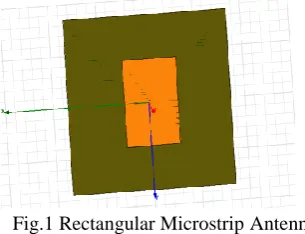
For FR4 Glass Epoxy and ROGERS the width of patch is 28 mm and length of patch is 42 mm and for PAPER EPOXY the width of patch is 31.25 mm and length of patch is 47.40 mm. The co-axial feed point is used to excite antenna, which is located such that it provide proper impedance matching at the operating frequency as shown in Fig.1. We simulate Rectangular Microstrip antenna on HFSS.
Fig.1 Rectangular Microstrip Antenna
Fig. 2 Return Loss for RMSA (Simulated and Fabricated)
The Summary of observed lower, higher and central frequencies along with return loss and calculated bandwidth for FR4 Glass Epoxy RMSA is as shown in Table 1.
Table 1: Summary of RMSA
RMSA Parameters
FR4 ROGERS PAPER EPOXY
HFSS VNA HFSS VNA HFSS VNA FL (GHz) 2.4045 2.4040 2.4183 2.3951 2.4020 2.4172 Fc (GHz) 2.4357 2.4282 2.4394 2.4312 2.4297 2.4658 FH (GHz) 2.4657 2.4856 2.4612 2.4569 2.4582 2.5011 Bandwidth (MHz) 61.2 81.6 42.9 61.8 56.2 83.9
Return Loss (dB) -33.330 -23.281 -19.004 -47.901 -13.260 -23.05 VSWR 1.090 1.151 1.261 1.035 1.550 1.129 Rin 48.23 43.498 47.34 48.982 43.54 48.847
III. ANALYSIS OF CMSA
The actual radius and effective radius of the circular patch can be obtained by:
………
(4)Where,
= Patch Radius, F= Operating Frequency, h = thickness of substrate, = Dielectric Permittivity of Substrate also,
………
(5) Where,= Effective Patch Radius
10.15662/ijareeie.2014.0310029
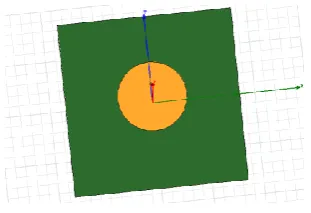
For FR4 Glass Epoxy, ROGERS the radius of circular patch is 17 mm and for PAPER EPOXY the radius of circular patch is 18.7 mm also the co-axial feed point is used to excite antenna, which is located such that it provide proper impedance matching at the operating frequency as shown in Figure 3. We simulate Circular Microstrip antenna on HFSS.
Figure 4 shows Return Loss for CMSA with all three types of materials. While observing Return Losses for all the three materials the lower, higher and center frequencies are also observed to calculate the bandwidth of CMSA.
Fig.4 Return Loss for CMSA (Simulated and Fabricated)
The Summary of observed lower, higher and central frequencies along with return loss and calculated bandwidth for FR4 Glass Epoxy RMSA is as shown in Table 2.
Table 2: Summary of CMSA
RMSA Parameters FR4 ROGERS PAPER EPOXY
HFSS VNA HFSS VNA HFSS VNA
FL (GHz) 2.3847 2.3267 2.3412 2.3355 2.3784 2.2826
Fc (GHz) 2.4148 2.3929 2.3554 2.3646 2.4078 2.3333 FH (GHz) 2.4403 2.4150 2.3706 2.4107 2.4382 2.3576 Bandwidth (MHz) 55.6 88.3 29.4 75.2 59.8 75.0
Return Loss (dB) -19.71 -22.64 -33.45 -30.19 -13.39 -20.39 VSWR 1.230 1.184 1.043 1.086 1.540 1.203 Rin 43.97 50.160 48.03 34.419 39.57 48.130
. IV. ANALYSIS OF NLMSA
For FR4 Glass Epoxy, ROGERS and PAPER EPOXYthe width of patch is 28 mm, 27.8 mm and 31.1 mm also, length of patch is 36.9 mm, 36.2 mm and 40.5 mm respectively.
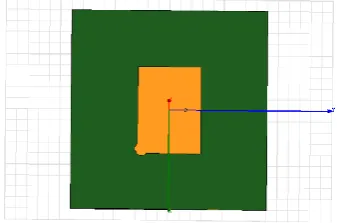
The co-axial feed point is used to excite antenna, which is located such that it provide proper impedance matching at the operating frequency as shown in Fig.5.We simulate rectangular Microstrip antenna on HFSS. There is residual change at one corner of antenna as shown in Figure 5. This change has been made in a such way that the result should be best as compared to regular shape of antennas (RMSA, CMSA) which are already been used in Microstrip antenna industries while using them in most of the applications.
Figure 6 shows Return Loss for NLMSA with all three types of materials. While observing Return Losses for all the three materials the lower, higher and center frequencies are also observed to calculate the bandwidth of NLMSA.
Fig.6 Return Loss for NLMSA (Simulated and Fabricated)
The Summary of observed lower, higher and central frequencies along with return loss and calculated bandwidth for FR4 Glass Epoxy NLMSA is as shown in Table 3.
Table 3: Summary of NLMSA
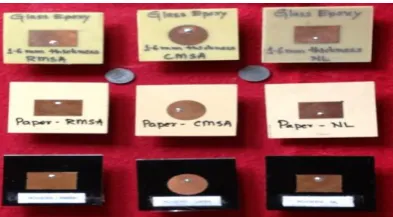
Fig. 7 shows antennas are fabricated from simulation results; these fabricated antennas are tested using VNA to measure antenna performance parameters for substrate materials i.e. FR4 Glass Epoxy, Paper Epoxy and Rogers.
Fig. 7 Material variation Fabricated Antennas
RMSA Parameters
FR4 ROGERS PAPER EPOXY
HFSS VNA HFSS VNA HFSS VNA
FL (GHz) 2.3924 2.4150 2.4279 2.3973 2.4068 2.4172
Fc (GHz) 2.4196 2.4415 2.4476 2.4437 2.4156 2.4371 FH (GHz) 2.4468 2.4967 2.4673 2.4790 2.4235 2.5011 Bandwidth
(MHz) 54.4 81.7 39.4 81.7 16.7 83.9 Return Loss (dB) -23.52 -35.18 -22.339 -29.831 -10.220 -23.054
10.15662/ijareeie.2014.0310029
V. ANALYSIS OF RETURN LOSS AND VSWR
Fig. 8 VSWR for RMSA (Simulated and Fabricated)
Fig. 8 shows VSWR for simulated and fabricated antennas with substrate materials FR4 Glass Epoxy, Paper Epoxy and Rogers for RMSA.
Fig. 9 VSWR for CMSA (Simulated and Fabricated)
Fig. 9 shows VSWR for simulated and fabricated antennas with substrate materials FR4 Glass Epoxy, Paper Epoxy and Rogers for CMSA.
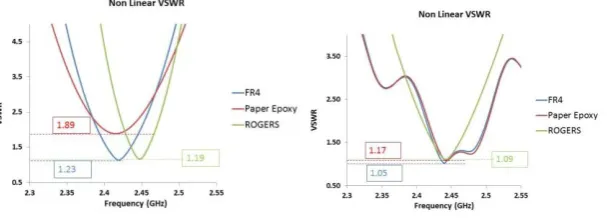
Fig. 10 VSWR for NLMSA (Simulated and Fabricated)
Fig. 10 shows VSWR for simulated and fabricated antennas with substrate materials FR4 Glass Epoxy, Paper Epoxy and Rogers for NLMSA.
VI. CONCLUSIONS
The High Frequency Structure Simulator and fabricated VNA testing analysis of performance of RMSA, CMSA and NLMSA using coaxial feeding techniques for various substrate materials such as FR4 Glass Epoxy, ROGERS and PAPER EPOXY presented in this paper shows that making residual change in conventional antennas it is possible to design and maintain the bandwidth of Non-Linear antenna. Interestingly, the bandwidth of the all antennas is closer to 80 MHz (i.e. Bandwidth of ISM Band) also which is matched with the conventional antenna. The Return Los and VSWR of simulated and fabricated antenna have been maintained up to the acceptable level with RMSA, CMSA and NLMSA.
REFERENCES
1) Veeresh G. Kasabegoudar & K. J. Vinoy , “Coplanar Capacitively Coupled Probe Fed Microstrip Antennas for Wideband Applications,” IEEE Transactions on Antennas and Propagation ,Vol No.58, pp.3131-3139, 2010.
2) Wen Ling Chen,Guang Ming Wang and Chen Xin Zhang, “Bandwidth Enhancement of a Microstrip-Line-Fed Printed Wide-Slot Antenna With a Fractal-Shaped Slot,” IEEE Transactions on Antennas and Propagation, Vol.57.No.7, pp. 2176 – 2179,2009.
3) V. V. Khairnar, B. V. Kadam, K. R. Khandagle , “Design of Equilateral Triangular Microstrip Patch Antenna with Co-axial Feeding Technique,” Special Issue of International Journal of Electronics, Communication & Soft Computing Science & Engineering, ISSN: 2277-9477, pp. 37-39,2013. 4) Jai Yi Sze and Kin Lu Wong, “Bandwidth Enhancement of a Microstrip Line Fed Printed Wide Slot Antenna, IEEE Transections on Antennas and Propagation,” Vol.49.No.7, pp. 1020-1025, 2001.
5) Jia-Yi Sze, and Kin-Lu Wong, “Slotted Rectangular Microstrip Antenna for Bandwidth Enhancement,” IEEE Transactions on Antennas and Propagation, vol no.48, pp. 1149-1152, 2000.
6) B. J. Kwaha,O. N Inyangand P.Amalu, “The circular Microstrip patch antenna-Design and Implementation,” International Journal of Research and Reviews in Applied Sciences, pp. 86-95,2011.
7) Sonali Jain, and Rajesh Nema, “Review Paper for Circular Microstrip Patch Antenna,” International Journal of Computer Technology and Electronics Engineering (IJCTEE) Volume 2, Issue 1, pp. 169-173, 2009.
8) Verma Alka , “Analysis and Design of Circular Microstrip Antenna in X Band,” International Journal of Advanced Engineering Research and Studies,pp. 93-94,2012.
BIOGRAPHY
Prof. B. T. Salokhe has Completed B.E.and M.E. Electronics Engineering in Shivaji University,