Design and Fabrication of Double Angled Eight Sided Solar
Cooker
Raghavendra Prasada S.A
1*; Anup R
2, Basavaraj Navi
3; Darshan S L
4& Sanjay
Kumar S
51*
Assistant Professor, Thermal Power Engineering (Mechanical),
2,3,4 & 5
BE Students, Mechanical Engineering Alva‟s Institute of Engineering and Technology,
Moodbidri, Karnataka, India,
1*
Abstract
Given the prevalent energy crises across the globe, it is always desired to exploit new and renewable energy sources which are readily available at almost negligible cost.. Solar cookers have come in various forms: parabolic cookers, panel cookers, box cookers, and funnel cookers; each with its own design and performance peculiarities. In this project double angled eight sided solar cooker was designed, fabricated and tested. Chrome plated steel whose reflectivity of 85%was used as reflective surface to increase temperature and heat required to cooking. The test results shown that maximum of upto95 0C temperature can be achieved without changing the position of solar dishand also it is possible to achieve heating power of 1981.2Wattin 10 min, required for cooking any kind of vegetables.The maximum efficiency of this solar cooker is 211% for 10 min time span.
Keywords: Energy, Cooker, Temperature, Solar, Performance
Keywords
:
Biodiesel; Cashew nut shell oil; Injection pressure; Fuel consumption; Performance.1. Introduction
The concept of an energy plan for a rural community by making use of locally available resources to meet electrical and other energy needs has been revisited over the years. A lot of this may owe to the slow but continuously arising awareness among national and international states, about the fast depleting conventional energy sources and the urgent need to find and implement technology for alternative energy sources. Recent work in this area has duly stressed importance, of late, in trying to apply the idea to the rural localities given their remote location and the consequent difficulties in connecting the conventional grid. As a fast developing and densely populated country, India‟s energy demand is continuously raising in all sectors like industrial, transportation, agriculture, domestic etc. Although there is a huge increase in the conventional power generating capacity, still the country is facing energy crisis. On a national
average energy India is facing energy shortage of 10.3% within the range of 3%-21% and is 15.4% short in peak demands. For a country like India, which has agriculture as its major occupation, the overall development of villages, where an overwhelming section of the population resides in, plays an influential role in the nation‟s economic growth. So, more importantly, an insight should be given on the aspects of village development and their electrification is vital towards realizing this. Literature in this domain, especially concerning India, need to gain good ground. Even though India is among the largest countries, and thus has abundant renewable sources of energy, they have gone untapped for years. Palakkad district of Kerala remains India‟s only “total electrified district” as on Feb 11th 2010 [1].
achieved by ensuring both the complete electrification of the region and the continuous supply of energy. Moreover, the employment opportunities are enhanced because of the local labour (skilled and unskilled) required for the maintenance and operation. A number of local people are bound to find employment in the form of workers in biomass plant as well. The proposed methodology provides a comprehensive sustainable energy solution for the village community with the present level of proven technology solutions which are robust, reliable, easy to maintain, inexpensive and easy to handle [2].
2. Difficulties in Assessing Solar
Cookers under Current Conditions
Inventors, engineers, and backyard enthusiasts have created literally hundreds of different types of solar cookers. This wide variety of designs complicates efforts to standardize and evaluate solar cooking devices. Work by Funk and Larson (2000) in the United States has led to the creation of American Society of Agricultural Engineering(ASAE) Standard S580, which sets forth a rigorous procedure for conducting thermal testing of the solar cooker and provides a framework for establishing a Cooking Power normalized to a standardized insolation.
The present work focuses on combining the strengths and addressing the weaknesses of the current testing standards for solar cookers. This will be accomplished through the development of an evolutionary framework that combines rigorous and repeatable thermal characterization with more subjective assessments of cooker ergonomics and safety factors. Much of the discussion in the present work will focus on the DAES cooker.
3. The Benefits of Using Solar Cookers
Solar cookers can be life-saving devices for people in sunny but fuel-scarce regions. In desert settlements like the Darfur refugee camps in Eastern Chad, where the sun shines most days of the year, the use of solar cookers, along with fuel-efficient stoves and hay baskets, has virtually eliminated the need for women and girls to makelong and dangerous trips away from their camps to search for firewood.
3.1 Solar cookers save money and fuel
Free sunshine is available most days of the year in countries located within thirty degrees north and south of the equator. Solar cooking on sunny days allows families to save scarce wood, charcoal, dung or gas for use at night and on cloudy days. Some urban residents spend 30-50% of their income to buy cooking fuel mainly charcoal or Liquefied Petroleum Gas (LPG). Many impoverished governments currently use a significant percentage of their budgets to subsidize imported LPG and kerosene. If their citizens had access to solar cooking technology, they could dramatically reduce their consumption of wood, dung and charcoal and the need for subsidized LPG.
3.2 Solar cookers save time
With box and panel solar cookers food can be left unattended to cook while women do other work indoors or in the shade. Since food will not burn in box and panel solar cookers, no stirring is necessary. Pots are easy to clean because food doesn‟t stick an important factor in regions where water is scarce. Parabolic solar cookers, which instantly generate the intense heat of an open fire, can boil a pot of water in 15 to 20 minutes.
3.3 Solar cookers can be made from locally available and recycled materials
Solar cookers can be made using a variety of materials, including wood, glass, cardboard and sheet metal available in local markets.
3.4 Solar cookers are safe, healthy and convenient
forced to reduce their consumption of nutritious beans and legumes that require lengthy cooking and extra fuel. When women are able to solar cook on sunny days, their homes, kitchens and courtyards remain smoke-free and they can afford to prepare healthier, slow cooked foods.
3.5 Solar cookers can kill disease-causing organisms in water
These organisms which can cause diarrhea and which result in the deaths of tens of thousands of children every year can be killed by heating water in a process called pasteurization. Water that has been heated to 149ºF (65ºC) for a short period of time is pasteurized and is free from microbes including Escherichia coli, Rotaviruses, Giardia and the Hepatitis A virus. Women who have limited access to fuel can pasteurize several liters water on a sunny day with a solar cooker. If provided with an inexpensive, reusable Water Pasteurization Indicator (WAPI), women can be sure that water they leave to heat unattended in a solar cooker has reached pasteurization temperature and is safe to drink. WAPI‟s contain a soy-based wax that melts at 65 degrees centigrade and drops to the bottom of a clear, sealed plastic tube, which can be flipped over and reused for years.
3.6 Traditional foods can be prepared with solar cookers
All traditional foods can be cooked using one of the three types of solar cookers: parabolic, panel or box. Each type of solar cooker can be constructed in different sizes with designs that can be adapted to local cooking requirements.
3.7 Solar cookers are easy to transport
The great advantage of offering the Cook kit to stressed populations is that it can be folded up for easy storage and transport. On sunny days, farmers and herders can carry a Cook kit, a small pot and raw ingredients with them into the field to cook a hot lunch without the need to build and tend a fire.
3.8 Using solar cookers preserves trees, the atmosphere and the soil
Almost three billion people still cook every day over open fires. The increased use of solar cookers will help address several of our planet‟s most pressing environmental problems black carbon air pollution and the massive deforestation and erosion caused by people cutting down trees to fuel their cooking fires and make charcoal.
4. Description of project
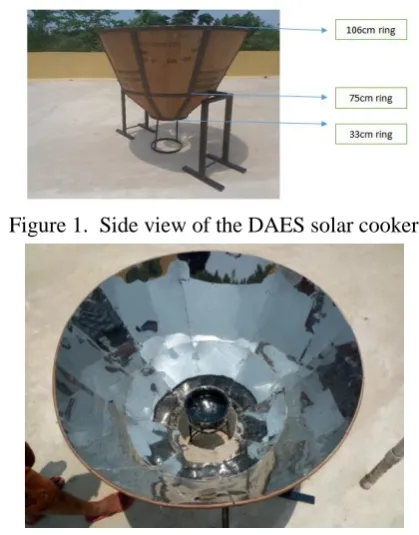
The outer frame of DAES solar cooker is made up of a mild steel (MS), 0.75cm metal strip (MS) is made into three rings of diameter 106cm, 75cm and 33cm respectively. Three rings are connected by eight metal strips of 3.8cm which are set at an angle of 450 and 670. The inside surface of frame is covered with Flex plywood of 6mm thickness for better flexibility to avoid heat loss, the plywood surface is covered with chromium plated stainless steel of 0.3mm thickness. The whole set up is supported with stand.
Figure 1. Side view of the DAES solar cooker
5. Materials used
5.1 Cooker frameMild steel, mild steel is used in the manufacture of frame, the frame is used to support the insulator. Three rings are connected by eight metal strips of 3.8cm which are set at an angle of 450 and 670.68cm metal strip (MS) is made into three rings of diameter 106cm, 75cm and 33cm respectively. We have used mild steel of because it costs less and weigh less. Mild steel costs around 50/kg.
Figure 3. 1.25 inch MS strip
5.2 Insulator
Flex plywood used as insulator, of 6mm thickness for better flexibility and to avoid heat loss.
5.3 Reflector
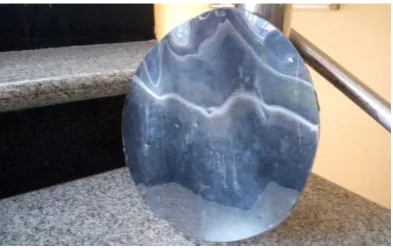
Chromium plated stainless steel of 0.3mm thickness and reflectivity 0.85 was used as reflector.
Figure 4. Chromium plated stainless steel
5.4 Absorber
Aluminum was selected over copper and steel because of its lower cost, light weight, and ease of fabrication. Its light weight reduces the overall weight of the solar cooker.
Figure 5. Aluminum vessel or pan (black painted)
5.5Absorber surface coating
Black paint was selected for the absorber coating. It was selected over other coatings because of its higher absorptivity at angles other than normal incidence, adherence and durability when exposed to weathering, sunlight and high stagnation temperatures, cost effectiveness, and protection to the absorber material.
5.6 Support stand
Galvanized Iron steel of square cross section is used as stand for support, it has significant advantages in terms of durability and versatility. The physical properties of steel includes high strength, low weight, durability, ductility and resistance to corrosion. Steel, as we all know, offers great strength it is light in weight.
Figure 6. Rectangular metal bar for making stand
5.7 Food Material and Heat Transfer Fluid:
perishable food item and can be cooked simply without adding any additive. Water was selected as the heat transfer fluid.
5.8 Selection of materials for the Fabrication of DAES
Sl.no ITEM MATERIALS QUANTITY
1. Frame Mild steel 9.7 kg 2. Insulator Flex plywood 6x4 ft
3. Reflector Chromium plated stainless steel
sheet
6x4 ft
4. Absorber Aluminium 1 lit 5. Stand GI steel 2 ft 6. Handle GI steel ½ ft 7. Cookpot
table
Mild steel 1.25 ft
Table 1: List of Materials
6. Methodology of the DAES solar
cooker
As it comes to the Solar cooker the angle given must be directed to the single position where the cooking pot is seated, So Design plays a significant role in preparation of solar cooker.
6.1 Design of DAES solar cooker
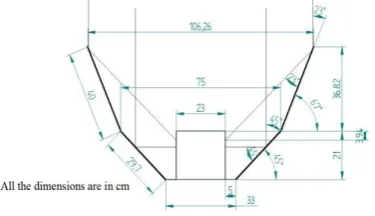
The basic principle of working of solar cooker is “Snell‟s law”,It says that the angle of Incidence of the incident ray will be equal to the angle of Reflected ray,
Figure 7. 2D Design of DAES Solar cooker
This solar cooker consists of a Double angle, provided for which the sun rays can be completely concentrated over the vessel or
cookpot surface. The first angle given is of 450 which allows the constant rate of heating over the surface and the other angle given is of 670 for more concentration of sun rays over the cookpot. The height of cookpot which can be placed must be less than 30cm, if it is more, the cooking takes place slowly. The diameter of the cookpot allowed for cooking is 23cm, if the diameter is more, then tilting according to the solar movement becomes tedious to operate.
Figure 8. Development of the dish leaf
The whole dish is divided in to 8 components for complete dish,which is covered with Flex Plywood of 6mm thick and which is then covered with Chromium plated stainless steel for better reflectivity.
The whole apparatus is placed over an independent motion table which can be moved without disturbing the Cookpot and can be changed according to the solar movement i,e. for every 45minutes, It can be easily locked with Key and Hole mechanism which is given to the support
6.2 Fabrication of DAES solar cooker
The Whole component is divided in to 3 parts, they are-
I. Cooker Dish (Double angled dish) II. Support Table.
III. Cookpot Table.
6.3Cooker Dish(Double angled dish)
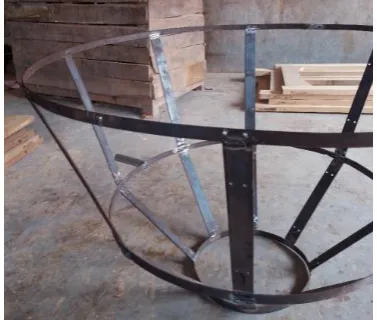
And the fitted ring is made in contact with other ring through same 1.25inch mild steel strip of 40cm height, These rings are positioned at an angle of 670 for more concentration of solar radiation i,e. at 37cm apart.The inside surface of the dish is covered with flex plywood for better heat resistance and is once again covered with chromium plated stainless steel for better reflectiveness.
The dish is supported over a table by giving a two pipe welded at ends which is holed at the ends on one of the pipe.
Figure 9. Fabricated dish frame
6.4Support table
The support table is made of GI steel, which is rigid enough to bear the load and inclination of the dish. The two pipes of the dish will mate for the complete support of the dish, the holes are also made on the support pipe for the alignment of the dish in accordance with solar movement. The support table is made independent of the cookpot table to not to disturb the vessel placed.
GI is selected over MS because of its resistance over corrosion and rust and its superior strength to bear load of dish over any angle. It is made to a height in which a person can place the dish easily as possible.
Figure 10. Side stand for DAES cooker 6.5Cook pot table
It is made of mild steel material, Its made with 2 rings at top and bottom supported by 2 metal strips of 38cm height. It can be placed and moved independently with support table. The 2 rings enables the easy movement of the dish underneath it.
Figure 11. Cookpot table
6.6 Working of DAES solar cooker
selection is the important criteria of this solar cooker.
When the apparatus is prepared and kept over the optimized angle towards sun, heat zone is created at the center and now the vessel is placed over the cookpottable. The angle of the dish has to be changed for every 45minutes by this time our recipe will be finished by this time.
Figure 12. water boiling in the pan
7.
RESULTS AND DISCUSSION
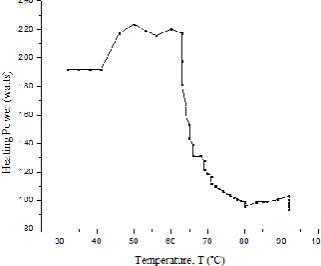
Based on the experimental observations calculations were done to find out heating power of the cooker. the results are given in the table shown below.
Figure 13. Graph of Temperature Vs Time
Above graph(Fig.22) is plotted by taking Time on X-axis and Temperature along Y-axis.Initial temperature of water (320C) is noted down using Thermometer.Then it is kept inside the solar cooker, temperature is noted down for every min.Temperature increases from 350C to 630C rapidly then it gradually increases from 630C
to 920C.In normal atmospheric condition temperature of water raises very quickly, once after reaching 630C the heating process becomes slow due to the movement of sun or change of its position in sky. Hence for the rise of temperature from 630C to 660C taken 10minutes. Temperature of water in the pan depends on direct sunlight and reflected or concentrated sunlight. The position of the concentrated sunlight varies due the sun movement along the sky, which leads to the variation of the temperature.so as the time varies temperature also varies.
Figure 14. Graph of Temperature Vs Heating power
Above graph is plotted by taking Temperature along X-axis and Heating power along Y-axis.Heating power is calculated using Qheat = m*Cp*
where is time 60sec and T is
Figure 15. Graph of Temperature Vs Efficiency
Above graph is plotted by taking Temperature along X-axis and efficiency along Y-axis.Efficiency is calculated usingƞ
where Qheat is heating power. I is
irradiation 770w/m2 and A refers to surface area 1.217m2 of dish. We can see that the efficiency of the system is increases initially because of the perfect alignment of the dish towards Sun but later the efficiency has decreased because of the misalignment of the dish towards Sun. efficiency is the parameter used to find out utilization of available heat to cook. When the heat is properly absorbed or utilized by vegetable or food placed inside the pan efficiency of the cooker improves, whereas if there is any loss the atmosphere or the material of the cooker by conduction and convection efficiency decreases as happened in this case.
8. CONCLUSION
A DAES cooker has been built and tested. The experimental results showed that the low efficiency of the parabolic cooker is attributed to the optical and thermal losses from the reflector and the pot.
The energy efficiency of the solar cooker varies because input solar radiation is rich in energy and being utilized in the form of heat at low temperature.
The energy efficiency can be increased only marginally by increasing the reflectivity of reflectors, proper designing of cooking place and by using a suitable cooking pot. Cylindrical shaped cooking vessels made of aluminum or
copper and painted black should be preferred for a higher cooking efficiency. The DAES cooker presents encouraging results while being compared to other types of solar cooker. Solar cooking technology is a key item in order to deal with deforestation.
9. FUTURE SCOPE
Average cost of solar cookers decreases day by day on the contrary their power output and efficiency considerably in-creases. In the upcoming future, widespread use of this technology is expected hopefully not only in developing countries but also throughout the world. Renewable energy resources will play an important role in the world„s future. According to the global renewable energy scenario, proportion of the solar thermal applications will be about 480 million tons oil equivalent by 2040. Nowadays, solar cookers are also available to use in the areas with limited solar radiation depending on the developments in solar power concentrating systems and material technology. In addition, the most challenging point of solar cookers, un-available to use when sun goes away, is overcome with thermal energy storage techniques. Briefly, it is anticipated that solar cooking technology will be demanded by a huge group of people in the near future because of its outstanding features.
It is recommended to change the reflective material like glass or aluminum foil instead of steel plates, which has reflectivity higher than steel.
It is recommended to use automatic solar tracking system instead of using manually operating technique.
It is recommended to vary the dimensions of the cooker in order to improve the efficiency.
10. REFERENCE
[2]. E. B.Joyee&A. N. M.Mizanur Rahman, “design and construction of parabolic dish solar cooker”,International Journal of Engineering Research and Applications, Vol.3, Issue 4, pp. 93-107.
[3]. I. L. Mohammed, “Design and fabrication of parabolic dish solar thermal cooker”,International Journal of Engineering Research and ApplicationsVol.3, Issue 4, pp. 1179-1186.
[4]. Shawn shaw, “Development of comparative framework for evaluating the performance of solar cooking devices”. Vol.4, Issue 2, pp. 198-246.
[5]. RajendraC.Patil, Mahesh M. Rathore and Manojkumarchopra “An overview of Solar cookers”, International Journal of Enhanced Research in Science Technology & Engineering,Vol.2, Issue 3, pp. 112-120.
[6]. Basil Okafor, E. “Performance evaluation of a parabolic solar cooker”,International Journal of Engineering and TechnologyVol.3, pp. 923-927.
[7]. Y R supple, N.N Suraskar, “Design and fabrication of manually track parabolic solar disc for in house cooking”,International Journal of Modern Engineering ResearchVol.2, Issue 6, pp. 4228-4230.
[8]. Adil A.S.“Detail study of parabolic solar cooker SK-14”,International Research Journal of Engineering and Technology,Vol.2, Issue 4, pp. 24-27.
[9]. Ismail Isa Rikota, “Comparative analysis on solar cooking using box type solar cooker finned cooking pot”, International Journal of Modern Engineering ResearchVol.3, Issue 3, pp. 1290-1294.
About Authors
Raghavendra Prasada S.A was born in