Available online: https://edupediapublications.org/journals/index.php/IJR/ P a g e | 1555
Mining the Dynamic Time Frames to Discovery Ranking
Fraud in Mobile Apps
1V. JAYA VARSHINI DEVI, 2G. CHANDRA SEKHAR, 3K. N. NIRMALA
1M.Tech, Department: Computer Science and Engineering, BVC college of Engineering, Email:
[email protected],Rajahmundry, JNTUK, A.P,India
2 Assistant Professor, Department: Computer Science and Engineering,BVC college of Engineering, Email:
[email protected], , Rajahmundry, JNTUK, A.P
3Assistant Professor, Department: Computer Science and Engineering, ,BVC college of Engineering,
E-mail: [email protected] Rajahmundry, JNTUK, A.P
Abstract
Ranking fraud in the Mobile App showcase alludes to fraudulent or beguiling exercises which have a reason for knocking up the Apps in the prevalence list. In reality, it turns out to be increasingly visit for App designers to utilize shady means, for example, swelling their Apps' deals or posting imposter App evaluations, to confer ranking fraud. While the significance of forestalling ranking fraud has been generally perceived, there is constrained comprehension and research around there. To this end, in this paper, we give an all encompassing perspective of ranking fraud and propose a ranking fraud identification framework for mobile Apps. In particular, we first propose to precisely find the ranking fraud by mining the dynamic time frames, to be specific driving sessions, of mobile Apps. Such driving sessions can be utilized for distinguishing the neighborhood inconsistency rather than worldwide irregularity of App rankings. Moreover, we research three sorts of proofs, i.e., ranking based confirmations, rating based proofs and audit based proofs, by displaying Apps' ranking, rating and survey practices through measurable speculations tests. What's more, we propose a streamlining based accumulation strategy to coordinate every one of the confirmations for fraud
Available online: https://edupediapublications.org/journals/index.php/IJR/ P a g e | 1556
ranking fraud. Along these lines, we create four instinctive baselines and welcome five human evaluators to approve the viability of our approach Evidence Aggregation based Ranking Fraud Detection (EA-RFD).
Index Terms—Mobile Apps, Ranking Fraud Detection, Evidence Aggregation, Historical Ranking Records, Rating and Review.
INTRODUCTION
THE amount of Mobile Apps has created at a stunning rate over the span of late years. For example, as of the end of April 2013, there are more than 1.6 million Apps at Apple's App store and Google Play. To animate the progression of mobile Apps, various App stores moved step by step Application leaderboards, which show the chart rankings of most standard Apps. In all actuality, the App leaderboard is a standout amongst the most basic courses for propelling mobile Apps. A higher rank on the leaderboard usually prompts a gigantic number of downloads and million dollars in pay. In this way, App architects tend to examine diverse courses for instance, publicizing push to propel their Apps in demand to have their Apps situated as high as would be reasonable in such Application leaderboards. In any case, as a late example, as opposed to relying upon ordinary advancing courses of action, shady App architects fall back on some fraudulent plans to purposefully help their Apps additionally, at last control the chart rankings on an App store. This is by and large completed by using indicated "bot homesteads" or "human water military" to explode the App downloads, assessments and reviews in a brief traverse. For example, an article from
VentureBeat [4] reported that, when an App was progressed with the help of ranking control, it could be moved from number 1,800 to the principle 25 in Apple's without top leaderboard and more than 0,000-100,000 new customers could be increased inside a couple days. In truth, such ranking fraud raises magnificent stresses to the mobile Application industry. For example, Apple has advised of separating on App creators who present ranking fraud [3] in the Apple's App store.
Available online: https://edupediapublications.org/journals/index.php/IJR/ P a g e | 1557
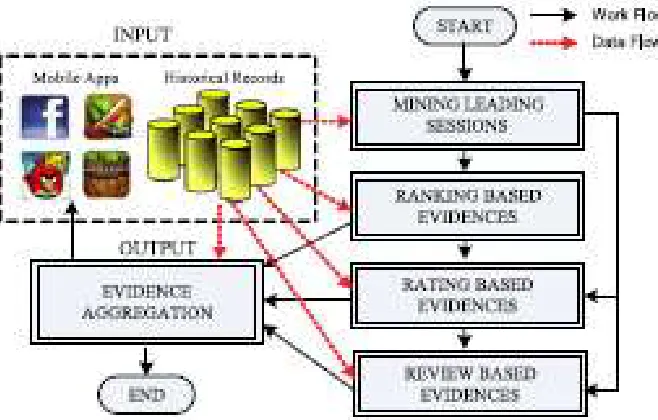
Fig. 1. The system of our ranking fraud detection system for mobile Apps
Without a doubt, our careful observation reveals that mobile Apps are not for the most part situated high in the leaderboard, yet rather just in some driving events, which outline various driving sessions. Observe that we will display both driving events and driving sessions in detail later. Figuratively speaking, ranking fraud as a general rule happens in these driving sessions. Along these lines, recognizing ranking fraud of mobile Apps is truly to recognize ranking fraud inside driving sessions of mobile Apps. Specifically, we first propose a clear yet effective count to perceive the fundamental sessions of each App in view of its unquestionable ranking records. By then, with the examination of Apps' ranking practices, we find that the fraudulent Apps frequently have different ranking cases in each driving session took a gander at with standard Apps. Thus, we portray some fraud affirmations from Apps' obvious ranking records, and make three abilities to focus such ranking based fraud affirmations. In any case, the ranking based verifications can
be affected by App fashioners' reputation and some true blue publicizing exertion, for instance, "compelled time markdown". As a result, it is not satisfactory to simply use ranking based confirmations. Consequently, we encourage propose two sorts of fraud verifications in view of Apps' assessing and review history, which reflect some variation from the norm plans from Apps' bona fide rating likewise, overview records. Besides, develop an unsupervised demonstrate collection technique to join these three sorts of verifications for evaluating the authenticity of driving sessions from mobile Apps. Fig. 1 shows the structure of our ranking fraud location framework for mobile Apps.
IDENTIFYING LEADING SESSIONS FOR MOBILE APPS
Available online: https://edupediapublications.org/journals/index.php/IJR/ P a g e | 1558
(a) Leading Events (b) Leading Sessions
Fig. 2. (a) Example of leading events; (b) Example of leading sessions of mobile Apps.
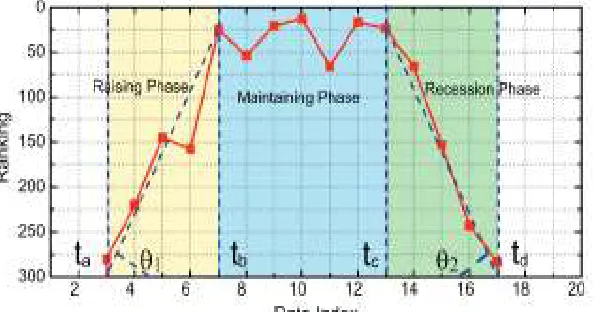
Fig 3. An Example of different Ranking Phases of Leading Event
Mining Leading Sessions
There are two ventures for mining driving sessions. To begin with, we need to discover driving events from the App's bona fide
Available online: https://edupediapublications.org/journals/index.php/IJR/ P a g e | 1559
In Algorithm 1, we mean every driving occasion e and session s as tuples
, e e start end
t t
and tstarte ,tende ,Es separately,
where Es is the arrangement of driving occasions in session s. Specifically, we first think solitary driving event e for the given App an (i.e., Step 2 to 7) from the most punctual beginning stage time. For each evacuated singular driving event e, we check the time navigate among e and the present driving session s to pick whether they have a place with a similar driving session. Especially, if ( e s )
start end
t t , e will be
considered as another driving session (i.e., Step 8 to 16). Subsequently, this calculation can distinguish driving occasions and sessions by checking a's chronicled positioning records just once.
Ranking Based Evidences
Available online: https://edupediapublications.org/journals/index.php/IJR/ P a g e | 1560
occasion. To be sure, such a ranking example demonstrates an essential comprehension of driving occasion. In the accompanying, we formally characterize the three ranking periods of a main occasion.
Rating Based Evidences
The rating based confirmations are valuable for ranking fraud identification. Nonetheless, once in a while, it is not adequate to just utilize ranking based proofs. For instance, some Apps made by the popular designers, for example, Gameloft, may make them lead occasions with substantial estimations of u1 because of the engineers' validity and the "verbal" publicizing impact. Additionally, a portion of the lawful showcasing administrations, for example, "constrained time rebate", may likewise bring about noteworthy ranking based proofs. To explain this issue, we likewise think about how to concentrate fraud confirmations from Apps' authentic rating records. In particular, after an App has been distributed, it can be evaluated by any client who downloaded it. Without a
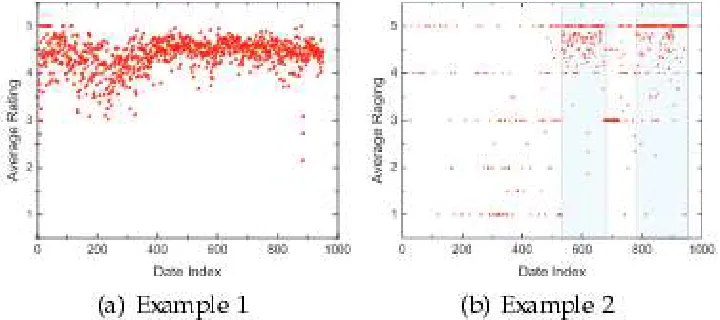
doubt, client rating is a standout amongst the most vital components of App commercial. An App which has higher rating may draw in more clients to download and can likewise be positioned higher in the leaderboard. Subsequently, evaluating control is additionally an essential point of view of ranking fraud. Instinctively, if an App has ranking fraud in a main session s, the evaluations amid the era of s may have abnormality designs contrasted and its authentic appraisals, which can be utilized for building rating based confirmations. For instance, Figs. 4a and 4b demonstrate the dispersions of the every day normal rating of a prominent App "WhatsApp" and a suspicious App found by our approach, separately. We can watch that an ordinary App dependably gets comparable normal rating every day, while a fraudulent App may get generally higher normal appraisals in some eras (e.g., driving sessions) than different circumstances. Along these lines, we characterize two rating fraud confirmations in view of client rating practices as takes after.
Fig 4. Two Real-world examples of the Distribution of App’s daily Average Ratings
Review Based Evidences
Other than evaluations, by far most of the App stores in like manner allow customers to create some abstract comments as App
Available online: https://edupediapublications.org/journals/index.php/IJR/ P a g e | 1561
study control is a champion among the most basic perspective of App ranking fraud. Specifically, before downloading or acquiring another flexible App, customers as often as possible first read its chronicled reviews to encourage their essential administration, and a versatile Application contains more positive overviews may pull in more customers to download. In like manner, fakers as often as possible post fake reviews in the fundamental sessions of a specific App remembering the ultimate objective to grow the App downloads, and thusly prompt the App's ranking position in the leaderboard. But some past tackles review spam revelation have been represented starting late [14], [19], [21], the issue of perceiving the adjacent irregularity of reviews in the primary sessions and getting them as verifications for ranking fraud area are still under-researched. To this end, here we propose two fraud affirmations in light of Apps' study hones in driving sessions for distinguishing ranking fraud.
Without a doubt, an extensive part of the review controls are executed by bot develops in view of the high cost of human resource. Thusly, review spammers routinely post distinctive duplicate or close duplicate overviews on the same App to grow downloads [19], [21]. Strangely, the common App constantly have widened studies since customers have assorted individual acknowledgments and usage experiences. In perspective of the above observations, here we describe a fraud signature Sim(s), which implies the ordinary shared closeness between the overviews inside driving session s. Specifically, this fraud stamp can be enlisted by taking after steps. At first, for each review c in driving session s, wee remove all stop words (e.g., "of", "the") and institutionalize verbs and engaging words (e.g., "playsplay",
"betterextraordinary"). Normally, the higher estimation of Sim(s) exhibits more duplicate/close duplicate studies in s. Thusly, if a primary session has on a very basic level higher estimation of Sim(s) differentiated and other driving sessions of Apps in the leaderboard, it has high probability of having ranking fraud.
RELATED WORK
Generally speaking, the related works of this review can be accumulated into three orders. The essential arrangement is about web ranking spam discovery. Specifically, the web ranking spam insinuates any consider exercises which pass on to picked site pages an unmerited perfect relevance or centrality [30]. For example, Ntoulas et al. [22] have focused on various parts of substance construct spam with respect to the web and showed different heuristic strategies for perceiving content based spam. Zhou et al. [30] have focused on the issue of unsupervised web ranking spam discovery. Specifically, they proposed a profitable online associate spam and term spam identification strategies using spamicity. Starting late, Spirin and Han [25] have reported a survey on web spam location, which completely exhibits the measures and computations in the written work. No ifs ands or buts, the work of web ranking spam location is generally in view of the examination of ranking benchmarks of web inquiry apparatuses, for instance, PageRank additionally, address term repeat. This is not the same as ranking fraud discovery for portable Apps.
Available online: https://edupediapublications.org/journals/index.php/IJR/ P a g e | 1562
Wu et al. [27] have considered the issue of recognizing cross breed shilling attacks on rating data. The proposed approach depends on the semi supervised learning and can be used for solid thing recommendation. Xie et al. [28] have inspected the issue of singleton review spam location. Specifically, they understood this issue by recognizing the co-quirk outlines in various review based time course of action. But some of above approaches can be used for irregularity discovery from recorded rating and review records, they are not prepared to remove fraud affirmations for a given day and age (i.e., driving session). Finally, the third grouping consolidates the reviews on versatile Application proposal. For example, Yan and Chen [29] developed a versatile App recommender framework, named Appjoy, which depends on customer's App utilize records to create a slant organize instead of using express customer evaluations. In addition, to deal with the sparsity issue of App usage records, Shi and Ali [24] focused on a couple recommendation models and proposed a substance based shared isolating model, named Eigenapp, for suggesting Apps in their site Getjar. Moreover, a couple of researchers examined the issue of abusing improved consistent information for portable App proposal.
For example, Zhu et al. [32] proposed a uniform framework for tweaked association careful recommendation, which can organize both association independency and dependence doubts. Nevertheless, to the best of our adapting, none of past works has focused on the issue of ranking fraud identification for versatile Apps.
CONCLUSION
Available online: https://edupediapublications.org/journals/index.php/IJR/ P a g e | 1563
REFERENCES
[1] (2014). [Online]. Available: http://en.wikipedia.org/wiki/cohen’s_kappa
[2] (2014). [Online]. Available: http://en.wikipedia.org/wiki/information_ret rieval
[3] (2012). [Online].
Available:https://developer.apple.com/news/ index.php? id=02062012a
[4] (2012). [Online].
Available:http://venturebeat.com/2012/07/0 3/apples -crackdown-on-app- ranking- manipulation/
[5] (2012). [Online]. Available: http://www.ibtimes.com/applethreatens-crackdown -biggest-app-store-ranking-fra ud-406764
[6] (2012). [Online]. Available: http://www.lextek.com/manuals/onix/index. html
[7] (2012). [Online]. Available: http://www.ling.gu.se/lager/mogul/porter-stemmer.
[8] L. Azzopardi, M. Girolami, and K. V. Risjbergen, “Investigating the relationship between language model perplexity and ir precision-recall measures,” in Proc. 26th Int. Conf. Res. Develop. Inform. Retrieval, 2003, pp. 369–370.
[9] D. M. Blei, A. Y. Ng, and M. I. Jordan, “Latent Dirichletallocation,” J. Mach. Learn. Res., pp. 993–1022, 2003.
[10] Y. Ge, H. Xiong, C. Liu, and Z.-H. Zhou, “A taxi driving fraud detection system,” in Proc. IEEE 11th Int. Conf. Data Mining, 2011, pp. 181–190.
[11] D. F. Gleich and L.-h. Lim, “Rank aggregation via nuclear norm minimization,” in Proc. 17th ACM SIGKDD Int. Conf. Knowl. DiscoveryData Mining, 2011, pp. 60–68.
[12] T. L. Griffiths and M. Steyvers, “Finding scientific topics,” Proc. Nat. Acad. Sci. USA, vol. 101, pp. 5228–5235, 2004.
[13] G. Heinrich, Parameter estimation for text analysis, “ Univ. Leipzig, Leipzig,
Germany, Tech. Rep.,
http://faculty.cs.byu.edu/~ringger/
CS601R/papers/ Heinrich-GibbsLDA.pdf, 2008.
[14] N. Jindal and B. Liu, “Opinion spam and analysis,” in Proc. Int. Conf. Web Search Data Mining, 2008, pp. 219–230.
[15] J. Kivinen and M. K. Warmuth, “Additive versus exponentiated gradient updates for linear prediction,” in Proc. 27th Annu. ACM Symp. Theory Comput., 1995, pp. 209–218.
[16] A. Klementiev, D. Roth, and K. Small, “An unsupervised learning algorithm for rank aggregation,” in Proc. 18th Eur. Conf. Mach. Learn., 2007, pp. 616–623.
[17] A. Klementiev, D. Roth, and K. Small, “Unsupervised rank aggregation with distance-based models,” in Proc. 25th Int. Conf. Mach. Learn., 2008, pp. 472–479.
[18] A. Klementiev, D. Roth, K. Small, and I. Titov, “Unsupervised rank aggregation with domain-specific expertise,” in Proc. 21st Int. Joint Conf. Artif. Intell., 2009, pp.
Available online: https://edupediapublications.org/journals/index.php/IJR/ P a g e | 1564
[19] E.-P. Lim, V.-A. Nguyen, N. Jindal, B. Liu, and H. W. Lauw, “Detecting product review spammers using rating behaviors,” in Proc. 19thACMInt. Conf. Inform. Knowl. Manage., 2010, pp. 939–948.
[20] Y.-T. Liu, T.-Y. Liu, T. Qin, Z.-M. Ma, and H. Li, “Supervised rank aggregation,” in Proc. 16th Int. Conf. World Wide Web, 2007, pp. 481–490.
[21] A. Mukherjee, A. Kumar, B. Liu, J. Wang, M. Hsu, M. Castellanos, and R. Ghosh, “Spotting opinion spammers using behavioral footprints,” in Proc. 19th ACM SIGKDD Int. Conf. Knowl. Discovery Data Mining, 2013, pp. 632–640.
[22] A. Ntoulas, M. Najork, M. Manasse, and D. Fetterly, “Detecting spam web pages through content analysis,” in Proc. 15th Int. Conf. World Wide Web, 2006, pp. 83–92.
G. Shafer, A Mathematical Theory of Evidence. Princeton, NJ, USA: Princeton Univ. Press, 76.
[24] K. Shi and K. Ali, “Getjar mobile application recommendations with very sparse datasets,” in Proc. 18th ACM SIGKDD Int. Conf. Knowl. Discovery Data Mining, 2012, pp. 204–212.
[25] N. Spirin and J. Han, “Survey on web spam detection: Principles and algorithms,” SIGKDD Explor. Newslett., vol. 13, no. 2, pp. 50–64, May 2012.
[26] M. N. Volkovs and R. S. Zemel, “A flexible generative model for preference aggregation,” in Proc. 21st Int. Conf. World Wide Web, 2012, pp. 479–488.
86 IEEE TRANSACTIONS ON
KNOWLEDGE AND DATA
ENGINEERING, OL. 27, NO. 1, JANUARY 2015
[27] Z. Wu, J. Wu, J. Cao, and D. Tao, “HySAD: A semi-supervised hybrid shilling attack detector for trustworthy product recommendation,” in Proc. 18th ACM SIGKDD Int. Conf. Knowl. Discovery Data Mining, 2012, pp. 985–993.
[28] S. Xie, G. Wang, S. Lin, and P. S. Yu, “Review spam detection via temporal pattern discovery,” in Proc. 18th ACM SIGKDD Int. Conf. Knowl. Discovery Data Mining, 2012.
[29] B. Yan and G. Chen, “AppJoy: Personalized mobile application discovery,” in Proc. 9th Int. Conf. Mobile Syst., Appl., Serv., 2011, pp. 113–126.
[30] B. Zhou, J. Pei, and Z. Tang, “A spamicity approach to web spam detection,” in Proc. SIAM Int. Conf. Data Mining, 2008, pp. 277–288.
[31] H. Zhu, H. Cao, E. Chen, H. Xiong, and J. Tian, “Exploiting enriched contextual information for mobile app classification,” in Proc. 21st ACMInt. Conf. Inform. Knowl.
Manage., 2012, pp. 1617–1621.
[32] H. Zhu, E. Chen, K. Yu, H. Cao, H. Xiong, and J. Tian, “Mining personal context-aware preferences for mobile users,” in Proc. IEEE 12th Int. Conf. Data Mining, 2012, pp. 1212–1217.
Available online: https://edupediapublications.org/journals/index.php/IJR/ P a g e | 1565
Ms.V. Jaya Varshini Devi,
Pursuing My M.Tech (C.S.E.) Department: Computer Science and
Engineering, BVC college of Engineering, Rajahmundry,
JNTUK, A.P,India
Mr. G. Chandra Sekhar, Assistant Professor, Department: Computer Science and
Engineering,BVC college of Engineering, , Rajahmundry, JNTUK, A.P
Ms. K.N.Nirmala, Assistant Professor, Department: Computer Science and