ISSN 2348 – 7968
Effect of different land use patterns on soil Carbon-dioxide
Emission in Eastern Himalaya
S.I. Bhuyan1, I. Laskar2, O.P. Tripathi3 & M.L. Khan4 1
Department of Botany, University of Science & Technology Meghalaya, 9th Mile, Ri-Bhoi-793101, Meghalaya
1
Department of Botany, Maryam Ajmal Womens’ College of Science and Technology, Hojai, Assam-782435
3
Department of Forestry, North Eastern Regional Institute of Science & Technology (Deemed University), Nirjuli – 791 109, Arunachal Pradesh
4
Department of Botany, Dr. Hari Singh Gour Central University, Sagar – 470003 Madhaya Pradesh
Abstract
The study was conducted inthree prominent land use systems of East Siang district, Arunachal Pradesh to measure soil CO2
released from the soils. Soil respiration rate varied significantly between different seasons as well as annually. Soil respiration rate was consistently the higher in the Forest area (296.54 mg CO2 m-2 h-1), followed by the Paddy AES (291.42 mg CO2 m-2 h -1
) when both seasonal and annual means were compared. Soil respiration in all the sites showed strong seasonal patterns with higher value observed in the wet season compared to the dry season in most of the sites. Seasonal variations in the soil respiration rate are mostly influenced by the prevailing climatic conditions such as rainfall and temperature in the different land use patterns in northeastern India.
Keywords: Abiotic variable, Ecosystem process, Decomposition, Microbial community.
1. Introduction
Soil respiration, the key ecosystem process that releases carbon from the soil in the form of CO2, plays an important role in the global carbon cycling as well as other nutrient cycles. It has been found that a high amount of CO2 passes through the soil every year, which is more than ten times of CO2 released from fossil-fuel combustion (Raich and Potter, 1995). High CO2 flux into atmosphere and the soil mineralizable C, as a whole increase the atmospheric CO2 level and provide a positive feedback to global warming (Raich and Schlesinger, 1992).
Nevertheless, the rate and amount of in situ CO2 release depends on the vegetation types and seasons of the year (Raich and Potter, 1995). Its high changeability is due to different abiotic variables such as soil temperature and water content (Longdoz et al. 2000; Janssens et al. 2001). Different biochemical processes such as microbial decay of the soil organic matter and root respiration are also the important factors that determine the rate of soil respiration (Buchmann, 2000; Hanson et al. 2000). However, all factors fluctuate their effect with the changes of time and space (Rayment and Jarvis, 2000; Stoyan et al. 2000). Therefore, to identify the different biotic and abiotic factors which regulate soil CO2 emissions rates is an essential stride in assessing the potential impacts of
environmental change. However, very limited works have been conducted on annual soil CO2 flux from India (Singh and Gupta, 1977; Tewary et al. 1982) and especially from northeastern India (Laishram et al. 2002; Devi & Yadava, 2008). Therefore, the present study was conducted with the objectives to investigate the seasonal and spatial variation and the effects of different factors on soil respiration in different land use patterns.
2
.Materials and methods
Study was conducted in East Siang district, Arunachal Pradesh located between 27030′ to 29020′ N latitude and 94042′ to 95035′ E longitude and forms a part of Eastern Himalaya. Topography of the district is variable and the elevation ranges from 130 to 752 m asl. Climatic conditions in the district vary from place to place due to mountainous nature of the terrain. The rainfall of the district is 618.7 mm in Jan-May and 2334 mm in June-July (Bhuyan, 2012).
The study was conducted during the year 2010-2011 in three major land use pattern widespread in the district viz., Forest, Jhum and Paddy agro-ecosystem (AES). Soil sampling was done seasonal basis for a period of one annual cycle. Soil respiration rate was determined by alkali absorption method (Anderson, 1982) using open-ended cylinders, which were inserted into the soil up to 15 cm depth. Five identical cylinders were used in each of the sites. Fifty ml of 0.25 N NaOH solution in each cylinder was maintained for 24 h and all plants parts or stones inside the cylinder was removed. After 24 h the alkali was titrated with 0.25 N HCl solution using phenolphthalein as an indicator. CO2 absorbed from the soil was calculated using the formula proposed by Anderson and Ingram (1993): CO2 mg= V×N × 22
Where V = volume of HCl N = normality of HCl
ISSN 2348 – 7968
following Zar (1974) to study the relationship between climatic factors and soil respiration.
3. Results and discussions
As a result of analysis of variance (ANOVA) it has been found that soil respiration rate varied significantly between the different seasons in summer, rainy, winter periods, as well as annually (p<0.01). Variation patterns of soil respiration were related to the variation of microclimatic factors in the study sites. Soil respiration rate was consistently the highest in the Forest area (296.54 mg CO2 m-2 h-1), followed by the Paddy AES (291.42 mg CO2 m-2 h-1) when both seasonal and annual means were compared (Table 1). However, minimum soil respiration rate (135.54 mg CO2 m-2 h-1) observed in Jhum field. Maximum rate of CO2 efflux in forest among the three sites may be due to the different microbial communities associated with different tree species and the substrate quantity (Devi, 2005). However, microbial communities associated with species present in the area and which vary in different land use patterns and such variations could also affect soil respiration rate (Zhou et al. 2002).
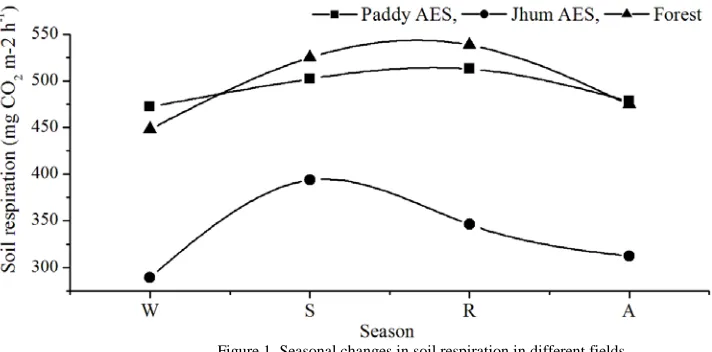
Soil respiration in all the sites showed strong seasonal patterns with higher value observed in the wet season compared to the dry season in most of the sites (Fig. 1). Afterward, soil respiration rates followed a steady decrease towards the end of the year in all the fields. During the winter all the sites showed lower amount of CO2 emission. Similar results were reported by different authors (Tang et al. 2006; Mo et al. 2007, 2008). Study area is a monsoon climate, where more than 80% of annual precipitation falls in the wet season (April to September). Temperature in the wet season is significantly higher than that in the dry season. Consequently, maximum plant growth during this season and soil microbial activity can contribute greater soil respiration rate. Higher soil respiration rate during the rainy season in Forest and Paddy AES may be due to a higher soil and air temperature, high soil moisture and relative humidity. Availability of all these factors enhances the activity of soil microbes which leads to a greater decomposition of litter materials and as a result more release of CO2 can be found. Therefore, the decomposition rates also an important factor for the rate of CO2 emission. The higher decomposition rate during the rainy season was reported in different land use patterns in north east India (Devi, 2005; Bhuyan, 2012). Similar results higher soil respiration rate in wet seasons were reported by many workers (Kursar, 1989, in a lowland moist forest of Panama; Rajvanshi and Gupta 1986, in tropical Dalbergia sisoo forest; Savage and
Davidson 2001, in Harvard forests; Saraswathi et al. 2008, in a semi-arid soil of India), our observations. Other reports a maximum rate of soil respiration either in spring or early summer (Davidson et al. 2002; Laishram et al. 2002; Rastogi et al. 2002). However, winter season showed the minimum rates of soil respiration which due to the slow decomposition and microbial activity.
Soil temperature and moisture showed clear seasonal patterns throughout the year (P< 0.001). Soil was wet and warm from the month of April through September (wet season) and became cool and dry from the month of October to the March of the next year (dry season) (Fig 2). However, seasonal patterns of soil temperature and moisture were consistent with the seasonality of air temperature and precipitation. Annual mean soil temperature and soil moisture were found 23±0.19 C0 and 22±0.90%, respectively in the selected sites. Soil in the forest is little bit drier and warmer than that in the Paddy and Jhum fields. However, both the Paddy and Jhum fields were almost similar in soil temperature.
Data from soil respiration values of different sites were pooled and regressed against temperature and moisture contents and as a result significant linear relationships were identified. Many works have reported that temperature is the critical factor for predicting the soil respiration (Singh and Gupta, 1977; Pandey and Singh, 1981; Raich and Potter, 1995; Bijracharya et al. 2000; Saraswathi et al. 2008; Devi and Yadava, 2008). Soil respiration is controlled primarily by temperature (Lloyd and Taylor, 1994). It is due to the soil physiological processes are controlled by enzymatic rates in a greater extent than resource supply rates (Skopp et al. 1990; Craine et al. 1998). It also controlled by the SOC content and ecosystem type (Zheng et al. 2009). So the respiratory substrate present in the soil plays a crucial role in the rate of soil respiration (Liu et al. 2006).
It was found that soil respiration was most sensitive to fluctuations in temperature and soil moisture in the soils. In most of the sites, significant exponential relationships between soil respiration rate and soil temperature were found (Table 2). Different microclimatic factor such as soil temperature and soil respiration rate varied significantly among the land use patterns. It was found wet weather during the month of June, July and August, caused the co-occurrence of warm, wet soil conditions.
ISSN 2348 – 7968
Table 1. Soil respiration rate, temperature and organic carbon content of the investigated land uses (mean of 1 year).
Land use N Soil respiration (mg CO2 m-2 h-1)
Soil temperature (C0)
SMC (%) Organic Carbon (%) Paddy AES 8 291.42±5.24 22±1.12 24.2±1.12 2.10±0.08 Jhum AES 8 135.54±11.12 21±.08 20.12±2.01 2.50±0.04 Forest 8 296.54±7.44 25±1.22 21.7±0.87 2.24±0.44
Table 2. Correlation co-efficient (r) for the relationship of soil respiration rate (CO2 released) with the measured abiotic variables in two forest stands
Parameters Land use patterns
Paddy Jhum Forest
SMC 0.92** 0.74* 0.91**
ST 0.89* 0.88* 0.78*
Relative Humidity 0.65NS 0.66* 0.64NS Mean air temperature 0.77* 0.84* 0.80*
Rainfall 0.89* 0.81* 0.80*
NS – not significant; *P<0.05; ** P<0.01
and Kirkham 1971; 42%, Gupta and Singh 1981; 24%, Li et al. 2002 and 22–53%, Yazaki et al 2004). The amount also varies in different seasons. Minimum contribution of root respiration to soil respiration had been found during the dormant season than the growing season (Rochette and Flanagan, 1997). Microbial respiration is also greatly affected by root exudates and turnover (Kuzyakov et al. 2000). Soil nutrient quality especially availability of nitrogen in the soil affects significantly on the rate of soil respiration (Boxman et al. 1998; Mo et al. 2008). More N addition could increase soil respiration significantly (Bowden et al. 2004). Soil organic carbon varied in different sites and higher concentration was found in Jhum followed by Forest and Paddy agro-ecosystem (Table 1).
Figure 1. Seasonal changes in soil respiration in different fields.
ISSN 2348 – 7968
References
Anderson, J.M. and Ingram, J.S.I., Tropical Soil Biology and Fertility: A Handbook of Methods. C.A.B. International, UK. 1993.
Anderson, J., Soil respiration. In Methods of Soils Analysis, Part 2. Agronomy 9 (eds Page, A. L., Miller, R. H. and Keeney, D. R.), American Society of Agronomy, Madison, WI, 1982. pp.; 831–871.
Bhuyan, S.I. 2012. Soil nutrients dynamics and associated microbial biomass under different agro-ecosystems in East Siang district, Arunachal Pradesh, Ph.D. Thesis, North Eastern Regional Institute of Science and Technology, Nirjuli-791109, Arunachal Pradesh. Bijracharya, R..M., Lal R. and Kimble J.M., Diurnal and
seasonal CO2–C flux from soil as related to erosion
phases in central Ohio. Soil Science Society of America Journal, 2000; 64, 286–
293.
Bowden, R.D., Davidson, E., Savage, K., Arabia, C. and Steudler, P., Chronic nitrogen additions reduce total soil respiration and microbial respiration in temperate forest soils at the Harvard Forest, Forest Ecol. Manag., 2004; 196, 43–56.
Boxman, A.W., Blanck, K., Brandrud, T.E., Emmett, B.A., Gundersen, P., Hogervorst, R.F., Kjonaas, O.J., Person, H. and Timmermann, V., Vegetation and soil biota response to experimentally-changed nitrogen inputs in coniferous forest ecosystems of the NITREX project, Forest Ecol. Manag. 1998; 101, 65–79.
Buchmann, N., Biotic and abiotic factors controlling soil respiration rates in Pieca abies stands. Soil Biol Biochem 2000; 32, 1625–1635.
Craine, J.M., Wedin D.A., and Chapin F.S., Predominance of ecophysiogical controls on soil CO2 flux in a Minnesota grassland, Plant Soil, 1998; 207, 77–86. Davidson, E.A., Savage, K., Verchot, L.V., Navarro, R.,
Minimizing artifacts and biases in chamber based measurements of soil respiration. Agric For Meteorol 2002; 113:21–37
Devi, N.B. 2005. Litterfall, Litter Decomposition and Soil Microbial Biomass Dynamics at Langol Hill Range, Manipur. Ph.D. Thesis, Manipur University, Imphal, India. 152 pages.
Devi, N.B. & Yadava P.S., Emission of CO2 from Soil in a
Subtropical Mixed Oak Forest of Manipur, Northeastern India. International Journal of Ecology and Environmental Sciences 2008; 34 (3), 293-297. Dugas, W.A., Heuer, M. L. and Mayeux, H.S., Carbon dioxide
fluxes over bermudagrass, native prairie, and sorghum; Agric. For. Meteorol. 1999; 93 121–139.
Gupta, S. R. and Singh ,J. S. Soil respiration in a tropical grassland; Soil Biol. Biochem. 1981; 13, 261–268 Hanson, P.J., Edwards, N.T., Garten, C.T., Andrews, J.A.,
Separating root and soil microbial contributions to soil respiration: a review of methods and observations. Biogeochemistry 2000; 48, 115–146.
Janssens, IA, Lankreijer, H, Matteucci, G, Kowalski, AS, Buchmann, N, Epron, D, Pilegaard, K, Kutsch, W, Longdoz, B, Grunwald, T, Montagnani, L, Dore, S, Rebmann C, Moors EJ, Grelle A, Rannik U¨ , Morgenstern K, Oltchev S, Clement R, Guðmundsson, J, Minerbi, S, Berbigier, P, Ibrom, A, Moncrieff, J, Aubinet, M, Bernhofer, C, Jensen, NO, Vesala, T, Granier, A, Schulze, E-D, Lindroth, A, Dolman, AJ,
Jarvis, PG, Ceulemans, R, Valentini, R, Productivity overshadows temperature in determining soil and ecosystem respiration across European forests. Glob Change Biol 2001; 7:269–278
Kucera, C.L. and Kirkham, D.L., Soil respiration studies in tall grass prairies in Missouri; Ecology, 1971; 52, 912–915 Kursar, T.A., Evaluation of soil respiration and soil CO2 concen-
tration in a lowland moist forest in Panama. Plant Soil, 1989; 113, 21–29
Kuzyakov, Y., Friedel, J.K. and Stahr, K., Review of mechanisms and quantification of priming effects; Soil Biol. Biochem. 2000, 32 1485–1498
Laishram, I.D., Yadava, P.S. and Kakati, L.N., Soil respiration in a mixed oak forest ecosystem at Shiroy Hills, Manipur in north-eastern India. International Journal of Ecology and Environmental Sciences, 2002; 28, 133–137. Li, L. H., Han, X.G., Wang, Q.B., Chen Q.S., Zhang Y., Yang J.,
Bai W.M., Song S.H., Xing X.R. and Zhang S.M., Separating root and soil microbial contributions to total soil respiration in a grazed grassland in the Xilin River Basin; Acta Phytoecol. Sin. 2002; 26, 29–32
Liu, H.S., Li L.H., Han, X.G., Huang, J.H., Sun, J.X., and Huang, H.Y., Respiratory substrate availability plays a crucial role in the response of soil respiration to environmental factors, Appl. Soil Ecol., 2006; 32, 284–292
Lloyd, J. and Taylor, J.A., On the temperature dependence of soil respiration, Funct. Ecol., 1994; 8, 315–323.
Longdoz, B., Yernaux, M., Aubinet, M., Soil CO2 efflux
measurements in a mixed forest: impact of chamber disturbances, spatial variability and seasonal evolution. Glob Change Biol 2000; 6:907–917.
Mo, J.M., Zhang, W., Zhu, W.X., Fang, Y.T., Li, D.J., and Zhao, P., Response of soil respiration to simulated N deposition in a disturbed and a rehabilitated tropical forest in southern China, Plant Soil, 2007; 296, 125– 135.
Mo, J.M., Zhang, W, Zhu, W.X. Gundersen P., Fang Y.T., Li D.J., and Wang H., Nitrogen addition reduces soil respiration in a mature tropical forest in southern China, Glob. Change Biol., 2008; 14, 403–412. Pandey, U. and Singh, J.S., A quantitative study of forest floor
litterfall and nutrient return in an oak conifer forest in Himalaya. II. Pattern of litterfall and nutrient. Acta Oecologia Generallis, 1981; 2, 83–99.
ISSN 2348 – 7968
Raich, J.W. and Schlesinger, W.H, The global carbon dioxide flux in soil respiration and its relationship to vegetation and climate. Tellus, 44B, 1992; 81–99.
Rajvanshi, R. and Gupta, S.R., Soil respiration and carbon balance in a tropical Dalbergia sissoo forest ecosystem. Flora, 1986; 178, 251-260.
Rastogi, M., Singh, S. and Pathak, H., Emission of carbon dioxide from soil. Current Science, 2002; 82, 510–517. Rayment, M.B., Jarvis, P.G., Temporal and spatial variation of
soil CO2 efflux in a Canadian boreal forest. Soil Biol Biochem 2000; 32, 35–45
Rochette, P. and Flanagan, L.B., Quantifying rhizosphere respiration in a corn crop under field conditions; Soil Sci. Soc. Am. J. 1997; 61, 466–474
Saraswathi, S.G., Lalrammawia, C. and Paliwal, K., Seasonal variability in soil-surface CO2 efflux in selected young
tree plantations in semiarid eco-climate of Madurai. Current Science, 2008; 95, 94–99.
Savage, K.E., Davidson, E.A., Interannual variation of soil respiration in two New England forests. Global Biogeochemical Cycles 2001; 15, 337–350.
Singh, J.S., and Gupta, S.R., Plant decomposition and soil respiration in terrestrial ecosystems. Botanical Review, 1977; 43, 449–529.
Skopp, J., Jawson, M.D., Doran J.W., Steady-state aerobic microbial activity as a function of soil water content. Soil Sci Soc Am J., 1990; 54, 1619–1625
Stoyan, H., De-Polli H., Bohm S., Robertson G.P., Paul E.E., Spatial heterogeneity of soil respiration and related properties at the plant scale. Plant Soil, 2000; 222, 203–214
Tang, X,, Liu, S,, Zhou, G., Zhang, D., Zhou, C., Soil-atmospheric exchange of CO2, CH4, and N2O in three subtropical forest ecosystems in southern China. Global Change Biol 2006; 12, 1–15.
Tewary, C.K., Pandey, U. and Singh, J.S., Soil and litter respiration rate in different microhabitats of a mixed oak conifer and their control by edaphic and substrate quality. Plant and Soil, 1982; 65(2), 233-238.
Walkley, A. and Black, I.A., An examination of Degtjareff method for determining soil organic matter and a proposed modification of the chromic acid titration method. Soil Science, 1934; 37, 29-37.
Yazaki, Y., Mariko, S and Koizumi, H, Carbon dynamics and budget in a Miscanthus sinensis grassland in Japan; Ecol. Res. 2004; 19, 511–520
Zar, J.H., Biostatistical Analysis. 2nd eds. Prentice-Hall, Englewood Cliffs, NJ. 1974;
Zhou, L,X,, Yi W,M,, Yi, Z,G,, Ding, M,M., Soil microbial characteristics of several vegetations at different elevation in Dinghushan Biosphere Reserve. Trop Subtrop For Ecosyst Res 2002; 9, 169–174