Vision based Hand Gesture Recognition
System for Robot control
Mrinal Parikshit Chandane
Former Assistant Professor, Dept. of E&TC, K.J.Somaiya College of Engineering, Mumbai, Maharashtra, India
ABSTRACT: The paper discusses the system developed to control a robot using hand gestures recognition. The system is simple and uses a personal computer and an USB Web camera. The advantage of the system is that it enables the user to control the robot remotely either from home or office. The basis of this approach is the fast segmentation process to extract the hand posture from the whole image and also to deal with different backgrounds and lighting conditions. The robot is connected to the nearby computer using wired or wireless connection. The command for the robot is given to the computer via the web camera The command goes through image processing and signal processing using MATLAB and then given to the Robot for further action.
KEYWORDS: Image Processing, Signal Processing, Hand gesture recognition, MATLAB, Robot control
I. INTRODUCTION
Most of the machines or robots are controlled by devices like remotes, joysticks, keyboards etc. The keyboard and the mouse are currently the main interfaces between man and computer. In other area where 3D information is required, like computer games, robotics and design, mechanical devices like roller-balls, joysticks and data gloves are used. This gives the need to design a hardware interface between the man and the machine/ robot to type or give commands. However, humans communicate mainly by vision and sound. A man- machine interface will be more intuitive if it makes greater use of the vision and audio recognition. This will eliminate the need of physically typing the commands or pressing the buttons to control the robot. Unlike audio commands, visual system would be more preferable in noisy environments or in situations where sound would cause a disturbance.
The visual system proposed is the hand gesture. The amount of computation require to process hand gestures is much greater that that of mechanical devices. But, with latest advances in processors of personal computers, efficient and fast algorithm can be implemented to make this system a viable preposition. A new vision-based framework is presented in this paper that allows the user to interact with computers through hand postures. The system is designed to adapt for different light conditions and background. This efficiency and adaptability make the system suitable for real-time applications.
II.SYSTEM OPERATION
Fig.1 System Modesl
The above fig.1 shows the processes to compose the general framework: 1.Acquisition: A frame from the web cam is captured.
2.Segmentation: Each frame is processed separately before its analysis. The images is smoothed, skin pixels are labeled, noise is removed and small gaps are filled. Image edges are found and finally after a blob analysis, the blob which represents the user’s hand is segmented. A new image is created which contains the portion of the original one where the user’s hand was placed.
3.Pattern Recognition: Once the user’s hand has been segmented, it’s posture is defined by MATLAB.
4.Executing action: Finally, the system carries out the corresponding action according to the recognized hand posture.
Fig.2 Hand Gesture Detection
III. IMAGE PROCESSING
The operators developed for image processing must be kept low time consuming in order to obtain the fast processing rate needed to achieve real time speed. Furthermore, certain operators should be adaptable to different light conditions and backgrounds. The steps to be followed for image enhancement are :
1.Skin Color Features: Modeling skin color requires the selection of an appropriate color space and identifying the cluster associated with skin color in this space. HSI space i.e. Hue, Saturation and Intensity space was chosen since the hue and saturation pair of skin-tone colors are independent of the intensity component. Thus, colors can be specified using just two parameters instead of three specified by RGB space color. The fact that appearance of the skin color tone depends on the lighting conditions was confirmed in the analysis of these images. The values lay between 0 and 35 for hue component and between 20 and 220 for saturation component.
subtracts from each pixel color band (R,G,B) the average of the whole image, so odd colored images like the reddish one are turned into more natural images.
3.Grouping Skin-Tone pixels: Once the initial image has been smoothed and normalized, a binary image is obtained in which every white pixel represents a skin-tone pixel from the original image. The skin-tone classification is based on the normalized image and considerations of the HSI space color. Then, a pixel was classified as a skin tone pixel if its hue and saturation components lay in a certain range. However, these ranges still vary slightly depending on light conditions, user’s skin color and background. These ranges are defined by two rectangles in the HS plane: the RI rectangle for natural light (0 ≤ H ≤ 15; 20 ≤ S ≤ 120) and the R2 rectangle for artificial light (0 ≤ H ≤ 15; 20 ≤ S ≤
120).
4.Blob analysis: Blobs, Binary linked objects, are groups of pixels that share the same label due to their connectivity in a binary image. After a blob analysis, all those pixels that belongs to the same object share a unique label, so every blob can be identified with this features: area, perimeter length, compactness and mass centre about each one. After this stage, the image contains blobs that represent skin areas of the original image. The user’s hand may be located using the global features available for every blob, but the system must have been informed whether the user is right or left handed. Most likely, the two larges blobs must be the user’s hand and face. Hence, it is assumed that the hand corresponds to the right most blob for a right handed user and vice-versa.
IV. HAND GESTURE DETECTION
Fg.3 Initializtion GUI
Fig.4 Image Capture (GUI)
graph is plotted in form of intensity verses length of circumference. From the plotted graph, the number of negative edges are calculated. Hand gesture is detected as one less that the number of negative edges as shown in fig.5 .
Fig.5 Gesture Detection (GUI)
V. SYSTEM OVERVIEW
1.Image recognition and processing system
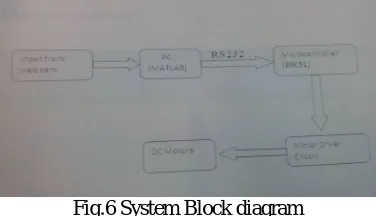
Fig.6 System Block diagram
The input is given to the personal computer. The input is recognized and processed in MATLAB. The obtained data is sent from PC to microcontroller via serial communication port using RS 232C. The whole process is shown in fig.6 above.
2.Microcontroller system
As shown fig.7, given below , the microntroller system does
Take the input from the PC Debug the signal
Gives command for DC motors.
3.Driver circuit
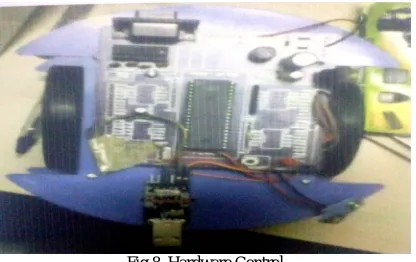
Fig 8. Hardware Control
In the above fig. 8 , the driver circuitry is shown and does the following
Interface betweeen the microcontroller and motors Gives proper signals to the motors
V. CONCLUSION
Hand - gesture implementation involves significant usability challenges including fast response time, high recognition accuracy, quick to learn and user satisfaction. The few vision-based gesture systems have matured beyond prototypes or made it to the commercial market for human computer devices. The commercial appeal suggests that hand-gesture based interactive applications can become important players in the next-generation interface systems due to their ease of access and naturalness of control.
REFERENCES
[1] V.I.Pavlovic, R. Sharma , T. S. Huang, “Visual interpretation of hand gestures for human-computer interaction: a review”, IEEE Transactions on Pattern analysis and machine intelligence, vol.19, issue 7, pp. 677-695, July 1997
[2] Horst Bunke, Juan Jose, Villanueva, Gamma Sanchez, Xavier Otazu, “Progress in computer vision and image analysis”, World Scientific Publishing Co. Pte. Ltd., vol.73, 2010
[3] Siddharth S. Rautaray, Anupam Agarwal, “Vision based Hand Gesture Recognition for human computer interaction: Survey”, Artificial Intelligence Review,Springer, vol.43, issue 1, pp. 1-54, January 2015
[4] Pei Jia, Huosheng H. Hu, Tao Lu, Kui Yuan, “Head gesture recognition for hands free control of an intelligent wheelchair”, Industrial Robot: An International Journal, Vol. 34 Iss: 1, pp.60 - 68
[5] Pragati Garg, Naveen Aggarwal and Sanjeev Sofat, “Vision Based Hand Gesture Recognition ”, International Journal of Computer, Electrical, Automation, Control and Information Engineering Vol:3, No:1, 2009
[6] A. Mulder, “Hand gestures for HCI”, Technical Report 96-1, vol. Simon Fraster University, 1996
[7] Richard Watson, “A Survey of Gesture Recognition Techniques”, Technical Report TCD-CS-93-11, Department of Computer Science, Trinity College Dublin, 1993.
[8] B. Stenger, A. Thayananthan, P.H.S. Torr, R. Cipolla , “Model-based hand tracking using a hierarchical Bayesian filter” , IEEE transactions on pattern analysis and machine intelligence, September 2006