Enhancing speech corpus resources with multiple lexical tag layers
Andreas Witt, Harald L¨ungen, Dafydd Gibbon
Fakult¨at f¨ur Linguistik und Literaturwissenschaft Universit¨at Bielefeld
[email protected] [email protected]
Postfach 10 01 31 33501 Bielefeld, Germany
Abstract
We describe a general two-stage procedure for re-using a custom corpus for spoken language system development involving a transfor-mation from character-based markup to XML, and DSSSL stylesheet-driven XML markup enhancement with multiple lexical tag trees. The procedure was used to generate a fully tagged corpus; alternatively with greater economy of computing resources, it can be employed as a parametrised ‘tagging on demand’ filter. The implementation will shortly be released as a public resource together with the corpus (German spoken dialogue, about 500k word form tokens) and lexicon (about 75k word form types).
1.
Introduction
The present project is the result of a co-operation be-tween the VERBMOBIL lexicon data subproject and the text technology working group at the University of Biele-feld. VERBMOBIL is a large joint project dealing with the machine translation of spoken language, where 1128 mono-and multilingual dialogues in the domains of appointment scheduling, travel planning and hotel booking have been collected since 1993 (Jekat et al., 1997). The corpus con-sists of digitised audio recordings and their transcriptions (marked as ’TRLs’ in Figure 1), and is used for the training of acoustic and language models for speech recognition, for grammar and domain modelling, and for training and eval-uating a statistical translation system. The languages cov-ered are English, German, and Japanese. At the time of writing, the German subcorpus used for the work reported here contained 489,722 word form tokens, and 7,926 dif-ferent word form types, a type-token ratio of 0.016 with a high level of saturation for the domain.
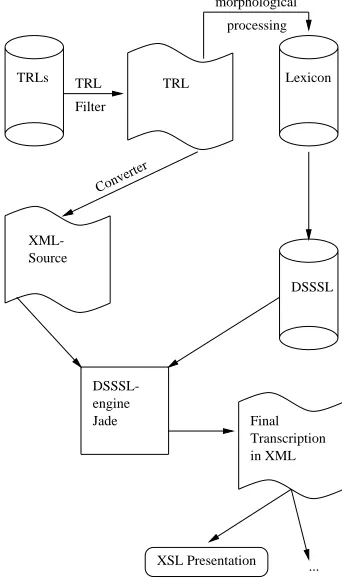
From the transcriptions, a lexicon for speech related lex-ical information below the word level is derived in var-ious stages of automatic and semi-automatic processing (L¨ungen et al., 1998; L¨ungen and Sporleder, 1999). For the present project, we have additionally converted the tran-scriptions to an XML representation, and the lexicon to a DSSSL list representation. We have then employed the DSSSL engine OPENJADE to combine these into an en-hanced, reusable transcription in XML format. The data flow is depicted in Figure 1.
2.
Data
2.1. Transcription source format
The dialogues are transcribed orthographically with project-specific character-based markup conventions (TRL = ‘transliteration’, (Kohler et al., 1994; Burger, 1997)), devised for both manual and machine processing. Based on orthographic transcription on the word form level, the markup also encompasses spontaneous speech phenomena such as interruptions, corrections, repetitions, reductions,
XSL Presentation TRLs TRL
Filter
TRL Lexicon
Converter
XML-Source
DSSSL
Final Transcription in XML
DSSSL-engine Jade
morphological processing
...
Figure 1:Architecture
hesitations, speaker overlaps, and human noise as well as background and technical noise types. The example in Fig-ure 2 illustrates the markup type:
Tag Category Example TRL TEI-XML Encoding
Lexical <*ENG>Miss <foreign lang=”ENG”>Miss</foreign> Lexical Hannover <name>Hannover</name>
Lexical *Treffi <neol>Treffi</neol> Lexical #zehn <number>zehn</number>
Technical gap <T>tz <gap reason=”empty signal” pos=”word-initial”>tz</gap> Unclear wir% <unclear>wir</unclear>
Human <B> <vocal desc=”breath”> Human <Laugh> <vocal desc=”laugh”> Non-human <#Rustle> <event desc=”rustle”>
Variant ’ner <reg orig=”’ner”>einer</reg> Morph. coordination be-- <m mcat=”nonheadcoord”>be</m> Truncation heu= <del type=”truncation”>heu</del>
Table 1: Example of corresponding Verbmobil and TEI speech annotations
lexicon) to generate an even more highly structured ment, containing more information than the original docu-ment. For doing this, we employed the ISO-Standard Docu-ment Style Semantic and Specification Language (DSSSL, ISO 10179:1996). Amongst other things, DSSSL defines a style language for the visual appearance of documents, and a tree transformation component for the transforma-tion of SGML-documents. Up to now, these two func-tions have mainly been exploited for the purpose of
pre-senting SGML-documents (e.g. as a presentation language
for printout, or as a language for transformation to HTML), but DSSSL allows for more sophisticated kinds of process-ing. It is for example possible to incorporate a parser for natural language into text processing using DSSSL, pro-viding automatic syntactic annotation of (maybe previously untagged) text (Witt, 1999).
Thus, the arguments of the transformation function are firstly the XML transcriptions (Figure 5) according to TEI conventions and secondly the lexicon transformed into DSSSL-conform notation (Figure 4).
... </word>
<word sampa="f6.+k’e:6#+s#g’’Yns.t+IC" cat="A"
morph-readings="1">
<m sampa="f6" morph-cat="">ver</m> <m sampa="ke:6"
morph-cat="">kehr</m>
<m sampa="s" morph-cat="">s</m> <m sampa="gYnst"
morph-cat="">g¨unst</m>
<m sampa="IC" morph-cat="">ig</m> </word>
<word sampa="g@.+l’e:.g+@n cat="A"
...
Figure 6: CORPUSTREE2(enhanced XML markup)
The transformation program runs with the DSSSL
en-gineOPENJADE, and converts the source XML file into a
new XML file augmented by our morpho-lexical informa-tion, producing the output in Figure 6.
5.
Presentation
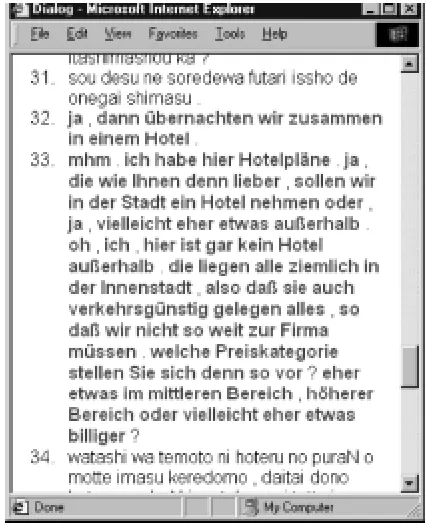
The resulting XML document may be used in differ-ent applications. The most obvious one is to provide inter-ested researchers with all the information available about a corpus in one document i.e. the transcriptions and the lexical information whenever it is needed. For this reason, we have developed a presentation using standard software (e.g. Internet Explorer 5), which allows the user to specify which components of the structured document should be displayed. Figure 7 shows this standard presentation mode.
Figure 7:Standard presentation in Internet Explorer 5
Figure 8:Pop-up window showing morpholexical information
The presentation has been rendered using XSL (Ex-tensible Stylesheet Language). XSL style sheets are pre-sentable using standard WWW browsers such as Netscape or Internet Explorer. As an alternative, the DSSSL transfor-mation component can be used to convert the XML source to HTML, but then the advantages of XML we mentioned above are lost. Moreover, no standard software for the pre-sentation of style sheets designed with the DSSSL presen-tation component exists yet.
6.
Results and prospects
We have described a procedure for automatically gen-erating a multi-layer XML treebank from a conventionally annotated corpus, a relational lexical database, and a corpus which was produced using this procedure. It will shortly be made publicly available. The procedure is designed to en-able re-use of existing corpora and lexica with new corpora and lexica in multimodal system development.
7.
References
Bleiching, Doris, Guido Drexel, and Dafydd Gibbon, 1996. Ein Synkretismusmodell f¨ur die deutsche Morphologie. In Dafydd Gibbon (ed.), Natural language processing
and speech technology: Results of the 3rd KONVENS Conference, Bielefeld, October 1996. Berlin: Mouton de
Gruyter.
Burger, Susanne, 1997. Transliterationen spontansprach-licher Daten - Lexikon der Transliterationskonventionen - Verbmobil II. Verbmobil Technisches Dokument 56. LMU M¨unchen.
Gibbon, Dafydd, 1995. Verbmobil Lexicon: Conventions for spelling and pronunciation. Verbmobil Technisches Dokument 31. Universit¨at Bielefeld.
Gibbon, Dafydd and Daniela Steinbrecher, 1995. Verbmobil-Standardfilter f¨ur Transliterationen Version 2.2. Verbmobil Technisches Dokument 38. Universit¨at Bielefeld.
Jekat, Susanne, Christian Scheer, and Tanja Schultz, 1997. VM II Szenario: Instruktionen f¨ur alle Sprachstellungen. Verbmobil Technisches Dokument 62. Universit¨at Ham-burg, LMU M¨unchen, Universit¨at Karlsruhe.
Kohler, Klaus, Gloria Lex, Matthias P¨atzold, Michael Scheffers, Adrian Simpson, and Werner Thon, 1994. Handbuch zur Datenerhebung und Transliteration in TP14 von VERBMOBIL - 3-0. Verbmobil Technisches Dokument 11. Universit¨at Kiel.
L¨ungen, Harald, Karsten Ehlebracht, Dafydd Gibbon, and Ana Paula Quirino Simoes, 1998. Bielefelder Lexikon und Morphologie in Verbmobil Phase II. Verbmobil Re-port 233. Universit¨at Bielefeld.
L¨ungen, Harald and Caroline Sporleder, 1999. Automatic induction of lexical inheritance hierarchies. In Jost Gip-pert (ed.), Multilinguale Corpora. Codierung,
Struk-turierung, Analyse. Prague: Enigma Corporation.
Schaaf, Thomas and Michael Dorna, 1998. Behandlung unbekannter W¨orter im Verbmobil System. Verbmobil Memo 132. Universtit¨at Karlsruhe/Universit¨at Stuttgart. Sperberg-McQueen, C.M. and Lou Burnard, 1994.
Guide-lines for electronic text encoding and interchange (TEI P3. Chicago: Text Encoding Initiative. Volumes I and
II.
Witt, Andreas, 1998. TEI-based XML-Applications: Transcriptions. In Joint Conference of the ALLC and ACH (ALLCACH98). Debrecen. Http://www.arts.klte.hu/allcach98/abst/jegyzek.htm. Witt, Andreas, 1999. DSSSL zur Verarbeitung
linguis-tischer Korpora. In Jost Gippert (ed.), Multilinguale
Corpora. Codierung, Strukturierung, Analyse. Prague:
Enigma Corporation.