Developing Infrastructure for the Evaluation of Single and Multi-document
Summarization Systems in a Cross-lingual Environment
Horacio Saggion , Dragomir Radev
, Simone Teufel
, Wai Lam
, Stephanie M. Strassel
Department of Computer Science University of Sheffield
211 Portobello Street, Sheffield S1 4DP, England, UK [email protected]
School of Information & Department of Electrical Engineering and Computer Science University of Michigan
550 E. University 3080 West Hall Ann Arbor, MI 48109-1092
Computer Laboratory Cambridge University
JJ Thomson Avenue Cambridge CB3 0FD, UK [email protected]
Department of Systems Engineering & Engineering Management The Chinese University of Hong Kong
Shatin Hong Kong [email protected]
Linguistic Data Consortium University of Pennsylvania
3615 Market Street Philadelphia, PA 19104 [email protected]
Abstract
We describe our work on the development of Language and Evaluation Resources for the evaluation of summaries in English and Chinese. The language resources include a parallel corpus of English and Chinese texts which are translations of each other, a set of queries in both languages, clusters of documents relevants to each query, sentence relevance measures for each sentence in the document clusters, and manual multi-document summaries at different compression rates. The evaluation resources consist of metrics for measuring the content of automatic summaries against reference summaries. The framework can be used in the evaluation of extractive, non-extractive, single and multi-document summarization. We focus on the resources developed that are made available for the research community.
1.
Introduction
Evaluation is an essential step of any natural lan-guage processing task. In the field of text summarization almost all research is published with an in-house evalu-ation, which makes it difficult to replicate experiments, to compare results, or to use evaluation data for training purposes. The development of standards of evaluation and sharable resources is of paramount importance for
progress in text summarization. SUMMAC (Mani et al., 1998) and DUC (2000) are clear examples of efforts to advance text summarization research.
Doc-uments, a 6-week language engineering workshop at the Center for Language and Speech Processing, Johns Hop-kins University. The objectives of the workshop were the integration of cross-lingual information retrieval with single and multi-document summarization and its evalu-ation.
2.
Corpus and Annotation
We use a parallel corpus of English and Chinese (Cantonese) texts which are translations or near trans-lations of each other. The corpus consists of 18,461 document-pairs. The corpus, called the Hong Kong
Newspaper Corpus (corpus number LDC2000T46), is
provided by the Linguistic Data Consortium (LDC). The average size in words for a document is 347.8 for English and 325.2 for Chinese, in sentences it is 16.2 and 15.5, respectively. The texts are not typical news articles. The Hong Kong Newspaper mainly publishes announcements of the local administration and descriptions of municipal events, such as an anniversary of the fire department, or seasonal festivals.
Each document in the corpus was annotated in order to provide structural and linguistic information. The an-notation for each document includes information about the document identity, its language and its translation. For the purpose of text summarization (or sentence ex-traction) research it was identified that annotations on the sentence level were required in order to allow fair comparison between different summarization technolo-gies. We provided mark-up on the paragraph, sentence and word level. As one of the research objectives of the workshop was to investigate new measures for con-tent evaluation based on the notion of vocabulary over-lap, English documents were also annotated with parts of speech and morphologic information.
2.1. Corpus Processing and Encoding
All corpus information is encoded in XML, and several DTDs were written to describe the structure of the document after each processing step. This proved an advantage for Software engineering in the project, as many modules had to be interfaced, and XML validation made it very easy to check for errors in the input and output of each module in the pipeline.
2.1.1. Processing of English Documents
We automatically separated the main title from the main body of text of the news article, inserted sentence and word boundaries using the LT TTT Tokenisation Tool (Grover et al., 2000), a software package developed within an XML processing paradigm which provides tools for text tokenisation and mark-up. Semi-automatic
corrections of sentence boundaries were made in those sets of documents where human sentence segmentation was available. In Figure 1, we show a short document from the corpus annotated with sentence boundaries.
The English corpus was further annotated with part of speech tags1 (Mikheev, 2000). The tagger is
based on a combination of Hidden Markov Models and Maximum Entropy technologies, it comes trained on 4 million words of the Wall Street Journal. A lemmatiser (Humphreys et al., 2000) was also used to obtain lemmas for each noun and verb in the text. It is a rule-based algorithm that produces for each noun and verb in the input text an affix and root. The program is implemented as a set of regular expressions which represent both morphological analyses of the input and exception rules. The program can be considered domain independent because exception rules were derived from WordNet (Miller, 1995), but also revised by the analysis of a number of English corpora. A sentence annotated with parts of speech and lemmas can be seen in Figure 2.
2.1.2. Processing of Chinese Documents
Sentence segmentation in Chinese is based on punctuation. A list of punctuation symbols that usually indicate end of sentences was created. This list was used in conjunction with a greedy matching algorithm over sequences of punctuation symbols as the basis for sentence end identification. Further, we made use of a word segmentation program derived from the tool provided in http://www.mandarintools.com for the BIG5 encoding. Words in Chinese were identified by means of a dictionary used in conjunction with a maximal matching algorithm that attempts to match the longest possible word in the dictionary. The algorithm is able to identify dates, times, person names, locations, money amounts, organization names, and percentages. In Figure 3, we show a small Chinese document annotated with sentence boundaries.
2.1.3. Named Entity Recognition
Named Entity (NE) detection is the process of identifying and categorising names in texts (person, organization, location, date, time, money, and percent). Both Chinese and English text were annotated with named entity tags using IdentiFinder (BBN, 2000), a probabilistic natural language software tool that scans text to locate NEs. The tool analyzes training data, counts and compiles statistics about the training data, convert those statistics into probabilistic models, applies
1
<?xml version=’1.0’ encoding=’UTF-8’?>
<!DOCTYPE DOCSENT SYSTEM "/export/ws01summ/dtd/docsent.dtd" >
<DOCSENT DID=’D-19980303 004.e’ DOCNO=’2203’ LANG=’ENG’ CORR-DOC=’D-19980303 004.c’>
<BODY>
<HEADLINE><S PAR="1" RSNT="1" SNO="1"> Joseph W P Wong accepts ATV’s apology </S></HEADLINE>
<TEXT>
<S PAR=’2’ RSNT=’1’ SNO=’2’>The Secretary for Education and Manpower, Mr Joseph W P Wong, said today (Tuesday) that he had accepted the apology of Asia Televi-sion Limited (ATV) over the remarks made on him in the ATV programme "Hong Kong Affairs" last Monday (February 23) and would not pursue the matter further.</S> </TEXT>
</BODY> </DOCSENT>
Figure 1: Document 19980303 004.e annotated with sentence boundaries.
<S PAR=’1’ RSNT=’1’ SNO=’1’><W C=’NNP’ L=’joseph’>Joseph</W> <W C=’NNP’ L=’w’>W</W> <W C=’NN’ L=’p’>P</W> <W C=’NNP’ L=’wong’>Wong</W> <W C=’VBZ’ L=’accept’>accepts</W> <W C=’NNP’ L=’atv’>ATV</W> <W C=’POS’ L="’s">’s</W> <W C=’NN’ L=’apology’>apology</W> </S>
Figure 2: Sentence from document 19980303 004.e annotated with word boundaries and linguistic information.
those models to the NE task and outputs the same text with SGML marked-up text. The software was used with the pre-trained models and is available in both English and Chinese. The information about named entities in the corpus was kept in separate files and only used in some summarization experiments.
2.1.4. Sentence Alignment
Sentence alignment is the process of finding corre-spondences between source and target sentences in a pair of documents translation of each other. Sentence-level alignment was performed based on our re-implementation of Gate and Church’s (1991) alignment algorithm. The basic assumption is that longer sentences in one language tend to be translated into longer sen-tences in the other language, and that shorter sensen-tences tend to be translated into shorter sentences. The informa-tion about sentence alignment is kept in tables and used in our cross-lingual evaluation.
2.2. Queries and Clusters
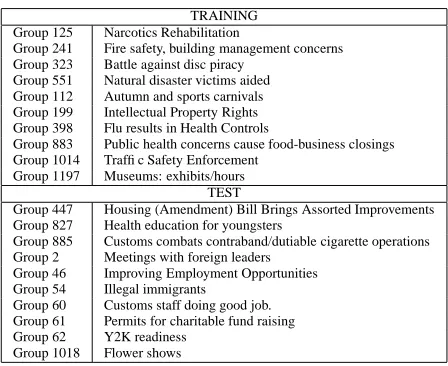
We used 400 documents for our experiments. They were clustered into document sets of 10 documents about one subject (“narcotics rehabilitation”, “natural disaster victims aided”, “customs staff doing good job”, etc.). LDC annotators developed 40 such queries according to our guidelines, then they used an in-house information retrieval engine and human revision, to find the 10 most relevant documents for that query. We
provided a manual Chinese translation of each query. Queries in English can be seen in Figure 4
2.3. Target Summaries
Three LDC judges then assessed each sentence in the 10 relevant documents, and assigned each sen-tence a score on a scale from 0 to 10, expressing how important this sentence is for the summary (Radev et al., 2000). This annotation, which is called “utility judgement”, allows us to compile human-generated ’ideal’ summaries at different compression rates, which is one gold-standard we use for our different measures of sentence-based agreement, both between the human agreement and between the system and the human annotators. We call this gold standard “human extracts”. While utility judgement was only performed on English documents, in section 3.2. we show how we obtain human extracts for Chinese documents.
differ-Figure 3: Document 19980303 004.c annotated with sentence boundaries.
TRAINING Group 125 Narcotics Rehabilitation
Group 241 Fire safety, building management concerns Group 323 Battle against disc piracy
Group 551 Natural disaster victims aided Group 112 Autumn and sports carnivals Group 199 Intellectual Property Rights Group 398 Flu results in Health Controls
Group 883 Public health concerns cause food-business closings Group 1014 Traffic Safety Enforcement
Group 1197 Museums: exhibits/hours TEST
Group 447 Housing (Amendment) Bill Brings Assorted Improvements Group 827 Health education for youngsters
Group 885 Customs combats contraband/dutiable cigarette operations Group 2 Meetings with foreign leaders
Group 46 Improving Employment Opportunities Group 54 Illegal immigrants
Group 60 Customs staff doing good job. Group 61 Permits for charitable fund raising Group 62 Y2K readiness
Group 1018 Flower shows
Figure 4: 20 queries produced by the LDC.
ent gold standard we use (only for multi-document sum-maries); we call them “human summaries”. Only human summaries in English are available in the corpus.
2.4. Inter-judge Agreement in Human Extracts
In order to measure agreement amongst the human extracts, we use Kappa (Siegel and Castellan, 1988), a statistical measure which addresses the problem of ran-dom agreement, and which is increasingly used in em-pirical NLP work and evaluation (Carletta, 1996). Kappa has the following advantages:
It factors out random agreement. Random agree-ment is defined as the level of agreeagree-ment which
would be reached by random annotation using the same distribution of categories as the real annota-tors.
It allows for comparisons between arbitrary num-bers of annotators and items.
It treats less frequent categories as more important (in our case: selected sentences), similarly to preci-sion and recall but it also considers (with a smaller weight) more frequent categories as well.
No matter how many items or annotators, or how the categories are distributed,
when there is no agree-ment other than what would be expected by chance, and
when agreement is perfect. If two annotators agree less than expected by chance, Kappa can also be negative. In our experiments we found low agreement among the judges (0.127 when selecting 10% of the text and 0.324 when selecting 90% of the text). This result is disappointing, but it is consistent with prior research (Rath et al., 1961) and it is still possible to use target summaries in different scenarios proposed in the litera-ture (Salton et al., 1996; Mani, 2001).
2.5. Summarization Technologies and Automatic
Summaries
During this workshop we have focused only on extractive summarization technology: automatic sum-maries are produced by selecting ”relevant” sentences from the text representation. We have explored different summarization technologies that work on single and multi document mode. We have included two base-line methods in our framework: random summaries (constructed from sentences picked at random from the source) and lead based summaries (produced from sentences appearing on the beginning of the text). Random summaries should give a lower bound for the performance any system should have, while lead based summaries give a nice and simple baseline that sometimes obtain very good performance for specific tasks (see (Brandow et al., 1995)). More intelligent summarizers used in our evaluation are: Mead (Radev et al., 2000), Lexical Chains (Barzilay and Elhadad, 1997; Silber and McCoy, 2000), Summarist (Hovy and Lin, 1999), and Websumm (Mani and Bloedorn, 1999).
These summarization technologies were used to produce summaries for the entire corpus at differ-ent compression rates, covering many aspects of the summarization space (single, multi, cross-language summarization, word and sentence compression, query-based summarization) that were used for the purpose of evaluation of our experimental framework.
2.6. Information Retrieval Environment
We made use of an IR engine for conducting full-length document and summary retrieval. We adopted SMART (Salton, 1971) as the search engine for our retrieval experiments. The original SMART could only
handle English documents. We changed the way it reads tokens so that it could deal with double-byte Chinese characters. We further configured the enhanced version of SMART, XSMART, to process the XML-formatted documents in the corpus.
For monolingual retrieval, queries are expressed in the same language as the documents. English and Chi-nese queries are used to retrieve the English and ChiChi-nese documents respectively. To obtain Chinese queries for conducting Chinese mono-lingual retrieval, the English queries were manually translated into Chinese queries by several native Chinese speakers on the team.
In addition to monolingual retrieval, we also ex-plored cross-lingual retrieval for the relevance correla-tion measure that will be explained in the next seccorrela-tion. In the cross-lingual retrieval setting, English queries are used for retrieving Chinese documents. Automatic query translation is applied to English queries producing Chinese queries. The automatically translated Chinese queries are then submitted to XSMART to retrieve Chi-nese documents.
3.
Metrics for Evaluation in a
Cross-lingual Environment
The evaluation of text summarization systems is an emergent research topic. Content evaluation assesses if automatic systems are able to identify the intended “top-ics” of the source document. Text quality evaluation as-sesses the readability, grammar and coherence of auto-matic summaries. Evaluations can be done in intrinsic or extrinsic fashions as defined by Sparck Jones and Gal-liers (1995). As part of our work we have explored both intrinsic and extrinsic evaluations. Our extrinsic evalua-tion assess summarizaevalua-tion in a informaevalua-tion retrieval task, our extrinsic evaluation assess the content of the sum-mary by means of content-based similarity measures. In this paper we only focus on the description of the met-rics for evaluation. The results of our experiments will be reported in detail elsewhere.3.1. Information Retrieval Evaluation
Scalable Text Summarization, pages 10–17, Madrid,
Spain, July.
GTE. BBN Technologies, 2000. IdentiFinder: User
Manual, July. Version 5.0.
R. Brandow, K. Mitze, and Lisa F. Rau. 1995. Auto-matic condensation of electronic publications by sen-tence selection. Information Processing and
Manage-ment, 31(5):675–685.
Jean Carletta. 1996. Assessing agreement on classifica-tion tasks: The kappa statistic. CL, 22(2):249–254. M. Crochemore and W. Rytter. 1994. Text Algorithms.
Oxford University Press.
R.L. Donaway, K.W. Drummey, and L.A. Mather. 2000. A Comparison of Rankings Produced by Summa-rization Evaluation Measures. In Proceedings of
the Workshop on Automatic Summarization, ANLP-NAACL2000, pages 69–78. Association for
Computa-tional Linguistics, 30 April 2000.
2000. Document Understanding Conference.
T. Firmin and M.J. Chrzanowski. 1999. An Evaluation of Automatic Text Summarization Systems. In I. Mani and M.T. Maybury, editors, Advances in Automatic
Text Summarization, pages 325–336. The MIT Press.
W.A. Gale and K.W. Church. 1991. A Program for Aligning Sentences in Bilingual Corpus. In COLIN
91, pages 177–184.
C. Grover, C. Matheson, A. Mikheev, and M. Moens. 2000. LT TTT: A Flexible Tokenisation Tool. In
Pro-ceedings of LREC’00.
E. Hovy and C-Y. Lin. 1999. Automated Text Summa-rization in SUMMARIST. In I. Mani and M.T. May-bury, editors, Advances in Automatic Text
Summariza-tion, pages 81–94. The MIT Press.
K. Humphreys, R. Gaizauskas, and H. Cunningham. 2000. LaSIE Technical Specifications. Technical re-port, Department of Computer Science. University of Sheffield.
Hongyan Jing, Regina Barzilay, Kathleen McKeown, and Michael Elhadad. 1998. Summarization evalua-tion methods: Experiments and analysis. In AAAI 98
Spring Symposium on Intelligent Text Summarization,
pages 60–68.
P.A. Jones and C.D. Paice. 1992. A ’select and gen-erate’ approach to to automatic abstracting. In A.M. McEnry and C.D. Paice, editors, Proceedings of the
14th British Computer Society Information Retrieval Colloquium, pages 151–154. Springer Verlag.
Inderjeet Mani and Eric Bloedorn. 1999. Summarizing similarities and differences among related documents.
Information Retrieval, 1(1):35–67.
I. Mani, D. House, G. Klein, L. Hirshman, L. Obrst, T. Firmin, M. Chrzanowski, and B. Sundheim. 1998. The TIPSTER SUMMAC Text Summarization
Eval-uation. Technical Report Technical Report MTR 98W0000138, The Mitre Corporation, McLean, Vir-ginia.
Inderjeet Mani. 2001. Automatic Summarization. John Benjamins Publishing Company.
A. Mikheev. 2000. Tagging Sentence Boundaries. In
Proceedings of the NAACL, Seattle, USA. ACL.
G. Miller. 1995. WordNet: a Lexical Database for En-glish. Communications of the ACM, Volume 38(Num-ber 11), Novem38(Num-ber.
C.D. Paice and M.P. Oakes. 1999. A Concept-Based Method for Automatic Abstracting. Technical Report Research Report 27, Library and Information Com-mission.
K. Papineni, S. Rouskos, T. Ward, and W-J. Zhu. 2001. Blue: A Method for Automatic Evaluation of Machine Translation. Research Report RC22176, IBM. Dragomir R. Radev, Hongyan Jing, and Malgorzata
Budzikowska. 2000. Centroid-based summarization of multiple documents: sentence extraction, utility-based evaluation, and user studies. In ANLP/NAACL
Workshop on Summarization, Seattle, WA, April.
G. Rath, A. Resnick, and R. Savage. 1961. The forma-tion of abstracts by the selecforma-tion of sentences: Part 1: sentence selection by man and machines. American
Documentation, 12(2):139–141.
Gerard Salton, James Allan, and Amit Singhal. 1996. Automatic text decomposition and structuring.
Infor-mation Processing & Management, 32(2):127–138.
G. Salton. 1971. The SMART Retrieval System:
Exper-iments in Automatic Document Processing. Prentice
Hall, Englewood Cliffs, NJ.
G. Salton. 1988. Automatic Text Processing. Addison-Wesley Publishing Company.
Sidney Siegel and N. John Jr. Castellan. 1988.
Non-parametric Statistics for the Behavioral Sciences.
McGraw-Hill, Berkeley, CA, 2nd edition.
H.G. Silber and K.F. McCoy. 2000. Efficient text sum-marization using lexical chains. In Proceedings of
the ACM Conference on Intelligent User Interfaces (IUI’2000).
K. Sparck Jones and J.R. Galliers. 1995. Evaluating
Natural Language Processing Systems: An Analysis and Review. Number 1083 in Lecture Notes in