How to Evaluate and Compare Tagsets? A Proposal
Herv´e D´ejean
Seminar f¨ur Sprachwissenschaft Universit¨at T¨ubingen [email protected]
Abstract
We propose a methodology which allows an evaluation of distributional qualities of a tagset and a comparison between tagsets. Evaluation of tagset is crucial since the task of tagging is often considered as one of the first tasks in language processing. The aim of tagging is to summarise as well as possible linguistic information for further processing such as syntactic parsing. The idea is to consider these further steps in order to evaluate a given tagset, and thus to measure the pertinence of the information provided by the tagset for these steps. For this purpose, a Machine Learning system, ALLiS, is used, whose goal is to learn phrase structures from bracketed corpora and to generate formal grammar which describes these structures. ALLiS learning is based on the detection of structural regularities. By this means, it can be pointed out some non-distributional behaviours of the tagset, and thus some of its weaknesses or its inadequacies.
1.
Introduction
A typical and familiar case of corpus annotation is grammatical tagging (also called word-class tagging, part-of-speech tagging or POS-tagging). In this case a label or tag is associated with a word [. . . ] to indicate its grammatical class. (Garside et al., 1997)
As G. Leech has written, tagging is one of the major tasks in corpus annotation. More and more this annotation is done automatically or semi-automatically by means of taggers. The emergence of these annotated corpora allows the de-velopment of learning techniques using these corpora in or-der to learn taggers or parsers (Brill, 1993; Charniak et al., 1993; Brant, 1999). One of the questions which is asked when you want to annotate a corpus or to train a tagger is: which tagset do you use and why? For this purpose several tagsets have to be compared. Whereas methodologies for evaluating tools (taggers or parsers) exist (Paroubek, 1998; LREC, 1998; Caroll et al., 1999), the problem of evaluation of tagsets seems to be less investigated.
The existing methods proposed until now try to modify an existing tagset in order to improve the tagging accuracy (Section 7.). (EAGLES, 1996a; Baker et al., 1998) pro-pose guidelines which offer an abstract model of features sets, but these recommendations rather concern the stan-dardisation of tagset and provide no criterion for evaluating tagsets1.
In this article we propose a methodology which distin-guishes the problem of tagset evaluation from tagging eval-uation, and tries to evaluate the pertinence of tagsets rela-tively to parsing. The general idea relies on this observa-tion: Part-of-Speech tagging is often seen as the first stage of a more comprehensive syntactic annotation, which as-signs a phrase marker, or labelled bracketing to each sen-tence of a corpus, in the manner of a phrase structure gram-mar (Garside et al., 1997). If we can substitute tags for words, and nevertheless correctly parse sentences (in our case only phrase structures are parsed), we can consider that no essential information has been lost during tagging.
1
Even if standardisation helps indirectly tagset evaluation.
In the contrary case (some structures can not be correctly parsed), some tags do not contain enough information (con-tained at the word level) to achieve a partial parsing of the sentence. We will show that the number of tags is not an appropriate criterion for evaluating a tagset, and that the quality of a given tagset rather depends on its distributional properties.
How to do practically this evaluation? We use a Ma-chine Learning system, ALLiS, which generates a grammar of a given structure from a bracketed corpus. ALLiS main task is to determine whether or when a given tag belongs to a given phrase structure (PS), and we can indirectly use it to evaluate tagsets. ALLiS first learns the canonical be-haviour of a tag, and then identifies its deviant bebe-haviours. They correspond to non distributional behaviours.
The plan of this article is as follows: Section 2. calls to mind some goals and properties of tagset. Section 3. ex-plains the methodology proposed here. The next section provides an illustration of an evaluation of tagsets. In Sec-tion 5. three tagsets are compared. SecSec-tion 6. puts the ques-tion of the influence of the structures definiques-tion used for evaluating tagset. Finally, Section 7. discusses some related works.
The tagsets used in this article are the Penn Treebank tagset (hereafter Penn) (Marcus et al., 1993), the CLAWS2 tagset (Garside et al., 1987) and the SUSANNE tagset (Sampson, 1995).
2.
About Tagsets
2.1. What kind of Tagsets and what Kind ofEvaluation
cri-teria, concludes that the external (linguistic) criteria should be followed. The “structural” part is not taking into account (use or not of features, organisation in hierarchical tree).
2.2. Notion of Domain
We can consider tagging as “the annotation of the words in a text with tags indicating their syntactic properties” (Halteren, 1999). The notion of distribution is often used when building up a tagset. If this notion is often em-ployed or cited, the notion of domain (Harris, 1954, page 159) is less known or not enough explicitly used. Harris wrote: “All the statements about dependence and substi-tutability apply within some specified domain”, and Harris cited word, phrase and clause as common types of domain. We consider that all the tags generated by a distributional method are in relation with a specific domain, and that they have to report their membership of these domains. One tag has to belong to one and only one domain. Although, the use of general tags simplifies the work of parsers, this tag-ging is not optimal since the parser has to come down to the lexical level to determine the syntactic behaviour of a word, namely its domain. The Penn tag VBG belongs to several domains and rather reflects a morphological property. Only using this tags, the syntactic behavior (which domain it be-longs to) of a word tagged VBG is not possible.
3.
A Proposal for Evaluating Tagsets
3.1. Using parsing for evaluating tagsets
The idea of using parsing for evaluating tagset is quite obvious, since the purpose of tagging is to help syntactic parsing and since these two levels are strongly correlated:
In fact there is a strong argument that these [tag-ging and parsing] are not really distinct levels at all: grammatical tagging is merely a specifica-tion of the leaves [. . . ] of the phrase structure tree which is a favoured model for syntactic an-notation. (Garside et al., 1997)
In (Giguet and Vergne, 1997) or (Karlsson et al., 1995) tag-ging and parsing are done simultaneously, providing very good result at the tagging level, even though a great many work uses a sequential approach (tagging then parsing). The quality of tagsets is, in the last case, very important since parsing uses information provided by tagging. If a tag has no clear syntactic properties, its use does not allow an economy in the description and in the processing. In this case, the parser has to retagged the word in order to solve the problem of its membership to a given structure, and for this reason the use of this tag is non-optimum.
For evaluating tagsets, we consider the quality of in-formation transmitted by tagging for parsing. One way to judge this quality is to answer this question: Is it possi-ble to parse a sentence using only tags? If the answer is positive, the tagset transmits the necessary syntactic infor-mation containing in the words, and has thus performs its purpose. If the answer is negative, the tagset contains some classes which are not well enough defined. Table 1 illus-trates this problem: a same sequence of tags (here DT NN
JJ NN) can have more than one analyse, and the informa-tion contained in the tags themselves is not enough to find the right analyse.
[ the world automotive market ]
DT NN JJ NN
[ the shuttle ] [ last year ]
Table 1: Two possible parsings of the sequence DT NN JJ NN (Wall Street Journal corpus).
The domains we proposed for this evaluation are the non-recursive phrase structures (PS) and simple clauses. Evaluation using a full parsing does not seem realistic presently since parsing prepositional phrases requires gen-erally lexical resources (Collins and Brooks, 1995). The use of PS and clauses allows a fully coverage of many tagsets.
3.2. The Theoretically Minimal Tagset
We would like to point out that the quality of a tagset does not depend on the quantity of tags. For this purpose, we build up the minimum tagset necessary to parse sen-tence whatever the domains are. The first idea is to use a tagset with one tag per structure. Suppose we want to parse only NP and VP. We simply need three tags: NP and VP and O (other, for elements which do not belong to NP or VP). Words belonging to the NP structure are tagged NP and similarly for VP. But this tagset is not enough. The fol-lowing example illustrates the problem: a sequence of ad-jacent NP tags can correspond to a sequence of structures.
[NPthe way the economyNP] [VPwill performVP]
NP NP NP NP VP VP
the way the economy will perform
In order to solve this problem, we have to add one feature to each tag: the break property. A tag takes the feature B+ if it introduces a break into a sequence of elements belonging to the same kind of structure (in general these elements cor-respond to specific classes such as determiner in English). The word the must be tagged NP
B+. The new parsing of
the preceding sentence is :
[ the way ] [ the economy ] will perform . . . NP
B+ NPB- NPB+ NPB- VPB+ VP
B-the way the economy will perform
Thus a tagset composed of one tag pro Phrase Structure with the feature B+ or B- is enough in order to segment sen-tences into those structures (but this tagset does not allow the inner parsing of a structure). We estimate that a tagset of about 20 tags is enough to parse a sentence into PS and clause structures.
3.3. The Learning System: ALLiS
is done: we use a Machine Learning technique in order to evaluate linguistic data.
ALLiS2 (Architecture for Learning Linguistic Struc-tures) (D´ejean, 2000) is a learning system which uses the theory refinement in order to learn non-recursive PS. Using bracketed corpora as input ALLiS learns a regular expres-sion grammar which describes PS. This grammar is then used by the CASS parser (Abney, 1996) or by the Xerox Finite State Tools (Karttunen et al., 1997). The learning task is composed of two steps. The first step is the gener-ation of an initial grammar. In this grammar, each tag is assigned the value: “belong to the structure” or “does not belong to the structure”. This initial grammar provides an incomplete analysis of the data. The second step is the re-finement of this grammar. During this step, the validity of the rules of the initial grammar is checked and the rules are improved (refined) if necessary. This refinement relies on the use of two operations: the contextualisation (in which contexts such a tag belongs or not to the PS) and lexicalisa-tion (such a word belongs to the phrase). ALLiS generates a list of problematic points of the tagset encountered during the learning phase. This identification of problemtic points can only be provided by symbolic learning systems, since statistical methods can just provide directly a segmentation into structures (Tjong Kim Sang and Veenstra, 1999).
3.3.1. Notion of refinement
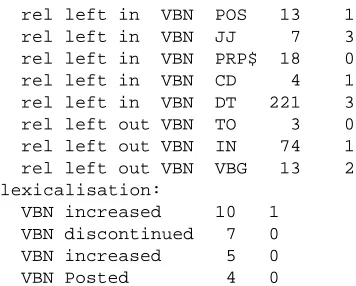
The notion of “refinement” is the central notion for AL-LiS. When a rule is learned (for example: the tag VBN does not belong to NP), ALLiS tries to find out exceptions to this rules. In order to refine this rule, it disposes of two opera-tors: the contextualisation and the lexicalisation (Table 2). The contextualisation provides a list of contexts where an element categorised in one category can appear in another category. The tag VBN is categorised by default as occur-ring out of an NP3, but ALLiS can detect contexts in which
it always occurs inside an NP. The lexicalisation points out words whose behaviour is constant. In our training corpus the word increased occurring before a noun belongs to an NP 10 times and only one time outside whatever the preced-ing context is. Both operations can be redundant: the/DT increased/VBN labor/NN costs/NNS.
Since ALLiS can provide contextual rules in order to improve the parsing, these are not beyond the actual tag-ging technology which mainly relies on the notion of local contexts. These situations can be detected at the tagging level.
3.4. Notion of Recoverability
This methodology considers that tagsets must contain the most possible syntactical information, and all the tags which do not follow this principle are thus negatively judged.
An opposite point of view is develop in the Penn Tree-bank (Marcus et al., 1993) which uses the notion of
recov-2
A demo of the chunker for NP and VP can be used at: http://www.sfb441.uni-tuebingen.de/ ˜dejean/chunker.html.
3The occurrences of VBN in an NP represent 15% of the total
occurrences
VBN non rel
contextualisation:
rel left in VBN POS 13 1
rel left in VBN JJ 7 3
rel left in VBN PRP$ 18 0
rel left in VBN CD 4 1
rel left in VBN DT 221 3
rel left out VBN TO 3 0
rel left out VBN IN 74 1
rel left out VBN VBG 13 2
lexicalisation:
VBN increased 10 1
VBN discontinued 7 0
VBN increased 5 0
VBN Posted 4 0
Table 2: Refinement of the tag VBN for the NP structure. First line: the tag VBN after the tag POS occurs 13 times in an NP and one time outside.
erability:
A key strategy in reducing the tagset was to elim-inate redundancy by taking into account both lex-ical and syntactic information. (Marcus et al., 1993, 314)
The idea is to reduce the size of the tagset used as start-ing point (the Brown tagset), so that the redundancy con-tained in the corpus is also reduced. Then, even if the Penn tagset does not contain enough information in order to de-termine the syntactic role of each element, tags function can be found out using lexical information (the word) or syntactical one (bracketing):
We would like to emphasize that the lexical and syntactic recoverability inherent in the POS tagset version of the Penn Treebank corpus al-lows end users to emply a much richer tagset than the small one described in Section 2.2 if the need arises (Marcus et al., 1993, 315).
It seems that this need systematically arises for process-ing applyprocess-ing a cascaded approach, since this bottom up approach can not use higher level in order to identifiy the syntactic role of tags. But this identification is easy by us-ing the Penn Treebank since the syntactic information is present. We understand the philosophy of the recoverabil-ity as being: if you know the word and its structure, you can find its tag. But from the “automatic processing” point of view, the situation is generally opposite: if the word and its tag are known, can we determine its syntactic structure? We can also notice that this notion of recoverability seems to be in contradiction with the following remark found in the same article: By contrast [with the Brown corpus], since one of the main role of the tagged version of the Penn Treebank corpus is to serve on the basis for a bracketed version of the corpus, we encode a word’s syn-tactic function in its POS tag whenever possible. (Marcus et al., 1993, page 316)
4.
How to Evaluate of a Tagset
We present two kinds of evaluation: a global and a local one. If it could seem to be interesting to get a quantifica-tion of the quality of a tagset, we will see that a qualitative approach is preferable, and at any rate is mandatory to iden-tify intrinsic weaknesses of a tagset. All the tagsets studied provide roughly similar result and they only differ about some specific points whose frequency is quite low.
But, first of all, we have to choose a domain (Sec-tion 2.2.). Three are studied: the based-NP, based-VP, and Based-PP. The definition of these structures is provided by the Penn Treebank (Section 6. discusses the importance of this choice regarding the evaluation). Sections 15-18 of the Wall Street Journal corpus serve as training data for AL-LiS, and Section 20 serves as test data. The data are tagged using the Penn tagset and CLAWS2 tagset (ACQUILEX tagger (Garside et al., 1987)).
4.1. Global Evaluation
Global evaluation consists of evaluating the initial grammar generated by ALLiS. A “perfect” tagset, accord-ing to our criteria, would provide a score of 100% (or nearly), and would not be improved by contextualisation. The initial grammar generated by ALLiS for NP with the Penn tagset is (CASS formalism):
:np
NB = PRP| EX | WP | WDT; AB = DT | POS | PRP$ | WP$; A= JJS | JJ | JJR | $ | #; aA = RBR|RBS;
N= CD | NN | NNP | NNS | NNPS; NP -> NB |
AB* ((aA* A)* N)+;
This grammar is only composed of tags which are cate-gorised by ALLiS as belonging by default to NP (D´ejean, 2000).
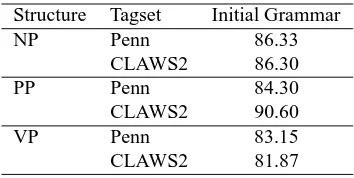
Table 3 shows a global evaluation of the Penn and CLAWS2 tagsets for NP, PP and VP
Structure Tagset Initial Grammar
NP Penn 86.33
CLAWS2 86.30
PP Penn 84.30
CLAWS2 90.60
VP Penn 83.15
CLAWS2 81.87
Table 3: Evaluation of two tagsets: the Penn Treebank and the CLAWS2 tagset. the rate isF =
2precisionrecall
recall+precision
.
From this table, it is, in fact, difficult to determine the best tagset. The result depends on the structure used. Con-cerning NP, the evaluation of the initial grammar provides two closed scores. This global evaluation offers no infor-mation at all about weaknesses and strengths of the dif-ferent tagsets. For instance, the initial NP grammar using the Penn tagset gets the best score thanks to few specific points: the use of the tag WDT for the word that, used as
wh-determiner, when the CLAWS used the CST, merging the classes of conjunction and of relative pronouns. Despite this weakness, which concerns a frequent structure and pe-nalises the CLAWS evaluation of 0.5%, the CLAWS tagset counterbalances this using other tags which are more dis-tributional than the Penn tags (Section 5.). The bad score of the Penn tagset concerning PP is due to the merging of prepositions and complementisers into one class (IN). Re-garding VP, the Penn tagset gets a better score. This is only due to a higher error rate with the CLAWS2 tagsets, er-rors which hide the better distributional properties of some CLAWS2 tags.
This kind of evaluation is biased by the fact that, most of the time, the improvements due to distributional tags only concern some specific points whose frequency is small. For example, tagging the word including as preposition (word tagged VBG in the Penn Treebank) improves the score of the VP parsing by only 0.45%. The rate of the errors of tag-ging is largely higher (5-7%) and hides such positive points of a tagset. It is also more interesting to restrict the evalua-tion to specific construcevalua-tions (Secevalua-tion 4.2.) in order to make the differences between tagsets emerged.
4.2. Local Evaluation
Another way to evaluate a tagset is to consider the be-haviour of each tag regarding a given domain, using the no-tion of reliability. The reliability of an element corresponds to the ratio between its frequency in the structure over its to-tal frequency in the corpus. If its reliability is 1 (resp. 0), the tag always belongs (resp. does not belong) to the struc-ture and its syntactical behaviour is predictable. An ideal tagset would provide tags which only belong to one unique structure. The tagset used by (Giguet and Vergne, 1997) defines tags from three structures: recursive NP, non-recursive VP and simple clause, and a tag only belongs to one domain (except coordinations). Parsing with this tagset is thus straightforward. Unfortunately, tagsets often pro-vide elements which can belong to several structures. We can be tempted to use this information to furnish a direct quantifiable criterion of comparison between tagsets, but some tries do not lead to conclusive results. One possible evaluation might be to estimate the number of reliable tags for a given tagset, but this feature offers no easy way to compare tagsets: a reliable tag in one tagset can correspond to several reliable tags in another tagset, and thus the last tagset is privileged (an operation of mapping would be nec-essary in order to compare tagset by this way). However, this criterion can be used in order to evaluate the intrinsic quality of a tagset (a very good tagset being only composed of reliable tags). Table 4 provides some examples of the reliability of some tags for the Penn, CLAWS2 and SU-SANNE tagsets.
Tagset Tag NP Rel. Tag NP Rel. Penn
RB 13% NN 98%
CLAWS2
RL 7% NN1 98%
RR 18% NNT1 99%
RA 22% NNU 98%
RT 49% NNL1 98%
RG 70% NNJ1 99%
SU
RAa 0% NNT1c 100%
RAh 100% NNT1h 100% RTt 100% NNT1m 100% RGi 100%
Table 4: Syntactic reliability of some adverbial and nominal tags in the NP structure (Penn, CLAWS2 and SUSANNE tagsets)
but can be required by other purposes (Information Extrac-tion for example).
The following table shows that these new tags corre-spond to classes including few words having a very specific behaviour.
RAa ago
RAh am, pm, o’clock
RTt today, tomorrow, yesterday, tonight RGi around, about, circa, getting on for, over
some, under, up to
This example perfectly illustrates the remark by Creis-sels: Among adverbs, it seems that we find a certain number of units whose distribution is so specific that is is not obvi-ous that their categorisation to one or the other big cate-gory allows achieving an economy in the description [...]. (Creissels, 1995)
We can also find another positive point when using more precise tags, point which concerns manual annotation. In Sections 15-16 of the Wall Street Journal corpus, the word about is tagged RB when it occurs before a numeral or a measure. But in Sections 17-18, this word in the same con-text is systematically tagged with another tag: IN. We think that the use of a specific tag (as RGi used in the SUSANNE corpus) for this word in this particular context would have avoided this error of annotation.
This list of the non-reliable tags constitutes a precious resources in order to improve tagset. It points out weak-nesses of the tagset, namely tags which possess no clear syntactic behaviour, and which require subcategorisation (introduction of new reliable tags). This list is used in order to compare tagsets as described in the next section.
5.
Comparison between the Penn, CLAWS2
and SUSANNE Tagsets
We compare here three tagsets: the Penn tagset, the CLAWS2 tagset and the SUSANNE tagset. We do not dis-pose of a tagger using the SUSANNE tagset, and we thus have to use two different corpora to achieve this compari-son. The Penn tagset is a simplification of the Brown tagset (Francis, 1980), when the CLAWS2 is an extention of it:
On the other hand, when the UCREL group be-gan to move on from the problem of automatic word-tagging to the larger problem of parsing, they found it necessary to introduce a few new wordtags for words having a special role with re-spect to higher levels of grammatical structure. (Garside et al., 1987, page 166)
The SUSANNE tagset is also a refinement of the CLAWS2 tagset.
We present here several specific points where ALLiS detects difficulties. These points were noted during the pro-cessing of the Penn tagset and we will see how the two other tagsets process them.
5.1. Adverbs
The study of the traditional “class” of adverbs is interesting since it is generally one of the most non-distributional in the grammar. The Penn tagset uses just one tag, RB, for its class. CLAWS2 and SUSANNE tagsets present a dozen of classes which correspond more or less to the tag RB (the mapping is not direct). Let look at how the three tagsets process the sequence [NP about a year NP]:
about RB/IN a DT year NN (Penn)
about RG a AT1 year NNT1 (CLAWS2)
about RGi a AT1 year NNT1c(SU)
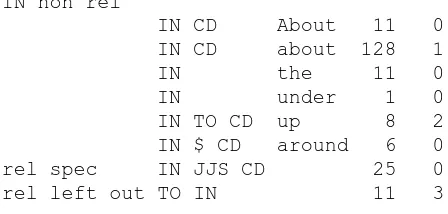
The Penn just specifies than about is tagged as adverb or as proposition/complementiser (depending on the sections of the corpus), and ALLiS can not learn that, in this context, the word about belongs to the NP (IN follows by DT NN traditionally corresponds to a PP). Only the presence of a cardinal (CD) allows the correct parsing of the word about (Table 5) The case is similar which the CLAWS2 tagset (RG: class of the general adverbs).
IN non rel
IN CD About 11 0
IN CD about 128 1
IN the 11 0
IN under 1 0
IN TO CD up 8 2
IN $ CD around 6 0
rel spec IN JJS CD 25 0
rel left out TO IN 11 3
Table 5: Processing of the tag IN (Penn tagset).The pres-ence of the word the tagged IN is due to errors of tagging.
SUSANNE uses the tag RGi which exactly corresponds to the current structure:
Words tagged RGi and other functioning simi-larly preceding a sequence of numeral and mea-sure are analysed as forming a IC tagma [up-per group] without internal grouping. (Sampson, 1995, page 226)
learnable without contextualisation or lexicalisation. We consider then that the SUSANNE tagset best covers this structural point. The CLAWS2 and Penn tagset have simi-lar behaviour.
Another interesting structure is noun phrase functioning adverbially followed by the word ago. The sequence a year ago is encoded as an Adverbial Phrase (ADVP) by the Penn Treebank and by SUSANNE (RX:t) and is tagged:
a DT year NN ago RB (Penn)
a AT1 year NNT1 ago RA (CLAWS2)
a AT1 year NNT1c ago RAa (SUSANNE)
In order to build the temporal adverbial phrase from these sequences of tags, ALLiS has to use lexical information with the Penn tagset: the tag RB is not reliable even in the context DT NN, and the problem can be only solved thanks to the lexicalisation of RB (ago). With CLAWS2, the contextual information (RA after NNT1) is enough to built the adverbial structure. And finally, the SUSANNE tagset needs no contextual at all: the information is directly contained in the tag RAa, composed of just one word: ago and which occurs only in this kind of structure. We then establish the following classification for this structure: first SUSANNE, then CLAWS (need of contextualisation), and then Penn (need of lexicalisation).
5.2. A “Break in the Time”
The second main point we want to consider in order to compare these tagsets concerns nouns describing period of time functioning adverbially at the clause level.
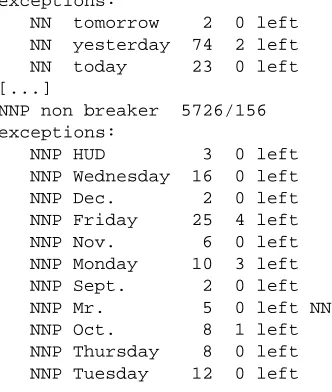
In the Wall Street Journal corpus, words such as yes-terday or tomorrow are tagged NN and compose NP. Since we use the NP definition of the Wall Street Journal cor-pus, we consider these words as member of NP. The prob-lem of these words is illustrated Table 1: contrary to other words tagged NN and NNP, these words do not constitute a unique structure with the immediate preceding noun. This behaviour of breaker can only be detected through an oper-ation of lexicalisoper-ation. The table 6 can be read as: If a tag NN is preceded by a noun, then both mainly belong to the same NP (line NN non breaker 6861/123). But there are 123 exceptions *of* this behaviour, and 99 (2+74+23) of these exceptions are covered by the three words tomorrow, yesterday and today. The case is similar with the tag NNP whose exceptions concern dates.
Concerning the CLAWS2 tagset, the wordclasses NNT(1/2) correspond to temporal nouns (day, week, month) and their break property is gotten directly. The problem concerns words such as yesterday. These words are tagged RT as well as words such as then and now. The class RT corresponds to quasi-nominal adverbs of time. ALLiS cat-egorises the tag RT as non-member of NP by default (it mostly occurs out of NPs), and then uses contextualisation and lexicalisation to correctly parse words which are con-sidered inside an NP. But contrary to the Penn tagset, the breaker property of the tag RT is automatically detected and no lexicalisation is needed (Table 7). This choice (adverb and not noun) penalises the CLAWS2 during the first step of the global evaluation (Table 3). But, for the second step
NN non breaker 5861/123
exceptions:
NN tomorrow 2 0 left
NN yesterday 74 2 left
NN today 23 0 left
[...]
NNP non breaker 5726/156
exceptions:
NNP HUD 3 0 left
NNP Wednesday 16 0 left
NNP Dec. 2 0 left
NNP Friday 25 4 left
NNP Nov. 6 0 left
NNP Monday 10 3 left
NNP Sept. 2 0 left
NNP Mr. 5 0 left NN
NNP Oct. 8 1 left
NNP Thursday 8 0 left
NNP Tuesday 12 0 left
Table 6: Detection of the Break Property for the tags NN and NNP (Penn).
(contextualisation), the CLAWS2 offers better results (the detection of the break property is automatic whereas the Penn needs lexicalisation).
RT outer by default contextualisation:
rel left out RT VV0 9 3
(EXP) now RT VV0 3 3 2
rel left out RT IF 4 1
rel left out RT VVD 26 4
(EXP) then RT VVD 3 3 2
rel left out RT II 18 4
(EXP) then RT II 4 4 2
rel left out RT VVG 4 1
rel left out RT VVN 10
rel left out RT ICS 10 3
rel right out RT IW 3
rel right out RT . 44 9
(EXP) now RT . 8 9 2
rel right out RT IF 3
rel right out RT II 25 9
(EXP) now RT II 3 3 2
(EXP) then RT II 4 4 2
then RT ICS 8/9 -> 1 left tag lexicalisation:
RT tomorrow 8 0
RT tonight 2 0
RT Yesterday 15 0
RT yesterday 150 0
RT Today 8 0
RT today 54 2
RT then 8 1 ICS
RT breaker 9/93
Table 7: Processing of the tag RT tag (CLAWS2).
CLAWS2). The syntactic information is entirely contains in tags and the tagset is totally distributionally regarding this point.
This structure describing a period of time is distri-butionally well-marked4, and the introduction of a spe-cific phrase (and thus spespe-cific tags only belonging to this phrase) is strongly recommended (introduction present in SUSANNE). It is interesting to note that all the modifica-tions done for the SUSANNE tagset are validated by AL-LiS.
6.
Interaction between Tagsets and
Structures
We would like here to point out the importance of the definition of the domain used during the evaluation. Since the definition of a structure can vary from one corpus to another, it is interesting to see how well can a tagset adapt itself to a PS definition. We can think that the use of the NP definition provided by the Penn Treebank favours the Penn tagset to the detriment of the others. But, as we will see, using the Penn Treebank definition is not always an advantage for its tagset.
In the Wall Street Journal corpus, the words object and subject are tagged NN but do not belong to NP in specific contexts:
NN rel
subject/NN TO 14 0
order/NN IN TO 11 1 [...]
This behaviour is in contradiction with the general be-haviour of the other words tagged NN, and the lexicalisa-tion is needed in order to solve the problem. Regarding the CLAWS2 tagset, these words are respectively tagged BTO and JJ and are not considered as NP. SUSANNE uses the same kind of annotation but with ditto (BTO22 and II21). The definition used is thus an advantage of the two last tagsets and an inconvenient for the Penn tagset.
The opposite case can happen: a word tag as NN (noun), and then considered as belong to NP by the WSJ corpus, can be tagged differently by other tagsets. The following table gives the examples of the words example and instance which are tagged NN by the Penn tagset and occur in an NP, but which are tagged REX by the CLAWS2 tagset (adverb introducing appositional constructions).
REX outside by default exceptions:
REX instance 21 0
REX example 38 0
left out REX REX 59 2
This tag is considered as non-member of NP by default, but is identified as reliable when another tag REX occurs before it. Information provided by the lexicalisation is redundant (the context REX REX exactly corresponds to the sequences for example and for instance). These two words as tagged REX22 in the SUSANNE corpus, and this tag is directly reliable (the word for is tagged REX21).
4
Even at the phrase level
We see then that the two tagsets (CLAWS2 and SU-SANNE) can be adapted to the NP definition provided by the Penn Treebank. As said in the preceding section, the SUSANNE tagset adapts itself very easily concerning the “yesterday” problem (use of a specific tag: RTt). The adaption, although difficult to quantify, seems to be a very good criterion in order to evaluate the distributionality of a tagset. Tagsets (such as SUSANNE) being adaptable are composed of tags whose syntactical properties are clearly defined into a given domain.
7.
Other Approaches
The works already proposed about tagset evaluation concern rather the internal criteria (Section 2.). The pur-pose is thus to modify an existing tagset so that the tagging accuracy increases (EAGLES, 1996b). This improvement proceeds from the merge of some (generally) ambiguous wordclasses. The purpose of (Brants, 1995) is to reduce the size of the tagset in order to increase the frequency of some rare n-grams used by HMM, and thus to improve learn-ing. (Elworthy, 1994) studies the relationship between tag-ging accuracy and tagset size with the conclusion that tagset size has weak influence on the tagging accuracy. (Sch¨utze, 1995) proposes an algorithm for automatically merging dis-tributional classes in order to improve the tagging accuracy. If some mergings have no or little effect on the PS segmen-tation (merging of NN(S), NNP(S)), then other are catas-trophic (merging of RB, RP, RBR and RBS). These tags are certainly merged because of their lack of distributional properties.
(Hughes and Atwell, 1994) propose a way to evaluate automatically inferred wordclasses, but these classes can not by used directly for annotating corpora. (Wynne et al., 1998) combines the result of two different tagsets in order to improve tagging.
We can cite some tries in order to map tagsets (Hughes et al., 1995; Teufel, 1995). Similarly to ours, this technique might be indirectly used in order to compare tagsets (ease of one tagset to be map in one another, another manner to consider the degree of adaption of a tagset).
Few works propose manual comparison of tagsets. (M¨uller, 1997) compares the METS tagset and other En-glish tagsets, more specially concerning wh pronouns. In (Sampson, 1995), a comparison is sometimes done between the SUSANNE tagset and the CLAWS2 tagset, in order to explain the added modifications.
8.
Conclusion
through a detailled analysis for each tag. The same method-ology can be use in order to evaluate tagsets used at the phrase and clause level.
9.
Acknowledgements
This research is funded by the TMR network: Learn-ing Computational Grammars5. I would like to thank Erik
Tjong Kim Sang and Miles Osborne who provided data for this comparison.
10.
References
Abney, Steven, 1996. Partial parsing via finite-state cas-cades. In In Proceedings of the ESSLLI ’96 Robust Pars-ing Workshop.
Baker, J.P., Lou Burnard, A.M. McEnery, and A. Wilson, 1998. Corpus validation guidelines. Technical report, European Language Resources Association.
Brant, Thorsten, 1999. Cascaded markov models. In EACL 99.
Brants, Thorsten, 1995. Tagset reduction without informa-tion loss. In proceedings of ACL-95, student session. Brill, Eric, 1993. A Corpus-Based Approach to Language
Learning. Ph.D. thesis, Department of Computer and In-formation Science, University of Pennsylvania.
Caroll, John, Guido Minnen, and Ted Brisco, 1999. Corpus annotation for parser evaluation. In EACL workshop on Linguistically Interpreted Corpora (LINC).
Charniak, Eugene, Curtis Hendirckson, Neil Jacobson, and Mile Perkowitz, 1993. Equations for part-of-speech tag-ging. In Proccedings of the Eleventh National Confer-ence on Artifial IntelligConfer-ence.
Collins, Michael and James Brooks, 1995. Prepositional phrase attachment through a backed-off model. In Third Workshop on Very Large Corpora.
Creissels, Denis, 1995. El´ements de Syntaxe G´en´erale.´ Presses Universitaires de France.
D´ejean, Herv´e, 2000. Theory refinement and natural lan-guage learning. In COLING’2000. Saarbr¨ucken. EAGLES, 1996a. Morphosyntactic annotation. Technical
Report EAG-CSG/IR-T3.1, Consiglio Nazionale delle Ricerche. Istituto di Linguistica Computazionale. EAGLES, 1996b. Study of the relation between tagsets and
taggers. Technical Report EAG-CLWG-Tags/V, Con-siglio Nazionale delle Ricerche. Istituto di Linguistica Computazionale.
Elworthy, David, 1994. Tagset design and inflected lan-guages. In EACL-94 SIGDAT.
Francis, W. N., 1980. Studies in English Linguistics. Long-man, pages 192–209.
Garside, Roger, Geoffrey Leech, and Anthony Mc Enery (eds.), 1997. Corpus Annotation. Longman, London and New York.
Garside, Roger, Geoffrey Leech, and Geoffrey Sampson (eds.), 1987. The computational Analysis of English -A Corpus-based -Approach. London: Longman.
Giguet, Emmanuel and Jacques Vergne, 1997. From part-of-speech tagging to memory-based deep syntactic anal-ysis. In IWPT’97. MIT, Boston,Massachussets, USA.
5http://lcg-www.uia.ac.be/
Halteren, Hans Van (ed.), 1999. Syntatic Wordclass Tag-ging. Book News, Inc., Portland.
Harris, Zellig, 1954. Distributional structure. Word, 10(2-3):146–162.
Hughes, John and E. Atwell, 1994. The automated eval-uation of inferred word. In A. Cohn (ed.), Proceedings of the 11 European Conference on Artificial Intelligence (ECAI-94).
Hughes, John, Clive Souter, and John Atwell, 1995. Au-tomatic extraction of tagset mappings from parallel-annotated corpora. In EACL’95.
Karlsson, Fred, Atro Voutilainen, Huha. Heikkil¨a, and Artro Anttila (eds.), 1995. Constraint Grammar, a lan-guage independent system for parsing unrestricted text. Berlin and New York Mouton de Gruyter.
Karttunen, Lauri, Tam´as Gal, and Andr´e Kempe, 1997. Xe-rox finite-state tool. Technical report, XeXe-rox Research Centre Europe, Grenoble.
LREC (ed.), 1998. First International Conference on Lan-guage Ressources and Evaluation. Granada.
Marcus, Mitchell, B´eatrice Santorini, and Marc Ann Marcinkiewicz, 1993. Building a large annotated corpus of english: the penn treebank. Computational Linguis-tics, 19(2):313–330.
M¨uller, Frank Henrik, 1997. Tagsets f ¨ur das Englis-che im Lichte der Wortartendiskussion. Master’s thesis, Westf¨alische Wilhelms-Universit¨at M¨unster.
Nerbonne, John and Miles Osborne, 1999. Learning com-putational grammars. Technical report, TMR Project Nr. ERBFMRXCT980237, 1st Year Report.
Paroubek, Patrice, 1998. Experience in grace tagging eval-uation. In First International Conference on Language Ressources and Evaluation. Granada.
Sampson, Geoffrey, 1995. English for the Computer. The SUSANNE Corpus and Analytic Scheme. Oxford: Clarendon Press.
Sch¨utze, Hinrich, 1995. Distributional part-of-speech tag-ging. In EACL. Dublin.
Teufel, Simone, 1995. A support tool for tagset mapping. In Workshop SIGDAT, EACL ’95.
Tjong Kim Sang, Erik and Jorn Veenstra, 1999. Represent-ing text chunks. In ProceedRepresent-ings of EACL’99, Association for Computational Linguistics. Bergen.
Wermter, Stefan, Ellen Riloff, and Gabriele Scheler, 1996. Connectionist, statistical and symbolic approaches to learning natural languages processing.