Evaluating Morphosyntactic Tagging of Croatian Texts
Željko Agi
ć
*, Marko Tadi
ć
**
* Faculty of Electrical Engineering, Mechanical Engineering and Naval Architecture University of Split
Ruđera Boškovića bb, HR-21000 Split, Croatia [email protected]
** Department of Linguistics, Faculty of Philosophy University of Zagreb
Ivana Lučića 3, HR-10000 Zagreb, Croatia [email protected]
Abstract
This paper describes results of the first successful effort in applying a stochastic strategy – or, namely, a second order Markov model paradigm implemented by the TnT trigram tagger – to morphosyntactic tagging of Croatian texts. Beside the tagger, for purposes of both training and testing, we had at our disposal only a 100 Kw Croatia Weekly newspaper subcorpus, manually tagged using approximately 1000 different MULTEXT-East v3 morphosyntactic tags. The test basically consisted of randomly assigning a variable-size portion of the corpus for the tagger’s training procedure and also another fixed-variable-size portion, variable-sized at 10% of the corpus, for the tagging procedure itself; this method allowed us not only to provide preliminary results regarding tagger accuracy on Croatian texts, but also to inspect the behavior of the stochastic tagging paradigm in general. The results were then taken from the test case providing 90% of the corpus for training purposes and varied from around 86% in the worst case scenario up to a peak of around 95% correctly assigned full MSD tags. Results on PoS only expectedly reached the human error level, with TnT correctly tagging above 98% of test sets on average. Most MSD errors occurred on types with the highest number of candidate tags per word form – nouns, pronouns and adjectives – while errors on PoS, although following the same pattern, were almost insignificant. Detailed insight on tagging, F-measure for all PoS categories is provided in the course of the paper along with other facts of interest.
1.
Introduction
The primary purpose of our experiment, defined before the actual investigation even started, was to inspect whether statistical methods of MSD/PoS tagging would really be appropriate to tag a highly inflectional language such as Croatian including the desired accuracy of above 90% correctly tagged tokens on average. History of PoS/MSD tagging of Croatian is rather short one. There has been only one rule-based prototype tagger developed
and tested in (Žubrinić, 1995) master thesis, displaying
very good properties on known words. To the best of our knowledge this paper presents the first analysis of stochastic tagging strategies on Croatian. Therefore, the experiment has to be regarded as preliminary — any of the provided conclusions should be treated only as input for other, thoroughly implemented investigations which may give the final decision regarding MSD tagging of large-scale Croatian corpora.
In plain words, we did not allow this experiment to state that statistical approach should by all means be applied to tagging of Croatian corpora; first and the most important, we wanted to point out to what – on basis of results presented further in the paper – seemed to us the right way for future research and possible system imple-mentation. Taking into consideration the current state of language technologies development for Croatian, even a small research project like the one presented is also an important one.
In the following sections 2 and 3 the paper describes the corpus used for training and testing and implemen-tation of the TnT tagger on the corpus. The sections 4 and 5 present the evaluation methods and results discussion respectively. The paper is concluded with conclusion and future work.
2.
Language resources
In order to MSD-tag a text written in Croatian using a Markov model tagger such as TnT, one has to have pre-tagged corpus at his/her disposal. For the purposes of this experiment, we had at hands only a single 100 Kw newspaper corpus; in this section, we provide a short description of its basic characteristics, PoS distribution and some lexical properties.
2.1. The corpus
The Croatia Weekly 100 Kw newspaper corpus (the CW100 corpus further in the text) consists of articles
extracted from seven issues of the Croatia Weekly
newspaper, which has been published from 1998 to 2000 by the Croatian Institute for Information and Culture (HIKZ). This 100 Kw corpus is a part of Croatian side of the Croatian-English Parallel Corpus (CW corpus)
described in detail in (Tadić, 2000). The CW100 corpus
was pre-tagged using the MULTEXT-East version 3 (MTE v3) morphosyntactic specifications on the top of XCES corpus encoding standard (Ide et al, 2000):
...
<w lemma="ipak" ana="Rn">ipak</w>
<w lemma="početi" ana="Vmps-sfa">počela</w> <w lemma="Hrvatska" ana="Npfsd">Hrvatskoj</w> ...
Figure 1: Excerpt from the XML encoding of CW100 corpus
semi-auto-matically tagged using full MTE v3 MSD tagset by matching the CW100 corpus and the Croatian Morphological Lexicon (Tadić & Fulgosi, 2003) at
uni-gram via the Croatian Lemmatization Server (Tadić,
2003) at (http://hml.ffzg.hr).
Croatian language in general implements 12 out of 14 different PoS categories defined in the MTE v3 specifi-cation: Adjective (A), Conjunction (C), Interjection (I), Numeral (M), Noun (N), Pronoun (P), Particle (Q), Adverb (R), Adposition (S), Verb (V), Residual (X) and Abbreviation (Y). However, 11 of them actually do appear in the CW100 corpus (Residual missing out), the fact once again suggesting that it’s a rather small resource to operate with, both in quantity and quality, especially when compared to resources available for some other highly inflectional Eastern European languages.
General corpus details are presented in the second column of Table 1; overall token count includes word forms and punctuation and it can easily be seen that the newspaper texts contained approximately 25 tokens per sentence (22 of them being word forms), each of them tagged using 896 different morphosyntactic descriptions.
Total on corpus Sentences only
Tokens 118529 112902
Word form 103161 98567
Other 15368 14335
Sentences 4626 4162
Different MSD 896 892
Table 1: Corpus details
However, the first conclusion is somewhat incorrect; the data given in the second column presents all tokens in the corpus, including the ones in header and byline sections of newspaper articles and being that these writings are often not entirely grammatical and therefore should not be treated as sentences by definition, we made another simple calculation by excluding all header and byline data; the results are given in the third column of the table and so the corpus has approximately 27 tokens per one grammatical sentence within the articles. Excluding 5627 header and byline tokens would have led us to a loss of 4 different MSD tags and thus we decided to include all corpus data in the tagging process, mainly because of this loss of knowledge and also the nature of tagger operation, which is described further in the text. Moreover, this enabled us to simulate the “real situation” of using this tagging procedure for a large scale newspaper corpus.
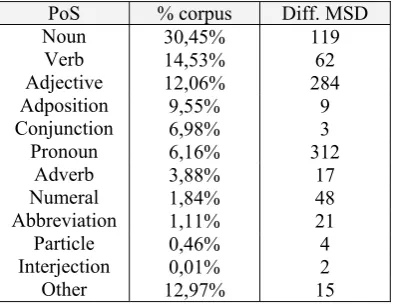
PoS % corpus Diff. MSD
Noun 30,45% 119
Verb 14,53% 62
Adjective 12,06% 284
Adposition 9,55% 9
Conjunction 6,98% 3
Pronoun 6,16% 312
Adverb 3,88% 17
Numeral 1,84% 48
Abbreviation 1,11% 21
Particle 0,46% 4
Interjection 0,01% 2
Other 12,97% 15
Table 2: PoS distribution on the corpus
Distribution of PoSs in the corpus is in fact exactly what we expected before the experiment actually begun. Common newspaper texts are mainly written in plain Croatian and for news-reporting purposes, most sentences comply to relatively simple subject-verb-object model and therefore nouns and verbs dominate the distribution.
Basic tagging expectations can now be easily inferred directly from data in Table 2; categories Adjective (A) and Pronoun (P) are tagged using a large number of MSD tags and the corpus does not contain them in numbers great enough to contribute statistically to the training procedure. Therefore, we expected the highest error rates to appear upon tagging pronouns and adjectives, followed by the most common ones – nouns and verbs. Actual details on MSD-tagging these parts of speech are discussed in detail throughout the results section.
2.2. The lexicon
In this paper, the term lexicon does not represent the before-mentioned Croatian Morphological Lexicon, but a resource built by the tagger’s training procedure; we present its details before discussing the TnT tagger itself mainly because they provide additional insight on the nature of the CW100 corpus.
The first column of Table 3 provides us with the number of types that were found on the corpus, while the second one states how many of them had more than one morphosyntactic description. Results state that the CW100 emergent lexicon contains only 13,95% ambiguous entries. Ambiguous token count also suffered an exponential quantitative decrease when presented as a function of MSD per token count; most ambiguous entries have only 2 or 3 MSD tag candidates.
Lexicon entries Ambiguous
25310 3505 Table 3: CW100 corpus lexical ambiguity
In addition, only 2,01% of the emergent lexicon was ambiguous on PoS; on basis of given information, we reasonably expected good tagging results. However, the nature of available resources and testing methods enclosing the tagger also applied important constraints on interpreting these results; these issues are all thoroughly investigated in sections regarding testing methodology and conclusions.
3.
The TnT tagger
The TnT (“trigrams and tags”) program, first described in (Brants, 2000), is an excellent implementation of a (hidden) Markov model paradigm of PoS/MSD tagging. TnT is optimized for maximum speed and straightforward usage on virtually any language and tagset, given that both resources are written in a standard file format that the application can understand.
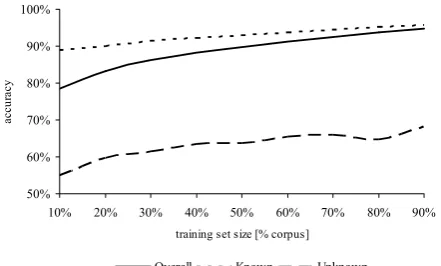
The first couple of rows in Table 5 provide noticeable evidence to support our claims: given an average training set sized at 10% or 20% of the corpus, tagging accuracy on adjectives and pronouns is up to 30% lower then on all other PoS combined and averaged. Moreover, the rise on these two PoSs is much faster than on others, displaying obviously high importance of the quantity of the raw language data quantity for successful tagging of difficult categories.
50% 60% 70% 80% 90% 100%
10% 20% 30% 40% 50% 60% 70% 80% 90%
training set size [% corpus]
acc
ur
acy
Nouns Pronouns Adjectives
Figure 3: F-measure on nouns, pronouns and adjectives Along with before-mentioned adjectives and pronouns, Figure 3 also provides MSD-tagging results for nouns; the higher starting accuracy is a direct consequence of their distribution; approximately 30% of the entire CW100 corpus is consisted of nouns and about 10% more than pronouns and adjectives make together.
Given these results on full MSD, it is plain to see that improving accuracy on difficult PoSs would definitely lead to substantial overall improvement and also that additional effort on putting together larger language resource for training is the direction for future work.
5.2. Results on PoS
Results of (Test-1) and (Test-2) are expectedly far better on PoS, being that fewer tags provide the trigram tagger better transition and emission matrices, given the same training set.
% corpus Overall Known Unknown
10% 93,82% 98,46% 82,79%
20% 95,45% 98,26% 84,96%
30% 96,09% 98,55% 83,93%
40% 97,04% 98,52% 86,21%
50% 97,72% 98,76% 86,48%
60% 98,02% 98,71% 89,13%
70% 98,27% 98,64% 90,52%
80% 98,37% 98,78% 84,66%
90% 98,63% 98,77% 90,40%
Table 6: Tagger accuracy on PoS
The main observation is, of course, overall accuracy on PoS peaking at 98,63% and actually reaching human level of error. However, the constraint put upon presenting the corresponding MSD result also applies on PoS.
Additional data in Table 6 and Table 7 also confirms the importance of training procedure, i.e. the quality of HMM matrices, for overall tagging accuracy; the third
column of Table 7 shows that PoS accuracy on unknown words is at least 20% higher than the corresponding accuracy on MSD and, given that no lexical entries influence correctness on unknown words, we argue this is a direct consequence of tagset differences, i.e. that 26 PoS tags on approximately 100000 tokens (90% of the corpus) provide TnT with a much more tuned-up transition matrix than 896 MSD tags could ever do.
% corpus Difference on known on unknown Difference 10% 9,51% 27,88% 20% 8,16% 25,26% 30% 7,15% 22,54% 40% 6,36% 22,71% 50% 5,69% 22,80% 60% 5,02% 23,73% 70% 4,12% 24,52% 80% 3,54% 20,02% 90% 2,90% 22,11% Table 7: Absolute PoS-MSD accuracy difference On the other hand, known token characteristics show that TnT tagger operates amazingly well upon tagging tokens it stored in lexicon during the training procedure; it could therefore be argued that knowing an entry (i.e. having large enough training corpora) is the key point to success, both for PoS and MSD tagging. Since the absolute difference given in Table 7 reaches the lowest value of around 3% in favor of PoS, this result is practically insignificant having in mind the difference between corresponding tagsets.
5.3. Comparison
Three similar up-to-date PoS/MSD tagging research papers were used in order to provide comparison and to place our research results relative to the others; these are:
• Evaluation of various taggers and tagsets of Slovene,
as described in (Džeroski et al., 2000); researchers had at hands a Slovene translation of Orwell’s famous
novel 1984. for purposes of training and testing the
TnT tagger, along with a rule-based tagger, maximum entropy tagger and also a memory-based solution.
• In (Van Halteren et al., 2000), the TnT tagger was
tested using three different training corpora, two of them being English – LOB and WSJ corpus – and one Dutch – the Eindhoven corpus.
• A detailed investigation is described in (Hajič, 2000)
concerning tagging of Czech, Estonian, Hungarian and Romanian (and also Slovene and English which we ignore as they are already provided in other two papers), using two non-HMM stochastic strategies.
All results, including the ones provided by TnT and the CW100 corpus of Croatian, are presented in Table 8. However, before even considering them, some other facts regarding those other experiments should be pointed out.
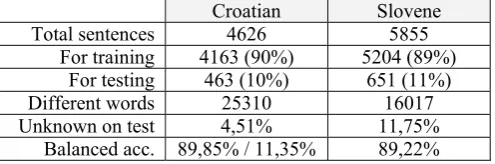
words constraint. Secondly, (Hajič, 2000) uses stochastic paradigms other than HMMs – a maximum entropy tagger and an exponential (log-linear) tagger. Research described in (Džeroski et al., 2000) for Slovene is most similar to the one we provide for Croatian, thus Table 9 containing comparison of test details is provided.
Training set Diff. MSD on corpus Result
Croatian ~106000 896 94,83% TnT
Czech 87071 970 82,23%MET
Dutch ~750k 341 92,06% TnT
English ~1M 170 97,55% TnT
Estonian 81383 476 86,05% EXP
Hungarian 102992 401 91,84% EXP
Romanian 104583 486 92,34% MET
Slovene 81805 1004 89,22% TnT
Table 8: Stochastic strategies on various languages We could argue that overall results of tagging Croatian with TnT are better than ones on Slovene, but two last rows of Table 9 should by all means be taken into consideration before providing actual conclusions. First of these two rows presents the number of unknown tokens TnT encountered when tagging the test case upon which it achieved results presented in Table 8 for Croatian and Slovene; it is plain to see that results for Croatian are around 5% better than the ones for Slovene, but also that the trigram model for Croatian had 7% more “language knowledge”.
Croatian Slovene
Total sentences 4626 5855
For training 4163 (90%) 5204 (89%)
For testing 463 (10%) 651 (11%)
Different words 25310 16017
Unknown on test 4,51% 11,75%
Balanced acc. 89,85% / 11,35% 89,22%
Table 9: Croatian vs. Slovene corpus stats
Therefore, in the last row of Table 9, we have chosen tagger accuracy achieved when trigrams for Croatian had approximately the same amount of language information as for Slovene – around 11% unknown tokens encountered – and the two results formed almost a perfect match, thus proving that trigram taggers’ accuracy is highly dependent on the amount of data provided.
We should mention also one more reason for making this balance. While in the Croatian CW100 the test corpus was composed of a number of different articles from newspaper (with relative common vocabulary), in the Slovenian case the test corpus was a single text (a novel) expectedly showing higher percentage of unknown words. This had to be normalized with aforementioned procedure. With this problem explained and solved, we could finally state that experimental tagging of Croatian texts using the TnT trigram tagger was successful when compared to recent results achieved on other similar languages.
6.
Conclusions and future work
There are many directions for further enhancement of the results presented in this paper. Additional annotated
corpora could be used in order to test the tagger in an environment differing in distributional properties from the training set, the tagger itself could be altered in order to match specific properties of Croatian language, etc. Given this facts, we consider this paper a baseline for more thoroughly implemented additional research.
The paper presented a full course of experiment of applying a hidden Markov model based TnT tagger on tagging texts of Croatian language using full MTE v3 morphosyntactic descriptions. Obtained results peaked at around 95% correctly assigned tags with around 5% unknown tokens encountered, showing a trigram tagging paradigm would be a reasonable choice for further tagging of larger Croatian corpora in the future.
7.
References
Brants, T. (2000). TnT – A Statistical Part-of-Speech
Tagger. In Proceedings of the Sixth Conference on
Applied Natural Language Processing. Seattle, Washington 2000.
Brill, E. (1995). Transformation-based error-driven learn-ing and natural language processlearn-ing: A case study in
part-of-speech tagging. In Computational Linguistics
1995, 21(4):543-565.
Džeroski, S., Erjavec, T. & Zavrel, J. (2000). Morpho-syntactic Tagging of Slovene: Evaluating Taggers and
Tagsets. In Proceedings of the Second International
Conference on Language Resources and Evaluation. ELRA, Paris-Athens 2000, pp. 1099-1104.
Hajič, J. (2000). Morphological Tagging: Data vs.
Dictionaries. In Proceedings of the ANLP-NAACL.
Seattle, Washington, USA, 2000, pp. 94-101.
Ide, N., Bonhomme, P., Romary, L., (2000). An XML-based Encoding Standard for Linguistic Corpora. In
Proceedings of the Second International Conference on Language Resources and Evaluation, pp. 825-830. (see also at http://www.xces.org).
Tadić, M. (2000). Building the Croatian-English Parallel
Corpus. In Proceedings of the Second International
Conference on Language Resources and Evaluation. ELRA, Paris-Athens 2000, pp. 523-530.
Tadić, M. (2003). Jezične tehnologije i hrvatski jezik. Exlibris, Zagreb 2003.
Tadić, M., Fulgosi, S. (2003). Building the Croatian
Morphological Lexicon. In Proceedings of the
EACL2003 Workshop on Morphological Processing of Slavic Languages. Budapest 2003, ACL, pp. 41-46. Van Halteren, H., Zavrel, J. & Daelemans, W. (2000).
Improving accuracy in wordclass tagging through combination of machine learning systems. In
Proceedings of the ANLP-NAACL. Seattle, Washington, USA, Morgan Kaufman Publishers 2000.
Van Rijsbergen, C. (1979). Information retrieval. Butterworths, London 1979.
Van Rooy, B. & Schäfer, L. (2003). An evaluation of three PoS taggers for the tagging of the Tswana Learner
English Corpus. In Proceedings of the Corpus
Linguistics 2003 conference. Lancaster, UK, 2003. Žubrinić, T. (1995). Mogućnosti strojnoga označavanja i