Using collocations from comparable corpora to find translation equivalents
Serge Sharoff, Bogdan Babych, Anthony Hartley
Centre for Translation Studies School of Modern Languages and Cultures
University of Leeds, Leeds, LS2 9JT, UK {s.sharoff,b.babych,a.hartley}@leeds.ac.uk
Abstract
In this paper we present a tool for finding appropriate translation equivalents for words from the general lexicon using comparable corpora. For a phrase in the source language the tool suggests a range of possible expressions used in similar contexts in target language corpora. In the paper we discuss the method and present results of human evaluation of the performance of the tool.
1.
Introduction
One of the most frequent problems that occur in transla-tion practice concerns the choice of the best target word for rendering source expression X in context Y. The trans-lator knows the meaning of each word in a sentence and the standard set of its translations, but cannot find a target expression that is suitable for the current context. The ob-vious way to find a solution for the word-choice problem is by consulting dictionaries. However, dictionary lookup may fail in two senses: a source expression be missing in available dictionaries, or, worse, a dictionary can mislead the translator by listing a term or source expression with its translation, but the translation is NOT in common use in the target language in the suggested way. The situation is worse for multiword expressions (MWEs). For instance, the Oxford Russian Dictionary (ORD) lacks a translation for the Russian expression ÷åòêàÿ ïðîãðàììà (‘precise programme’), while the Multitran Russian-English dictio-nary suggests that it can be translated as clear programme. However, it is much less frequent in English, just 2 in-stances in the BNC, while the Russian expression÷åòêàÿ
ïðîãðàììàoccurs 70 times in a comparable Russian cor-pus.
On the other hand, there are natural limits on the number of translation equivalents to be listed in a bilingual dictionary, imposed by its size and usability. A printed dictionary can-not afford giving separate translations for derived forms or listing dozens of translation equivalents for a relatively un-ambiguous word, such as programme (for instance, English monolingual dictionaries list no more than 2 or 3 senses for it). As for usability, it is impossible to use a (printed or electronic) dictionary in which the relevant translation is dee pin the long list of potential translation equivalents: a translator or a student is unlikely to find a translation they want. Translations for polysemous words are too numerous to be listed for all possible contexts. For example, ORD already lists 74 translations for clear and yet the list does not include many frequent combinations with clear, such as
position, distinction, majority.
With respect to technical terms, dictionaries often lack ade-quate terminology, especially for rapidly growing domains, such as software or environmental protection. Parallel cor-pora offer the possibility of searching for examples of trans-lations in context, but they are not as representative as
large monolingual corpora and they are not always avail-able in the specific domains needed by a translator. For instance, the Europarl corpus is very large for parallel cor-pora (its English section contains 18 million words), but it is restricted to the language of parliamentary debates only, e.g. it has no instances of vent one’s anger, an expression which is quite frequent in the BNC (26 instances).
There has been surprisingly little research on computational methods for finding translation equivalents of words from the general lexicon. Practically all previous studies con-cerned detection of terminological equivalence, e.g. (Dagan and Church, 1997; Bennison and Bowker, 2000; Peters et al., 2000). However, words from the general lexicon exhibit polysemy, which is reflected differently in the target lan-guage, thus causing the dependency of their translation on corresponding context. Also such variation is not captured by dictionaries. Because of their importance, words from the general lexicon are studied by translation researchers, and comparable corpora are increasingly used in transla-tion practice and training (Varantola, 2003). However, such studies are mostly constrained to lexicographic exercises or analysis of properties of translated texts in comparison to the general language (Hansen and Teich, 2002). Such studies do not provide a computational model for finding appropriate translation equivalents for expressions that are not listed or are inadequate in dictionaries.
The paper reports on an ongoing investigation into the de-tection of translation equivalents in large monolingual cor-pora for (a) polysemous words that are difficult to translate using decontextualised information in dictionary entries, and (b) technical terminology that is not reflected in dic-tionaries, but is available in corpora. We use a collection of corpora whose total size is about 300 million words per lan-guage, consisting of reference corpora (such as the BNC), newspaper corpora and corpora automatically derived from the Internet (Sharoff, 2006a).
2.
Methodology
2.1. Research problemsuf-ficient similarity between linguistic resources available in the two languages, such as references to objects and pro-cesses, subjective evaluations of a state of affairs, expres-sion of emotions.1
Our first attempt at implementing this research programme is devoted to finding the most appropriate translations of collocations and multiword expressions (MWEs). Since many collocations have a more or less fixed meaning, according to the “one-sense-per-collocation” hypothesis (Resnik and Yarowsky, 2000), we can be sure about reli-ability in their translation. As mentioned above, many fre-quent collocations are missed in dictionaries, so translators have to rely on their expertise in finding suitable translation. For instance, daunting experience is not listed in major dic-tionaries. In the following examples
(1) Hospital admission can prove a particularly
daunting experience.
(2) Even though you knew that what you said didn’t
matter, it was a daunting experience.
the expression evaluates an unpleasant experience. We can find a suitable translation by studying similar evaluations in the target language. On the other hand, some colloca-tions cannot be translated independently from the context they are used in. For instance, no mean feat is translated in some dictionaries (e.g. ABBYY Lingvo) asñòîÿùåå äåëî (lit. ‘worthy deed’), but the suggested translation does not fit into many contexts, such as:
(3) I did all the cleaning, cooking and kept his books in
order, which was no mean feat.
In this context no mean feat does not refer to the worthi-ness of doing the listed actions, so a translator has to ex-plore various possibilities for rendering the significance of the achievements.
Our goal in this project was to implement a tool that helps translators to find solutions to difficult translation problems. The tool presents the results as lists of suggested translation equivalents (usually 50 to 100 suggestions) ordered alpha-betically or by their frequency in target language corpora. Translators can skim through these lists and identify a vari-ant which is mostly appropriate in a given context. From a user perspective the tool works more like a dynamic dic-tionary or thesaurus, not like a Machine Translation (MT) system. However, unlike dictionaries it can find translation equivalents for words and word combinations that are not explicitly coded as dictionary entries. Very often it success-fully suggests translations for idiosyncratic word combina-tions, e.g., recreational fear orñîáëþäàòü ýêîëîãè÷åñêèå ïðèëè÷èÿ (lit. ‘to observe ecological decency’), which have been created by their authors and are either rare or not present at all in the source language corpus.
The detection methodology, which is implemented in a semi-automatic tool, comprises two stages: generalisation
1
We do not claim that emotions and evaluation are identi-cal between the two languages. There are good arguments for language-specific differences in the expression of evaluations or emotions (Wierzbicka, 1999); however, a translator has to convey these expressions into the target language.
of the context of a problematic expression in the source guage, and restriction of the search field in the target lan-guage.
2.2. Context generalisation
The problem with using comparable corpora to find trans-lation equivalents is that there is no obvious bridge between two languages. Unlike aligned parallel corpora, compara-ble corpora provide a model for each individual language, while dictionaries, which can serve as a bridge, are not use-ful for the task in question, because the problem we want to address involves precisely translation equivalents that are not listed there.
The procedure we use for context generalisation is based on the generation of similarity classes, which consist of words sharing collocations with words in the target expression. This sketches the domain of a lexical item and captures the most important aspects of its use. Optimal feature selection for producing similarity classes has received some attention in recent research. Following (Rapp, 2004) we use the Sin-gular Value Decomposition method to measure the similar-ity between contexts. For instance, strong has the following similarity class: powerful, weak, strength, potent, heavy,
good, overwhelming, intense, robust, tough, weaken, com-pelling, fierce. Even if there is no requirement that words
in the similarity class are of the same part of speech, it hap-pens quite frequently that most words have the same part of speech because of the similarity of contexts.
2.3. Bridging comparable corpora
At the second stage we generate a translation class by trans-lating words from the similarity class into the target lan-guage and producing similarity classes for all translations. The bilingual dictionary resources we use are derived from the source file for the Oxford Russian Dictionary provided by the OUP. Given that a similarity class contains 10-30 words and the dictionary lists 2-3 equivalents for each of them, the procedure typically outputs a list of about 600 words.
In the next step we produce an equivalence class, consisting of translations of words in the similarity class. For instance, the equivalence class of the Russian word îïûò (experi-ence) includes:
(4) ability, acquire, aptitude, capability, capacity, competence, courage, evidence, experience, experiment, expertise, feasibility, flair, hypothesis, ingenuity, intelligence, investigation, knowledge, laboratory, learning, method, opportunity, perception, qualification, rat, research, skill, stamina, statistical, strength, study, talent, technique, test, training, vision.
The result reflects the ambiguity ofîïûò, which can mean ‘experience’, as well ‘experiment’ (hence the presence of
hypothesis, laboratory and rat in the equivalence class);
however it does preserve the semantic core ofîïûò, which is about skills and abilities.
2.4. Filtering multiword collocates
MWEs: explicit collocation search that restricts colloca-tions to within the translation class; and implicit search that restricts target expressions (which can be single words) by identifying translation similarity classes between the most probable collocations for those expressions. This technique is based on the observation that even if an equivalence class contains some words that are not relevant to the source ex-ample (e.g. hypothesis or rat), those unrelated words cre-ate little noise, as they rarely colloccre-ate with words in the second equivalence class (e.g. insurmountable or onerous), which belong to the equivalence class of daunting.
2.4.1. Explicit collocation search for multiword equivalents
The procedure of finding translation equivalents for MWEs can be illustrated by the example of the Russian expression
ñïîðòèâíûé èíòåðåñ(lit: ‘sports interest’). This expres-sion can be used in sports context as well as metaphorically, with a general meaning ’an interest which is not related to profit: something done for fun or pleasure’, e.g.,Ìíîãèå
õàêåðû çàíèìàþòñÿ âçëîìîì èç ñïîðòèâíîãî èíòåðåñà
(lit: ‘Many hackers break sites out of sports interest’). This expression is moderately frequent in Russian coprora (0.48 items per million words), but it is not found in any main-stream Russian-English dictionaries.
A set of translation equivalents for a multiword expression is found using the following procedure:
Step 1. Each word in query is translated into a TL word literally, using a dictionary. Forñïîðòèâíûé èíòåðåñthe literal dictionary translation is generated: [sports]
[inter-est]
Step 2. TL similarity classes for these dictionary
transla-tions are generated. In our example the classes are:
(5) sports, athletics, badminton, basketball, cricket, football, golf, gymnastics, indoor, leisure, outdoor, racing, rugby, ski, snooker, soccer, sport, sporting, sports, squash, tennis
(6) interest, avid, benefit, concern, curiosity, desire, enthusiasm, excitement, fascinate, importance, influence, keen, pay, share, value
Step 3. SL similarity classes for words in the original
query are generated and translated into TL using a dictio-nary. In our example the translated SL similarity classes are:
(7) sports, basketball, biathlon, rolling, skating, ski, olympic, swimming, sailing, competition, sport, sportsman, tennis, figured, football, hockey
(8) interest, kindness, attention, thoughtful, attentive, wish, request, desire, amazement, curiosity, distrustful, hostility, need, attractiveness, fixed, passion, liking, sympathy, respect, satisfaction, pleasure, amusement
Step 4. TL translation classes for each word in the query
are generated by combining results of stage 2 and stage 3 (a TL similarity class and a translated SL similarity class). In
our example these classes are intersections of correspond-ing sets for sports (contains 31 words) and interest (con-tains 35 words).
Step 5. All theoretically possible candidate translations for the query are generated as a cartesian product of the TL translation classes (i.e., as the set of ordered sequences where each word from the first class is combined with each word from the second class, etc.). Forñïîðòèâíûé èíòåðåñ
there are31×35 = 1085possible combinations, including
(9) sports benefit, sports curiosity, sports excitement,...
leisure passion, competition concern...,
most of which never occur in English corpora.
Step 6. Each potential candidate translation generated on stage 5 is checked in the database of TL MWEs. This database is pre-compiled off-line from corpora and includes all N-grams with frequency > 1 which pass a filter of lexical and part-of-speech configuration constraints. On average only 2.0% of the potential candidate translations are found in this database and presented to users of the system. In our example 4.2% (46out of1085expressions) were found in the MWE database. The most frequent expressions are:
(10) competition concern (frequency = 60), sport need
(59), football need (43), leisure interest (38), sporting interest (37), sporting passion (23), ....
Step 7. Human users inspect the list and either select the candidate which fits best into their specific context, or in-vent a new translation equivalent, using ideas or translation strategies from the TL expressions in the list.
For example they may note that in certain context the ex-pression leisure interest can express the desired idea, es-pecially where contexts are not directly related to sports competitions. Then translators can re-organise the TL sen-tence around such solution, or think about a similar solution which uses another non-literal translation strategy inspired by the examples presented.
2.4.2. MWE database
The MWE database is the central component in filtering out potential translation candidates for multiword queries. An alternative solution would be to query corpora directly for presence and frequencies of MWEs; however, its im-plementation would be very slow under any corpus search engine, including the CWB.
The database contains the list of N-grams for corpora in each language filtered by a set of constraints on lexical and part-of-speech features. We used a permissive prin-ciple of filtering – everything is allowed except that which is explicitly forbidden – which is more flexible and eco-nomic than the standard prudent method of filtering (Man-ning and Schütze, 1999; Justeson and Katz, 1995), under which everything is forbidden except that which is explic-itly allowed. For example, to exclude N-grams with an un-desirable (incomplete) feature combination from the MWE database, such as
weapon_NN of_IN mass_JJ,
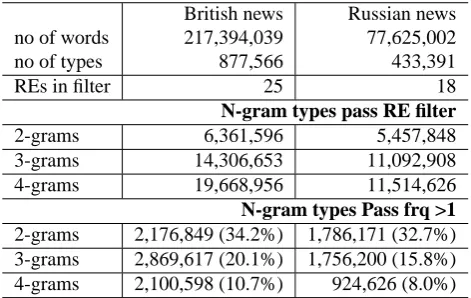
British news Russian news
no of words 217,394,039 77,625,002
no of types 877,566 433,391
REs in filter 25 18
N-gram types pass RE filter
2-grams 6,361,596 5,457,848
3-grams 14,306,653 11,092,908
4-grams 19,668,956 11,514,626
N-gram types Pass frq >1 2-grams 2,176,849 (34.2%) 1,786,171 (32.7%) 3-grams 2,869,617 (20.1%) 1,756,200 (15.8%) 4-grams 2,100,598 (10.7%) 924,626 (8.0%)
Table 1: MWEs in News Corpora
run_VV a_DT completely_RB ethical_JJ
the following RE constraints are used: _IN _JJ$ _DT _JJ$. The numbers of N-grams which pass the filter and then the frequency threshold, as well as the percentage of items which pass the frequency threshold, are presented in Ta-ble 1.
It is an interesting fact that the filter and the frequency threshold balance each other with respect to MWEs of dif-fernent length, so in general the number of MWEs of length 2, 3 and 4 is not very much different. There are more longer expressions which pass through the RE filter, but fewer of them pass through the frequency threshold, so roughly equal numbers of MWEs of different length are included in the database.
2.4.3. Implicit collocation search for single-word equivalents
For single-word queries only one TL translation class can be generated. The query does not contain other words which can be used as explicit collocation filters.
Note that in our method multiword queries take advantage of internal consistency of multiword queries, in a sense that they represent complete constituents with internally coher-ent syntactic and semantic structure: users usually don’t ask about weapons of mass, but rather about mass destruction if they experience difficulties with the phrase weapons of
mass destruction. In fact, multiword queries in our method
benefit from the results of such intuitive and highly accu-rate human parsing of sentences and phrases which contain difficult fragments.
Also, multiword queries have some relative contextual in-dependence: usually they can be used as a unit in a wider variety of contexts. So they do not predict which word or phrase will necessarily preceede or follow them; there is much greater variation outside the muliword query. There-fore, multiword queries provide very reasonable boundaries for accurately expanding and limiting collocation filters to necessary contexts.
Single-word queries do not have these advantages. Al-though the returned TL translation classes for single words are much shorter and can be inspected more easily
com-pared to multiword queries, it is also desirable to find a method to filter out spurious elements of these classes which would not pass collocation filters in TL corpora. For example, the translation class for the Russian word
âîñòðåáîâàííûé (‘requested’) contains 18 words, which can be easily inspected by human translators. But can some non-relevant items be filtered out from this list automati-cally?
We suggest that the list of 5 top single-word collocates of the single-word query can be collectively used as a reason-able approximation for such a TL collocation filter. Even though there is no guarantee that the returned collocations concatenated with the query will produce internally consis-tent and contextually independent MWEs, these properties may be correctly guessed by at least by one or a few collo-cates, so there can be a reasonable implicit collocation filter for the single-word query.
We suggest the following procedure for implicit collocation filtering of TL translation classes:
Step 1. Two sets of 5 collocates ranked best on their Log Likelihood score are returned for the immediate right and immediate left context.
Step 2. For each of these, collocated TL translation classes are generated according to the procedure for explicit collocation filtering described in the previous section.
Step 3. TL translation classes are combined into one TL translation class – separately for the right and for left set of collocates.
Step 4. The set of rightmost words in the TL translation class of the left collocate and the set of leftmost words of the TL translation class of the right collocates are inter-sected. The resulting list contains only words which are present in both lists. In our example, the resulting list for the wordâîñòðåáîâàííûé(‘requested’) is:
(11) advantageous, attractive, claim, competitive, dynamic, popular, productive, profitable, receptive, susceptible, technically, topical, unprofitable, vulnerable, winning
Items, which have been fitered out by the implicit colloca-tion filter are:
(12) complaisant, disadvantageous, talkative
We see that in our example the filter correctly elliminates non-relevant items (in this case the precision is high), but the recall still needs to be improved: some non-relevant items still pass the implicit collocation filter and are present in the returned list, e.g., claim, receptive, susceptible,
tech-nically, unprofitable, vulnerable. This can be due to the fact
that there is less internal consistency and contextual inde-pendence for implicit collocates as compared to the explicit collocation search.
3.
Usability of the tool
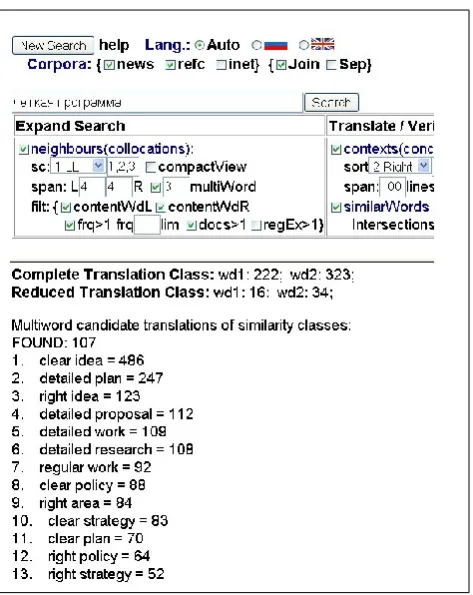
3.1. InterfaceThe interface to the tool is powered by IMS Corpus Work-bench (Christ, 1994) and itself presents a customisation of a more generic interface to CWB (Sharoff, 2006b). In ad-dition to standard options for making lists of concordance lines and collocations, it provides options for making lists of similarity classes, finding MWEs in the two languages, and choosing the strategy for detection of translation equiv-alents. For instance, the translator can enter a search term, such as ÷åòêàÿ ïðîãðàììà (‘precise programme’)2 and check the resulted list of English expressions, as shown in Figure 1. One of the suggested options that appeal to pro-fessional translators is clear strategy, which can be used in the following smooth translation:
(13) This team should be put together by responsible
politicians, who have a clear strategy for resolving the current crisis
Figure 1: Filtered list collocations
3.2. Legitimate translation variation
For each difficult translation problem the system returns multiple translation variants, some of which are potentially useful for translators. We carried out a number of case studies in order to find out whether translators tend to pre-fer some of these variants and disprepre-fer the others, that is, whether there exists some optimal translation solution for
2
It appeared in the context of Ñîáðàòü ýòó
êîìàíäó äîëæíû îòâåòñòâåííûå ëþäè, èìåþùèå ÷åòêóþ ïðîãðàììó âûõîäà èç êðèçèñà.
each of such translation problems. We asked several profes-sional translators to score the usefulness of system output for several problems on 5-point scale.
The results were surprising in so far as, for the majority of problems, translators preferred very different translation solutions and did not agree in their scores on the same so-lutions. In general, the average standard deviation of the responses of different judges is 1.06 , which means that if we assume Gaussian distribution, only about 68% of scores are the same or differ just by 1 point, but about one third of responces differ by 2 points or more on the 5-point scale. For instance, for the English phrase recreational fear in the sentence:
(14) Patrick West recently claimed that Britain’s
mourning for Princess Diana was ‘recreational grief ’. Maybe we also suffer from recreational fear.
the Russian solution generated by our tool ñïîðòèâíûé
èíòåðåñ ’leasure interest’ received the following set of
scores: 4, 1, 1, 1, 1, 1, 3. Interestingly, the translator who gave the score 4 also provided the following comment:
ñïîðòèâíûé èíòåðåñ (‘sports interest’) is very good for translating ‘recreational grief’, though I would suggest to use a set Russian phraseðàäè ñïîðòèâíîãî èíòåðåñà(‘for the sake of sports in-terest’).
Other evaluators went for other alternatives and did not see this solution at all, which explains the low scores for it. Note that for this example the score 1 indicates a lack of attention to a potentially good solution in the presence of alternative equally good solutions, but not the quality of the evaluated example – a kind of a masking effect.
In general, such divergence cannot be expected under the assumption that the scores reflect some genuine, objective
quality of translation solutions. This fact can be explained
rather by the phenomenon of a legitimate translation vari-ation, e.g. (Papineni et al., 2001), which is even higher for salient lexical items that are often most difficult to trans-late (Babych and Hartley, 2004). Translators tend to agree on easy bits in translation, but have much greater disagree-ment about difficult bits, which also tend to be more central to the general content of the text. However, sentence trans-lation has to be internally consistent, so the choice about such difficult problems has to be made first, and more triv-ial fragments are built around these solutions.
Our tool gives translators an idea about possible non-literal translation solutions, but in many cases this involves exten-sive revision of the general structure of the sentence. In this sense the tool is more than just a dictionary: it can point the translators to potentially very good and contextually appro-priate suggestions, which usually come at later stages of revision of the draft translation. Translators can organise their texts around such solutions more efficiently compared to the usual way of revising initial non-literal translation (Shveitser, 1988).
4.
Conclusions
types; developing semi-automatic translation lookup tools which go beyond the limits of standard bilingual dictionar-ies; testing the system with trainee and professional transla-tors; and applying these methods to MT development. The current implementation works for translations between En-glish and Russian, but can be extended to other languages, for which the necessary bilingual dictionaries and large monolingual corpora are available.
Another approach which we investigate within the UK-funded project ASSIST together with the University of Lancaster uses a model of the semantic context of situation, e.g. ‘unpleasant situation’ in the case of daunting
experi-ence. This allows less restrictive identification of possible
translation equivalents, as well as a reduction in suggestions irrelevant for the context of the current example. This can be achieved by using ‘semantic signatures’ obtained from USAS, a broad-coverage semantic parser, (Rayson et al., 2004). The semantic tagset used by USAS is a language-independent multi-tier structure with 21 major discourse fields, subdivided into 232 sub-categories, such as
E5-= Fear (for daunting); X9.1+= Ability (for experience), which can be used to detect the semantic context. Identi-fication of semantically similar situations can be achieved by the use of segment-matching algorithms as employed in Example-Based MT and translation memories (Planas and Furuse, 2000; Carl and Way, 2003).
Acknowledgements
The project is supported by theEPSRCgrantEP/C005902.
5.
References
Bogdan Babych and Anthony Hartley. 2004. Extending the BLEU MT evaluation method with frequency weight-ings. In Proceedings of the 42d Annual Meeting of the
Association for Computational Linguistics, Barcelona.
Peter Bennison and Lynne Bowker. 2000. Designing a tool for exploiting bilingual comparable corpora. In
Proceed-ings of LREC 2000, Athens.
Michael Carl and Andy Way, editors. 2003. Recent
ad-vances in example-based machine translation. Kluwer,
Dordrecht.
Oliver Christ. 1994. A modular and flexible architec-ture for an integrated corpus query system. In
COM-PLEX’94, Budapest.
Ido Dagan and Kenneth Church. 1997. Termight: Coor-dinating humans and machines in bilingual terminology acquisition. Machine Translation, 12(1/2):89–107. Silvia Hansen and Elke Teich. 2002. The creation and
ex-ploitation of a translation reference corpus. In
Proceed-ings of the Third Language Resources and Evaluation Conference, LREC 2002, Spain.
John S. Justeson and Slava M. Katz. 1995. Techninal ter-minology: some linguistic properties and an algorithm for identification in text. Natural Language
Engineer-ing, 1(1):9–27.
Christopher Manning and Hinrich Schütze. 1999.
Founda-tions of Statistical Natural Language Processing. MIT
Press, Cambridge, MA.
K. Papineni, S. Roukos, T. Ward, and W. Zhu. 2001. Bleu: a method for automatic evaluation of machine transla-tion. Technical Report RC22176 (W0109-022), IBM Research Division, Thomas J. Watson Research Center. C. Peters, E. Picchi, and L. Biagini. 2000. Parallel and
comparable bilingual corpora in language teaching and learning. In S. P. Botley, T. McEnery, and A Wilson, ed-itors, Multilingual Corpora in Teaching and Research, pages 73–85. Rodopi.
Emmanuel Planas and Osamu Furuse. 2000. Multi-level similar segment matching algorithm for translation mem-ories and example-based machine translation. In
COL-ING, 18th International Conference on Computational Linguistics, pages 621–627.
Reinhard Rapp. 2004. A freely available automatically generated thesaurus of related words. In Proceedings of
the Forth Language Resources and Evaluation Confer-ence, LREC 2004, pages 395–398, Lisbon.
Paul Rayson, Dawn Archer, Scott Piao, and Tony McEnery. 2004. The UCREL semantic analysis system. In
Pro-ceedings of the workshop on Beyond Named Entity Recognition Semantic labelling for NLP tasks in asso-ciation with LREC 2004, pages 7–12, Lisbon.
Philip Resnik and David Yarowsky. 2000. Distinguish-ing systems and distDistinguish-inguishDistinguish-ing senses: New evaluation methods for word sense disambiguation. Natural
Lan-guage Engineering, 5(2):113–133.
Serge Sharoff. 2006a. Creating general-purpose corpora using automated search engine queries. In Marco Baroni and Silvia Bernardini, editors, WaCky! Working papers
on the Web as Corpus. Gedit, Bologna.
Serge Sharoff. 2006b. A uniform interface to large-scale linguistic resources. In Proceedings of the Fifth
Lan-guage Resources and Evaluation Conference, LREC 2006, Genoa.
A.D. Shveitser. 1988. Theory of Translation: Status,
Prob-lems, Aspects. Nauka, Moskow.
Krista Varantola. 2003. Translators and disposable cor-pora. In Federico Zanettin, Silvia Bernardini, and Do-minic Stewart, editors, Corpora in Translator Education, pages 55–70. St Jerome, Manchester.
Anna Wierzbicka. 1999. Emotions across Languages and