CSEIT1725161 | Received : 01 Nov 2017 | Accepted : 08 Nov 2017 | November-December-2017 [(2)6: 07-11 ]
International Journal of Scientific Research in Computer Science, Engineering and Information Technology © 2017 IJSRCSEIT | Volume 2 | Issue 6 | ISSN : 2456-3307
11
Image Segmentation Technique - A study on Region Growing
Approaches
J. Magelin Mary
Asst. Professor, Holy Cross College, Tiruchirappalli, India
ABSTRACT
Region growing is an iterative process by which regions are merged starting from individual pixels or initial segmentation and grow iteratively until every pixel is processed. Region is grown from the seed pixel by adding in neighbouring pixels that are similar, increasing the size of the region. In this paper, the main aim is to study the Region growing approaches for image segmentation.
Keywords : Region Growing, Pixel, Splite And Merge, Segmentation
I.
INTRODUCTION
Segmentation subdivides an image into different regions which may represent objects or parts of objects, which exist in the scene being viewed. The level of subdivision is dependent upon the problem being solved. Ideally, segmentation should stop when the required objects in an application have been found. For example, with the automated detection of fish in an image taken from a fish farm, the segmentation process should stop when the fish objects have been found. There is no need to continue subdivision past the level of detail required to identify the fish. In a computer vision system, segmentation accuracy determines the success or failure of the procedure[1].
Image segmentation algorithms are usually based on one of these two properties of intensity values: similarity and discontinuity. Similarity approaches attempt to partition an image into regions that are similar according to a set of predefined criteria. Some examples of methods that fit into this category are thresholding, region growing or region splitting and merging. Discontinuity approaches attempt to partition an image based on sudden changes in intensity, such as edges in an image[2].
Image segmentation is one of the most important categories of image processing. The purpose of image segmentation is to divide an original image into homogeneous regions. It can be applied as a
pre-processing stage for other image pre-processing methods. Image processing and analysis is an important area in the field of robotics. This is particularly true for the operation of autonomous vehicles. The operation of an autonomous vehicle is based on first acquiring data that describe its environment. Indeed, the motion planning and control of a fully autonomous vehicle requires an intelligent controller to be able to make decisions to allow the autonomous vehicle to maneuver in an unknown field based on these data[3]. These data sets include range data, 2D images, and position measurements. This data is used to identify and avoid obstacles and to map the surrounding terrain.
The organization of the paper is as follows. In Section II, presents an overview of Region growing, and Section III discuss about Region Split and Merge for image segmentation and Section IV presents conclusion.
II.
Region Growing – An Overview
methods which starts with a set of "seed" points in an image and from these seed points grows regions by appending each seed point to neighbouring pixels that have similar properties (if its within the threshold limit). These properties could be grey level values in grey level images or RGB (Red Green Blue) values in colour images or textures[5].
The most primitive region growers used only aggregate of properties of local group of pixels to determine regions. More sophisticated, grow regions by merging more primitive regions. To do this in a structured way requires sophisticated representations of regions and boundaries[6]. Also, the merging decisions can be complex, and can depend upon descriptions of the boundary structures separating regions in addition to the region semantics. Following are the early techniques of region growing:
1. Global Techniques: Pixels are grouped into regions on the basis of the properties of large numbers of pixels distributed throughout the image[7].
2. Splitting and Merging Techniques: The foregoing techniques are related to individual pixels or sets of pixels. State space techniques merge or split regions using graph structures to represent the regions and boundaries. Both local and global merging criteria can be used[8].
The effectiveness of region growing algorithms depends heavily on applications area and input image. If the image is sufficiently simple, then simple global techniques will be effective. However on very difficult images, even the most sophisticated techniques still may not produce a satisfactory segmentation. Hence, region growing is sometimes used conservatively to preprocess the image for more knowledgeable processes[9].
Global techniques involve the region growing via thresholding approach assumes an object background image and picks a threshold that divides the image pixels into either object or background. X is part of the object if f (X ) > T, otherwise it is part of background. The best way to pick the threshold T is to search the histogram of grey levels, assuming it is bimodal, and find the minimum separating the two peaks. Finding the right valley between the peaks of a histogram can be difficult when the histogram is not a smooth function. Smoothing the histogram can help but does
not guarantee that the correct minimum can be found. The elegant method to treat the bimodal images assumes, that the histogram is the sum of two composite normal functions and determines the valley location from the normal parameters[10].
The single threshold method is useful in simple situations, but primitive. For example, the region pixels may not be connected, and further processing may be necessary to smooth region boundaries and remove noise. A common problem with this technique occurs when the image has a varying background of varying grey level, or for regions that vary smoothly in grey level by more than the threshold. Two modifications of the threshold approach to ameliorate are: (1) High pass filter the image to deemphasize the low frequency background variation and then try the original technique, and (2) Use a spatially varying threshold method[11].
Spatially varying threshold method divides the image up into rectangular subimages and computes a threshold for each subimage. A subimage can fail to have a threshold if its gray level histogram is not bimodal. Such subimages receive interpolated thresholds from neighbouring subimages that are bimodal, and finally the entire picture is thresholded using the separate thresholds for each subimage[12].
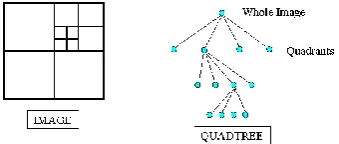
The most natural method to overcome the over-segmentation of watersheds transformation is to merge the small regions in a homogeneous region since they may possess certain homogeneous characteristics in intensity, texture or statistical properties. The Split/Merging method takes an intensity image as an input and splits it into small grids usually using quadtree structure. Finally, the procedure merges small grids according to their statistical properties[13].
Figure 1. Quadtree representation
Split/Merging method. As explained in following section, the watersheds transformation algorithm processes the original image into a labeled image with boundary pixels; each label represents a different region. Two important keys for merging different regions together are[14]:
1. If the regions are adjacent or not
2. How dissimilar/similar the regions are to each other.
Figure 2. Split and Merging with Quadtrees
III.
Region Spliting and Merging
Region splitting and merging is another image segmentation method that takes spatial information into consideration[15]. The method is as follows:
A. Region Spliting
The region splitting procedure is as follows,
1. Let R represent the entire image and select a predicate P.
2. Split or subdivide the image successively into
smaller and smaller quadrant regions if, stop until the region.
This particular splitting technique has a convenient representation in the form of a so called quadtree. Note that the root of the tree corresponds to the entire image and that each node corresponds to a subdivision.
(a) (b)
Figure 3. The Split and Merging of image (a) can be represented by a Quadtree (b).
The above final partition of the above method is likely to contain adjacent regions with identical properties.
This drawback may be mixed by applying merging, merging only adjacent regions whose combined pixels satisfy the predicate.
B. Region Merging
The region splitting procedure is as follows[16], 1. Merge an only if.
2. Stop when no further merging or splitting possible.
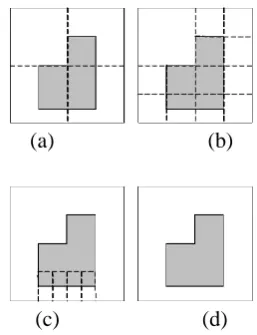
The following figure is an example of image splitting and merging. (a) The original image is divided into four quadrants. In (b) the image is further divided into smaller quadrants, except quadrant 1 which satisfies the predicate P. In (c) the remaining quadrants that does not satisfy the predicate P in (b) is further divided. In (d) merging is done with adjacent regions[4].
(a) (b)
(c) (d)
Figure 4. Region Spliting and Merging
tends to result in sharper edges whereas, region growing without merge splitting generated images with blurry edges[3].
In this technique any grid structure is chosen, and homogeneity property H . If for any region R in that structure H(R) = false, split that region into four subregions. If for any four appropriate regions RK1...RK4, H(RK1U RK2U RK3U RK4)= true, merge
them into a single region. When no regions can be further split or merged, stop. A significant simplification result merging of any two adjacent regions Ri and Rj is allowed and if each one satisfies
predicate individually. This results in much simpler and faster algorithm because testing of the predicate is limited to individual quad regions. All the quad regions which satisfy the predicate are filled with one’s and their connectivity can be easily examined. The quad regions that do not satisfy the predicate are filled with zero’s to create a segmented image[7].
The seeded region growing (SRG) method described in this section is a greedy algorithm, closely related to the watershed transform, which assigns a label to every pixel in the image while satisfying a connectivity constraint. The technique begins with a set of seeds that mark the regions to be segmented and uses a priority based system to grow regions one pixel at a time. This means that a single seed will grow to fill the entire image if there are no other seeds to compete with it. Other approaches place a threshold and stop a region growing when the threshold is exceeded, so a single seed will not necessarily grow to fill the entire image[1][5][8].
(a) (b)
↑ direction of growth • seed pixel ■ grown pixels ο pixels being considered
Figure 5. (a) Start of growing a region, (b) Growing process after few iterations
A region growing method starts the growing process from a selected initial point or seed and evolves regions iteratively until a region of interest (ROI) is obtained.
The nature of region growing leads to (i) where it starts, i.e., the search of seeds whether specified implicitly or explicitly, (ii) how it grows, i.e., the growing conditions and (iii) when it stops growing process. It is a region growing method which starts the growing process from selected initial points or seeds and evolves regions iteratively until maximal intra region homogeneity is reached. The image points that are not associated to any seed are related to the background[2][6].
(a) (b)
Figure 6. Example of Region Growing approach, (a) Original image, (b) using Region Split and
Merge method.
The nature of region growing leads to (i) the search of seeds whether specified implicitly or explicitly, and (ii) unbridled growing directions. The former implies the importance of seed selection, and thus scanning the image to determine seeds is prerequisite of the segmentation. Regions can also be grown in an unseeded manner using split and merge or graph based approaches in. Greedy approaches are parameter free, but require selection of seeds by some form of pre filtering or manual interaction[5][9].
IV.
Conclusion
The effectiveness of region growing algorithms depends heavily on applications area and input image. If the image is sufficiently simple, then simple global techniques will be effective. In this paper presents a study on region growing approaches for image segmentation.
V.
REFERENCES
[1]. Palus, H. and Bereska, D. 1999]. Region-based colour image segmentation, Silesian University of Technology, Department of Automatic Control.
[3]. J.R. Beveridge, et al. Segmenting images using localized histograms and region merging. IJCV, 2(3):311–352, 1989.
[4]. L. Liu and S. Sclaroff. Deformable shape detection and description via model-based region grouping. CVPR, II:21–27, 1999.
[5]. S.C. Zhu and A. Yuille. Region competition: Unifying snakes, region growing, and Bayes/MDL for multiband image segmentation. PAMI, 18(9):884–900, 1996.
[6]. R. Ohlander, K. Price, D.R. Reddy, "Picture segmentation usingrecursive region Splitting method", Computer Image Processing, Vol. 8, pp. 313-333, 1978.
[7]. R. Adams and L. Bischof, "Seeded Region Growing", IEEE Transactions on Pattern Analysis and Machine Intelligence, Vol. 16, pp. 641-647, 1994.
[8]. SA. Hojjatoleslami, J. Kittler, "Region Growing: A new approach", IEEE Transactions of Image Processing, Vol. 7, No. 7, pp.1079-1084,2000. [9]. X. Yu, J. Yla-Jaaski, "A New Algorithm for
Image Segmentation based on Region Growing and Edge Detection" Proc. International conference on Circuits and System, Vol.1, pp. 5 16-519, 1991.
[10]. J. H. Xuan, T. Adali, and Y Wang, "Segmentation of Magnetic Resonance Brain Image: Integrating Region Growing and Edge Detection," Proc. International Conference on Image Processing, Vol. 3, pp. 544-547, 1995. [11]. R.D. Stewart, I. Fermin and M.Opper, "Region
growing with pulse coupled neural Networks: An alternative to seeded region growing", IEEE Transactions on "Neural Networks", Vol. 13, pp. 1557-1562, 2002.
[12]. Hao Xiaohui, C. Bruce, C. Pislaru, J.F. Greenleaf, "A novel region growing method for segmenting ultrasound images", IEEE Symposium Ultrasonics, Vol. 2, pp. 1717 – 1720, 2000.
[13]. R. Beare, "Regularized Seeded Region Growing", CSIRO Mathematical and Information Sciences, pp. 91-99, 2002.
[14]. Shu Yen Wan and William. E. Higgins, "Symmetric Region Growing", in IEEE International Conference on Image Processing, pp. 1196-1199, 2000.
[15]. Yu-Bu Lee, Soo Min Song, Jae Sung Lee, Myoung Hee Kim, "Tumor segmentation from
small animal PET using region growing based on gradient magnitude", Proceedings of 7th International Workshop on Image processing, pp. 243-247, 2005.