CSEIT172669 | Received : 05 Nov 2017 | Accepted : 15 Nov 2017 | November-December-2017 [(2)6: 173-177]
International Journal of Scientific Research in Computer Science, Engineering and Information Technology © 2017 IJSRCSEIT | Volume 2 | Issue 6 | ISSN : 2456-3307
173
Secure Cloud Storage Auditing Using Hash-Code Technique
Zeba Masroor , Md Ateeq Ur Rahman
1M.Tech Scholar, Department of Computer Science & Engineering, Shadan College of Engineering & Technology, Hyderabad,
Telangana, India
2Professor, Department of Computer Science & Engineering, Shadan College of Engineering & Technology, Hyderabad,
Telangana, India
ABSTRACT
The Main objective of the project is to provide hash-value security to the data of the data owner. Every data dynamically generates some blocks of code then every block will have hash code. This hash code or value is totally dependent on the data it contains. First data will be encrypted at client side itself afterwards it will generate hash value of that block. With this technique we are aiming to provide high level security to the data in cloud. The Major problem lies in the security of the data in cloud where a user totally trusts on a remote server to store their data securely. There is numerous amount of studies have been conducted to address the issue of block level security. Untrusted servers need high level infrastructure to overcome the issue of data security in cloud. Hash Value based security is a well formed and clearly examined technique over a period of time in cloud. It converts the actual data with a secure unreadable code called as hash value. It is a key-value pair in which elements are arranged or organized in dictionary entry object.
Keywords : Hash-Table, Hash-Value, Cryptography, Dynamic Hash-Table, Merkel Hash Tree, Cloud Servers, Third Party Auditor, Secure Auditing.
I.
INTRODUCTION
Distributed storage is a vital branch of distributed computing, whose objective is to give effective and on request outsourcing information administrations for clients abusing very virtualized frameworks. Because of the minimal effort and superior of distributed storage, a developing number of associations and people are having a tendency to outsource their information storage to proficient cloud administrations suppliers (CAS), which floats the fast advancement of distributed storage and its relative methods as of late. Be that as it may, as another forefront innovation, distributed storage still faces numerous security challenges.
One of the greatest concerns is the way to decide if a distributed storage framework and its supplier meet the lawful desires of clients for information security. This is fundamentally caused by the accompanying reasons. To start with, cloud clients (information owners), who outsource their information in public, can never again confirm the trustworthiness of their information through customary procedures that are regularly utilized in neighborhood stockpiling situations.
Second, CSPs, which endure Byzantine
generously build the overhead that the clients may not bear.
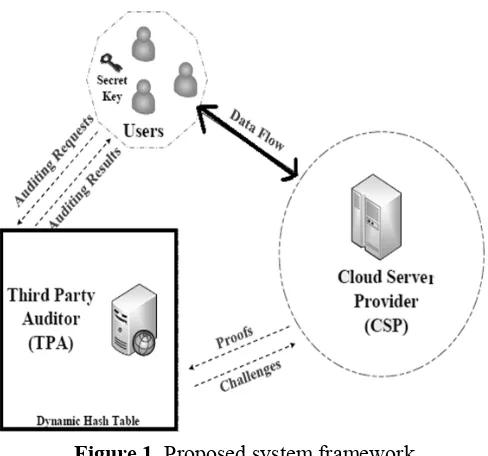
Figure 1. Proposed system framework
II.
EXISTING AND PROPOSED SYSTEMS
2.1 Existing System:
In Recent year cloud auditing became the very challenging action towards data security. There are lot of studies conducted so far to address the issue of secure cloud storage auditing.
Ateniese et al. to start with displayed people in general reviewing plan, in which reliable examining comes about and fundamentally lessen clients' superfluous weight by presenting a free TPA. Accordingly, it is more normal and down to earth, and prominently accepted to be the privilege in the general population inspecting, in any case, some imperative issues as takes after stay to be tended to or additionally Gone
Privacy-saving: information security insurance has dependably been a vital subject for distributed storage. In general society inspecting, the center of this issue is the way to protect utilizations' security while presenting a TPA. In spite of the fact that abusing information encryption before outsourcing is a way to deal with alleviate the security worry in distributed storage, it can't counteract information spillage amid the check procedure. Subsequently, it is critical for the cloud inspecting to incorporate a security protecting instrument free to information encryption.
Cluster examining: to improve the productivity and empower the versatility of open reviewing, the TPA should manage different inspecting undertakings from
different clients in a quick and cost-proficient way, i.e., bolster the bunching evaluating.
Dynamic inspecting: as it is outstanding that a distributed storage framework isn't only an information stockroom, the clients frequently need to refresh the information progressively spurred by different application necessities. In this manner, it is noteworthy for distributed storage examining to help information progression.
2.1.1 Disadvantages of Existing System:
Existing schemes failed to explain the cloud auditing in real time scenario. A user needs to make a request dynamically to audit his/her data in cloud
Some schemes any how manages to provide data security through cryptography technique
There are many issues regarding the application performance raised as the auditing performed at server side.
It is basic and noteworthy to create productive reviewing strategies to reinforce information ownersʹ trust and trust in distributed storage, of which the center is the means by which to adequately check information trustworthiness remotely.
The existing plans would bring about substantial computational expenses of the TPA and expansive correspondence overhead amid the refreshing and check forms.
2.2 Proposed System:
This paper shows Secure Cloud Storage Auditing by using Hash-Table Technique (SCSA-HT).
A user can totally rely on untrusted server i.e., cloud server for their personal data security.
This paper is an extension of an open examining plan (DHT‐PA) utilizing another information structure called dynamic hash table (DHT). Misusing the DHT, our plan can accomplish dynamic inspecting.
2.2.1 Advantages of Proposed System:
Auditing process is very clear and transparent with the cloud server of the user’s data in cloud.
Performance will be increased as the data in encrypted at client side for further processing of auditing.
III. METHODOLOGY
The fact that DHT‐PA moves the approved data from the CSP to the TPA, its computational expenses and correspondence overhead are altogether littler than the plan in view of skip list and the one in view of MHT. DHT‐PA likewise beats IHTPA in refreshing, as the seasons of refreshing operations on the DHT are many less than that on the IHT.
In expansion, we stretch out DHT‐PA to accomplish security safeguarding by consolidating the homomorphic authenticator in light of people in general key with irregular concealing produced by the TPA.
IV. IMPLEMENTATION & RESULTS
Below are some of the screenshots of the process.
Output Screenshot 1: Registration page
This is the Registration Page of our application. Here users’ needs to provide their personal details like username, password, emailed, dob, gender, mobile no. and address in order to create an account in the cloud.
Output Screenshot 2: User Login page
After Successful Registration Users can login in to the application. Users will provide credentials like username and password, this will be verified with the cloud and then users will be authenticated.
Output Screenshot 3: File upload page
After Successful Login Users can upload their personal data in cloud. Here an example has been given where user is trying to upload a text file with the name student.txt.
The Uploaded file will be separated in to three different blocks or chunks for security. These blocks contain the actual data but in encrypted format. Every block will have a hash code with which it will be identified.
Output Screenshot 5: Server View Files
This is the View File Details page of the Server. Here file details like filename, username, file id, cloud status and verify blocks link are displayed. When clicked on view blocks link a new page will be displayed for the server.
Output Screenshot 6: View Users Details This is the View Users Details page of the server. Here all the registered users from the cloud are displayed in a grid.
Output Screenshot 7: User File Block Decryption
This is the File Decryption page. Here when provided correct secret key user file will be decrypted and they can download the file by clicking on submit button.
V.
CONCLUSION
verification to dazzle the information data. Also, our plan additionally misuses the total BLS signature system from bilinear maps to play out numerous examining errands all the while, of which the rule is to total every one of the marks by various clients on different information obstructs into a solitary short one and check it for just a single time to lessen the correspondence cost in the confirmation procedure. We formally demonstrate the security of our plan, and assess the reviewing execution by nitty gritty analyses and examinations with the current ones.
VI. REFERENCES
[1]. H. Dewan and R. C. Hansdah. Proposed a paper "A Survey of Cloud Storage Facilities ", Proc. 7th IEEE World Congress on Services, pp. 224‐
231, July 2011.
[2]. C. Wang, Q. Wang, K. Ren, N. Cao and W. Lou. Proposed a paper "Toward Secure and Dependable Storage Services in Cloud Computing", IEEE Trans. Service Computing, vol. 5, no. 2, pp. 220‐232, 2012.
[3]. K. Ren, C. Wang and Q. Wang. Proposed a paper "Security Challenges for the Public Cloud," IEEE Internet Computing, vol. 16, no. 1, pp. 69– 73, 2012.
[4]. J. Ryoo, S. Rizvi, W. Aiken and J. Kissell. Proposed a paper "Cloud Security Auditing: Challenges and Emerging Approaches", IEEE Security & Privacy, vol. 12, no. 6, pp. 68‐74, 2014.
[5]. C. Wang, K. Ren, W. Lou and J. Li. Proposed a paper "Toward Publicly Auditable Secure Cloud Data Storage Services", IEEE network, vol. 24, no. 4, pp. 19‐24, 2010.