Review Article
PRACTICAL IMPLICATIONS OF SPONTANEOUS ADVERSE DRUG REACTION REPORTING
SYSTEM IN HOSPITALS-AN OVERVIEW
SAINUL ABIDEEN P
Department of Clinical Pharmacology, Narayana Hrudayalaya Hospital, Jaipur, Rajasthan, India. E-mail: [email protected]
Received: 1 March 2013, Revised and Accepted: 22 March 2013
ABSTRACT
Adverse drug reactions (ADRs) are global problems of major concern which leads to morbidity and mortality. It causes 30% of h ospitalized patients and lead 2-6% of all medical admissions. Spontaneous reporting of ADRs is the cornerstone of pharmacovigilance and is essential for maintaining patient safety. The necessity of a spontaneous ADR surveillance system is addressed by many authorities like World Health Organization, Food and Drug Administration, Joint Commission International and Uppsala monitoring center. However, existing postmarketing surveillance systems massively rely on spontaneous reports of ADRs which suffer from serious underreporting, latency, and inconsistent reportin g. Studies estimated that only 6–10% of all ADRs are reported in hospitals. It is a very low percentage to go in deep and analyze the reason for the same and to resolve that underlying factors. Researchers proved that knowledge, attitude and false perceptions about the ADRs are the major challenges in the spontaneous reporting of ADRs. Which includes personal, professional, system related and organization related conflicts. Majo rity of them can improve by doing the system and personal targeted implications. Identifying, analyzing and working on these issues can improve the ADR surveillance system in hospitals to attain the patient safety. Understanding the pharmacovigilance, identifying and sorting out the obstacles of spontaneous reporting through an efficient pharmacovigilance department, continuous educational interventions, patient centered surveillance programs, health care team work efforts towards the detection of ADRs and implementation of the computer or personal assisted ADR trigger tool programs can furnish out a successful pharmacovigilance system in the hospitals and thereby we can constitute a good quality health care system.
Keywords: Spontaneous reporting system, adverse drug reaction, pharmacovigilance, Patient safety
INTRODUCTION
Adverse drug reactions (ADRs) are global problems of major concern in both developing and developed nations. It affects both children’s and adults with unreliable magnitudes, causing both morbidity and mortality [1-6]. ADRs are come across in as many as 30% of hospitalized patients and lead 2-6% of all medical admissions [1, 5, 7-9]. Drug induced adverse events leads to increased suffering, prolongs hospital stay and causes significant amplified in hospital expenditure. ADRs have a great impact on public health by imposing a substantial economic burden on the society and the health care systems [1-3, 6, 9-13]. For these and other reasons, the requirement of a more active ADEs surveillance and reporting systems in hospitals have been addressed by both national and international authorities. The World Health Organization (WHO) [14], the US Food and Drug Administration (FDA) [15], and the Joint Commission on Accreditation of Healthcare Organizations [16] have all demanded this need. The necessity of a hospital-based ADR monitoring and reporting programmers is to identify and quantify the risks associated with the use of drugs. Therefore, it is essential to motivate and educate all the healthcare professionals to understand their roles and responsibilities in the detection, management, documentation, and reporting of ADRs.
The purpose of this article is to demonstrate the fundamental concepts of pharmacovigilance and to deliver evidence based overview on different aspects that the healthcare professionals need to consider while implementing an efficient and most convenient spontaneous ADR reporting system in their hospital setup. We authors making an attempt give an outline picture on major underlying factors of under reporting of ADRs and a series of literature based recommendations to intensify the detection and reporting of ADRs among the readers.
UNDERSTANDING PHARMACOVIGILANCE- Clinical importance and current scenario in hospitals
The World Health Organization defines adverse drug reactions (ADRs) as 'a reaction which is noxious and unintended and which occurs at doses normally used in humans for prevention, diagnosis
or therapy of disease, or for the modification of physiological functions' [17]. Epidemiological studies have concluded that about 5% of all hospital admissions were associated with ADRs [1, 5, 7-9]. The Institute of Medicine (IOM) estimates that the total national costs of the US, including lost household production, lost income, disability, and healthcare costs, due to avoidable adverse drug events (ADEs) at $17 billion to $29 billion. The report pointing out that the healthcare costs comprise over one half of this estimate [10].
Pharmacovigilance is the Science and activities relating to the detection, assessment, understanding and prevention of adverse effects or any other medicine-related problem [18]. The aims of the Pharmacovigilance includes to Improve the patient care and safety in relation to the use of medicines and all medical and paramedical interventions, Improve the public health and safety in relation to use of medicines, Contribute to the assessment of benefit, harm, effectiveness, and risk of medicines, encouraging their safe, rational, and more effective use, and Promote understanding, education and clinical training in pharmacovigilance and its effective communication to public [17,18].
surveillance of drugs are awfully important in detecting, reporting, analyzing and managing the risks associated with drugs once they are available for the use of the general population.
Discovering and analyzing mysterious ADRs as early as possible in postmarketing surveillance is highly advantageous and beneficial. The report form Ralph Edwards of Uppsala monitoring center, Sweden, says that spontaneous reporting of ADRs is one of the basic methods for post-marketing surveillance and constitutes for detection of signals indicating new and serious ADRs [20]. Spontaneous reporting of ADRs remains the core part of pharmacovigilance since it is targeting patient safety [21]. However, existing postmarketing surveillance systems massively rely on spontaneous reports of ADRs which suffer from serious underreporting, latency, and inconsistent reporting [21-30]. The incidence of serious and fatal ADRs in hospitals is extremely high. The research teams of Fletcher A et al., and Smith CC et al., estimated that the reporting rate of ADRs is only 6–10% [28, 29]. The very critical and the least rating scenario of under reporting like this escort to delay in signal detection and consequently affect negatively on the public health. The majority of ADRs are predictable from the known pharmacology of the drugs and many indicated the known interactions and are therefore likely to be preventable. Even though, Pharmacovigilance has always been considered one of the most painstaking and challenging critical activity by almost all the key stake holders, associated with drugs, and its high place in organizational priorities has never been questioned. With the increasing quantity and complexity of medications available today, a comprehensive rapid ADR surveillance program is essential in hospitals to detect, evaluate, and develop mechanisms to prevent ADRs and their associated morbidity, mortality, and increased economical burdens [3].
IDENTIFYING THE CAUSES OF UNDER REPORTING- what studies says
There are quite a few studies are conducted to evaluate and assess the principal factors associated with under reporting the ADRs among health professionals (pharmacists, physicians and nurses) and concluded that a cluster of issues are associated with it. Personal and professional characteristics of health care workers, their knowledge, awareness and attitudes to reporting are the major barriers which influence and diminishes the habit of reporting[22,23, 30]. According to Inman, he has summarized these factors as the 'seven deadly sins'. His description of the 'sins' include: attitudes relating to professional activities and problems associated with ADR-related knowledge and attitudes and excuses made by professionals [31]. A systematic review by Lopez-Gonzalez E et al on determinants of ADRs under-reporting from the global perspective have revealed that, three of the seven 'sins' proposed by Inman that are associated with professional activity (financial incentives, fear and ambition to publish) seem to contribute less significantly to under-reporting [26].
The different barriers to improved monitoring and spontaneous reporting of ADRs from the different researches [22, 23, 26, 30-36] are summarized as in Table 1. It shows the actual picture for denying reasons for the spontaneous reporting of ADRs. It is essential to go in deep about these obstacles and need to do the necessary efforts by all health care professionals for breaking these barriers to make meaningful the term pharmacovigilance in your hospital.
SPONTANEOUS ADR REPORTING- Making it practical
We discussed about the various barriers for under reporting. Under-reporting might be improved through activities focused on modifying such factors. But there are evidence based solutions for keeping away all these barriers.
Implementing the pharmacovigilance department- the first step and its responsibilities
It is essential to develop an exclusive department for the pharmacovigilance to initiate, motivate and educate about the importance of ADRs reporting. Ayani I et al., reported that annual budget for a pharmacovigilance center is half expensive when compared to the economical burden due to ADRs [12]. Seeking the
technical and informative support from the national drug regulatory authorities or national pharmacovigilance departments will definitely become an added value for the department. Also it will help the commitment, believe and confidence to the healthcare professionals for reporting the ADRs. Department can take the initiation steps for developments, amendments and implementation of policies and protocols of the ADR reporting system throughout the hospital with the support of hospital management and administrative officials. Specially trained and educated staffs must be the back bone of the department. They must have the ability to monitor, categorize and analyze the ADR which are reported by the health care professionals. The department must be obliged to have the quality of working in a flexible attitude with respect to the knowledge awareness, and attitude of the reporter. Pharmacovigilance department should communicate closely and constantly with other multiple departments of hospitals for effective implementation of the reporting surveillance system. Other important recommendations, solutions and suggestions absorbed from the conclusions of diverse studies [32, 34-43] for an effective spontaneous reporting with respect to the knowledge, awareness, attitude and perceptions are as follows…
Make easy accessibility of yellow cards/reporting forms/systems
Provide the supportive drug informative database Making the reporting procedure is very easy
Follow the “no blame” policy (whether the report is correct or not)
Motivate and support the reporter
Accessing the E mail, Telephone, or Fax reporting systems were suggestive
Avoid more paper work with the reporter
Develop a system where the reporter need to spend very less time
Provide the feedback through the weekly/monthly newsletter/presentation
Provide the incentives and prizes for the best reporter Promote and support the publication attitude of health
care professionals
Educational interventions- the necessity of a continuous process
Educational interventions have been shown to influence reporting rates and it is the most vital requirement in terms of pharmacovigilance [30,36,41,42,44]. Under-reporting related to certain attitudes and knowledge, can be minimized through educational interventions [20,30]. Continuous education of healthcare workers about pharmacovigilance by oral presentations, verbal reminders, providing ADR newsletters/bulletin/case reports by email, mailing and direct distribution for hospital staff, advertisement, attending of pharmacist in the medical wards and involving actively in education and training of healthcare workers especially nurses and physicians were proposed for enhancement of knowledge, awareness and attitude of healthcare workers about ADRs [45].Even though the effects of the educational intervention are temporary, including pharmacovigilance as a topic in continuing education programs will provide a huge improvement in reporting. The educational interventions can be framed out in accordance to the knowledge, attitude and beliefs of the reporter. The clinical importance and the patient safety issues should be addressed during the time of training. It is essential to consider washing out all the false perceptions about the ADR reporting and how they can easily access the reporting system of the hospital.
Spontaneous reporting- only the teamwork can make it possible
multidisciplinary approach for the successful ADR monitoring and reporting program are already demanded by the Uppsala Monitoring center and the American Society of Health-System Pharmacists (ASHP) [46-46]. Since it’s the matter of patient safety, all health care professionals should play their own role to initiate reporting the ADR as a part of team for the complete patient safety. The administrative staffs and hospital higher officials can become a part of this effort by offering support, encourage and motivate to the pharmacovigilance department. Nursing staffs can contribute a critical role for ADR process, because nurses spare the most time with the patients when compared to other health care professionals. The drug induced toxic effects can easily identify and reported by the nurses. The physicians can expand their role through, not only giving the treatment but also by reporting, monitoring, assessing and reducing the treatment associated complications especially the occurrence of ADR. Coming to the pharmacists, they need to elaborate their role from traditional aspects of preparing and dispensing medicines by sitting inside the closed four walls. As a drug expert, pharmacists can use his/her professional skills to prevent, identify, and resolve drug-related problems and counsel patients on drug therapy for the early detection of ADRs [48]. Also studies proved that interventions of pharmacists’ can improve knowledge, attitude and perception of healthcare professionals about ADR since these are the great issue of importance regarding spontaneous reporting in pharmacovigilance and thereby it will improve the public health [43].The laboratory departments have a major role in spontaneous reporting system by monitoring and reporting the various laboratory triggers and signals generated due to the occurrence of ADEs (see Table 2). The respiratory therapist can involve in the reporting by monitoring the bronchodilator associated ADRs. Similarly all other departments like medical record department, microbiology department, radiology departments, blood transfusion department, emergency department...etc can grow to be a portion of this patient safety program by generating and monitoring different triggers/signals due to ADRs.
Talking & Educating the Patient- the concept of feeling the ADRs
Educating and counseling of patients regarding the unwanted effects of drugs will able the patient to report the drug related ADEs to the physician, nurse or the pharmacist. An interventional team work study by Abideen et al. revealed that 89% of the study populations were reported 83% of ADEs due to the educational intervention on ADR [49]. The clinical events and the patient complaints during the period in hospitals which are related to the ADEs can easily accessed and used to detect the ADEs by talking and hearing patient. Utilizing the concept of hearing the ADRs from the patient through the counseling for enhanced detection of ADRs were already proved some other authors also [49-51].
ADRs triggers and signals- the evidence based weapons to tackle the ADRs
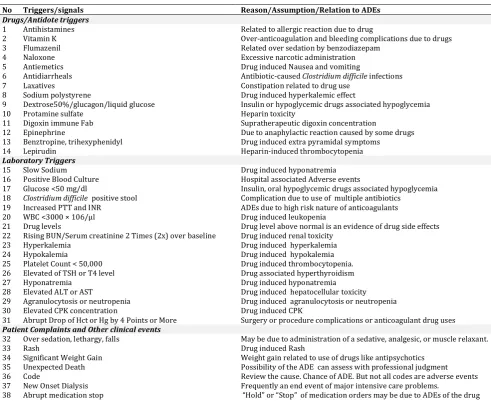
A variety of approaches have been experimented for the past several years to try and identify adverse events in hospital set up. The origin and impact of triggers and computer assisted ADEs signal detections are the major developments in the history of making possible the spontaneous reporting. A trigger is defined as an “occurrence, prompt, or flag found on review of the medical chart that ‘triggers’ further investigation to determine the presence or absence of an adverse event. The triggers consist of antidote, laboratory values, patient complaints, clinical events. Some of the common and important triggers absorbed from the various researches were illustrated in Table 2 [45, 52-55].
The concept of using a Trigger Tool for the detection of adverse events was first described by Classen in 1991.Looking back to the history and origin of triggers in ADRs detection, in 1991, Classen and colleagues demonstrated a computer surveillance system to detect ADRs from discontinuation orders, dosage decreases, antidote orders, and laboratory test orders. The 18-month study performed by Classen et al., the computerized system detected 731 ADRs in 36,653 patients, while the traditional voluntary detection methods identified only 9 reports [52]. A similar methodology was used by Dormann and colleagues to compare computerized monitoring of
ADRs vs. stimulated spontaneous reporting. Computer-based monitoring detected ADRs in 34 cases, whereas stimulated spontaneous reporting detected ADRs only in 17 cases. The study shows that the relative sensitivity of the computer-based monitoring and stimulated spontaneous reporting was found to be 74% (relative specificity, 75%) and 37% (relative specificity, 98%) respectively. The authors concluded that when compared to stimulate spontaneous reporting, computer monitoring system is more effective method for improving the detection of ADRs [2]. The utilization of a computerized surveillance ADR system has been also recommended and addressed by the ASHP and IOM as a mechanism for preventing ADEs [10, 56]. flow sheets, multidisciplinary progress notes, medication administration records, procedure notes, discharge summary..Etc [53, 55]. Many other individual and organizational studies were also conducted to identify the important triggers and to assess the accuracy of triggers with respect different areas of the hospital [53, 57-59]. Not all triggers may be worth full for the spontaneous reporting system. There are some limitations and a trigger will not be due to the occurrence of ADRs in all time. But when compared to the traditional system ADE trigger tool measuring system can opens more windows to detect the ADRs [53, 60]. The possibility of ADEs can confirmed only through a proper review with the help of an expert from the pharmacovigilance department of your hospital. It is difficult to give all triggers here. A limited and only most important ADR triggers are illustrated in table 2. The pharmacovigilance department of the hospital can made a list of trigger tools with respect to the area or department, and the proper education to the health care professionals will improve the spontaneous reporting.
CONCLUSION
Spontaneous reporting of ADR is the core tool for the effective pharmacovigilance in hospitals. However, Current scenarios of under reporting are pointing out to the expansion of patient risk issues and health care related economical crisis in future. Continuous studies are conducting and reporting about the underlying factors of under reporting and different approaches for how to resolve it. Creating awareness about ADR reporting by wiping the false perceptions among the health care workers and making it convenient may aid in improving spontaneous reporting in hospitals. The time is already exceeded to modify the personal and organizational attitudes towards the spontaneous reporting. The successful development of a spontaneous reporting system for good health care quality and patient safety can only achieved through the health care team effort with the continuous education and motivation. All the health care workers are supposed to exhibit their vital role for this patient safety program.
ACKNOWLEDGMENT
The author thank to all researchers and organizations who contributed the valuable implications with respect to the subject of this article.
Table 1: Obstacles of Spontaneous ADR reporting among healthcare workers
Knowledge
Unsure how to report an ADR
Unsure who is responsible for reporting ADRs Unsure which drug was responsible for the ADR Unsure if the reaction was a side effect rather than an
ADR Attitudes and beliefs
Concerned about legal liability by reporting Difficult to admit harm to patient
Concern that the report may be wrong Lack of confidence
Managing patient is more important than reporting Forgetfulness in reporting ADRs
Problems of confidentiality with patients’ data Don't feel the need to report well recognized
reactions
Really serious ADRs are well documented by the time a drug is marketed
A single unreported case may not affect ADR database Willing to publish or report only unusual cases in the
literature
Disabling/System/Other factors
Lack of resources for surveillance and reporting functions with a leader
Minimal feedback provided to the reporters Too busy to send ADR reports
Form unavailable when needed Lack of support
Insufficient data to complete a report
Lack of time to actively look for an ADR while at work Concern that a report will generate an extra work Legal Liability issues
The clinical workload
Lack of information and resources for searching for evidence of ADR
Table 2: Adverse Drug Reaction Trigger Tools
No Triggers/signals Reason/Assumption/Relation to ADEs
Drugs/Antidote triggers
1 Antihistamines Related to allergic reaction due to drug
2 Vitamin K Over-anticoagulation and bleeding complications due to drugs
3 Flumazenil Related over sedation by benzodiazepam
4 Naloxone Excessive narcotic administration
5 Antiemetics Drug induced Nausea and vomiting
6 Antidiarrheals Antibiotic-caused Clostridium difficile infections
7 Laxatives Constipation related to drug use
8 Sodium polystyrene Drug induced hyperkalemic effect
9 Dextrose50%/glucagon/liquid glucose Insulin or hypoglycemic drugs associated hypoglycemia
10 Protamine sulfate Heparin toxicity
11 Digoxin immune Fab Supratherapeutic digoxin concentration
12 Epinephrine Due to anaphylactic reaction caused by some drugs
13 Benztropine, trihexyphenidyl Drug induced extra pyramidal symptoms
14 Lepirudin Heparin-induced thrombocytopenia
Laboratory Triggers
15 Slow Sodium Drug induced hyponatremia
16 Positive Blood Culture Hospital associated Adverse events
17 Glucose <50 mg/dl Insulin, oral hypoglycemic drugs associated hypoglycemia
18 Clostridium difficile positive stool Complication due to use of multiple antibiotics
19 Increased PTT and INR ADEs due to high risk nature of anticoagulants
20 WBC <3000 × 106/μl Drug induced leukopenia
21 Drug levels Drug level above normal is an evidence of drug side effects
22 Rising BUN/Serum creatinine 2 Times (2x) over baseline Drug induced renal toxicity
23 Hyperkalemia Drug induced hyperkalemia
24 Hypokalemia Drug induced hypokalemia
25 Platelet Count < 50,000 Drug induced thrombocytopenia.
26 Elevated of TSH or T4 level Drug associated hyperthyroidism
27 Hyponatremia Drug induced hyponatremia
28 Elevated ALT or AST Drug induced hepatocellular toxicity
29 Agranulocytosis or neutropenia Drug induced agranulocytosis or neutropenia
30 Elevated CPK concentration Drug induced CPK
31 Abrupt Drop of Hct or Hg by 4 Points or More Surgery or procedure complications or anticoagulant drug uses Patient Complaints and Other clinical events
32 Over sedation, lethargy, falls May be due to administration of a sedative, analgesic, or muscle relaxant.
33 Rash Drug induced Rash
34 Significant Weight Gain Weight gain related to use of drugs like antipsychotics
35 Unexpected Death Possibility of the ADE can assess with professional judgment
36 Code Review the cause. Chance of ADE. But not all codes are adverse events
37 New Onset Dialysis Frequently an end event of major intensive care problems.
38 Abrupt medication stop “Hold” or “Stop” of medication orders may be due to ADEs of the drug
ALT: Alanine Transaminase, AST: Aspartate aminotransferase, BUN: Blood Urea Nitrogen, CPK: Creatinine Phosphokinase:, Hct: Hematocrit, Hg: Hemoglobin, INR: International Normalized Ratio, PTT: Partial Thromboplastin Time , TSH: Thyroid Stimulating Hormone, T4: Thyroxine, WBC: White Blood Cells
REFERENCES
1. Lazarou J, Pomeranz BH, Corey PN. Incidence of adverse reactions in hospitalized patients. A meta-analysis of prospective studies. JAMA 1998, 279:1200-1205. 2. Dormann H, Muth-Selbach U, Krebs S, Criegee-Rieck M,
Tregeder I, Schneider HT, Hahn EG, Levy M, Brune K, Gresslinger G. Incidence and costs of adverse drug
reactions during hospitalisation. Computerised monitoring versus stimulated spontaneous reporting.
Drug Saf 2000, 22:161–8.
4. Oshikoya KA. Adverse drug reaction in children: types, incidence and risk factors. Nig J Paediatr 2006, 33:29-35. 5. Einarson TR. Drug-related hospital admissions. Ann
Pharmacother 1993, 27:832–40.
6. Classen DC, Pestotnik SL, Scott Evans R, Lloyd JF, Burke JP. Adverse drug events in hospitalized patients. JAMA 1997;277:301–306
7. Levy M, Kewitz H, Altwein W, Hillerbrand J, Eliakim M. Hosptial admissions due to adverse drug reactions: a comparative study from Jerusalem and Berlin. Eur J Clin Pharmacol 1980; 17:25–31.
8. Kongkaew C, Noyce PR, Ashcroft DM. Hospital admissions associated with adverse drug reactions: a systematic review of prospective observational studies. Ann
Pharmacother 2008, 42:1017-1025.
9. Moore N, Lecointre D, Noblet C, Mabille M: Frequency and cost of serious adverse drug reactions in a department of general medicine. Br J Clin Pharmacol 1998; 45:301-8. 10. Kohn LT, Corrigan JM, Donaldson MS, eds. Institute of
Medicine Report: To Err is Human: Building a Safer Health System. Washington, DC: National Academy Press,
November 29, 1999, Available At:
http://bob.nap.edu/html/to_err_is_human/.
11. Bates DW, Spell N, Cullen DJ, Burdick E, Laird N, Petersen LA, Small SD, Sweitzer BJ, Leape LL. The costs of adverse drug events in hospitalized patients. JAMA. 1997;277:307–311
12. Ayani I, Aguirre C, Gutierrez G, Madariaga A, Rodríguez-Sasiaín JM, Martínez-Bengoechea MJ: A cost analysis of suspected adverse drug reactions in a hospital emergency ward. Pharmacoepidemiol Drug Saf 1999, 8:529-534. 13. Wu WK, Pantaleo N: Evaluation of outpatient adverse
drug reactions leading to hospitalization. Am J Health Syst
Pharm 2003, 60:253-259.
14. International drug monitoring: the role of the hospital. WHO Tech Rep Ser 1969; 426:5–24.
15. Pearson KC, Kennedy DL: Adverse drug reactions and the Food and Drug Administration. J Pharm Pract 1989; 2:209–13.
16. Joint Commission on Accreditation of Healthcare Organizations: Accreditation Manual for Hospitals, 1991. Chicago, IL: Joint Commission on Accreditation of Healthcare Organizations, 1991
17. WHO: Safety Monitoring of Medicinal Products: Guidelines for Setting Up and Running a Pharmacovigilance Centre, [http://www.who.int/medicinedocs]. Accessed May 16, 2005.
18. http://apps.who.int/medicinedocs/en/m/abstract/Js194 80en/
19. Cluff LE, Caranasos GJ, Stewart RB. Clinical problems with drugs. In: Smith LH, ed. Major problems in internal medicine. Philadelphia, PA: WB Saunders, 1975:5. 20. Ralph Edwards: Spontaneous reporting—of what? Clinical
concerns about drugs. Br J Clin Pharmacol 1999; 48, 138– 141
21. Rawlins MD. Pharmacovigilance: paradise lost, regained or postponed? The William Withering Lecture 1994. J R Coll Physicians Lond 1995; 29: 41–49
22. Barbara Kozamernik. Spontaneous adverse drug reaction reporting: attitudes and practice of health care professionals and distributors in South East European region. farm vestn 2010; 61 pharmacovigilance. Drug Safety 1997; 16: 355–365. 25. Lexchin J: Is there a role for spontaneous reporting of
adverse drug reactions? CMAJ 2006, 174:191-192.
26. Lopez-Gonzalez E, Herdeiro MT, Figueiras A: Determinants of under-reporting of adverse drug reactions: a systematic review. Drug Saf 2009, 32:19-31. 27. Fletcher A. Spontaneous adverse drug reaction reporting
vs event monitoring: a comparison. J R Soc Med 1991; 84:341-4.
28. Smith CC, Bennett PM, Pearce HM, Harrison PI, Reynolds DJM, Aronson JK, Grahame-Smith DG: Adverse drug reaction in a hospital general medical unit meriting notification to the Committee on Safety of Medicines. Br J
Clin Pharmacol 1996, 42:423-429.
29. Feely J, Moriarty S, O'Connor P: Stimulating reporting of adverse drug reaction by using a fee. Br Med J 1990, 300:22-23.
30. Herdeiro MT, Figueiras A, Polónia J, Gestal-Otero JJ. Influence of pharmacists' attitudes on adverse drug reaction reporting: a case-control study in Portugal. Drug Saf 2006; 29(4):331-40.
31. Inman WH: Attitudes to adverse drug-reaction reporting.
Br J Clin Pharmacol 1996, 41:433-435.
32. A. Vallano,, G. Cereza,C. Pedròs,, A. Agustí,, I. Danés,, C. Aguilera,& J. M. Arnau. Obstacles and solutions for spontaneous reporting of adverse drug reactions in the hospital. Br J Clin Pharmacol 2005; 60:6: 653-8
33. Kelly M, Kaye KI, Davis SR, et al. 2004. Factors influencing adverse drug reaction reporting in New South Wales teaching hospitals. J Pharm Pract Res, 34:32–5.
34. Christopher F. Green,1 David R. Mottram,1 Philip H. Rowe1, Munir Pirmohamed. Attitudes and knowledge of hospital pharmacists to adverse drug reaction reporting.
Br J Clin Pharmacol, 51, 81-86
35. Sweis D, Wong IC. A survey on factors that could affect adverse drug reaction reporting according to hospital pharmacists in Great Britain. Drug Saf. 2000 Aug;23(2):165-72.
36. Kazeem A Oshikoya and Jacob O Awobusuyi. Perceptions of doctors to adverse drug reaction reporting in a teaching hospital in Lagos, Nigeria. BMC Clinical Pharmacology
2009, 9:14
37. Desai CK, Iyer G, PanchalJ, Shah S, Dilkshit RK. An evaluation of knowlwdge, attitude, and practice of adverse drug reaction reporting among prescribers at a tertiary care hospital. Perspect Clin Res 2011 oct;2(4):129-36. 38. Monica Zolezzi and Nirasha Parsotam, Adverse drug
reaction reporting in New Zealand: implications for pharmacists, Ther Clin Risk Manag. 2005 September; 1(3): 181–188.
39. Goldman SA. Communication of medical product risk: how effective is effective enough? Drug Saf 2004; 27:519-34. 40. Erice Report. Effective communications in
pharmacovigilance, published by The Uppsala Monitoring Centre, Uppsala, Sweden 1997
41. Figueiras A, Herdeiro MT, Polonia J, Gestal-Otero JJ: An educational intervention to improve physician reporting of adverse drug reactions: a cluster-randomized controlled trial. JAMA 2006, 296:1086-1093.
42. Bracchi RC, Houghton J, Woods FJ, Thomas S, Smail SA, Routledge PA: A distance-learning programme in pharmacovigilance linked to educational credits is associated with improved reporting of suspected adverse drug reactions via the UK yellow card scheme. Br J Clin
Pharmacol 2005, 60:221-223.
43. Khalili H, Mohebbi N, Hendoiee N, Keshtkar AA, Khavidaki SD. Improvement of knowledge, attitude and perception of healthcare workers about ADR, a pre- and post clinical pharmacists intervention study: BMJ Open
2012;2:e000367.
45. Michel DJ, Knodel LC. Program coordinated by a drug information service to improve adverse drug reaction in a hospital. Am J Hosp Pharm. 1986;43:2202–2205
46. [ASHP] American Society of Health-System Pharmacists. 1995. Guidelines on adverse drug reaction monitoring and reporting [online]. Accessed Nov 2004. URL: www.ashp.org/bestpractices/MedMis/
MedMis_Gdl_ADR.pdf.
47. Uppsala Monitoring Center, WHO Collaborating Centre for International Drug Monitoring. 2000. Safety monitoring of medicinal products. Guidelines for setting up and running a pharmacovigilance centre. Uppsala: Uppsala Monitoring Center.
48. Hassali M, Kong D, Stewart K. Knowledge and perceptions of recent pharmacy graduates about generic medicines. Pharm Educ. 2007; 7(1):89.
49. Sainul Abideen P, Chandrasekaran K, Uma Maheswaran, Vijayakumar A, Kalaiselvan V, Pradeep Mishra, Moza Al Hail, Abdul Rouf, Binny Thomas. Implementation of Self Reporting Pharmacovigilance in Anti Tubercular Therapy Using Knowledge Based Approach. J Pharmacovigilance
2013, 1(1): 1-5
50. Jarernsiripornkul N, Krska J, Capps PA, Richards RM, Lee A (2002) Patient reporting of potential adverse drug reactions: a methodological study. Br J Clin Pharmacol 53: 318-325.
51. Krska J, Jarernsiripornkul N, Capps PAG, Richards. Patients self reports of potential adverse drug reactions.
Int J Pharm Pract 2001; R35.
52. Classen DC, Pestotnik SL, Evans RS, Burke JP. Computerized surveillance of adverse drug events in hospital patients. JAMA 1991; 266(20):2847-51
53. J D Rozich, C R Haraden, R K Resar. Adverse drug event trigger tool: a practical methodology for measuring
medication related harm. Qual Saf Health Care
2003;12:194–200
54. Steven M. Handler, Subashan Perera, Yazan F. Roumani, David A. Nace, Douglas B. Fridsma, Melissa I. Saul, Nicholas G. Castle, and Stephanie A. Studenski. Consensus list of signals to detect potential adverse drug reactions in nursing homes. J Am Geriatr Soc. 2008; 56(5):808-815. 55. All trigger tools for measuring ADEs. Institute for
healthcare improvement (IHI). Available at app.ihi.org/workspace/tools/trigger/alltools.aspx 56. American Society of Health-System Pharmacists.
Top-priority actions for preventing adverse drug events in hospitals. Recommendations of an expert panel. Am J
Health-Syst Pharm. 1996; 53:747-751.
57. Brenner S, Detz A, Lopez A, Horton C, Sarkar U. Signal and noise: applying a laboratory trigger tool to identify adverse drug events among primary care patients. BMJ
Qual Saf. 2012 Aug:21(8):670-5.
58. Mull HJ, Nebeker JR, Shimada SL, Kaafarani HM, Rivard PE, Rosen AK. Consensus building for development of outpatient adverse drug event triggers. J Patient Saf 2011 Jun;7(2):66-71
59. Matlow AG, Cronin CM, Flintoft V, Nijssen-Jordan C, Fleming M, Brady-Fryer B, Hiltz MA, Orrbine E, Baker GR. Description of the development validation of the Canadian paediatric trigger tool. BMJ Qual Saf 2011 May; 20(5):416-23.