A Chinese Dependency Syntax for Treebanking
Haitao Liu, Wei Huang
Department of Applied Linguistics Communication University of China
CN-100024, Beijing, China {byliuhaitao, howard}@cuc.edu.cn
Abstract. This paper presents a Chinese dependency syntax for treebanking. The syntax contains 13 word classes and 34 dependency types. A format of treebank based on the syntax is also proposed for the applications of computational and general linguistic research. Some experiments show that the treebank based on the proposed dependency syntax can be used for training and evaluating the dependency parser and for quantitative analysis of Chinese syntax.
Keywords: dependency relation, dependency syntax, treebank, Chinese syntax
1
Introduction
Treebanks are often used as a tool and resource for training and evaluating a syntactic parser in compu-tational linguistics [1]. However, treebanks are not only useful to compucompu-tational linguists, they are also an important tool for linguists from other branches of linguistics. In this way, if we are planning to build a treebank, perhaps we have to consider its applications in these two fields.
Although the Penn treebank based on phrase structure is still the standard of computational applica-tions of treebank, many new projects, particularly in Europe, like to use dependency structure as the an-notation schemes [5].
In this paper, we present a Chinese dependency syntax for treebanking. A format of dependency treebank is proposed for training and evaluate a dependency parser and for quantitative analysis of Chi-nese.
In section 2, we discuss some kernels of dependency grammar and how to build a dependency gram-mar for a language. Section 3 presents the proposed Chinese dependency syntax and how to process co-ordinating structures in this syntax. In section 4, a format of dependency treebank is given and some questions on the treebanking are discussed.
2 Dependency relation and dependency syntax
Valency Pattern”, the relation between two word classes will not only be described qualitatively, but also be defined quantitatively [8].
Fig. 1. Diagrammatic dependency syntax
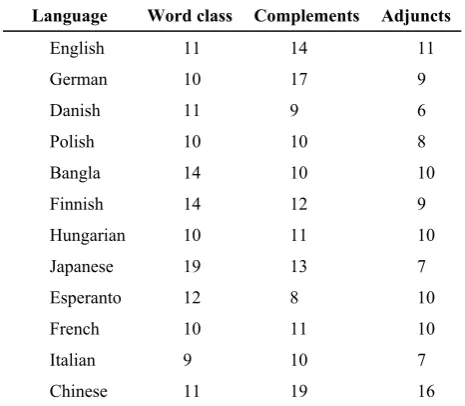
If word class and dependency type are the core elements of dependency syntax, what is the number of the word classes and types in a language? If it is too few, the analysis and learning based on the syntax will be easier, but it will degrade the describing precision of the model. If it were too numerous, the recognizing of the type will be more difficult for human and machine, and turns down the precision and efficiency of annotating and parsing. For finding an appropriate value, we investigate dependency grammars of more than 10 languages. The table 1 shows the result1.
Table 1. The amount of word class and dependency type of some languages
Language Word class Complements Adjuncts
English 11 14 11
German 10 17 9
Danish 11 9 6
Polish 10 10 8
Bangla 14 10 10
Finnish 14 12 9
Hungarian 10 11 10
Japanese 19 13 7
Esperanto 12 8 10
French 10 11 10
Italian 9 10 7
Chinese 11 19 16
The table shows that there are often about 10-20 word classes and 15-35 dependency types in the de-pendency syntax of a language.
3 Chinese dependency syntax
Dependency syntax of a language contains two parts: the tagset of word classes, the tagset of de-pendency types. Our task is for building a dede-pendency syntax to annotate a treebank, which is a time-consuming and labor-intensive task, we have to think how to automate the process and find more competent workers from early beginning. In other words, we should use the available resource as far as possible.
Based on the national standard “POS tagset for Chinese information processing" (2003) and popu-larly used “Grammar system for middle-school teaching”, we propose a set of word class with 13 types: noun (n), verb (v), adjective (a), adverb (d), pronoun (r), preposition (p), numeral (m), classifier (q), conjunction(c), interjection (e), particle (u), onomatopoeia (o) and punctuation (bd). Compared with the national standard of POS tags, we remove some tags, which do not work on the level of syntax. Com-paratively with traditional school grammar, we gives some functional (particle) words an important po-sition in the syntax, because they often play a crucial role during determining the dependency relation between two words. Figure 2 shows a hierarchy of POS tagset in Chinese2.
Fig. 2. A hierarchy of word classes in Chinese
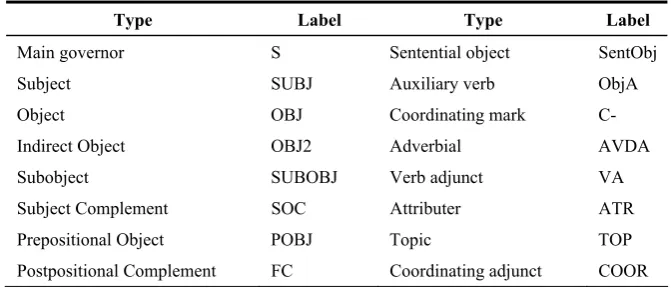
According to the three basic elements consisting of dependency relation: governor, dependent and dependency type, the tagset of Chinese dependency type is built.
Table 2. Chinese dependency types
Type Label Type Label
Main governor S Sentential object SentObj
Subject SUBJ Auxiliary verb ObjA
Object OBJ Coordinating mark C-
Indirect Object OBJ2 Adverbial AVDA
Subobject SUBOBJ Verb adjunct VA
Subject Complement SOC Attributer ATR
Prepositional Object POBJ Topic TOP
Postpositional Complement FC Coordinating adjunct COOR
Complement COMP Epithet EPA
Complement of usde ‘的’ DEC Numeral adjunct MA
Complement of usdi ‘地’ DIC Aspect adjunct TA
Complement of usdf ‘得’ DFC Adjunct of sentence end ESA
Object of Pba ‘把’ BaOBJ Parenthesis InA
Plural complement PLC Clause adjunct CR
Ordinal complement OC Correlative adjunct CsR
Complement of classifier QC Particle adjunct AuxR
Construction of Pbei ‘被’ BeiS Punctuation Punct
The dependency tagset contains 20 complements and 14 adjuncts. The amount of Chinese comple-ments is a little more than other languages, because Chinese has to use the functional words for com-pleting the grammatical functions, which often are morphologically realized in other languages.
Fig. 3. A hierarchy of dependency types in Chinese
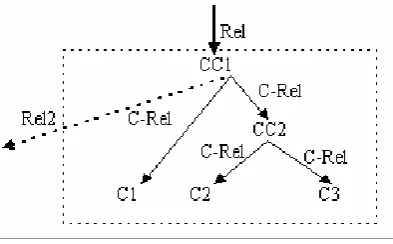
We use a method similar to PDT [16] and DLT [9] to process the coordinating structure. In Chinese the often used conjunctions are he(和), yu(与), tong(同) and punctuation(、). Figure 3 shows a structure with 2 conjunctions and three conjuncts.
Fig. 4. Coordinating structure
de-pendency type which governs the whole structure. For example, in the sentence “美丽的长江、黄河和
黑龙江都是中国的河流”(The beautiful Yangzi, Huanghe and Heilongjiang are the rivers of China), the
Chinese character string “长江 、 黄河 和 黑龙江” forms a coordinating structure. Where Rel-SUBJ, Rel2-ATR, CC1-‘、’, CC2-和, C-Rel-C-SUBJ, C1-长江, C2-黄河, C3-黑龙江.
4 Chinese dependency treebank
After having the dependency syntax, we have adopted the format in table 2 for a Chinese dependency treebank.
Table 3. Annotation of a sample sentence in treebank
Word Governor Order number
of Sentence Order
number Character POS
Order
number Character POS
Dependency type
S1 1 这 r 2 是 v subj
S1 2 是 v 6 。 bjd s
S1 3 三 m 4 个 q qc
S1 4 个 q 5 例子 n atr
S1 5 例子 n 2 是 v obj
S1 6 。 bjd
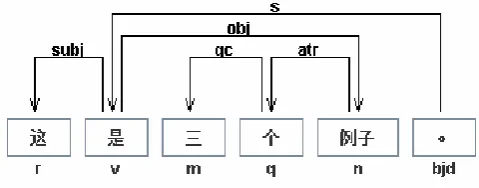
This format includes all three mentioned properties of dependency relation, but sometimes it is also helpful to construct a connected directed labeled graph [10] as in Figure 5.
Fig. 4. The dependency analysis as a graph
It seems that the proposed format includes some redundant information only from the viewpoint of computational linguistics, but because we also hope to use the treebank for quantitative analysis of Chi-nese, current format is helpful to satisfy the mentioned two tasks. It is easy to convert the format into a more exchangeable XML format3.
- <sentence id="1" user=“Liu Haitao" date="2006-06-22">
<word id="1" form="这" postag="r" head="2" deprel="subj" /> <word id="2" form="是" postag="v" head="6" deprel="s" />
<word id=“3” form=“三" postag="m" head="4" deprel="qc" /> <word id="4" form="个" postag="q" head="5" deprel="atr" /> <word id="5" form="例子" postag="n" head="2" deprel="obj" /> <word id="6" form="。" postag="bjd" head="0" deprel="ROOT" /> </sentence>
For verifying the dependency syntax and the format, we have built a tentative dependency treebank4. The treebank is built on the news (xinwen lianbo) of China Central Television, a genre which is in-tended to be spoken but whose style is similar to the written language. We select four complete broad-casting news of this program as the annotated material. For finding the comfortable annotation means, we make two groups of annotator to annotate the texts. Before beginning the annotation, training about dependency grammar, how to recognize a dependency relation in particular, was given to all participa-tors of this project. The first group consists of 20 undergraduates of Chinese linguistics, and the other group is only a graduate of computational linguistics with a background of Chinese linguistics. While everyone of the first group annotates the text with 500 tokens, the graduate has to finish the text with 10000 tokens. Then, two teachers of Chinese linguistics review all annotated texts. The final treebank includes 711 sentences and 20034 word tokens, so the mean sentence length is 28 words.
The annotators use MS-Excel or Access as the tool. It is feasible, because our treebank is very small, but these tools are not suitable for annotating long sentence. For making the annotation more easily, a system, with the name Depenendecy Grammar Annotator (DGA), has been developed [17].
Compared with the Penn Chinese Treebank [14] and the Sinica Treebank [2], our treebank is a native dependency treebank, whose annotate scheme is mainly based on the tradition of dependency grammar without phrase structure. We are using a pure syntactic annotation scheme, which make a distinction with the Prague Dependency Treebank [3] and the PropBank [12].
We have also successfully made some experiments based on the treebank, for instance, the depend-ency parsing and quantitative analysis of Chinese A statistical Chinese dependdepend-ency parser, using a gen-eral parser Maltparser released by Nivre [11] and the treebank built in this paper, has got the score 0.759 (UAS, unlabeled attachment score) and 0.712 (LAS, labeled attachment score). The analysis based on the treebank shows that Chinese has much in common with other languages, for example, the distribu-tion of noun in a text; but it also shows some particularities, for example that dependency distance is much greater in Chinese than in English, German and Japanese [8].
We are annotating a spoken language corpus using the same syntax and scheme, that is a necessary complementation to the current treebank.
5 Conclusions
In the paper, we propose a Chinese dependency syntax and a format of treebank based on the syntax. A tentative dependency treebank is built for verifying that the proposed syntax is suitable to annotate a Chinese text. The built treebank is not only used as the resource to train and evaluate the parser, also
works as a database for quantitative analysis of Chinese. The experiments show that the proposed de-pendency syntax and treebank are useful not only for computational linguistics, but it is also helpful for general syntactic studies.
Acknowledgments. We thank Richard Hudson and Joakim Nivre for detailed comments on an earlier stage of this paper. Work described in this paper was partly supported by The State Administration of Radio, Film & TV of China (the research project BW0357) and Communication University of China (the research project BBU211-15.4).
References
1. Abeillé, Anne (ed. 2003) Treebank: Building and using Parsed Corpora. Dordrecht: Kluwer.
2. Chen, Keh-Jiann et al. (2003) Sinica Treebank: Design Criteria, Representational Issues and Implementation. in Anne Abeille (ed. 2003). pp. 231-248.
3. Hajič, Jan, Alena Böhmová, Eva Hajičová, Barbora Vidová Hladká (2003) The Prague Dependency Tree-bank: A Three-Level Annotation Scenario. in A. Abeillé (ed. 2003), pp. 103-127.
4. Hudson, R. A. (1990) English Word Grammar. Oxford: Blackwell.
5. Kakkonen, T. (2005) Dependency Treebanks: Methods, Annotation Schemes and Tools. in Proceedings of the
15th Nordic Conference of Computational Linguistics (NODALIDA 2005). Joensuu, Finland.
6. Kreps, Christian (1997) Extraction, Movement and Dependency Theory. PhD thesis, University College Lon-don.
7. Liu, Haitao (2005) A Chinese syntax based on dependency relations. CUC Tech. Report.
8. Liu, Haitao (2006) Syntactic parsing based on Dependency Relations. in grkg/Humankybernetik, 47(3): 124-135.
9. Maxwell, D. and Schubert, K. (1989) Metataxis in practice: dependency syntax for multilingual machine
translation. Dordrecht: Foris.
10. Mel'cuk, I. A. (1988) Dependency syntax: theory and practice. Albany: State University Press of New York. 11. Nivre, J. (2006) Inductive Dependency Parsing. Dordrecht: Springer.
12. Palmer, Martha, Dan Gildea, and Paul Kingsbury (2005) The Proposition Bank: A Corpus Annotated with Semantic Roles, Computational Linguistics, 31(1): 71-106.
13. Tesnière, L. (1959) Eléments de la syntaxe structurale. Paris: Klincksieck.
14. Xue, Nianwen, Fei Xia, Fu-Dong Chiou, and Martha Palmer (2005) The Penn Chinese TreeBank: Phrase Structure Annotation of a Large Corpus. Natural Language Engineering, 11(2): 207-238.
15. Yamada, Hiroyasu and Yuji Matsumoto (2003) Statistical dependency analysis with Support Vector Ma-chines. in Proc. 8th International Workshop on Parsing Technologies (IWPT), pp.195-206, April 2003. 16. Žabokrtský, Zdeněk (2005) Valency Lexicon of Czech Verbs. Ph.D. Thesis, Faculty of Mathematics and
Phys-ics, Charles University in Prague.