Unsupervised document zone identification using probabilistic graphical models
Andrea Varga
∗, Daniel Preot¸iuc-Pietro
†, Fabio Ciravegna
∗∗Organisations, Information and Knowledge Research Group, †Natural Language Processing Research Group,
Department of Computer Science, 211 Portobello, Sheffield, S1 4DP {a.varga, daniel, f.ciravegna}@dcs.shef.ac.uk
Abstract
Document zone identification aims to automatically classify sequences of text-spans (e.g. sentences) within a document into predefined zone categories. Current approaches to document zone identification mostly rely on supervised machine learning methods, which require a large amount of annotated data, which is often difficult and expensive to obtain.
In order to overcome this bottleneck, we propose graphical models based on the popular Latent Dirichlet Allocation (LDA) model. The first model, which we call zoneLDA aims to cluster the sentences into zone classes using only unlabelled data. We also study an extension of zoneLDA called zoneLDAb, which makes distinction between common words and non-common words within the different zone types.
We present results on two different domains: the scientific domain and the technical domain. For the latter one we propose a new document zone classification schema, which has been annotated over a collection of 689 documents, achieving a Kappa score of85%. Overall our experiments show promising results for both of the domains, outperforming the baseline model. Furthermore, on the technical domain the performance of the models are comparable to the supervised approach using the same feature sets. We thus believe that graphical models are a promising avenue of research for automatic document zoning.
Keywords:document zoning, probabilistic graphical models, unsupervised learning
1.
Introduction
In many practical tasks there is a need to extract and ac-cess certain types of information from a large collection of textual documents. For example in corporate environ-ments, such as manufacturing, there are a huge amount of unstructured historical data generated during the lifecycle of a product. In such environments, engineers wanting to resolve an issue on a particular product are often interested in finding out the cause of the issue, problems encountered on other similar product types and the conclusion drawn after each investigation.
Another example are the biomedical researchers aiming to stay abreast with current research they are typically inter-ested in accessing information from PubMed1focusing on particular parts of the articles, such as the method proposed in the study, the results and conclusion obtained.
A major approach in such cases is to employ document zone classification to recognise the information structure of the documents, thus helping to assist information extrac-tion and organisaextrac-tion of factual informaextrac-tion from the docu-ments.
The vast majority of the approaches applied for document zoning, rely on supervised machine learning (Liakata et al., 2010; Nawaz et al., 2010; Teufel et al., 2009), which can achieve state-of-the-art performance given that a large amount of annotated data is available. However, gather-ing these annotations is often time consumgather-ing and expen-sive. Furthermore, in most domains the format and style of the documents can change rapidly, resulting that these approaches could achieve suboptimal results, and thus col-lecting more training data might be required.
In this paper, we thus investigate the possibility of
employ-1
http://www.ncbi.nlm.nih.gov/pubmed/
ing unsupervised approaches for document zoning, which to date has only been scarcely studied (Barzilay and Lee, 2004). We examine a couple of generative models for zone identification, which we call zoneLDA and zoneLDAb models, being extensions of the widely used Dirichlet Al-location (LDA) (Blei et al., 2003) model. Both of the pro-posed zoneLDA and zoneLDAb models can thus flexibly model the zones categories by ignoring the order in which the sentences occur in the documents. In addition, the zoneLDAb model discovers words which are common to the different zone types, and those are not good predictors for a zone category, and those that are specific to the zone types.
Our study also focused on evaluating our models on differ-ent domains, such as the scidiffer-entific biomedical domain, and a more technical aerospace domain. For the latter one, we also proposed a novel document zone annotation schema. Our extensive experiments of zoneLDA and zoneLDAb models show that although zoneLDA is equivalent with zoneLDAb without modelling the common words, in the majority of the cases zoneLDA outperforms zoneLDAb. These results are also superior to the baseline LDA model, and are close to the supervised Naive Bayes classifier for the aerospace domain, achieving an F-measure less than 5%.
α θ
z
β φ w
Ns Ns,n Z
Nd
α θ
β φB z
β φZ w
γ π indd,s,n
Z
Ns,n
Ns
Nd
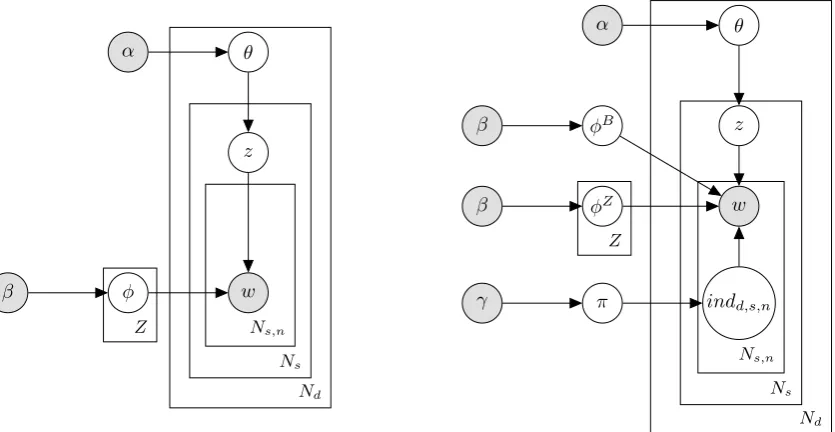
Figure 1: Graphical models of zoneLDA (left) and zoneLDAb models (right). The wordsware observed, while the per document zone distributionsθand per zone word distributionsφare hidden variables.
obtained experimental results. Conclusions and plans for future work are shown in section 7.
2.
Related work
Previous work on automatic labelling of document zones mostly employ supervised machine learning, using widely known classifiers such as Naive Bayes (Teufel and Moens, 2002), Hidden Markov Model (Li et al., 2010), Maximum Entropy (Merity et al., 2009), Support Vector Machines (Guo et al., 2011a; McKnight and Srinivasan, 2003) or Conditional Random Fields (Hirohata et al., 2008). Semi-supervised approaches using active learning have only started to gain attention very recently (Guo et al., 2011b). The majority of approaches have been applied to well-formatted scientific articles in the context ofcomputational linguistics (Teufel et al., 2009), biology (Mullen et al., 2005; Liakata, 2010; Nawaz et al., 2010; Agarwal and Yu, 2009; Hirohata et al., 2008) or chemistry(Liakata, 2010; Teufel et al., 2009), focusing on either the full text or ab-stract of the articles. The application of document zoning to complex technical domains, such as the aerospace domain has not been studied yet. These domains can pose addi-tional difficulties for a document zoner due to the intrinsic complexity of the language in them (Butters and Ciravegna, 2008) .
Furthermore, there has been only little work on using unsupervised approaches to document zone classification. (Barzilay and Lee, 2004) proposed a Hidden Markov Model (HMM) model to zoning with the states correspond-ing to topics from the document, and used a state-specific language model to generate the sentences relevant to the topics. Therefore they first applied clustering to compute the similarity between sentences as measured by the co-sine metric and then they estimated the parameters for the HMM.
On the other hand, unsupervised approaches based on LDA has been found successful on a variety of different tasks
in-cluding sentiment analysis (Lin and He, 2009), topic mod-elling (Zhao et al., 2011) and entity resolution (Dai and Storkey, 2011).
Continuing this success we propose two refined LDA mod-els for the task of document zoning, which in contrast to previous unsupervised approaches are more flexible, in that they don’t take into account the order of the sentences in the documents.
In the next section we formally introduce the task of doc-ument zoning and then we present our proposed graphical models in Section 4.
3.
The task of document zoning
We assume a corpus D consisting of documents{D1. . . DNd}. Each document Di in D is a
se-quence of sentences of Ns which we denote by
si = {si,1, . . . , si,Nsi}, and each sentence contains a sequence of Nsi,j,n words (in more general case a
se-quence of n-grams) si,j = {w1, . . . , wNsi,j ,n}, where the words are taken from the vocabularyV.
The task of document zoning then is to assign to each sentence si,j in document Di a zone category
z ∈ Z, where for example the distinct zone types Z ∈ {Introduction, Methods, Results, Abstract, Discussion}, and|Z|=NZ = 5.
4.
Methodology
We propose two generative models zoneLDA and zoneLDAb for document zoning which are refined versions of the Latent Dirichlet Allocation model.
4.1. zoneLDA model
The zoneLDA model as depicted in Figure 1. is based upon the assumption that documents are mixture of zones, where a zone is a probability distribution over words.
5.
Corpora
In order to evaluate our models we conducted experiments on corpora belonging to two very different domains: the scientific domain and the technical domain. Corpus statis-tics are presented in Table 1.
5.1. Scientific domain
For the scientific domain, we have built a corpus con-sisting of biomedical journal articles crawled from the PubMed system. We selected 1,106 articles from the PLoS Pathogens journal2 published between January 2006 until June 2011. 3 All the documents had to contain all the five zone categories of the widely used IMRAD (Introduction-Method-Results-Abstract-Discussion) (Agarwal and Yu, 2009) classification schema. The articles that didn’t con-tain at least one of the these zones were discarded.
In the data pre-processing phase we removed all text that was contained in the other zones of the document (such as ”References”, ”Supporting Information”, ”Synopsis”, etc.) as they are not the focus of our task. We also eliminated zone names as they would give away valuable information, figures, the text in tables and captions.
In order to reduce data sparsity we removed all numbers, words made out of special characters, citations, references, applied Porter stemming and discarded sentences which contained less than 5 words and words that occured in less then 10 documents. We also removed all stopwords and one-character words. Thus, the resulting corpus will con-tain only stemmed content words that are not very docu-ment specific, a typical procedure when training topic mod-els. We used a Python script4to perform these steps and to annotate each sentence with one of the IMRAD zone cate-gories.
The average length of the zones in the corpus is presented in Table 2.
5.2. Technical domain and proposed document zone annotation schema
Our second dataset consists of two corpora in the aerospace domain comprising of 689 textual reports, which were col-lected as part of the SAMULET research project funded by Rolls-Royce and the Technology Strategy Board, in which two of the authors are involved. Due to privacy reasons these corpora have restricted access and we will refer to them as Corpus A and Corpus B. These technical reports are unstructured and semi-structured PDF document con-taining a mixture of natural language sentences, images and tables. They were written at different stages of an investi-gation process, which is typically initiated by a customer raising a request regarding an issue on a particular engine. On these corpora we first conducted a corpus analysis to un-derstand and identify the information they share in common and the possible zone categories they contain. Our analysis revealed that there aresix zone typescommon in the reports
2
http://www.ncbi.nlm.nih.gov/pmc/journals/349/
3
The IDs of the Plos journals articles used in our experiments
can be found atwww.dcs.shef.ac.uk/˜daniel/plos.
ids
4The Python script is available atwww.dcs.shef.ac.uk/
˜daniel/pubmed.py
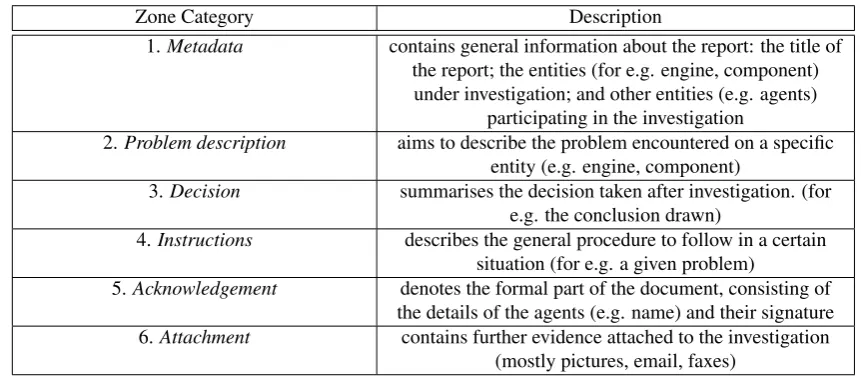
(see Table 4), as they all follow aproblem-solving perspec-tive of an investigation. For example these reports typi-cally contain theMetadatazone which introduces the main entities (engine, component) under investigation, then they continue with aProblem descriptionzone which describes the problems which occurred on these entities; next the In-structions zoneprovides typical instructions regarding what procedure should be taken, finally theDecisioncontains the decision taken after investigation. In addition, two other zones were found in these reports: theAcknowledgement
zone, which is the formal part of the document, and the At-tachmentzone, which includes further evidence taken dur-ing investigation (e.g. in forms of images, emails, faxes). Although the proposed zone categories share some com-monalities with existing classification schemas (e.g. IM-RAD), the Instructions and Acknowledgement zones are new in our schema. The instructions are typically split into tasks and subtasks, and may consider reference to some manuals (e.g. the engine manuals). TheAcknowledgement
zone acknowledges the conclusions drawn from the report, containing the signatures of the responsible agents. These two corpora were then annotated by two indepen-dent annotators (the first and the third author of the paper), achieving an inter annotator Kappa agreement of 85%. The average length of the zones in the corpora is presented in Table 3.
In the pre-processing stage we converted all the PDF docu-ment into plain text5and thus removed all the formatting in-formation and figures. Similarly to the biomedical corpus, we removed all the numbers and stop words. Furthermore, due to the diverse format of the documents, consisting of tables and natural language text, we considered as smallest unit of classification the lines of the documents, as opposed to sentences.
6.
Experiments
In this section we discuss the results obtained in our exper-iments using the two graphical models proposed in Section 4. For evaluating the accuracy of the clusters generated by the zoneLDA and zoneLDAb models we used a baseline LDA model, a supervised machine learning algorithm, and the random baseline. The baseline LDA model, employs the original LDA model proposed in (Blei et al., 2003) for discovering the topics in a document, and based on the dis-covered topics, at inference time, assigns to each sentence the most likely topic among the words within that sentence. For all the graphical models we run Gibbs sampling for 10,000 number of iterations and a burn-in of 500. The supervised classifier employed was the Naive Bayes clas-sifier which was trained with the same-bag-of-words fea-tures. We used the implementation of Naive Bayes avail-able in the Mallet toolkit6.
6.1. Dataset Preparation
We evaluated the proposed models on two very different domains: a publicly available scientific domain and a
tech-5
We used Apache PDFBox library available at http://
pdfbox.apache.org/for converting the Pdf documents into plain text format.
Domain Corpus name Number of documents
Average number of sentences per
document
Average number of distinct words
scientific domain PLOS journal articles 1,106 241±59 966±174
technical domain Corpus A 317 226±295 329±241
Corpus B 372 394±405 518±273
Table 1: Corpus statistics of documents in the scientific and technical domains.
Abstract Introduction Methods Results Discussion
11 27 64 88 53
Table 2: Average length for each IMRAD zone in the PLOS journal corpus
Corpus name Metadata Problem
descrip-tion
Decision Instructions Acknowledgement Attachment
Corpus A 36 3 22 76 17 35
Corpus B 30 49 13 107 13 25
Table 3: Average length for each proposed zone category in the technical corpora
Zone Category Description
1.Metadata contains general information about the report: the title of
the report; the entities (for e.g. engine, component) under investigation; and other entities (e.g. agents)
participating in the investigation
2.Problem description aims to describe the problem encountered on a specific entity (e.g. engine, component)
3.Decision summarises the decision taken after investigation. (for
e.g. the conclusion drawn)
4.Instructions describes the general procedure to follow in a certain
situation (for e.g. a given problem)
5.Acknowledgement denotes the formal part of the document, consisting of
the details of the agents (e.g. name) and their signature
6.Attachment contains further evidence attached to the investigation
(mostly pictures, email, faxes)
Table 4: Proposed document zone annotation schema in the aerospace domain
nical domain with restricted availability. The scientific do-main data consists of 1,106 biomedical articles downloaded from PubMed.
After stemming and removing the stop words the size of the vocabulary of this corpus was 46,698. We furthermore reduced the size of the vocabulary to avoid sparsity and de-crease the time required for training our graphical models. We discarded all the words which occurred in less than 10 documents, and in more than 70% of the corpus, result-ing in a reduced vocabulary of 6,843 words. In addition, we conducted experiments keeping only the top 1,000 most frequent words in the corpus; and another experiment in which we only removed words which occurred in less than 10 documents, but did not find any significant improve-ment.
Our technical domain data consists of two aerospace cor-pora. After stemming and removing the stop words the size
of the vocabulary of Corpus A was 4,153. After removing words which occur in less than 5 documents the vocabulary became 1,023. For the Corpus B the initial vocabulary has been reduced from 2,964 to 1,340 after discarding words which occur in less than 5 documents.
6.2. Evaluation metric
zoneLDAb models we employed pairwise clustering
evalu-5/1 5/3 5/5 50/1 50/3 50/5 100/1 100/3 100/5 0
Method Plos journal articles Corpus A Corpus B
Prec Recall F1 Prec Recall F1 Prec Recall F1
Random baseline 20,00% 20,00% 20,00% 14,28% 14,28% 14,28% 14,28% 14,28% 14,28%
LDA(baseline) 27,30% 49,10% 35,08% 42,90% 33,55% 37,65% 26,70% 42,50% 32,79%
zoneLDA 29,50% 43,70% 35,22% 49,25% 91,50% 64,03% 32,75% 84,80% 47,25%
zoneLDAb 26,63% 40,33% 32,08% 49,35% 68,40% 57,34% 33,30% 75,95% 46,29%
NaiveBayes 52,40% 51,23% 51,8% 78,07% 67,53% 72,41% 68,35% 40,99% 51,23%
Table 5: The best results obtained on scientific and technical domains
● ● ● ●
●
● ●
● ● ●
● ● ●
● ●
● ● ●
7/1 7/3 7/5 50/1 50/3 50/5 100/1 100/3 100/5 0
10 20 30 40 50 60 70
● zoneLDA zoneLDAb LDA NB
Number of zones/alpha value
F1 %
Corpus B
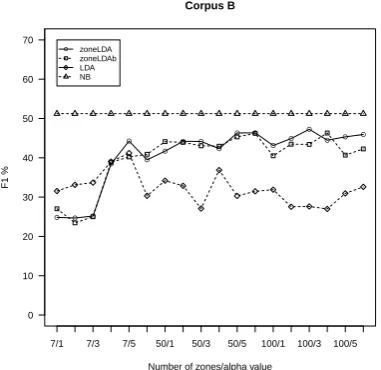
Figure 4: The performance of zoneLDA and zoneLDAb model over CorpusB.
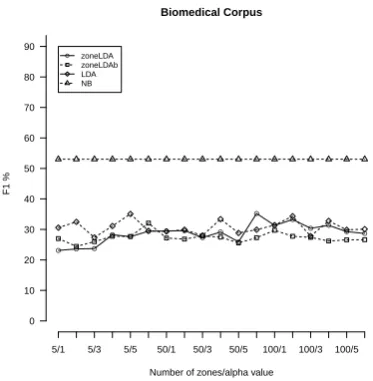
type, an F1-measure of 38,9%; and for the Results zone type an F1-measure of 41,5%. These results are as well in light with the results obtained with the supervised Naive Bayes classifier. Namely, the worst F1-measure of1%was achieved on the Abstract zone type, followed by the Intro-duction zone type with an F1-measure of43.32%, then for the remaining of the zone categories the classifier achieved an F1-measure of over50%. For the Discussion zone type being54.94%, for the Results zone type was70.43%, and for the Methods zone type achieving85.8%.
These results furthermore show, that for both zoneLDA, zoneLDAb models and the supervised Naive Bayes classi-fier, the best performances were achieved for the long zone categories, which contain the most number of sentences. This is because in case short zone categories such as Ab-stract uses words from other zones that are not discrimina-tive of this zone type.
When examining the results obtained by the baseline LDA model, however, the results look different. The worst re-sults were obtained for the Discussion zone, an F1-measure of2%, for the Methods zone type, an F1-measure of3.4%, and for the Abstract zone type, an F1-measure of 5.6%. Then for the Introduction the baseline model achieved an F1-measure of34.8%, and for the Results zone type an F1-measure of43.2%.
Figure 3 shows the results obtained in terms of F1-measure
over the aerospace Corpus A. As we can see, the zoneLDA model is more sensitive to the number of zone types learned. The best F1-measure of 64.03% was achieved with 100 zone categories using a symmetric Dirichlet prior (case ”100/3” in Figure 3). This result is also close to the supervised Naive Bayes classifier, which achieved and F1-measure of 72,41%. Similar trends can be seen for the zoneLDAb model, which improves its performance with the number of zone types learned, achieving the best F1-measure of 57.33% using 100 zone categories with an asymmetric Dirichlet prior (case ”100/4” in Figure 3). Compared to the baseline LDA model, we can also notice that both zoneLDA and zoneLDAb models perform consis-tently better when having a large number of word distribu-tions and clustering.
Figure 4 shows the results obtained in terms of F1-measure over the aerospace Corpus B. The performance of the zoneLDA model slightly increases with the number of zone types learned. The best F1-measure of 47,25%was achieved using 100 zone categories with an asymmetric Dirichlet prior (case ”100/3” in Figure 4), which is only5%
less than the performance of the supervised Naive Bayes classifier. The performance of the zoneLDAb model is also very similar, being over40%for all the different cases when 50 or 100 zone categories are used, the best values of46,29%(case ”100/4” in Figure 4) was obtained for 100 topics with an asymmetric Dirichlet prior. Compared to the baseline LDA model, we can also notice that both zoneLDA and zoneLDAb models perform consistently better when having a large number of word distributions and clustering.
In summary, our results show that in general the perfor-mance of the zoneLDA and zoneLDAb models increases with the number of word distributions learned. For the ma-jority of the cases, when the number of word distributions is more than 50, the zoneLDA model consistently outper-forms the zoneLDAb model. This is because the back-ground words discovered by the zoneLDAb model seem to contain zoning information.
mod-els exhibit a significant improvement over the LDA model. In this case, the discovered word distributions are less sen-sitive to topic information, allowing the zone information to be discovered. Moreover, on the technical domain, the performance of the unsupervised zoneLDA and zoneLDAb models are comparable with the supervised Naive Bayes algorithm.
7.
Conclusions
In this paper we introduced zoneLDA and zoneLDAb mod-els for unsupervised document zoning, which cluster the sentences in a document into predefined zone categories. Both of the models ignore the order of the sentences in the documents, and the second zoneLDAb model makes a dis-tinction between content and background words. In our ex-periment, the two models improve upon the baseline LDA model which first discovers the topics of the words within the sentences, and then infers the most likely zone for a sentence.
We demonstrated the effectiveness of the models on two very different domains: a scientific biomedical domain and on two technical aerospace corpora. For the latter do-main, we also proposed a novel document zone annotation schema, and our unsupervised graphical models achieved performance comparable with the supervised Naive Bayes classifier, with less than5%deficit in F1-measure.
Our future work will consist in evaluating these models on corpora from other domains and in constructing more elab-orate graphical models for document zoning.
8.
References
Shashank Agarwal and Hong Yu. 2009. Automatically classifying sentences in full-text biomedical articles into Introduction, Methods, Results and Discussion. Bioin-formatics.
Regina Barzilay and Lillian Lee. 2004. Catching the drift: Probabilistic content models, with applications to generation and summarization. InProceeding of the North American Chapter of the Association for Com-putational Linguistics: Human Language Technologies (HLT-NAACL).
David M. Blei, Andrew Y. Ng, and Michael I. Jordan. 2003. Latent dirichlet allocation. Journal of Machine Learning Research, Volume 3, March.
Jonathan Butters and Fabio Ciravegna. 2008. Using simi-larity metrics for terminology recognition. In Proceed-ing of the International Conference on Language Re-sources and Evaluation (LREC).
Andrew M. Dai and Amos J. Storkey. 2011. The grouped author-topic model for unsupervised entity resolution. In Proceeding of International Conference on Artificial Neural Networks (ICANN).
Yufan Guo, Anna Korhonen, Maria Liakata, Ilona Silins, Johan Hogberg, and Ulla Stenius. 2011a. A comparison and user-based evaluation of models of textual informa-tion structure in the context of cancer risk assessment.
BMC Bioinformatics.
Yufan Guo, Anna Korhonen, and Thierry Poibeau. 2011b. A weakly-supervised approach to argumentative zoning
of scientific documents. InProceeding of the Conference on Empirical Methods on Natural Language Processing (EMNLP).
Kenji Hirohata, Naoaki Okazaki, and Sophia Ananiadou. 2008. Identifying sections in scientific abstracts using conditional random fields. In International Joint Con-ference on Natural Language Processing.
Ying Li, Sharon Lipsky Gorman, and Noemie Elhadad. 2010. Section classification in clinical notes using super-vised hidden markov model. InProceeding of the ACM International Health Informatics Symposium (IHI). Maria Liakata, Simone Teufel, Advaith Siddharthan, and
Colin Batchelor. 2010. Corpora for the conceptualisa-tion and zoning of scientific papers. InProceeding of the International Conference on Language Resources and Evaluation (LREC).
Maria Liakata. 2010. Zones of conceptualisation in scien-tific papers: a window to negative and speculative state-ments. InProceeding of the Workshop on Negation and Speculation in Natural Language Processing (NSNLP). Chenghua Lin and Yulan He. 2009. Joint sentiment/topic
model for sentiment analysis. InProceeding of the Con-ference on Information and Knowledge Management (CIKM).
Larry McKnight and Padmini Srinivasan. 2003. Catego-rization of sentence types in medical abstracts. Proceed-ing of the Annual Symposium of the American Medical Informatics Association (AMIA), pages 440–444. Stephen Merity, Tara Murphy, and James R. Curran. 2009.
Accurate argumentative zoning with maximum entropy models. InWorkshop Proceeding of the Text and citation analysis for scholarly digital libraries (NLPIR4DL). Tony Mullen, Yoko Mizuta, and Nigel Collier. 2005. A
baseline feature set for learning rhetorical zones using full articles in the biomedical domain.Proceeding of the ACM Special Interest Group on Knowledge Discovery and Data Mining (SIGKDD).
Raheel Nawaz, Paul Thompson, John McNaught, and Sophia Ananiadou. 2010. Meta-knowledge annotation of bio-events. InProceeding of the International Con-ference on Language Resources and Evaluation (LREC). Simone Teufel and Marc Moens. 2002. Summarizing sci-entific articles: Experiments with relevance and rhetori-cal status.Computational Linguistics.
Simone Teufel, Advaith Siddharthan, and Colin R. Batch-elor. 2009. Towards domain-independent argumentative zoning: Evidence from chemistry and computational lin-guistics. InProceeding of the Conference on Empirical Methods on Natural Language Processing (EMNLP). Wayne Xin Zhao, Jing Jiang, Jianshu Weng, Jing He,