A Basic Language Resource Kit for Persian
Mojgan Seraji, Be´ata Megyesi, Joakim Nivre
Uppsala University, Department of Linguistics and Philology E-mail:[email protected]
Abstract
Persian with its about 100,000,000 speakers in the world belongs to the group of languages with less developed linguistically annotated resources and tools. The few existing resources and tools are neither open source nor freely available. Thus, our goal is to develop open source resources such as corpora and treebanks, and tools for data-driven linguistic analysis of Persian. We do this by exploring the reusability of existing resources and adapting state-of-the-art methods for the linguistic annotation. We present fully functional tools for text normalization, sentence segmentation, tokenization, part-of-speech tagging, and parsing. As for resources, we describe the Uppsala PErsian Corpus (UPEC) which is a modified version of the Bijankhan corpus with additional sentence segmentation and consistent tokenization modified for more appropriate syntactic annotation. The corpus consists of 2,782,109 tokens and is annotated with parts of speech and morphological features. A treebank is derived from UPEC with an annotation scheme based on Stanford Typed Dependencies and is planned to consist of 10,000 sentences of which 215 have already been annotated.
Keywords: BLARK for Persian, PoS tagged corpus, Persian treebank
1.
Introduction
Having a standard and publicly available basic language re-source kit (BLARK) containing rere-sources such as dictio-naries, lexicons, general and specialized corpora as well as tools for processing language data is necessary and much needed for language studies, language technology applica-tions and language teaching. The number of existing re-sources and tools varies greatly from language to language, and only a few has a large number of resources and tools for processing language data. Compared to languages like English, Persian despite its large number of speakers in the world belongs to the group of languages with less devel-oped linguistically annotated data sets and tools, and only a few of them are freely available.
In this paper we present various BLARK components for Persian, all freely available and developed by re-using ex-isting resources and applying data-driven state-of-the-art methods to the linguistic analysis of Persian. We report our work on text processing tools, namely tools for text normalization, sentence segmentation, tokenization, part-of-speech tagging, and parsing. In addition, we present the Uppsala PErsian Corpus (UPEC) and our efforts on de-veloping the Uppsala PErsian Dependency Treebank (UP-EDT).
This paper is divided into the following sections. In Sec-tion 2, we start with a short descripSec-tion of Persian and its main characteristics, as well as a discussion of problems concerning text processing. Section 3 briefly reviews al-ready existing resources and tools for Persian, and in Sec-tion 4 we introduce our work on the BLARK components. Finally, in Section 5 we conclude our paper.
2.
Persian
Persian belongs to the Iranian branch of the Indo-European family. There are three varieties of the language, Western Persian referred to as Parsi or Farsi (Parsi has been arabicized to Farsi due to the lack of the phoneme /p/ in Arabic) spoken in Iran, Eastern Persian referred to as Dari spoken in Afghanistan, and Tajiki spoken in Tajikistan and
Uzbekistan. Persian has also had a strong influence on neighboring languages such as Turkish, Armenian, Azer-baijanian, Urdu, Pashto, and Punjabi.
We start with a description of some important characteris-tics of Persian orthography that need to be considered when developing language resources and tools. Then we continue with an overview of the morphological and syntactic struc-ture of Persian.
2.1. Orthography
Isolated Final Medial Initial Name
H.
H.
K.
K.
beH
H
K
K
peH
H
K
K
teH
H
K
K
seh.
h.
k.
k.
jimh
h
k
k
ˇceh
h
k
k
he-ye jimi(literally jim-like he)
p
p
k
k
khe
sin
shin
sˆad
zˆad
£
£
taˆ
£
£
zˆa¨
©
ª
«
’eyn¨
©
ª
«
qeyn¬
¬ ¯
¯
fe
¯
¯
qˆaf¸
¸
»
»
kˆafÀ
À
Ã
Ã
gˆafÈ
È
Ë
Ë
lamˆÐ
Ð
Ó
Ó
mimà
à
K
K
nunè
é
ê
ë
he-yedo-ˇceˇsm (literally two-eyed he)
ø
ø
K
K
yeTable 1: Dual-joining Persian characters
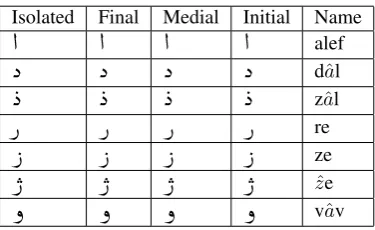
Isolated Final Medial Initial Name
@
@
@
@
alefX
X
X
X
dˆalX
X
X
X
zˆalP
P
P
P
reP
P
P
P
zeP
P
P
P
zeˆð
ð
ð
ð
vˆavTable 2: Right-joining Persian characters
only used for beginner learners and it is expected that adult native speakers have already developed cognitive strate-gies for efficient linguistic performance, those are unten in texts. The absence of the short vowels from writ-ten texts create lexical ambiguity for words such as:
XQÓ
“man” or “died”,Qº
“sugar” or “thank”, andI ®Ê¿
“thick” or “maid”.A phoneme may be represented by various letters which
ø Aë é KA gH.AJ» øAëé KA gH.AJ»
øAë é KA gH.AJ» øAë é KA g H.AJ»
øAë é KA m'.AJ»
ø Aëé KA g H.AJ»
ø Aë é KA m'.AJ» ø Aë é KA g H.AJ»
ø Aëé KA m'.AJ»
ø Aëé KA gH.AJ»
øAëé KA m'.AJ»
øAëé KA g H.AJ»
Table 3: 12 different types of writing the plural and definite form of the compound word “
øAëé KA gH.AJ»
” (the libraries).may cause disparities in letter substitution, especially in case of transliterating foreign words when deciding a proper grapheme for a desired phoneme. There are vari-ous letters for the same phoneme such as the phoneme /t/ represented by the two letters,
H
and, the phoneme /h/ by
h
andè
, /s/ by the three lettersH
,
, and
, and finally the phoneme /z/ by the four lettersX
,P
,
, and. We can also find two different types of space characters with different Unicode encodings, i.e., the white space and the zero-width non-joiner (ZWNJ). The white space in Persian designates word boundaries as in many languages while the ZWNJ marks boundaries inside a word. The ZWNJ, also known as pseudo-space, zero-space or virtual space, is a non-printing character in computerized typeset-ting of some cursive script placed between two characters to be printed in the final and initial forms to each other. The ZWNJ keeps the word forms intact and close together without being attached to each other. Considering the wide range of varieties of typing styles and the optionality of shifting between white space and ZWNJ, one word may be written in various ways in a text. Compound words and inflectional affixes are highly affected and can be typed ei-ther as attached to (when ignoring both spaces ei-thereby los-ing the internal word boundaries) or detached (when uslos-ing white space instead of ZWNJ) from their adjacent word, which in both cases raise issues in text processing. Inflec-tional suffixes may follow compound words, as the word
é KA gH.AJ»
(library) followed by the plural suffixAë
- /-hˆa/ to-gether with the ezafe particleø
- /-ye/ and might appear in 12 forms as shown in Table 3.2.2. Persian Morphology
Persian has a rich morphology dominated by an affixal sys-tem. There is no grammatical gender. Verbs can express tense, aspect, and mood, and agree in person and num-ber with the subjects. Possessiveness is expressed by the genitive clitic ezafe -e1 or by pronominal genitive clitics
(-am, -at, -aˇs, -emˆan, -etˆan, -eˇsˆan) which are the bound forms of full personal pronouns. There are several plural markers -hˆa, -ˆan, (with variants -gˆanand -yaˆn), and some Arabic plural markers -ˆat, -in,un, attaching only to Ara-bic loanwords. AraAra-bic broken plural also exists in Persian that follows Arabic template morphology and is directly in-herited with nouns borrowed from Arabic. Adjectives vary in the suffixes -
QK
/-tar/ and -áKQK
-/tarin/ for comparative and superlative forms respectively. Pronouns often appear as pronominal clitics (Ð
- /-am/ 1sg,H
- /-at/ 2sg,
- /-aˇs/ 3sg,àAÓ
- /-emˆan/ 1pl,àAK
- /-etˆan/ 2pl,àA
- /-eˇsˆan/ 3pl) which are the bound forms of personal pronouns. Pronom-inal clitics can be attached to nouns, adjectives/adverbs, prepositions, and verbs. Their function is as possessive genitive.AJ»
(his/her book), partitive genetiveAKY Jk
(some of that), object of a preposition P@
(of him/her), non-canonical subjectYK@ú× YK.
(he/she dislike), and di-rect objectY KX P
(they hit him/her). For instanceY KX P
(they hit him/her) consists of the verb stemX P
(hit), the personal agreement markerY K
- (they) and the pronominal clitic
- (him/her). The native word formation in Persian is based on combining verbal stems, adjectives, and nouns with affixes.2.3. Persian Syntax
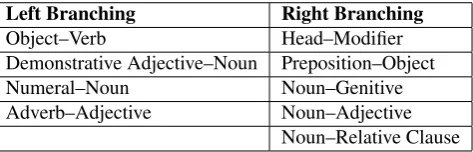
The Persian word order is SOV and consistent with the language being verb final, the head word usually follows its dependent. Note that, the language direction indicates a tendency between left-branching (head-final) and right-branching (head-initial) structure (Stilo, 2005). Therefore the syntactic pattern has a mixed typology, and according to Stilo (Stilo, 2005), “this syntactic pattern often serves as a transition or buffer zone that represents a hybridiza-tion of two opposite patterns between a group of typically VO languages (as in Arabic) and a group of typically OV languages (as in Turkish)”. Table 4 shows the set of inter-related syntactic features in Persian. However, prepositions and superlative adjectives always precede their dependent (nouns).
Sentences consist of an optional subject, and object fol-lowed by a compulsory verb, i.e., (S) (O) V. Subjects, how-ever, can be placed anywhere in a sentence or they may completely be omitted as Persian is a pro-drop language with an inflectional verb system (where person and number are inflected on verb). The use and the order of the op-tional constituents are relatively arbitrary and this scram-bling characteristic makes Persian word order highly
flexi-1
An ezafe (-ez) is an unstressed enclitic particle that links the elements within a noun phrase, adjective phrase or prepositional phrase indicating the semantic relation between the joined ele-ments and is represented by the short vowel /e/ after consonants or /ye/ after vowels.
Left Branching Right Branching
Object–Verb Head–Modifier
Demonstrative Adjective–Noun Preposition–Object
Numeral–Noun Noun–Genitive
Adverb–Adjective Noun–Adjective
Noun–Relative Clause Table 4: The syntactic patterns of Persian.
ble.
3.
Existing Resources and Tools for Persian
The first linguistically annotated Persian corpus was the Bi-jankhan corpus (BiBi-jankhan, 2004) released in 2004. The corpus consists of newspaper articles and common texts consisting of in total 4300 different topics such as cultural, technical, fiction, and art. The texts of total 2,597,939 words are annotated with morpho-syntactic and partly se-mantic features. The original tagset contains 550 tags or-ganized in a tree structure. The tags follow a hierarchi-cal annotation scheme starting with the most general tag and continues with the names of the subcategories. There is an updated version of the corpus with a reduced tagset of 40 tags containing only main part-of-speech categories with basic morphological features. The corpus comes with software for the calculation and extraction of language fea-tures such as: conditional distribution probability, word fre-quency, and recognition of homonyms, synonyms, concor-dances and lexical order.
Another linguistically annotated, but not freely available, corpus is the Persian Linguistic Data Base (PLDB) (Assi, 2005) containing information about pronunciation and grammatical annotation with a morpho-syntactic tagset of 44 tags. The database consists of more than 56 million words of contemporary texts.
The Tehran English-Persian subtitle corpus is another open source resource consisting of 554,621 aligned sentences. 57,465 word/phrase pairs extracted from a bilingual dictio-nary have been also added to this subtitle corpus (Pilevar et al., 2011).
Persian dialog telephone database comprises 100 hours of 200 Persian native speaker dialogs (Ghayoomi et al., 2010). In addition, there exist two open source lexicons for Per-sian, namely the Dehkhoda lexicon (Dehkhoda, 2006) and PerLex (Sagot et al., 2011). The Dehkhoda lexicon is an electronic monolingual Farsi lexicon containing 343,466 entries with information about the morphological structure of compound words (Dehkhoda, 2006). PerLex (Sagot et al., 2011) is another morphological lexicon consisting of about 36,000 lexical entries from the Bijankhan corpus (Bi-jankhan, 2004) and Wikipedia.
In parallel to our work, two different freely available treebanks were released with different annotation schemes. The Persian Dependency Treebank (Rasooli et al., 2012) consists of 10,000 manually annotated sentences represent-ing dependency relations of 43 categories. The sentences are also annotated with morpho-syntactic features. The Persian Tree Bank (Ghayoomi, 2012) on the other hand, is based on HPSG grammar and has a rule-based approach by defining a set of rules in CLaRK. The treebank data set is taken from the Bijankhan corpus and contains 1000 trees.
As tools for Persian, a standard text preparation (STeP-1) (Shamsfard et al., 2009) has been designed to pre-process texts. The system employs a tokenizer, a morphological an-alyzer, and a spell checker to normalize texts into a standard one. Unfortunately the software is not open source. To our knowledge there is only one freely available open source processing tool for Persian, namely the link gram-mar parser (Dehdari, 2006) based on the dependency-like link grammar (Sleator and Temperley, 1993). The link grammar parser produces an output where links are rep-resented in such a way that every node involved in a link cannot be uniquely tied to a token position in the sentence. The parser provides no explicit way to extract the head of the sentence.
4.
An Open Source BLARK for Persian
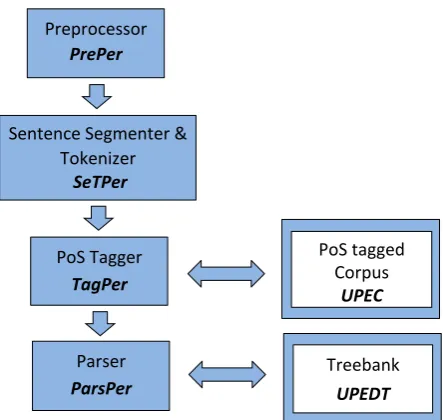
We describe the basic language resources and tools for processing Persian, which we develop and make freely available. Our BLARK components include a set of re-sources and tools for processing Persian texts such as a pre-processorPrePer, a sentence segmenter and tokenizer SeT-Per, a part-of-speech taggerTagPer, and a parserParsPer. As for resources, we present the Uppsala PErsian Corpus (UPEC), and the Uppsala PErsian Dependency Treebank (UPEDT) , which is still under development. An overview of the open source BLARK for Persian is given in Figure 4. Each component is described in detail in the following sec-tions.
4.1. Uppsala PErsian Corpus: UPEC
The importance of having large scale annotated corpora for natural language processing is well-known. The Bijankhan corpus (described in section 3) is a good basic resource for Persian since the corpus is large, freely available and lin-guistically annotated. However, the corpus is created from on-line material and includes a wide range of typing styles with different character encodings which have an impact on
BLARK Pipeline for Persian
Preprocessor
PrePer
Sentence Segmenter & Tokenizer
SeTPer
PoS Tagger
TagPer
PoS tagged Corpus
UPEC
Parser
ParsPer Treebank UPEDT
Figure 1: Open source resources and tools for Persian.
the accuracy of natural language processing tools. In addi-tion, the current release of the corpus lacks sentence seg-mentation. Therefore we decided to release a modified and normalized version of the corpus which is called Uppsala PErsian Corpus (UPEC). The normalization steps include the following:
• In the Bijankhan corpus, the object marker
@P
(rˆa) was annotated as a preposition P. In UPEC we modified the annotation to a CLITIC as the object marker rˆaalways follows the object in Persian, i.e., it can be considered to be an enclitic case marker rather than a preposition.• All past participle verbs with the tag V PA (past tense verb) were modified to V PP (past participle verb).
• Multi-word expressions, such as
é» úGAm.
'@ P@
(since, where),é» áK@ ÉJËX éK.
(for the sake of, because),ðP áK@ P@
(hence),Iêk. à@ P@
(thence), were treated inconsistently in the corpus; sometimes as one single token and sometimes as several. For a more consistent analysis we separated all multi-word expressions into their distinct tokens.• Prepositional phrases made by prepositions and pronominal clitics such as
H P@
(of you),IîE.
(to you), or prepositions and demonstrative pronouns such asáKYK.
(to this),à@YK.
(to that) with the tag P were re-placed by the tag P PRO.• Words with erroneous tags were also corrected and we are planning to correct the whole corpus as time al-lows.
• White spaces in compound words and inflectional af-fixes were changed to ZWNJ.
• Arabic and Western digits were all converted to Per-sian digits.
4.2. A Pre-processor for Persian: Pre-Per
Persian texts, as mentioned earlier, can be written by dif-ferent authors in various styles using difdif-ferent encodings, making Persian text processing issues extra challenging. Therefore, when processing Persian texts, the input texts need to undergo some preparations to be converted and cleaned up into pure standard texts. A standard text is a text written in standard style where the internal word boundaries are marked based on official orthography introduced by the Academy of Persian Language and Literature (APLL). Our goal in creating a pre-processor for Persian was to normalize different writing styles with various encodings. Hence, in our BLARK pipeline we have inserted a pre-processor developed for Persian, named PrePer, as our first module to take care of various encodings with different Unicode characters, and various typing styles in different genres. Therefore, the input text first needs to pass through the pre-processor module.
PrePer is a software program developed in Ruby for the task of editing and cleaning up texts in Persian. The program uses the existing Virastar module for some formatting tasks (Barghi, 2011). The present PrePer handles miscellaneous cases and performs functions to normalize texts into com-putational standard script. PrePer via Virastar also takes care of the occurrences of mixed character encodings. By preprocessing texts all letters in Arabic style with Arabic Unicode characters are edited to Persian style with map-ping to Persian Unicode encoding. In addition, Arabic and Western digits are all converted to Persian digits. PrePer also converts white space to ZWNJ between:
• nouns and plural suffixes
Aë
- /-hˆa/ ,à@
- /-an/,ˆH@
- /-ˆat/, andáK
- /-in/• the suffixes /-i/
ø
- orúG
- (after long vowel /u:/) when denoting indefiniteness or abstractness, as well as the indefinite suffixø@
- (after silent h) and any nouns when forming indefinite nouns or abstract nouns• nouns and pronominal clitics
• past participle verbs and copula enclitics
• nouns and verbal stems in compound words
• verbal stems and the suffix
¸@
- /-ˆak/• verbal stems and the suffixes
P@
/ar/ orˆPAÇ
/gar/ whenˆforming nouns of action
• nouns and their adjacent suffixes when forming adjective-adverbs or adjective-nouns
• the negative prefixes
A K
/nˆa/, and -úG.
(im, in, un, -less) and its adjacent word• the prefixes -
Zñ
, -ÐY«
, -@Q ¯
, and their adjacent words when forming determinative juxtaposed nouns and ad-jectives.4.3. Sentence Segmentation and Tokenization: SeTPer
A sentence segmenter and tokenizer for Persian texts called SeTPer has been developed, aiming at segmenting texts based on Persian sentence boundaries, i.e., handling full stops, exclamation marks and question marks, and tokeniz-ing a ZWNJ normalized text. SeTPer uses the modular soft-ware platform Uplug, a system designed for the integration of text processing tools (Tiedemann, 2003). The Uplug sen-tence segmenter and tokenizer is a rule-based program, that can be adapted to various languages by using regular ex-pressions for matching common word and sentence bound-aries. SeTPer treats the full stop, the question mark, and the exclamation mark as sentence boundaries.
Token separators are: apostrophe, brackets, colon, semi-colon, dash, exclamation mark, question mark, at sign, slash, backslash, percent, asterisk, and tilde. The tokenizer also handles numerical expressions, web URLs, abbrevi-ations, and titles. Acronyms are seldom used in Persian (Ghayoomi et al., 2010) but might exist in SMS, and in so-cial media platforms, and are therefore also taken care of. To evaluate SeTPer, we applied the software to two dif-ferent texts; one in standard writing style and another in non-standard writing style. In standard writing style the internal word boundaries are marked on the basis of the of-ficial orthography of the Farsi language (Academy, 2005). The results showed that standard texts were successfully tokenized with an accuracy of 100% when evaluated on 100 randomly chosen sentences. On a random sample from non-standard texts, the tokenizer resulted in 98% recall and 95% precision on the character level, due to internal word boundaries not being marked in a consistent way.
4.4. A Statistical Part-of-Speech Tagger for Persian: TagPer
Our goal in creating a tagger for Persian was to develop a robust data-driven part-of-speech tagger to disambiguate ambiguous words (words with more than one tag), and annotate unknown words (not being in the training data). The part-of-speech tagger TagPer has been developed for Persian using the statistical part-of-speech tagger HunPoS (Hal´acsy et al., 2007), an open source reimplementation of TnT (Brants, 2000) that is based on Hidden Markov Mod-els with trigram language modMod-els. The great advantage of HunPoS is that it is open source and freely available com-pared to other taggers.
the scores may not be directly comparable.
Later we performed the same experiment on UPEC, using the same training and test set data splits as on the Bijankhan corpus. The results revealed an overall accuracy of 97.8%. The result shows an improved performance of the tagger which is probably due to more consistent normalization and morpho-syntactic annotation of the corpus. The TagPer, part-of-speech tagger for Persian developed using UPEC is also freely available.
4.5. A Dependency Parser and a Treebank for Persian: ParsPer and UPEDT
The goal in creating a parser for Persian was to develop a data-driven dependency parser. Using machine learn-ing with supervised learnlearn-ing techniques has already proven to be a successful approach in developing large linguisti-cally annotated corpora in a short period of time. Further-more, data-driven parsers have been shown to be able to efficiently assist the process of developing a treebank, and parser performance can be improved as the size of the tree-bank grows. In our work, we use MaltParser (Nivre et al., 2006) which is an open source data-driven parser based on dependency structures to syntactically annotate texts in or-der to build a treebank.
As the basis for treebank data we decided to use UPEC, as it is large open source balanced corpus with validated, mor-phologically analyzed texts. In order to build the treebank, we extracted 10,000 sentences randomly from our corpus to serve as treebank data with an average sentence length of 19 words per sentence (Seraji et al., 2012).
The annotation scheme is based on dependency structure, where each head and dependent relation is marked and an-notated with functional categories, denoting the grammat-ical function of the dependent to the head. The syntactic annotation is based on the Stanford Typed Dependencies (Marneffe and Manning, 2008) which is a de facto standard for English. Although originally developed for English, the scheme is designed to be cross-linguistically valid. It has been adapted to Chinese for use with the Stanford Parser, and it has recently been adapted successfully to Finnish (Haverinen et al., 2010).
We have annotated 215 sentences from UPEC using the Stanford Typed Dependencies. The relations given by the Stanford scheme were directly applicable to Persian and most constructions could be analyzed. However, two con-structions could not be covered, therefore we introduced the following two extensions:
• Accusative marker: The relationaccis used for the accusative marker of direct objects.
• Light verb construction:The relationlvcis used for the preverbal noun, adjective or adverbial elements in light verb constructions.
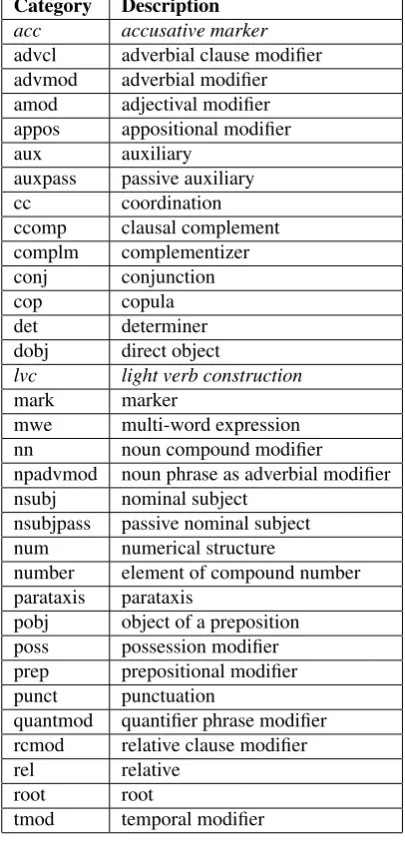
The syntactic relations with the extended Stanford scheme adapted to Persian are listed with explanations in Table 5. It is worth noting that in our earlier published results (Seraji et al., 2012), the syntactic annotation scheme included two additional relations:ezafe construction (ez)and interjec-tion (int). Theezdependency label was used to indicate
Category Description acc accusative marker advcl adverbial clause modifier advmod adverbial modifier amod adjectival modifier appos appositional modifier
aux auxiliary
auxpass passive auxiliary
cc coordination
ccomp clausal complement complm complementizer
conj conjunction
cop copula
det determiner
dobj direct object
lvc light verb construction
mark marker
mwe multi-word expression
nn noun compound modifier
npadvmod noun phrase as adverbial modifier nsubj nominal subject
nsubjpass passive nominal subject num numerical structure
number element of compound number parataxis parataxis
pobj object of a preposition poss possession modifier prep prepositional modifier
punct punctuation
quantmod quantifier phrase modifier rcmod relative clause modifier
rel relative
root root
tmod temporal modifier
Table 5: Syntactic relations in UPEDT based on Stanford Typed Dependencies including extensions for Persian.
the semantic relation of the nominal elements in a sentence and has been replaced by the Stanford relationsposs (pos-session modifier) andamod(adjective modifier) because of the similarity of the relational function. Theintrelation has been replaced by the Stanford relationparataxisbased on the same motivation.
215 sentences have already been manually corrected and validated to be used as seed training data for the data-driven dependency parser, MaltParser. To annotate and correct our syntactic annotation we used the free TrEd tree editor (Ha-jic et al., 2001). Figure 2 shows the dependency annotation for a sentence from the seed data set.
To evaluate the performance of MaltParser when trained on the seed data, we carried out an empirical study with 10-fold cross validation using the 215 manually validated sen-tences. Results from the current stage of the parser revealed a mean labeled attachment score of 62%. The developed parser ParsPer is intended to be optimized in later stages when the size of the treebank has grown.
mani, S. M. Hoseini, A. Noorian, Y. Souri, M. Hossein-Alizadeh, and M. Behniafar. 2012. Persian dependency treebank, annotation manual and user guide. Technical report, Dadegan.
B. Sagot, G. Walther, P. Faghiri, and P. Samvelian. 2011. A new morphological lexicon and a PoS tagger for the Per-sian language. In Proceedings of Fourth International Conference on Iranian Linguistics.
M. Seraji, B. Megyesi, and J. Nivre. 2012. Bootstrapping a Persian Dependency Treebank. Linguistic Issues in Lan-guage Technology, 7.
M. Seraji. 2011. A Statistical Part-of-Speech Tagger for Persian. InProceedings of the 18th Nordic Conference of Computational Linguistics NODALIDA, pages 340–343. M. Shamsfard, S. Kiani, and Y. Shahedi. 2009. STeP-1: Standard Text Preparation for Persian Language. In Pro-ceedings of the Third Workshop on Computational Ap-proaches to Arabic Script-based Languages (CAASL3). D. Sleator and D. Temperley. 1993. Parsing English with
a Link Grammar. In Third International Workshop on Parsing Technologies.
D. L. Stilo. 2005. Iranian as buffer zone between the uni-versal typologies of Turkic and Semitic. In ´Eva ´Agnes Csat´o, Bo Isaksson, and Carina Jahani (eds.), editors, Linguistic Convergence and Areal Diffusion: Case Stud-ies From Iranian, Semitic, and Turkic, pages 35–64, Lon-don: Routledge Curzon.