Evaluating Query Languages for a Corpus Processing System
Elena Frick
∗, Carsten Schnober
∗, Piotr Ba ´nski
∗†∗Institute for the German Language (IDS) †Institute of English Studies
R5 6–13, 68161 Mannheim, Germany University of Warsaw, Poland {frick | schnober | banski}@ids-mannheim.de
Abstract
This paper documents a pilot study conducted as part of the development of a new corpus processing system at the Institut für Deutsche Sprache in Mannheim and in the context of the ISO TC37 SC4/WG6 activity on the suggested work item proposal “Corpus Query Lingua Franca”. We describe the first phase of our research: the initial formulation of functionality criteria for query language evaluation and the results of the application of these criteria to three representatives of corpus query languages, namely COSMAS II, Poliqarp, and ANNIS QL. In contrast to previous works on query language evaluation that compare a range of existing query languages against a small number of queries, our approach analyses only three query languages against criteria derived from a suite of 300 use cases that cover diverse aspects of linguistic research.
Keywords:Query Language, Evaluation, Corpus Analysis, KorAP
1.
Introduction
This paper presents an evaluation of three corpus-query lan-guages (QLs) against a number of criteria informed by user surveys. QLs are defined here as formal languages in which users communicate their requests to the corpus process-ing software. The evaluation takes place at the Institut für Deutsche Sprache (IDS) in Mannheim and is part of devel-opment of a new corpus processing platform KorAP, which is planned to succeed COSMAS II (Bodmer, 2005), in order to address the needs of linguists and lexicographers, today and in the future, and to be flexible and scalable enough to deal with increasing corpora sizes and the demands of mod-ern corpus-linguistic practice (Ba´nski et al., 2012). The work described in this paper is part of the project design phase and serves as a basis for the selection of a QL for the new platform. It is also part of the ISO TC37 SC4/WG6 ac-tivity on the suggested work item proposal “Corpus Query Lingua Franca” (Ba´nski and Witt, 2011). This is a pilot study that formulates the initial criteria and that we plan to extend to other QLs.
2.
Query languages under evaluation
There exists a large number of QLs designed for text cor-pus querying, which makes it hardly feasible to generate a comprehensive overview in a limited space. For the ini-tial evaluation, we have chosen three QLs as representa-tives of different language families: the COSMAS II query language (Bodmer, 1996), the query language of Poliqarp (Przepiórkowski et al., 2004) and the ANNIS Query Lan-guage (AQL) (Rosenfeld, 2010).
2.1. COSMAS II QL
The COSMAS II QL (Bodmer, 1996) has been designed specifically for the COSMAS II system that serves as the interface to the DeReKo corpus (Kupietz et al., 2010). This QL with a flexible and powerful syntax allows the user to create from very simple to very complex queries that look for single words, words with special properties, and vari-ous combinations thereof. It provides a variety of operators
for defining distances between words and allows to specify positions in relation to sentence and paragraph boundaries. Operators for case-sensitive search and search for lemma are also available.
A unique feature of the COSMAS II QL are operators that allow the user to change the scope of the match in the out-put, as illustrated in examples 1 and 2. Queries 1a, 1b and 1c express the same request, for any verb followed by
Sonneat a distance of 1 to 3 tokens, but queries 1b and 1c use operators #LINKS and #ALL that allow for the results to be presented in different ways (cf. outputs in 2a, 2b, 2c).1
1. (a) {C} MORPH(V) /+w1:3 Sonne
(b) {C} #LINKS(MORPH(V) /+w1:3 Sonne)
(c) {C} #ALL(MORPH(V) /+w1:3 Sonne)
2. (a) Draußenscheintdie helleSonne.
(b) Draußenscheintdie helle Sonne.
(c) Draußenscheint die helle Sonne.
The COSMAS II QL also implements Boolean operators and allows wildcards, though restricted to the surface text. Apart from full text and annotation search, search in meta-data is supported as well.
2.2. Poliqarp QL
Poliqarp (Przepiórkowski et al., 2004) is a corpus indexing and search tool initially developed for the IPI PAN corpus (http://korpus.pl) that has later been extended and is now used for the National Corpus of Polish (http:// nkjp.pl) and distributed from SourceForge. The syntax of Poliqarp’s QL is based on that of the CQP (Corpus Query Processor) developed for the IMS Open Corpus Workbench (Christ, 1994).
A search query formulated in this QL is a sequence of terms, each of which can be an attribute-value pair or just a string corresponding to a word or a part of it. It is possible
1We use {A}, {C} and {P} to mark the query strings of,
Feature COSMAS II Poliqarp AQL
Single-word search Yes Yes Yes
Multi-word sequences Yes Yes Yes
Word combinations Yes Yes Yes
Search by partial matching Yes (wildcards) Yes (RegEx) Yes (RegEx)
Table 1: Plain-text search
in related work, like “metadata access” or “display direc-tives”. Our focus does not lie on querying a specific corpus or annotation format, but on covering all possible facets of linguistically motivated searches in order to find a QL that satisfies the end users’ requirements.
The second group of research endeavours, to which our sur-vey is complementary, evaluates the functionality of QLs against concrete query examples. In this approach, some authors focus on a single QL and demonstrate its expres-sive power, as Cassidy (2002) does for XQuery, Bouma (2010) for Prolog, and Kepser (2003) for fsq (Finite Struc-ture Query). Others compare several QLs for their func-tionality (cf. (Lai and Bird, 2004; Cassidy et al., 2000)). In either case, a very small number of query examples is taken into account for the evaluation of QLs and those approaches focus mainly on special selected issues, such as hierarchi-cal and sequential navigation (cf. (Lai and Bird, 2004)) or querying spoken dialogs (cf. (Cassidy et al., 2000)). The challenge of our approach lies in the analysis of a relatively small number of QLs but on the basis of a very detailed suite of 300 query examples that cover diverse aspects of linguistic research.
4.
Results
This section presents results of the application of the evalu-ation criteria, listed according to the categories enumerated in section 3.1, and illustrated with a series of tables.4
4.1. Plain-text search
The criteria in this category (cf. Table 1) evaluate the QLs’ capabilities for searching through surface text only. They investigate simple search for single words, word sequences and combinations, as well as search for words by partial matching. All the evaluated QLs fulfill these criteria except for COSMAS II that shows drastic limitations in searching for words by partial matching due to its lack of regular ex-pressions support. For example, a query for words that start with any vowel has to be expressed by searching for words beginning with each vowel separately and the unification of the results with the conjunction OR (=ODER) (cf. query 7). In Poliqarp and AQL, regular expressions make it possible to formulate the same request more elegantly (cf. 8).
7. {C} A* ODER a* ODER (...) ODER Y* ODER y*
8. {P} "[AaEeUuIiOoÜüÖöÄäYy].*"
4
Various categorisations of the criteria are possible here, de-pending on one’s focus; we have chosen what we believe to be a reader-friendly ordering.
4.2. Annotation-based search
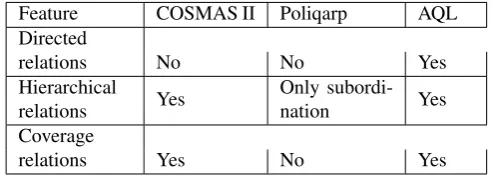
Corpora often contain various types of annotations apart from the surface text. These can include simple 1:1-relations, i.e. one tag for each token, or more compli-cated structures such as syntactic hierarchies or dependency graphs. Searching such structures requires a QL explic-itly providing structure-related queries. This is the case for AQL, while COSMAS II and Poliqarp provide partial solu-tions in this regard (cf. Tables 2 and 3).
Feature COSMAS II Poliqarp AQL Search in annotations Yes Yes Yes Search across
anno-tation layers Yes Yes Yes
Search by annotation
source No No Yes
Table 2: Annotation-based search
Both COSMAS II and Poliqarp support search in anno-tation content and across different annoanno-tation layers, as shown in queries 9 and 10. Query 9 looks for Named Enti-ties, whereas query 10 looks for the wordLehrerfollowed by a finite verb, within a sentence. However, both COS-MAS II and Poliqarp lack the possibility to ‘namespace’ annotation content in the way that AQL does (cf. query 6 above).
9. {C} MORPH(NE)
10. {P} [orth=Lehrer] [pos=VVFIN] within s
Moreover, in contrast to AQL (cf. query 5), COSMAS II and Poliqarp do not support directed relations pointing from one node to another (cf. Table 3).
Feature COSMAS II Poliqarp AQL Directed
relations No No Yes
Hierarchical
relations Yes
Only subordi-nation Yes Coverage
relations Yes No Yes
Table 3: Relationship between spans
phrase containing an adjective”.
11. {P} [pos=ADJA] within np
Both COSMAS II and AQL provide a variety of operators for specifying different types of coverage relations between spans (inclusion, full coverage, right and left alignment, right and left overlap). But AQL has an advantage because it also provides operators for specifying the type of rela-tionship. This is illustrated by queries 12 and 13. The for-mer looks for a sentence node directly dominating a noun phrase. The latter additionally includes sentence nodes that dominate a noun phrase indirectly.
12. {A} cat="S" & cat="NP" & #1 > #2
13. {A} cat="S" & cat="NP" & #1 >* #2
4.3. Constraints on the size and position of matches
This category (cf. Table 4) includes four criteria: they deal with specifying (i) the word order, (ii) distances between segments, (iii) positions of segments within a structure, and (iv) the extent of sentences and phrases. Not all of the eval-uated QLs satisfy these criteria fully. For example, regard-ing the word order, COSMAS II is limited to express in-direct precedence and does not allow queries such as “find an auxiliary verb followed by a main verb in the infinitive, potentially with one or more words in between”. The dis-tance between matches always has to be specified (cf. 14). Poliqarp offers a more comfortable way for expressing such queries, by using the ‘match any token’ operator ‘[ ]’ in combination with the Kleene star (cf. 15). AQL also fea-tures a simple way for specifying the word order by using the direct and indirect precedence operators ‘.’ and ‘.*’ (cf. 16).
14. {C} MORPH(VRB fin a) /+w10 MORPH(VRB inf v)
15. {P} [pos=VAFIN] [ ]* [pos=VVINF]
16. {A} pos="VAFIN" & pos="VVINF" & #1 .* #2
The three QLs assume different strategies in queries in-tended to find items occurring in any order. COSMAS II disregards precedence information: the search in (cf. 17) matches the three target words occurring in any sequence. Poliqarp appears to adopt almost a mirror strategy: it im-plicitly assumes that the sequence of terms in the query corresponds to the surface sequence of the matches. This is why a search for three words occurring in an arbitrary se-quence has to mention all orderings (query 18). AQL sep-arates the information concerning the targets and their or-dering, and expects the precedence information to be stated separately, as in (cf. 19). In this respect, AQL provides the user with the greatest amount of flexibility.
17. {C} Zukunft UND Gegenwart UND Vergangenheit
18. {P} Zukunft [ ]* Gegenwart [ ]* Vergangenheit | Zukunft [ ]* Vergangenheit [ ]* Gegenwart | Gegen-wart [ ]* Vergangenheit [ ]* Zukunft | GegenGegen-wart [ ]* Zukunft [ ]* Vergangenheit | Vergangenheit [ ]* Zukunft [ ]* Gegenwart | Vergangenheit [ ]* Gegen-wart [ ]* Zukunft
(#1 .* #2 & #2 .* #3 | #1 .* #3 & #3 .* #2 | #2 .* #1 & #1 .* #3 | #2 .* #3 & #3 .* #1 | #3 .* #2 & #2 .* #1 | #3 .* #1 & #1 .* #2)
Defining distances is not as trivial as one might expect, ei-ther. Poliqarp’s is the only evaluated QL that is able to specify a minimum distance between terms. For this pur-pose, regular expressions are applicable, as shown in query 20, which searches for a sequence of an article and a noun with at least one word between them.
20. {P} [pos=ART] [ ]+ [pos=NN]
Specifying various positions of tokens within a structure is supported extensively by COSMAS II. The following ex-amples illustrate queries looking for the wordheuteat the beginning (cf. 21a and 21b), at the end (cf. 22a and 22b), and in the third position in a sentence (cf. 23), while the query in example 24 matches heute at the beginning of a paragraph. Query 25 matches heute at the end of a sen-tence as well as before a colon, while example 26 expresses a query that looks forheute, but not at the beginning of a sentence and not after a colon.
21. (a) {C} <sa> /w0 heute
(b) {C} heute #IN(L) <s>
22. (a) {C} heute /w0 <se>
(b) {C} heute #IN(R) <s>
23. {C} <sa> /+w2 heute
24. {C} heute:pa
25. {C} heute:se
26. {C} heute:-se
AQL allows a search for an element at the beginning or at the end of a containing structure by using leftmost (cf. 27) and rightmost (cf. 28) child operators, as well as operators for the left (cf. 29) and right (cf. 30) alignments. It is also possible to search for an element at a specific distance from the beginning of the structure (cf. 31). The search for elements not adjacent to an edge of a containing structure is not supported.
27. {A} cat="NP" & "der" & #1 >@l #2
28. {A} cat="S" & cat="NP" & #1 >@r #2
29. {A} cat="S" & "Ein" & #1_l_#2
30. {A} cat="S" & pos="VVPP" & #1_r_#2
31. {A} cat="S" & node & pos="NN" & #1_l_#2 & #2.#3
Feature COSMAS II Poliqarp AQL
Define word order Yes, but specifying the distance
re-quired Yes, implicitly Yes, explicitly
Define distances Min. only in combination with max. Yes Min. only in combination with max.
Define positions Yes No Yes, but restricted
Define the extent of
sentences or phrases Min. only in combination with max. No
By tokens or directly dominated nodes; min. only in combination with max.
Table 4: Constraints on the size and position of matches
32. {C} #BEG(<s>) /5:50w,s0 #END(<s>)
In AQL, the extent of a structure can be specified in two ways: either by defining the amount of directly dominated children that this structure has or by defining the token span covered by it. Example 33 searches for a sentence contain-ing exactly five tokens while query 34 looks for an “S” node that dominates maximally five others. It is not possible to specify only the minimal number of tokens or nodes.
33. {A} cat="S" & #1:tokenarity=5
34. {A} cat="S" & #1:arity=1,5
4.4. Boolean operations
This section reports evaluation results concerning the use of Boolean operations: conjunction, disjunction and nega-tion. While the former two of those operations are fully supported by all three QLs, negation is not always express-ible, depending on its scope (cf. Table 5).
In Poliqarp and AQL, it is a trivial task to negate features of a token, e.g. ‘pos != ART’. This can be combined with any other condition, as in examples 35 and 36 that look for the word der whose part of speech is not ‘ART’. How-ever, negation applied to higher-order structures, for in-stance syntactic trees, is more complex. Neither Poliqarp nor AQL allow for negating specific segments as in “find word A but only if word B does not occur in the same text, sentence or phrase”. COSMAS II, on the other hand, does not always allow negation at the level of features of tokens, as e.g. in “find a token with a part-of-speech specification other than ‘article’” – this needs to be expressed implicitly by allowing for all possible values except ‘ART’. In com-parison, the search for der that is not an article is completely unproblematic (cf. 37).
35. {A} tok = "der" & pos != "ART" & #1_=_#2
36. {P} [orth = der & pos != ART]
37. {C} der %w0 MORPH(ART)
Search in structures and hierarchies is what tree-based lan-guages, in this paper represented by AQL, are designed for, and therefore perform best. Nevertheless, AQL does not provide the possibility to negate the dominance relation, e.g. the query “find all noun phrases that do not dominate any adjectives” is not feasible in AQL. The same is true for negating subordination relations, e.g. “search for an ad-jective that is not dominated by a noun phrase”. This also
holds for Poliqarp that does not provide operators to negate dominance and subordination.
Concerning negation of span relations, COSMAS II differs from Poliqarp and AQL in that it offers the negation opera-tor ‘%’ for searching for non-overlapping spans, and makes it possible to negate dominance, e.g. to specify elements that are disallowed within a sentence (cf. 38).
38. {C} <s> %w0 &haben
4.5. Universal quantification and implication
Our use case collection contains requests such as “find a sentence containing verbs in the first person singular only” or “find a noun phrase containing more than one noun, but all nouns must be in singular”. In order to recast them as QL statements, operators for universal quantification and strict implication are required (cf. (Marek et al., 2008)). None of the evaluated corpus processing systems supports this functionality. As has been noted in the literature, im-plementing such operators is not an easy task and may have serious consequences for system performance. Introduc-ing such functionality is a temptIntroduc-ing challenge that we are considering for KorAP, following the example set by the creators of the Stockholm Tree Aligner (Volk et al., 2007).
4.6. Fuzzy and pattern search
Regular expressions provide a lot of expressive power, which is why the lack of support for them on the part of COSMAS II (cf. Table 7) is a disadvantage that makes it impossible to reflect some of the user needs (cf. section 4.1). AQL supports regular expressions at the level of the textual content of individual tokens (cf. 39), annotations (cf. 40), and metadata. Poliqarp’s QL is able to apply reg-ular expressions also to higher-level constructs for the pur-pose of specifying the order of tokens and thus the content of syntactic constituents. A search for a sequence beginning with a determiner and ending with a noun, with any number of adjectives between them, can be specified in Poliqarp as shown in 41.
39. {A} /.*platz/ (or: tok=/.*platz/)
40. {A} pos=/VV.*/
41. {P} [pos=DET] [pos=ADJ]+ [pos=NN]
Negation within a segment on its features Yes, but only in combinations with
multiple features (query 37) Yes Yes Negation of segments (search for A but not B) Yes No No
Negation on dominance Yes No No
Negation on subordination No No No
Non-overlap Yes No No
Table 5: Negation
43). AQL does not provide dedicated case-related opera-tors, but can handle such requests through regular expres-sion sets (cf. 44).
42. {P} Institut für deutsche/i Sprache
43. {C} Institut für $deutsche Sprache
44. {A} "Institut" & "für" & /[Dd]eutsche/ & "Sprache" & #1 . #2 & #2 . #3 & #3 . #4
In contrast to COSMAS II, Poliqarp and AQL allow for the use of variables. This opens up the possibility to ex-press e.g. “agreement constraints” or “multiple node rela-tions with respect to one node” (König at all. 2003). The Poliqarp query in example 45 illustrates this by searching for a word repetitively in different inflectional forms within a sentence. The AQL query in 46 uses variables to find a noun and a verb phrase within the same sentence.
45. {P} [base=$1 & orth=$2] [ ]* [base=$1 & orth=$3] within s
46. {A} cat="S" & pos="NN" & cat="VP" & #1>#2 & #1>#3
The feature that distinguishes Poliqarp from both the other evaluated QLs is its support for handling ambiguous morphosyntactic interpretations within a single annotation layer. Allowing the user to choose between different equal-ity operators (‘=’, ‘==’, ‘˜’, ‘˜˜’) is a serious advantage for queries such as “find a noun where at least one case inter-pretation given by a morphological analyser (before disam-biguation) is nominative” (cf. 47) or “find a segment where all its interpretations in the given context (disambiguated interpretations) are relative pronouns” (cf. 48).
47. {P} [pos=NN & case~nom]
48. {P} [pos=="PREL.*"]
We have called the last criterion in Table 6 ‘search by alter-natives’. This refers to the ability of a QL to automatically expand a query e.g. by including words that are spelled or sound similar to the given term (search by similarity) or by searching a term and all its synonyms, hypernyms, or hyponyms (search by thesaurus). Support for such func-tionality is a useful feature in a QL, especially for cor-pora that contain raw material from a variety of sources. ‘Search by alternatives’ makes it possible to satisfy requests such as “find the wordGalerie, including mistypes such as
Gallerie” or “find verbs occurring as predicates forHund
or its hyponyms like Schäferhund, Collie, Dackel, etc”. This functionality is partially present in other QLs such as CATMA5, but none of the evaluated QLs supports it.
4.7. Metadata access
Both Poliqarp and AQL are capable of using document metadata to constrain matches (cf. Table 7). If the keyword ‘meta’ is used at the end of a query, followed by a specifi-cation of metadata attributes and values, Poliqarp restricts the scope of that query to e.g. texts by a certain author and published in a certain range of years (cf. 49).
49. {P} [orth=Frau] meta author=Goethe & created>=1800 & created<=1825
COSMAS II does not allow for joint searches across anno-tations and metadata. However, it provides the ‘#IN’ oper-ator to query metadata: example 50 illustrates how to find text titles (‘<üh>’ for German ‘Hauptüberschrift’) contain-ing the wordheute.6
50. {C} heute #IN <üh>
Besides “formal” metadata describing the title, author, genre of a text, etc., it may sometimes be useful to ac-cess information about the statistical properties of elements (sentences, tokens, word forms, pos, etc.) occurring in a document from the level of the QL. Naturally, this re-quires a number of preconditions to be fulfilled, concern-ing the nature of the queried resource (static or dynamic), the frequency of (re)indexing, etc. It is worth noting that some QLs, notably CATMA, support such functionality (the queryfreq=1selects any word occurring only once in a text (Schüch, 2010)).
Among the three evaluated QLs only Poliqarp claims to partially support this functionality by allowing the user to specify the minimum frequency threshold using the key-word ‘min<cmin>’ so that “only results which occurred at least <cmin> times in the matches should be displayed”
5CATMA (http://www.catma.de/) allows to search
for orthographically similar words and even to adjust the de-gree of similarity. This can be illustrated by the query
simil="Haus" 90%that selects any word which is, accord-ing to some pre-defined criteria, 90% similar to the wordHaus
(Schüch, 2010).
6The letter ‘ü’ is straightforwardly obtained from German
Feature COSMAS II Poliqarp AQL
RegEx No, but wildcards Yes Yes
Case-sensitivity Yes Yes With RegEx
Ambiguities within a single
annotation layer No Yes No
Variables No Variables for feature values Node variables
Search by alternatives No No No
Table 6: Fuzzy and pattern search
Feature COSMAS II Poliqarp AQL
Query metadata only Yes No No
Constrain search by metadata No Yes Yes
Search by statistical properties No Min. frequency threshold No
Table 7: Metadata access
(Buczy´nski, 2007). Given the limitations of our data set, we were not able to test this in practice.
4.8. Display directives
The criteria in Table 8 concern the output of search results. From a general point of view, it is disputable whether a QL should include directives for formatting the results, or whether that task should be delegated to the user interface. Nevertheless, it is useful at least to mark the information foci for the interface to act on, and this is what Poliqarp does by means of a dedicated marker that allows to align matched segments in columns. Query 51 searches for at-tributive adjectives that occur after a sequence comprising a preposition and the word immer. The ‘ˆ’-operator be-fore [pos="ADJA"] results in the output being split into four columns containing the left context, the left part of the match (the preposition and ”immer”), the right part of the match (the adjectives) and the right context.
51. {P} [pos=APPR] immer ˆ[pos=ADJA]+
Furthermore, the syntax of Poliqarp allows the user to spec-ify how many hits should be displayed (cf. 52) and to define the parameters for grouping and sorting them (cf. 53).
52. {P} [pos=ADJA & orth="a.*"] count 100
53. {P} [orth=Tag] group by case
As already mentioned in section 2.1, the COSMAS II QL is able to highlight user-defined parts of the match (cf. ex-amples 1 and 2).
5.
Summary
The present paper relates the results of a pilot study that we have conducted in order to establish the features that we would like to see in the QL adopted for the KorAP platform. The study is far from concluded, but we believe that the re-sults achieved so far are worth sharing with the community and may generate useful discussion.
We see the main outcome of this work as twofold: firstly, the evaluation criteria that we have generated, based
on user requirements, provide a generic measure for a functionality-based comparison of QLs that identifies their weaknesses and strengths. The second result is the ac-tual evaluation of three QLs representing different language families, by applying the aforementioned criteria.
Given that the three QLs come from different traditions and have been created with different data models in mind, it is natural to see that they differ in their capabilities. Never-theless, we have attempted to highlight limitations that are common to many usage scenarios. They include restricted support for negation (cf. 4.4), the lack of universal quanti-fiers and the impossibility to express implication (cf. 4.5). Additionally, specifying distances between tokens is, at the moment, not sufficiently robust and operators for specify-ing the extent of structures are not flexible enough (cf. 4.3). Desirable functionalities such as e.g. variables (cf. 4.6) and search by statistical properties (cf. 4.7) are not, or are only partially implemented, allowing for some very specific queries but not covering all searching aspects summarized under the appropriate criterion. Search by alternatives (cf. 4.6) is not provided by any of the evaluated QLs, which is due to the fact that this is not implemented in the respective systems.
Having identified these limitations allows to us to conclude that neither of the evaluated QLs satisfies our requirements for a new corpus analysis platform. This means that we will not re-use either of the evaluated QLs per se, but in-stead design a new QL that is based on existing ones, at least function-wise. The QL closest to our needs, especially given the data model assumed for KorAP, is AQL2, and the focus in the next phase of our research will be on how feasi-ble it may be to adopt the AQL (or at least its most essential features, possibly enhanced by desirable features of other QLs), in view of the limited scalability of the system that underlies ANNIS27.
7It is important to stress that ANNIS2 and AQL are under
Highlight user-defined parts of matches Yes No No
User-defined match alignment No Yes No
Define the context size Only in UI Only in UI Only in UI Define the number of displayed hits Only in UI Yes Only in UI User-defined sorting and grouping hits Only in UI Yes No
Table 8: Display directives
6.
Future work
In our subsequent work, we intend to focus on AQL and from this position, to extend the range of the evaluated QLs and to extend the area of the evaluation.
Two important QL features have not yet been investigated: usability and performance. For the former aspect, quantita-tive studies that measure features such as intuiquantita-tiveness and learnability on trial users would be helpful for an improved QL evaluation. At a later stage, empirical experiments such as those suggested by (Kaufmann and Bernstein, 2010) and (Graaumans, 2004), will be considered in order to fine-tune for usability.
For performance evaluation, comparable measures need to be implemented; this is an involved task because the mere time-consumption of a query depends on many aspects where the actual implementation may be more significant than the language itself. However, performance is impor-tant for KorAP as it is designed to process corpora with more than 50 billion tokens. Minimally, a computational cost estimation will be necessary, possibly by comparing the computational complexity of queries (cf. (Christ and Schulze, 1995)).
7.
Acknowledgements
The KorAP project, in the context of which the present study is conducted, is funded within the Senate Commit-tee Competition (SAW) programme of the Leibniz Associ-ation.
We wish to thank the anonymous LREC reviewers – we have attempted to address all their remarks. We are also grateful to Marc Kupietz and Andreas Witt, for their advice and helpful comments, Florian Zipser for his assistance in testing the ANNIS platform, and Amir Zeldes for prompt reactions to our queries as well as important remarks on an earlier version of this paper. Finally, we would like to thank Helge Krause and Franck Bodmer for their assistance with COSMAS II queries.
8.
References
Ba´nski, P. & Witt, A. (2011). Do linguists need a corpus query lingua franca? Presentation given at the ISO TC37 meeting, June.
Ba´nski, P., Fischer, P. M., Frick, E., Ketzan, E., Kupietz, M., Schnober, C., Schonefeld, O. & Witt, A. (2012). The new IDS corpus analysis platform: Challenges and prospects. InProceedings of LREC-2012, Istanbul, May. Bodmer, F. (1996). Aspekte der Abfragekompononente von COSMAS-II. In Jüttner, I. & Neumann, R. (Eds.),
LDV-INFO 8. Informationsschrift der Arbeitsstelle Lin-guistische Datenverarbeitung, pages 112–122. IDS. Bodmer, F. (2005). COSMAS II. Recherchieren in den
Korpora des IDS. Sprachreport, 21(3):2–5.
Bouma, G. (2010). Querying linguistic corpora with Pro-log. Semantic Approaches in Natural Language Process-ing.
Buczy´nski, A. (2007). Statistical extension to the poliqarp search engine. InTwelfth ESSLLI Student Session, pages 47–54, Dublin.
Cassidy, S., Welby, P., McGory, J. & Beckman, M. (2000). Testing the adequacy of query languages against anno-tated spoken dialog. InProceedings of the Speech Sci-ence and Technology ConferSci-ence, pages 428–433. Cassidy, S. (2002). XQuery as an annotation query
lan-guage: a use case analysis. In LREC-2002, Gran Ca-naria.
Christ, O. & Schulze, B. (1995). Ein flexibles und modu-lares Anfragesystem für Textcorpora. Tagungsberichte des Arbeitstreffens Lexikon+ Text.
Christ, O. (1994). A modular and flexible architecture for an integrated corpus query system. In Proceedings of the 3rd Conference on Computational Lexicography and Text Research. Budapest, Hungary.
Graaumans, J. (2004). A qualitative study to the usability of three XML query languages. InProceedings of the conference on Dutch directions in HCI, page 6. ACM. Janus, D. & Przepiórkowski, A. (2007). Poliqarp: An open
source corpus indexer and search engine with syntactic extensions. InProceedings of the 45th Annual Meeting of the ACL on Interactive Poster and Demonstration Ses-sions, pages 85–88. ACL.
Jarke, M. & Vassiliou, Y. (1985). A framework for choos-ing a database query language. ACM Computing Surveys (CSUR), 17(3):313–340.
Kaufmann, E. & Bernstein, A. (2010). Evaluating the us-ability of natural language query languages and inter-faces to semantic web knowledge bases. Web Semantics: Science, Services and Agents on the World Wide Web, 8(4):377–393.
Kepser, S. (2003). Finite structure query: A tool for query-ing syntactically annotated corpora. In Proceedings of the tenth EACL conference, volume 1, pages 179–186. ACL.
Kupietz, M., Belica, C., Keibel, H. & Witt, A. (2010). The german reference corpus DeReKo: A primordial sample for linguistic research. InLREC-2010. Malta.
Proceedings of the Australasian Language Technology Workshop, pages 139–146.
Marek, T., Lundborg, J. & Volk, M. (2008). Extending the TIGER query language with universal quantification. In
Proceeding of KONVENS, pages 3–14.
Mírovsk`y, J. (2008). PDT 2.0 requirements on a query lan-guage. Proc. 46th ACL, pages 37–45.
Przepiórkowski, A., Krynicki, Z., De¸bowski, Ł., Woli´nski, M., Janus, D. & Ba´nski, P. (2004). A search tool for corpora with positional tagsets and ambiguities. In Pro-ceedings of LREC-2004, pages 1235–1238.
Rosenfeld, V. (2010). An implementation of the Annis 2 query language. Technical report, Humboldt-Universität zu Berlin.
Schmid, H. (1994). Probabilistic part-of-speech tagging using decision trees. In Proceedings of international conference on new methods in language processing, vol-ume 12, pages 44–49. Manchester, UK.
Schüch, L. (2010).User Manual for CATMA 3.0.