854
Dependency-Based Relative Positional Encoding for Transformer NMT
Yutaro Omote and Akihiro Tamura and Takashi Ninomiya
Ehime University
{[email protected], tamura@cs, ninomiya@cs}.ehime-u.ac.jp
Abstract
In this paper, we propose a novel model for Transformer neural machine transla-tion that incorporates syntactic distances between two source words into the rel-ative position representations of a self-attention mechanism. In particular, the proposed model encodes pair-wise relative depths on a source dependency tree, which are the differences between the depths of two source words, in the encoder’s self-attention. Experiments show that our pro-posed model achieved a 0.5 point gain in BLEU on the Asian Scientific Paper Ex-cerpt Corpus Japanese-to-English transla-tion task.
1 Introduction
Machine translation (MT) has been actively stud-ied for many decades. In recent years, neural ma-chine translation (NMT) has become dominant. In particular, the Transformer model (Vaswani et al.,
2017), which is based solely on attention mech-anisms, has advanced the state-of-the-art perfor-mance on various translation tasks and has become the focus of many MT researchers nowadays. Un-like recurrent neural network (RNN) based mod-els (Sutskever et al.,2014;Luong et al.,2015) or convolutional neural network (CNN) based mod-els (Gehring et al.,2017), the Transformer model attends to words in the same sentence, i.e., a source sentence or a target sentence, through the self-attention mechanisms in each encoder and de-coder. In addition, it encodes the positional in-formation of each word, such as the word order, as positional encoding (PE) so that recurrent and convolutional structures are excluded and training can be parallelized. Since NMT appeared, trans-lation performance has been improved by using
the syntactic information, such as phrase struc-tures or dependency strucstruc-tures, of the source-side, target-side, or both (Ding and Palmer,2005;Chen
et al., 2017; Eriguchi et al., 2017; Wu et al.,
2018). In semantic role labeling (SRL), though the task is not MT,Strubell et al. (2018) improved a Transformer-based model through the learning of self-attention weighting on the basis of syntactic information, i.e., dependency structures. Hence, it is expected that the performance of Transformer NMT will be improved by incorporating syntax in-formation.
In this paper, we aim to improve Transformer NMT by using dependency structures. Some re-searchers have improved Transformer NMT by modifying self-attention. Shaw et al.(2018) used relative position information between two words encoded in self-attention in addition to the abso-lute position information of words.
Inspired by Shaw et al. (2018), we propose a novel Transformer NMT model that incorporates the relationships between two words on source de-pendency structures into relative position repre-sentations in self-attention. In particular, the pro-posed model adds a vector that encodes relative positional relationships between words on source dependency structures to a word embedding vec-tor. It adds only dependency information to the word embedding vector; hence, there is no need to change the whole Transformer’s mechanism or objective function, and it is easy to adapt the mechanism to other extended Transformer mod-els because it is highly extensible. Strubell et al.
(2018)’s method is different from our work in that their task is SRL, and to learn the attention be-tween words directly from dependency structures, they largely changed the Transformer’s model and objective function.
Ex-cerpt Corpus (ASPEC) Japanese-to-English trans-lation task. The experimental results demonstrate that our approach achieves a 0.5 point gain in BLEU over baseline Transformers (Vaswani et al.,
2017;Shaw et al.,2018).
2 Related Work
NMT performance has been improved by using the syntactic information of source language sen-tences, target language sensen-tences, or both.
Some researchers have focused on phrase struc-tures as syntactic information.Aharoni and Gold-berg(2017) incorporated target-side phrase struc-tures into NMT, andEriguchi et al.(2016) andMa et al.(2018) incorporated source-side phrase struc-tures. Our work is different from their research in that we focus on dependency structures rather than phrase structures. In addition, while their models are based on RNN-based NMT models, we aim to improve a Transformer NMT model.
Other researchers have focused on dependency structures as syntactic information. Chen et al.
(2017) proposed a hybrid NMT model of RNNs and CNNs to incorporate syntactic information into an encoder. Their model first learns source de-pendency representations to compute dede-pendency context vectors by using CNNs. The RNN-based encoder-decoder model learns a translation model, which is provided with the CNNs’ syntactic infor-mation. Sennrich and Haddow (2016) proposed an RNN-based NMT model that combines embed-ding vectors of linguistic features such as part-of-speech tags and dependency relation labels on a source sentence with the embedded representa-tions of the source words. Eriguchi et al. (2017) proposed a hybrid model, called NMT+RNNG, that learns parsing and translation by combining recurrent neural network grammar into an RNN-based NMT.
Most existing dependency-based NMT mod-els, including the above-mentioned modmod-els, are improvements over RNN-based NMT models, which, in terms of structure, differ greatly from the Transformer model. Because we make the pro-posed model consider dependency information in self-attention, which is the Transformer’s charac-teristic structure, the usage of dependency infor-mation is different from their models.
Recently, Wu et al. (2018) and Ma et al.
(2019) incorporated syntactic information into Transformer NMT. Wu et al. (2018) proposed a
dependency-based NMT model that uses depen-dency trees for both source and target languages. Their model encodes source sentences with two extra sequences linearized from source depen-dency trees and jointly generates both target sen-tences and their dependency trees. They applied their model not only to bi-directional RNNs but also to the Transformer, but did not improve the Transformer’s architecture. In contrast, we im-prove the Transformer model so that it incorpo-rates source dependency information by encod-ing pair-wise relative depths on a source depen-dency tree, which are the differences between the depths of two source words, in the encoder’s self-attention.
Ma et al. (2019) proposed several strategies
for improving NMT with neural syntax distance (NSD), which has been used for constituent pars-ing (Shen et al., 2018), and dependency-based NSD, which is an extension of the original NSD for dependency trees. In their work, they pro-posed a syntactic PE for Transformer NMT in order to incorporate positions on a dependency tree for each word via an absolute PE mechanism. In contrast, our model uses relative dependency-based distances between two words via a relative PE mechanism in the encoder’s self-attention.
3 Background
In this section, we first describe the baseline of our proposed model, the Transformer model. Then, we describe a Transformer model that employs rel-ative PE.
3.1 Transformer
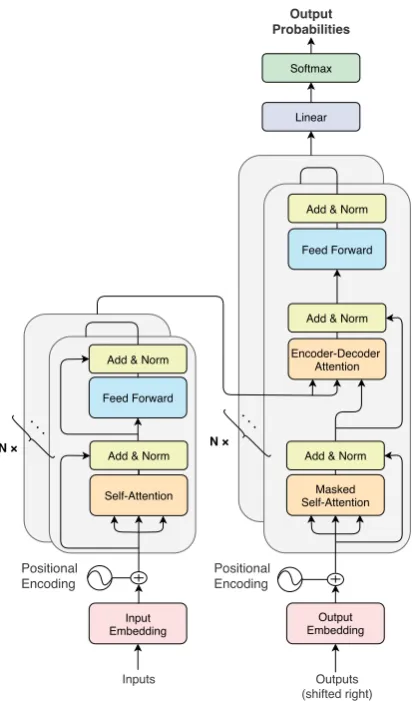
Transformer (Vaswani et al.,2017) is an encoder-decoder model that has a distinct architecture based on self-attention. Figure 1 shows the ar-chitecture of the model. Unlike RNN-based NMT and CNN-based NMT, Transformer does not have a recurrent or convolutional configuration of net-works. Instead, it encodes source sentences as in-termediate representations by using self-attention and decodes them by using self-attention and encoder-decoder attention.
The encoder maps an input sequence (x1, . . . ,xn) to a sequence of vector
representa-tions Z = (z1, . . . ,zn). Given Z, the decoder
generates an output sequence (y1, . . . ,yn′). In
Self-Attention Feed Forward
N ×
Input Embedding
Inputs
Add & Norm
Add & Norm
Masked Self-Attention
N ×
Output Embedding
Outputs (shifted right)
Add & Norm Encoder-Decoder
Attention Add & Norm
Positional Encoding
Add & Norm Linear Softmax
Positional Encoding
Feed Forward
Output Probabilities
Figure 1: Architecture of Transformer
encoder and target tokens in the decoder) to vec-tors of dimensiondmodel. Because the information
on proximity between tokens is not considered in self-attention itself, the information on a token’s position is embedded by using positional encoding (PE). Specifically, PE provides a matrix that represents the absolute position information of tokens in a sentence, and Transformer adds PE to the embedding matrix of the input tokens. Each element of PE is computed by the following equations, which are sine and cosine functions of different frequencies.
P E(pos,2i) = sin(pos/100002i/dmodel),
P E(pos,2i+ 1) = cos(pos/100002i/dmodel),
where pos is the position of each input token, i
is the dimension of each element, and dmodel is
the embedding dimension of an input token. The input of the encoder’s or decoder’s first layer is the embedding matrix added with the positional encoding.
The encoder’s layer has two sub-layers. The
first sub-layer is a multi-head self-attention mech-anism, and the second layer is a simple, position-wise fully connected feed-forward network (FFN). The decoder’s layer has three sub-layers. The first sub-layer is a masked multi-head self-attention mechanism, the second sub-layer is a multi-head encoder-decoder attention mechanism, and the third sub-layer is the FFN.
Residual connection (He et al.,2016) is applied to the sub-layers, followed by layer normaliza-tion (Ba et al.,2016), i.e., the output of each sub-layer is LayerN orm(x+Sublayer(x)), where
Sublayer(x) is the output of the original sub-layer.
The self-attention and the encoder-decoder at-tention employ a multi-head atat-tention mechanism. The multi-head attention first computes h dot-product attentions after linearly mapping three in-put vectors, q,k,v*1 ∈ R1×dmodel, from d
model
dimension todkdimension with parameter
matri-ces,WiQ, WiK, WiV ∈ Rdmodel×dk(i= 1, . . . , h), where dmodel is the dimension of input vectors,
anddk = dmodel/h. In what follows, each
dot-product attention is referred to as a head (Hi (i=
1, . . . , h)).
Hi =Attention(q′,k′,v′), (1)
Attention(q′,k′,v′) =sof tmax(q ′k′T
√ dk
)v′, (2)
q′ =qWiQ,k′=kWiK,v′ =vWiV. (3)
Then, multi-head attention linearly maps concate-nated heads with a parameter matrix, Wo ∈ Rdmodel×dmodel.
M ultiHead(q,k,v) =Concat(H1, . . . , Hh)WO.
(4) The encoder’s self-attention computes Equation
4by substituting the intermediate states of the en-coder, x1, . . . ,xn, for q,k,v. Specifically, each
head computes the following weighted sum.
zi= n
∑
j=1
αijxjWV, (5)
where z1, . . . ,zn are the outputs of the
self-attention. Each coefficient, αij, is computed by
using a softmax function:
αij =
exp (eij)
∑n
k=1exp (eik)
, (6)
*1In this paper, we treat a vector as a row vector according
whereeij is computed:
eij =
(xiWQ√)(xjWK)T
dz
, (7)
wheredzis the dimension ofzi.
The decoder’s self-attention computes Equation
4by substituting the intermediate states of the de-coder for q,k,v. During inference, however, it is not possible for the decoder to get the infor-mation on the words that will be generated later when predicting a word, i.e., only the intermedi-ate stintermedi-ates of the sub-sequence that has been gener-ated can be used for self-attention. Hence, masked attention is introduced to the decoder’s self-attention so as not to calculate the self-self-attention between a predicted word and succeeding words. Masked self-attention is calculated by changing Equation7:
eij =
{
(xiWQ√)(xjWK)T
dz (i≥j),
−∞ (otherwise). (8)
The coefficient representing the strength of the re-lationship between a certain word and the word lo-cated behind it (i < j) becomes zero, and it can be controlled so as not to consider the relationship. Hence, Equation6is changed:
αij =
{ exp (eij)
∑n
k=1exp (eik) (i≥j),
0 (otherwise). (9)
In the encoder-decoder attention, the intermedi-ate stintermedi-ates of the decoder are used for q, and the outputs of the encoder are used fork,v.
The FFN for inputxcompute as follows:
F F N(x) =max(0,xW1+b1)W2+b2, (10)
whereW1 ∈Rdmodel×df f,W2 ∈ Rdf f×dmodel are parameter matrices, andb1,b2are biases.
3.2 Transformer with Relative Positional Encoding
Shaw et al. (2018) proposed an extended
trans-former model that captures the pairwise relation-ships between input elements in terms of relative positions in both the encoder and decoder. In their method, the relationships between the intermedi-ate representations xi and xj, i.e., relative
posi-tion informaposi-tion between thei-th andj-th words in an input sentence, are represented by vectors
aVij,aKij ∈ Rdk. The relative position representa-tions are added to the output of the sub-layer to be
bought
father
My
car
a red
.
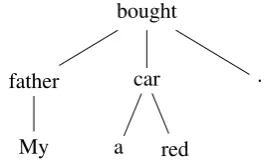
Figure 2: Example of Dependency Tree
the input to the next layer. Specifically, the follow-ing equation is used instead of Equation5.
zi= n
∑
j=1
αij(xjWV +aVij). (11)
The following equation is also used for the sub-stitution of Equation7in order to consider relative position relationships between words in calculat-ingeij:
eij =
xiWQ(xj√WK+aKij)T
dz
. (12)
Shaw et al. (2018) assume that relative
posi-tion informaposi-tion is not useful when the distance is long. They define the maximum relative position as a constantk. In addition, the relative position relationships between two words are captured by 2k+ 1 unique labels as follows, considering that succeeding words are in a positive direction and preceding words are in a negative direction.
aKij =wclipK (j−i,k), (13)
aVij =wclipV (j−i,k), (14)
clip(x, k) =max(−k, min(k, x)), (15)
where wK = (w−Kk, . . . ,wKk) and wV = (wV−k, . . . ,wkV) (wKk ,wkV ∈Rdk) are relative po-sition representations to be learned.
4 Dependency-Based Relative Positional Encoding for Transformer
My father bought a red car .
My 0 -1 -2 0 0 -1 -1
father 1 0 -1 1 1 0 0
bought 2 1 0 2 2 1 1
a 0 -1 -2 0 0 -1 -1
red 0 -1 -2 0 0 -1 -1
car 1 0 -1 1 1 0 0
. 1 0 -1 1 1 0 0
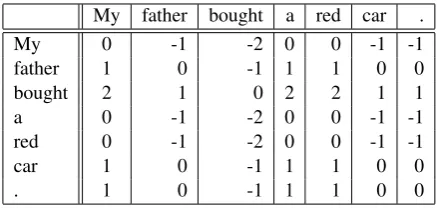
Table 1: Examples of Dependency-based Inter-Word Distances
the self-attention mechanism, following the idea of relative positional encoding (Shaw et al.,2018). The inter-word distance on dependency trees is defined as the relative depth between two words in dependency trees. The relative depthdistij
be-tween nodeniand nodenjcorresponding to word
wiand wordwj is defined as follows:
distij =depth(nj)−depth(ni), (16)
wheredepth(n)is the depth of nodenin a depen-dency tree. For example, in Figure2, the depth of “bought” (w3) relative to “My” (w1) is calculated by dist1,3 = 0−2 = −2. Table 1 shows a list of the inter-word distances on the dependency tree shown in Figure2.
The relative position between nodeniand node
nj in a source dependency tree is represented by
vectors, bVij,bKij ∈ Rdk, and the following equa-tions are used instead of Equaequa-tions11and12.
zi= n
∑
j=1
αij(xjWV +bVij), (17)
eij =
xiWQ(xj√WK+bKij)T
dz
. (18)
We assume that the influence of a distance de-creases if the distance is longer than some certain threshold. We limit the maximum distance to a constant l. The relative position representations
bVij andbKij between nodeniand nodenj in a
de-pendency tree are defined with inter-word distance labels:
bKij =wKclip(distij,l), (19)
bVij =wVclip(dist
ij,l). (20) Using these expressions, the encoder’s self-attention networks learn the relative position rep-resentations on a source dependency structure. We call this modelT ransf ormerdep.
We also describe a hybrid model that learns both relative position representations on dependency structures and relative position representations for linear relations in sentences, i.e., the relative posi-tional encoding explained in Section3.2. This hy-brid method is calledT ransf ormerdep+rel. The
T ransf ormerdep+rel model uses the sum ofaVij
andbVij and the sum ofaKij andbKij as relative po-sition information between two words. zi andeij
are defined inT ransf ormerdep+relas follows:
zi = n
∑
j=1
αij(xjWV +aVij+bVij), (21)
eij =
xiWQ(xjW√K+aKij +bKij)T
dz
. (22)
5 Experiments
5.1 Experimental Setup
We experimented on the WAT’18 Asian Scien-tific Paper Excerpt Corpus (ASPEC) (Nakazawa
et al.,2016) by using the Japanese-to-English
lan-guage pair. We tokenized English sentences by us-ing Moses (Koehn et al.,2007) and Japanese sen-tences by using KyTea (Neubig et al.,2011). We also parsed the dependency of the Japanese sen-tences by using EDA*2.
For model learning, we used 1,341,417 sentence pairs of 50 words or less for both the English and Japanese sentences from the first 1.5 million sen-tence pairs of the training data (1.txt, train-2.txt). The Japanese dictionary was comprised of words that appeared 7 times or more in the training data, and the English dictionary was comprised of words that appeared 10 times or more in the training data. The other words were replaced with
⟨U N K⟩ tags representing unknown words. We
used 1,790 sentences (dev.txt) as validation data and 1,812 sentences (test.txt) as test data.
We compared our models, T ransf ormerdep
and T ransf ormerdep+rel, with two baseline
Transformer NMT models, T ransf ormerabs
(Vaswani et al.,2017), which learns absolute posi-tion representaposi-tions, andT ransf ormerrel(Shaw
et al.,2018), which learns relative position repre-sentations in a sentence.
Hyper-parameters of all Transformer mod-els were determined, following the settings of
Vaswani et al.(2017). We set the number of stacks
*2http://www.ar.media.kyoto-u.ac.jp/
Model BLEU
T ransf ormerabs 25.91
T ransf ormerrel 26.72
T ransf ormerdep 26.10
T ransf ormerdep+rel 27.22
Table 2: Experimental Results
of the encoder and decoder layers to 6, the num-ber of heads to 8, and the embedding dimension to 512. We used the Adam optimizer (Kingma and Ba,2015) withβ1 = 0.9, β2 = 0.98, ϵ= 10−9. We used the same warm-up and decay strategy for the learning rate as Vaswani et al. (2017), with 4,000warm-up steps.
The maximum distances of the relative po-sition for linear relations in the sentences and dependency-based relations were set as k = 2,
l = 2 for T ransf ormerrel, T ransf ormerdep,
andT ransf ormerdep+rel*3. The batch size was
256, the number of epochs was 30, and the model with the best accuracy for the validation data was applied to the test data. In our experiments, target sentences were generated by a greedy algorithm.
5.2 Results
The evaluation results are shown in Table
2. We used BLEU to evaluate the transla-tion performance. As shown in the table,
T ransf ormerdep improved by 0.19 BLEU
points against T ransf ormerabs. This means
that the dependency-based positional encod-ing was effective for the Transformer model. Although the effectiveness of our dependency-based positional encoding (T ransf ormerdep)
was not as great as the relative positional en-coding (T ransf ormerrel), the hybrid model
(T ransf ormerdep+rel) achieved the best result
among these models. T ransf ormerdep+rel
improved by 1.31 BLEU points against
T ransf ormerabs and by 0.50 BLEU points
againstT ransf ormerrel. From these results, on
the Japanese-to-English translation task, the per-formance of Transformer NMT can be improved by incorporating source dependency structures into relative position representations.
bVij bKij BLEU
✓ ✓ 16.71
× ✓ 16.60
✓ × 15.62
× × 8.69
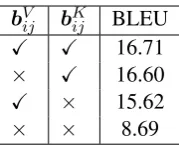
Table 3: Experimental Results for Ablating Rela-tive Position RepresentationsbVij,bKij
5.3 Discussion
Shaw et al. (2018) verified the effectiveness of
bothaV
ij andaKij, representing relative positional
relationships. They showed that the translation ac-curacy was comparative when aVij was removed from their model, but the translation accuracy de-creased whenaKij was removed. This means that
aKij was an effective representation, but aVij was less effective. In this section, to confirm the ef-fectiveness of the dependency-based representa-tions, we conducted ablation experiments on bVij
andbKij. We evaluated the Japanese-English trans-lation performance for T ransf ormerdep. The
absolute positional encoding was removed from all models, following the settings of Shaw et al.
(2018)’s verification. Specifically, we evaluated (i) theT ransf ormerdepmodel that used onlybVij,
where Equation 18 was changed to Equation 7, (ii) the T ransf ormerdep model that used only
bKij, where Equation17 was changed to Equation
5, and (iii) theT ransf ormerdepmodel that used
neitherbVij andbKij, i.e.,T ransf ormerabswithout
the absolute positional encoding.
The settings for the ablation experiment were as follows. In model training, we used the first 100,000 sentence pairs of 50 words or less for both English and Japanese sentences, which were ex-tracted from the training data (train-1.txt). Both the Japanese dictionary and the English dictionary were comprised of words that appeared 2 times or more in the training data, and the other words were treated as unknown words with UNK tags. The batch size was 100, and the number of epochs was 50. Other settings were the same as the main ex-periments in Section5.1.
The results are shown in Table 3. Ta-ble 3 shows that T ransf ormerdep using only
bVij was 1.09 points lower than the baseline
T ransf ormerdep, which used both bVij and
*3We chosek= 2becauseShaw et al.(2018) showed that
bKij, while T ransf ormerdep using only bKij
was 0.11 points slightly lower than the
base-line T ransf ormerdep. Table 3 also shows that
the T ransf ormerdep that used neither bVij and
bKij was 8.02 points lower than the baseline
T ransf ormerdep, which was significantly worse.
These results were consistent with the exper-imental results in Shaw et al. (2018). The dependency-based relative position representa-tions,bKij andbVij, were shown to be effective, but
bKij was more effective thanbVij.
6 Conclusion
In this paper, we proposed a novel Transformer NMT model that incorporates syntactic distances between two source words into the relative po-sitional encoding of an encoder’s self-attention mechanism. We demonstrated that our proposed model improved the translation accuracy, in terms of BLUE score, on the ASPEC Japanese-to-English translation task.
For future work, we would like to improve our model by introducing relative positional encoding to target dependency structures, i.e., dependency-based relative positional encoding for decoders. For example, we would like to integrate our en-coding into the dependency-based decoder in (Wu et al.,2018).
Acknowledgement
The research results have been achieved by “Re-search and Development of Deep Learning Tech-nology for Advanced Multilingual Speech Trans-lation”, the Commissioned Research of National Institute of Information and Communications Technology (NICT) , JAPAN. This work was par-tially supported by JSPS KAKENHI Grant Num-ber JP18K18110.
References
Roee Aharoni and Yoav Goldberg. 2017. Towards string-to-tree neural machine translation. In Pro-ceedings of the 55th Annual Meeting of the As-sociation for Computational Linguistics (Volume 2: Short Papers). Association for Computational Linguistics, Vancouver, Canada, pages 132–140.
https://doi.org/10.18653/v1/P17-2021.
Jimmy Lei Ba, Jamie Ryan Kiros, and Geoffrey E Hin-ton. 2016. Layer normalization. arXiv preprint arXiv:1607.06450.
Kehai Chen, Rui Wang, Masao Utiyama, Lemao Liu, Akihiro Tamura, Eiichiro Sumita, and Tiejun Zhao. 2017. Neural machine translation with
source dependency representation. In
Proceed-ings of the 2017 Conference on Empirical Meth-ods in Natural Language Processing. Association for Computational Linguistics, pages 2846–2852.
https://doi.org/10.18653/v1/D17-1304.
Yuan Ding and Martha Palmer. 2005. Machine translation using probabilistic synchronous
depen-dency insertion grammars. In Proceedings of
the 43rd Annual Meeting of the Association for Computational Linguistics (ACL’05). Association for Computational Linguistics, pages 541–548.
http://aclweb.org/anthology/P05-1067.
Akiko Eriguchi, Kazuma Hashimoto, and Yoshi-masa Tsuruoka. 2016. Tree-to-sequence
atten-tional neural machine translation. In
Proceed-ings of the 54th Annual Meeting of the As-sociation for Computational Linguistics (Volume 1: Long Papers). Association for Computational Linguistics, Berlin, Germany, pages 823–833.
https://doi.org/10.18653/v1/P16-1078.
Akiko Eriguchi, Yoshimasa Tsuruoka, and Kyunghyun Cho. 2017. Learning to parse and translate improves
neural machine translation. InProceedings of the
55th Annual Meeting of the Association for Compu-tational Linguistics (Volume 2: Short Papers). Asso-ciation for Computational Linguistics, pages 72–78.
https://doi.org/10.18653/v1/P17-2012.
Jonas Gehring, Michael Auli, David Grangier, De-nis Yarats, and Yann N. Dauphin. 2017. Convolu-tional sequence to sequence learning. In Doina Pre-cup and Yee Whye Teh, editors,Proceedings of the 34th International Conference on Machine Learn-ing. PMLR, International Convention Centre, Syd-ney, Australia, volume 70 of Proceedings of Ma-chine Learning Research, pages 1243–1252.
K. He, X. Zhang, S. Ren, and J. Sun. 2016.
Deep residual learning for image recognition.
In 2016 IEEE Conference on Computer Vision and Pattern Recognition (CVPR). pages 770–778.
https://doi.org/10.1109/CVPR.2016.90.
Diederik P. Kingma and Jimmy Ba. 2015. Adam:
A method for stochastic optimization. In 3rd
International Conference on Learning Represen-tations, ICLR 2015, San Diego, CA, USA, May 7-9, 2015, Conference Track Proceedings.
http://arxiv.org/abs/1412.6980.
Philipp Koehn, Hieu Hoang, Alexandra Birch, Chris Callison-Burch, Marcello Federico, Nicola Bertoldi, Brooke Cowan, Wade Shen, Christine Moran, Richard Zens, Chris Dyer, Ondrej Bojar, Alexan-dra Constantin, and Evan Herbst. 2007. Moses: Open source toolkit for statistical machine
trans-lation. In Proceedings of the 45th Annual
Poster Sessions. Association for Computational Lin-guistics, Prague, Czech Republic, pages 177–180.
https://www.aclweb.org/anthology/P07-2045.
Thang Luong, Hieu Pham, and Christopher D. Man-ning. 2015. Effective approaches to attention-based neural machine translation. In Proceedings of the 2015 Conference on Empirical Methods in Natu-ral Language Processing. Association for Compu-tational Linguistics, pages 1412–1421.
Chunpeng Ma, Akihiro Tamura, Masao Utiyama, Ei-ichiro Sumita, and Tiejun Zhao. 2019. Improv-ing neural machine translation with neural
syntac-tic distance. InProceedings of the 2019
Confer-ence of the North American Chapter of the As-sociation for Computational Linguistics: Human Language Technologies, Volume 1 (Long and Short Papers). Association for Computational Linguis-tics, Minneapolis, Minnesota, pages 2032–2037.
https://www.aclweb.org/anthology/N19-1205.
Chunpeng Ma, Akihiro Tamura, Masao Utiyama, Tiejun Zhao, and Eiichiro Sumita. 2018.
Forest-based neural machine translation. In
Proceed-ings of the 56th Annual Meeting of the Asso-ciation for Computational Linguistics (Volume 1: Long Papers). Association for Computational Lin-guistics, Melbourne, Australia, pages 1253–1263.
https://www.aclweb.org/anthology/P18-1116.
Toshiaki Nakazawa, Manabu Yaguchi, Kiyotaka Uchi-moto, Masao Utiyama, Eiichiro Sumita, Sadao Kurohashi, and Hitoshi Isahara. 2016. Aspec: Asian scientific paper excerpt corpus. In Proceedings of the Ninth International Conference on Language Re-sources and Evaluation (LREC 2016). pages 2204– 2208.
Graham Neubig, Yosuke Nakata, and Shinsuke Mori. 2011. Pointwise prediction for robust, adaptable japanese morphological analysis. InProceedings of the 49th Annual Meeting of the Association for Com-putational Linguistics: Human Language Technolo-gies. Association for Computational Linguistics, pages 529–533. http://aclweb.org/anthology/P11-2093.
Rico Sennrich and Barry Haddow. 2016. Linguistic input features improve neural machine translation. InProceedings of the First Conference on Machine Translation: Volume 1, Research Papers. Associ-ation for ComputAssoci-ational Linguistics, pages 83–91.
https://doi.org/10.18653/v1/W16-2209.
Peter Shaw, Jakob Uszkoreit, and Ashish Vaswani. 2018. Self-attention with relative position
repre-sentations. InProceedings of the 2018 Conference
of the North American Chapter of the Association for Computational Linguistics: Human Language Technologies, Volume 2 (Short Papers). Associa-tion for ComputaAssocia-tional Linguistics, pages 464–468.
https://doi.org/10.18653/v1/N18-2074.
Yikang Shen, Zhouhan Lin, Athul Paul Jacob, Alessan-dro Sordoni, Aaron Courville, and Yoshua Ben-gio. 2018. Straight to the tree: Constituency
parsing with neural syntactic distance. In
Pro-ceedings of the 56th Annual Meeting of the Asso-ciation for Computational Linguistics (Volume 1: Long Papers). Association for Computational Lin-guistics, Melbourne, Australia, pages 1171–1180.
https://doi.org/10.18653/v1/P18-1108.
Emma Strubell, Patrick Verga, Daniel Andor, David Weiss, and Andrew McCallum. 2018.
Linguistically-informed self-attention for
se-mantic role labeling. In Proceedings of the
2018 Conference on Empirical Methods in Natural Language Processing. Association for Computational Linguistics, pages 5027–5038.
http://aclweb.org/anthology/D18-1548.
Ilya Sutskever, Oriol Vinyals, and Quoc V Le. 2014. Sequence to sequence learning with neural net-works. In Z. Ghahramani, M. Welling, C. Cortes, N. D. Lawrence, and K. Q. Weinberger, editors, Ad-vances in Neural Information Processing Systems 27, Curran Associates, Inc., pages 3104–3112.
Ashish Vaswani, Noam Shazeer, Niki Parmar, Jakob Uszkoreit, Llion Jones, Aidan N Gomez, Ł ukasz Kaiser, and Illia Polosukhin. 2017. Attention is all
you need. In I. Guyon, U. V. Luxburg, S.
Ben-gio, H. Wallach, R. Fergus, S. Vishwanathan, and R. Garnett, editors, Advances in Neural Informa-tion Processing Systems 30, Curran Associates, Inc., pages 5998–6008. http://papers.nips.cc/paper/7181-attention-is-all-you-need.pdf.
Shuangzhi Wu, Dongdong Zhang, Zhirui Zhang, Nan Yang, Mu Li, and Ming Zhou. 2018. Dependency-to-dependency neural
ma-chine translation. IEEE/ACM Trans. Audio,
Speech and Lang. Proc. 26(11):2132–2141.