239
Dependency-Based Self-Attention for Transformer NMT
Hiroyuki Deguchi, Akihiro Tamura, Takashi Ninomiya
Ehime University
{deguchi@ai., tamura@, ninomiya@}cs.ehime-u.ac.jp
Abstract
In this paper, we propose a new Trans-former neural machine translation (NMT) model that incorporates dependency re-lations into self-attention on both source and target sides, dependency-based self-attention. The dependency-based self-attention is trained to attend to the modi-fiee for each token under constraints based on the dependency relations, inspired by linguistically-informed self-attention (LISA). While LISA was originally de-signed for Transformer encoder for se-mantic role labeling, this paper extends LISA to Transformer NMT by masking fu-ture information on words in the decoder-side dependency-based self-attention. Ad-ditionally, our dependency-based self-attention operates at subword units cre-ated by byte pair encoding. Experiments demonstrate that our model achieved a 1.0 point gain in BLEU over the base-line model on the WAT’18 Asian Scientific Paper Excerpt Corpus Japanese-to-English translation task.
1 Introduction
In the field of machine translation (MT), the Transformer model (Vaswani et al., 2017) has outperformed recurrent neural network (RNN)-based models (Sutskever et al., 2014) and con-volutional neural network (CNN)-based models (Gehring et al., 2017) on many translation tasks, and thus has garnered attention from MT re-searchers. The Transformer model computes the strength of a relationship between two words in a sentence by means of a self-attention mecha-nism, which has contributed to the performance improvement in not only MT but also various NLP
tasks such as language modeling and semantic role labeling (SRL).
The performance of MT, including statisti-cal machine translation and RNN-based neural machine translation (NMT), has been improved by incorporating sentence structures (Lin, 2004;
Chen et al.,2017;Eriguchi et al.,2017;Wu et al.,
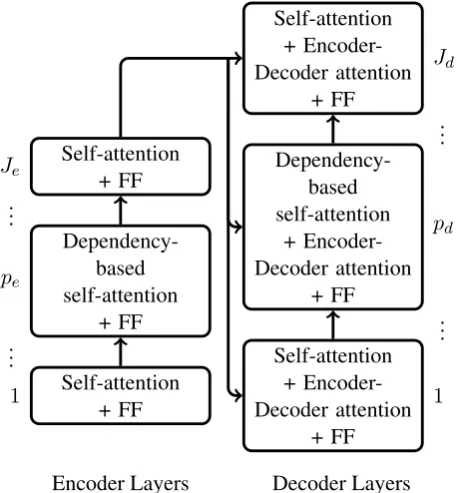
2018). In addition,Strubell et al.(2018) have im-proved a Transformer-based SRL model by in-corporating dependency structures of sentences into self-attention, which is called linguistically-informed self-attention (LISA). In LISA, one at-tention head of a multi-head self-atat-tention is trained with constraints based on dependency rela-tions to attend to syntactic parents for each token. In the present work, we aim to improve trans-lation performance by utilizing dependency rela-tions in Transformer NMT. To this end, we pro-pose a Transformer NMT model that incorporates dependency relations into self-attention on both source and target sides. Specifically, in training, a part of self-attention is learned with constraints based on dependency relations of source or target sentences to attend to a modifiee for each token, and, in decoding, the proposed model translates a sentence in consideration of dependency relations in both the source and target sides, which are cap-tured by our self-attention mechanisms. Hereafter, the proposed self-attention is called based self-attention. Note that the dependency-based self-attention is inspired by LISA, but the straightforward adaptation of LISA, which is pro-posed for Transformer encoder, does not work well for NMT because a target sentence is not fully revealed in inference. Therefore, the pro-posed model masks future information on words in the decoder-side dependency-based self-attention to prevent from attending to unpredicted subse-quent tokens.
at-tention as follows:
Qparse =S(p−1)WQparse, (11)
Kparse =S(p−1)WKparse, (12)
Vparse =S(p−1)WVparse, (13)
where WQparse, WKparse, and WVparse are d×
dhead weight matrices. Next, an attention weight
matrixAparse, where each value indicates the
de-pendency relationship between two words, is cal-culated by using the bi-affine operation as follows:
Aparse =sof tmax(QparseU(1)KparseT +QparseU(2)),
(14)
whereU(1)∈Rdhead×dhead,U(2)=
n
z }| { (u. . .u), and
u ∈ Rdhead are the parameters. In A
parse, the
probability of token q being the head of token t
(i.e.,tmodifyingq) is modeled asAparse[t, q]:
P(q=head(t)|X) =Aparse[t, q], (15)
whereXis a source sentence or a target sentence, and the root token is defined as having a self-loop (i.e.,q =head(t) = ROOT). Then, a weighted representation matrixMparse, which includes
de-pendency relationships in the source sentence or target sentence, is obtained by multiplyingAparse
andVparse:
Mparse=AparseVparse. (16)
Finally, after one attention head (e.g., Mn(phead) )
is replaced withMparse, the concatenation of all Mh(p)(i.e.,MparseandM1(p,2),...,nhead−1) is mapped
to ad-dimensional matrixM(p) like the
conven-tional multi-head attention:
M(p)=WM(p)[Mparse;M1(p);. . .;M (p)
nhead−1],
(17) whereWM(p) ∈Rd×dis a parameter matrix.
As can be seen in Equation (17), in the dependency-based self-attention, dependency re-lations are identified by one attention headMparse
of thep-th layer’s multi-head attention.
3.2 Objective Function
Our model learns translation and dependency parsing at the same time by minimizing the fol-lowing objective function:
etokens+λenceparseenc +λdeceparsedec , (18)
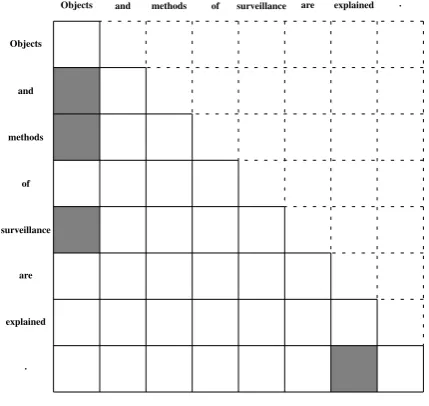
Objects and methods of surveillance are explained .
(a) Dependency relationships.
Objects and methods of surveillance are explained .
Objects
and
methods
of
surveillance
are
explained
.
(b) Attention matrix representing supervisions.
Figure 3: Decoder side masked dependency-based self-attention.
whereetokensis the error of translation, andeparseenc
and eparsedec are the errors of dependency
pars-ing in the encoder and the decoder, respectively.
λenc > 0 and λdec > 0 are hyper-parameters
to control the influence of dependency parsing er-rors in the encoder and the decoder, respectively.
etokens is calculated by label smoothed cross
en-tropy (Szegedy et al.,2016), andeparseenc andeparsedec
are calculated by cross entropy.
Note that, in the training of the decoder-side dependency-based self-attention, future informa-tion is masked to prevent attending to unpre-dicted tokens in inference. An example of training data for the decoder-side dependency-based self-attention is provided in Figure 3, where(a) is an example of dependency structures3and(b)shows the attention matrix representing the supervisions from (a). In (b), a dark cell indicates a depen-dency relation and a dotted cell means a masked
3In this paper, an arrow is drawn from a modifier to its
sentence pairs train 1,198,149
dev 1,790
test 1,812
Table 1: Statistics of the ASPEC data.
Model BLEU
Trans. 27.29
Trans. + DBSA(Enc) 28.05 Trans. + DBSA(Dec) 27.86 Trans. + DBSA(Enc) + DBSA(Dec) 28.29
Table 2: Translation performance.
element. As shown, future information on each word is masked. For example, the dependency re-lation from “are” to “explained” is masked.
3.3 Subword Dependency-Based Self-Attention
Recent NMT models have improved the trans-lation performance by treating a sentence as a subword sequence rather than a word sequence. Therefore, we extend dependency-based self-attention to work for subword sequences. In our subword dependency-based self-attention, a sen-tence is divided into a subword sequence by BPE (Sennrich et al., 2016). When a word is divided into multiple subwords, the modifiee (i.e., the head) of the rightmost subword is set to the modi-fiee of the original word and the modimodi-fiee of each subword other than the rightmost one is set to the right adjacent subword.
Figure 4 shows an example of subword-level dependency relations, where “@@” is a sub-word segmentation symbol. “Fingerprint” is divided into the three subwords: “Fing@@”, “er@@“, and “print”. When the head of the word “Fingerprint” is “input” in the original word-level sentence, the heads of the three sub-words are determined as follows: “er@@” = head(“Fing@@”), “print” = head(“er@@”), and “input” = head(“print”).
4 Experiments
4.1 Experiment Settings
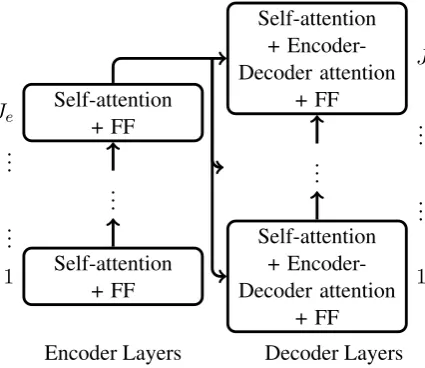
In our experiments, we compared the proposed model with a conventional Transformer NMT model, which does not incorporate dependency structures, to confirm the effectiveness of the pro-posed model. We stacked six layers for each
encoder and decoder and set nhead = 8 and d = 512. For the proposed model, we incor-porated dependency-based self-attention into the fourth layer in both the encoder and the decoder (i.e.,pe=pd= 4).
We evaluated translation performance on the WAT’18 ASPEC (Nakazawa et al., 2016) Japanese-to-English translation task. We to-kenized each Japanese sentence with KyT ea
(Neubig et al., 2011) and preprocessed according to the recommendations from WAT’184. We used the vocabulary of 100K subword tokens based on BPE for both languages and used the first 1.5 million translation pairs as the training data. In the training, long sentences with over 250 subword-tokens were filtered out. Table1 shows the statistics of our experiment data.
We used Japanese dependency structures gen-erated by EDA5 and English dependency struc-tures generated by Stanford Dependencies6in the training of the source-side dependency-based self-attention and the target-side dependency-based self-attention, respectively. Note that Stanford De-pendencies and EDA are not used in the testing.
4.2 Training Details
We trained each model using Adam (Kingma and Ba, 2014), where the learning rate and hyperparameter settings are set following
Vaswani et al.(2017). For the objective function, we setϵls (Szegedy et al., 2016) in label
smooth-ing to 0.1 and both the hyperparameters λenc
and λdec to 1.0. We set the mini-batch size to
224 and the number of epochs to 20. We chose the model that achieved the best BLEU score on the development set and evaluated the sentences generated from the test set using beam search with a beam size of 4 and length penaltyα = 0.6 (Wu et al.,2016).
4.3 Experiment Results
Table 2 lists the experiment results. Translation performance is measured by BLEU (Papineni et al., 2002). In Table 2, DBSA denotes our dependency-based self-attention. As shown, our proposed model
4
http://lotus.kuee.kyoto-u.ac.jp/WAT/ WAT2018/baseline/dataPreparationJE.html
5
http://www.ar.media.kyoto-u.ac.jp/ tool/EDA
6https://nlp.stanford.edu/software/
Fing@@ er@@ print is input as an image .
Figure 4: Subword-level dependency relationships.
Model BPE BLEU
Trans. w/o 26.39
Trans. w/ 27.29
Trans. + DBSA(Enc) + DBSA(Dec) w/o 26.62 Trans. + DBSA(Enc) + DBSA(Dec) w/ 28.29
Table 3: Effectiveness of subword.
“Trans.+DBSA(Enc)+DBSA(Dec)” performed significantly better than the baseline model “Trans.”, which demonstrates the effectiveness of our dependency-based self-attention. Table
2 also shows that using either the encoder-side dependency-based self-attention or the decoder-side dependency-based self-attention improves translation performance, and using them in combination achieves further improvements.
5 Discussion
To determine the effectiveness of our extension to utilize subwords, we evaluated the models with-out BPE, where each sentence is treated as a word sequence. In the models without BPE, words that appeared fewer than five times in the training data were replaced with the special token “<UNK>”. Table 3 lists the results. As shown, BPE im-proves the performance of both the baseline and the proposed model, which demonstrates the ef-fectiveness of the subword dependency-based self-attention. Table 3 also shows that the proposed model outperforms the baseline model when BPE is not used. This strengthens the usefulness of our dependency-based self-attention.
6 Related Work
NMT models have been improved by in-corporating source-side dependency relations (Chen et al.,2017), or target-side dependency re-lations (Eriguchi et al., 2017), or both (Wu et al.,
2018).
Chen et al. (2017) have proposed SDRNMT, which computes dependency-based context vec-tors from source-side dependency trees by CNN
and then uses the representations in the encoder of an RNN-based NMT model.
Eriguchi et al. (2017) have proposed
NMT+RNNG, which combines the RNN-based dependency parser, RNNG (Dyer et al.,
2016), and the decoder of an RNN-based NMT model.
Wu et al.(2018) have proposed a syntax-aware encoder, which encodes two extra sequences lin-earized from source-side dependency trees in ad-dition to word sequences, and have incorporated Action RNN, which implements a shift-reduce transition-based dependency parsing by predicting action sequences, into the decoder. Their method has been applied to an RNN-based NMT model and a Transformer NMT model.
As far as we know, except for Wu et al.
(2018), existing dependency-based NMT mod-els have been based on RNN-based NMT. Al-though Wu et al. (2018) used dependency rela-tions in Transformer NMT, they did not modify the Transformer model itself. In contrast, we have im-proved a Transformer NMT model to explicitly in-corporate dependency relations (i.e., dependency-based self-attention). In addition, whileWu et al.
(2018) need a parser for constructing source-side dependency structures in inference, our proposed method does not require an external parser in inference because the learned dependency-based self-attention of the encoder finds dependency re-lations.
7 Conclusion
decoder-S. Wu, D. Zhang, Z. Zhang, N. Yang, M. Li, and M. Zhou. 2018. Dependency-to-dependency neural machine translation. IEEE/ACM Transac-tions on Audio, Speech, and Language Processing
26(11):2132–2141.