423
Self-Knowledge Distillation in Natural Language Processing
Sangchul Hahn
Handong Global University Pohang, South Korea [email protected]
Heeyoul Choi
Handong Global University Pohang, South Korea [email protected]
Abstract
Since deep learning became a key player in natural language processing (NLP), many deep learning models have been showing remarkable performances in a variety of NLP tasks, and in some cases, they are even outperforming humans. Such high performance can be explained by efficient knowledge representation of deep learn-ing models. While many methods have been proposed to learn more efficient resentation, knowledge distillation from pre-trained deep networks suggest that we can use more information from the soft target probability to train other neural networks. In this paper, we propose a new knowledge distillation methodself-knowledge distilla-tion, based on the soft target probabilities of the training model itself, where mul-timode information is distilled from the word embedding space right below the soft-max layer. Due to the time complexity, our method approximates the soft target probabilities. In experiments, we applied the proposed method to two different and fundamental NLP tasks: language model and neural machine translation. The ex-periment results show that our proposed method improves performance on the tasks.
1 Introduction
Deep learning has achieved the state-of-the-art per-formance on many machine learning tasks, such as image classification, object recognition, and neural machine translation (He et al.,2016;Redmon and Farhadi,2017;Vaswani et al., 2017) and outper-formed humans on some tasks. In deep learning, one of the critical points for success is to learn bet-ter representation of data with many layers
(Ben-gio et al.,2013) than other machine learning algo-rithms. In other words, if we make a model to learn better representation of data, the model can show better performance.
In natural language processing (NLP) tasks like language modeling (LM) (Bengio et al., 2003; Mikolov et al., 2013) and neural machine trans-lation (NMT) (Sutskever et al., 2014; Bahdanau et al.,2015), when the models are trained, they are to generate many words in sentence, which is a sequence of classification steps, for each of which they choose a target word among the whole words in the dictionary. That is why LM and NMT are usually trained with the sum of cross-entropies over the target sentence. Thus, although language re-lated tasks are more of generation rather than clas-sification, the models estimate target probabilities with the softmax operation on the previous neu-ral network layers and the target distributions are provided as one-hot representations. As data rep-resentation in NLP models, word symbols should also be represented as vectors.
2003;Mikolov et al.,2010). Recently, several ap-proaches have been proposed to make more effi-cient word embedding matrices, usually based on contextual information (Søgaard et al.,2017;Choi et al.,2017).
On the other hand, knowledge distillation was proposed by (Hinton et al.,2015) to train new and usually shallow networks using hidden knowledge in the probabilities produced by the pretrained net-works. It shows that there is knowledge not only in the target probability corresponding to the target class but also in the other class probabilities in the estimation of the trained model. In other words, the other class probabilities can contain additional information describing the input data samples dif-ferently even when the samples are in the same class. Also, samples from different classes could produce similar distributions to each other.
In this paper, we propose a new knowledge dis-tillation method,self-knowledge distillation(SKD) based on the word embedding of the training model itself. That is, self-knowledge is distilled from the predicted probabilities produced by the training model, expecting the model has more information as it is more trained. In the conventional knowledge distillation, the knowledge is distilled from the esti-mated probabilities of pretrained (or teacher) mod-els. Contrary, in the proposed SKD, knowledge is distilled from the current model in the training process, and the knowledge is hidden in the word embedding. During the training process, the word embedding reflects the relationship between words in the vector space. A word close to the target word in the vector space is expected to have similar distribution after softmax, and such information can be used to approximate the soft target proba-bility as in knowledge distillation. We apply our proposed method to two popular NLP tasks: LM and NMT. The experiment results show that our proposed method improves the performance of the tasks. Moreover, SKD reduces overfitting prob-lems which we believe is because SKD uses more information.
The paper is organized as follows. Background is reviewed in Section 2. In Section 3, we describe our proposed method, SKD. Experiment results are presented and analyzed in Section 4, followed by Section 5 with conclusion.
2 Background
In this section, we briefly review the cross-entropy and knowledge distillation. Also, since our pro-posed method is based on word embedding, the layer right before the softmax operation, word em-bedding process is summarized.
2.1 Cross Entropy
For classification withCclasses, neural networks produce class probabilitiespi,i ∈ {0,1, ...C}by
using a softmax output layer which calculates class probabilities from the logit,ziconsidering the other
logits as follows.
pi=
exp (zi) P
kexp (zk)
. (1)
In most classification problems, the objective function for a single sample is defined by the cross-entropy as follows.
J(θ) = −X k
yklogpk, (2)
whereykandpkare the target and predicted
proba-bilities. The cross-entropy can be simply calculated by
J(θ) = −logpt, (3)
when the target probability yis a one-hot vector defined as
yk=
1, ifk=t(target class)
0, otherwise . (4)
Note that the cross-entropy objective function says only how likely input samples belong to the corresponding target class, and it does not provide any other information about the input samples.
2.2 Knowledge Distillation
A well trained deep network model contains mean-ingful information (or knowledge) extracted from training datasets for a specific task. Once a deep model is trained for a task, the trained model can be used to train new smaller (shallower or thinner) networks as shown in (Hinton et al.,2015;Romero et al.,2014). This approach is referred to as knowl-edge distillation.
with the distilled knowledge from the trained deep model, it can achieve a similar (or sometimes even better) performance compared to the pretrained deep model.
In the pretrained model, knowledge lies in the class probabilities produced by softmax of the model as in Eq. (1). All probability values includ-ing the target class probability describe relevant information about the input data. Thus, instead of one-hot representation of the target label where only the target class is considered in cross-entropy, all probabilities over the whole classes from the pretrained model can provide more information about the input data in cross-entropy, and can teach new models more efficiently. All probabilities from the pretrained model are considered assoft target probabilities.
In a photo tagging task, depending on the other class probabilities, we understand the input image better than just target class. When a class ‘mouse’ has the highest probability, if ‘mascot’ has a rel-atively high probability, then the image would be probably ‘mickey mouse’. If ‘button’ or ‘pad’ has a high probability, the image would be a mouse as a computer device. The other class probabilities have some extra information and such knowledge in the pretrained model can be transferred to a new model by using a soft target distribution of the training set.
When the target labels are available, the objec-tive function is a weighted sum of the conventional entropy with the correct labels and the cross-entropy with the soft target distribution, given by
J(θ) =−(1−λ) logpt−λ X
k
qklogpk, (5)
where pk is probability for class k produced by
current model with parameterθ, andqkis the soft
target probability from the pretrained model. λ
controls the amount of knowledge from the trained model. Note that the conventional knowledge distil-lation extracts knowledge from a pretrained model, and in this paper, we propose to extract knowledge from the current model itself without any pretrained model.
Furthermore, in a recently proposed paper by (Furlanello et al.,2018), they proved that knowl-edge distillation can be useful to train a new model which has the same size and the same architecture as the pretrained model. They trained a teacher model first, then they trained a student model with
distilled knowledge from the teacher model. Their experiment results show that the student models outperform the teacher model. Also, even though when the teacher model has a less powerful archi-tecture, the knowledge from the trained teacher model can boost student models which have more powerful (or bigger) architectures. It means that even the knowledge is distilled from a relatively weak model, it can be useful to train a bigger model.
2.3 Word Embedding
Word embedding is to convert symbolic represen-tation of words to vector represenrepresen-tation with se-mantic and syntactic meanings, which reflects the relations between words. Including CBOW, Skip-gram (Mikolov et al.,2013), and GloVe (Penning-ton et al.,2014), various word embedding methods have been proposed to learn a word embedding matrix. The trained embedding matrix can be trans-ferred to other models like LM or NMT (Ahn et al., 2016).
CBOW predicts a word given its neighbor words, and Skip-gram predicts the neighbor words given a word. They use feedforward layers, and the last layer of CBOW includes the word embedding ma-trix,W, as follows.
z=W h+b, (6)
wherebis a bias,his hidden layer, andzis logits for the softmax operation.
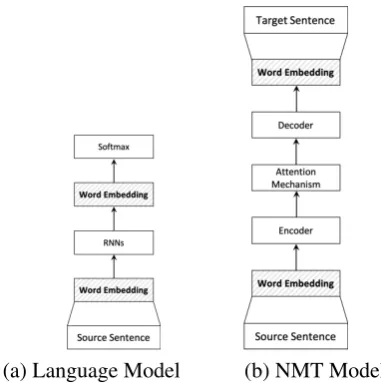
Words in the embedding space have semantic and syntactic similarities, such that two similar words are close in the space. Thus, when the classi-fication is not correct, the error can be interpreted differently depending on the similarity between the predicted word and the target word. For example, when the target word is ‘learning’, if the predicted word is ‘training’, then it is less wrong than other words like ‘flower’ or ‘internet’. In this paper, we utilize such hidden information (or knowledge) in the word embedding space, while training. Fig.1 shows where the word embedding is located in LM and NMT, respectively.
3 Self-Knowledge Distillation
(a) Language Model (b) NMT Model
Figure 1: Network architectures of LM and NMT. Word embedding is presented as gray boxes in the models.
3.1 SKD Equations
In order to apply knowledge distillation on a cur-rent training model, we need to obtain soft target probabilities asqk in Eq. (5) for all classes, but
they are not available explicitly. However, when the model is trained enough, then the word embed-ding has such information implicitly. If a wordwi
is close towj in the embedding space, the
prob-abilitypi would be close topj for a given input
sample.
Whentis the target class, we calculate the soft target probabilitiesqk based on the word
embed-ding. First, we assume thatqtshould be high, and
if wk is close towt in the embedding space,qk
should be also high. That is, the Euclidean distance between words is used to estimate the soft target probability. The other class probabilities (or soft target probabilities)qkcan be obtained by
qk=
1
Z exp{−σkwt−wkk2}, (7)
wherek · k2isl2-norm, andZ is a normalization term.σis a scale parameter and its value depends on the average distance to the corresponding near-est neighbors in the word embedding space. How-ever, due to the expensive computational cost, we do not calculateqkfor all classes, and we choose
just one of the other classes, which is the predicted class of the current model.
Assuming that the model predicts a classnfor a given input sample, onlyqtand qnare used as
distilled knowledge. We clip theqnvalue with 0.5,
meaning that the classncannot be more correct than the real targett, so Eq. (7) becomes
qn = min{exp{−σkwt−wnk2},0.5},
qt = 1−qn, (8)
whereqn+qt= 1. That is, we consider only two
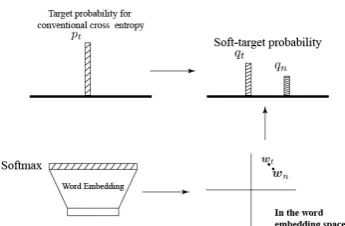
soft target probabilities as shown in Fig. 2. Note that we use Euclidean distance between wt and wnto calculateqn, but other approaches like inner
product would be possible.
Now, the objective function of SKD becomes similar to Eq. (5), and is defined by
J(θ) = −(1−λ) logpt
−λ(qtlogpt+qnlogpn), (9)
where the second term of Eq. (5) is approximated byλ(qtlogpt+qnlogpn), ignoring the other class
probabilities. Eq. (9) can be rewritten simply as follows.
J(θ) =−(1−λqn) logpt−λqnlogpn. (10)
Eqs. (9) or (10) can be understood in three cases. First, if the prediction is correct (n=t), then Eq. (9) is the same as the conventional cross-entropy objective. Second, ifwnis far fromwtin the word
embedding space, thenqnis close to zero and Eq.
(9) becomes close to the conventional cross-entropy objective. Finally, ifwnis close towt(e.g. qn=
0.4), it approximates the soft target probability with only two classestandn, and the model is trained to produce probabilities for classtandnas close asqtandqn. This approach trains the model with
different targets for different input samples. Fig. 2 presents how SKD obtains simplified soft target distribution based on the distance of target and estimated vectors in the word embedding space.
3.2 SKD Algorithm
Figure 2: Given a target classt, a soft target prob-abilities are obtained based on the distance in the word embedding space. However, only the target class and the predicted class have soft target proba-bilities in SKD.
transits to Eq. (10). To implement the transition, another parameterαis introduced to Eq. (10), lead-ing to the final objective function as follows.
J(θ) =−(1−αλqn) logpt−αλqnlogpn, (11)
αstarts from 0 with which Eq. (11) becomes the conventional cross-entropy. AfterK iterations,α
increases byηper iteration and eventually goes up to 1 with which Eq. (11) becomes the same as Eq. (9). In our experiments, we used a simplified equa-tion as in Eq. (12) withoutλso that the objective function relies gradually more on the soft target probabilities as training goes.
J(θ) =−(1−αqn) logpt−αqnlogpn. (12)
Table1summarizes the proposed SKD algorithm.
Table 1: Self-Knowledge Distillation Algorithm
Algorithm 1: SKD Algorithm
Initialize the model parametersθ
Initializeα = 0andσ
(See the experiments forσ values.) RepeatKtimes:
Train the network based on the cross-entropy in Eq. (3) Repeat until convergence:
Train the network based on
the SKD objective function in Eq. (12) Updateαwithα+η
(See the experiments forηvalues.)
3.3 NLP Tasks
SKD is applied to two different NLP tasks: lan-guage modeling (LM), and neural machine
transla-tion (NMT). Although LM and NMT are actually sentence generation rather than classification, they have classification steps to generate words for the target sentence. Also, the sum of cross-entropies over the words in the sentence is adapted as an objective function for them.
In addition, to check if SKD is robust against errors in the word embedding space, we also evalu-ate SKD when we add Gaussian noise in the word embedding space for target words in the decoder.
4 Experiments
To evaluate self-knowledge distillation, we com-pare it to the baseline models for language model-ing and neural machine translation.
4.1 Dataset
For language modeling, we use two different datasets: Penn TreeBank (PTB) and WiKi-2. PTB was made by (Marcus et al.,1993), and we use the pre-processed version by (Mikolov et al., 2010). In the PTB dataset, the train, valid and test sets have about 887K, 70K, and 78K tokens, respec-tively, where the vocabulary size is 10K. The WiKi-2 dataset introduced by (Merity et al.,2016) con-sists of sentences that are extracted from Wikipedia. It has about 2M, 217K, and 245K tokens for train, valid, and test sets. Its vocabulary size is about 33K. We did not apply additional pre-processing for the PTB dataset. The WiKi-2 dataset is pre-tokenized data, therefore we only added an end-of-sentence token (<EOS>) to every sentence.
For machine translation, we evaluated models on three different translation tasks (En-Fi, Fi-En, and En-De) with the available corpora from WMT’15 1. The dictionary size is 10K for En-fi and Fi-En
translation task, and 30K for the En-De translation task.
4.2 Language Modeling
Language modeling (LM) has been used in many different NLP tasks like automatic speech recogni-tion (ASR), and machine translarecogni-tion (MT) to cap-ture syntactic and semantic struccap-ture of a natural language. The neural network-based language mod-els (NNLM) and recurrent neural network language model (RNNLM) catch the syntactic and seman-tic regularities of an input language (Bengio et al., 2003;Mikolov et al.,2013). RNNLM is our base-line, which consists of a single LSTM layer and
single feed forward layer with ReLU (Le et al., 2015).
We evaluate four models: Baseline, Noise (with Gaussian noise on the word embedding), SKD, and Noise+SKD. To show that the information by SKD is more knowledgeable than random noise, we tested a noise injected model which injects only Gaussian noise to the word embedding space. The word dimension is set to 500 and the number of hid-den nodes is 400 for all models. We set theσand
ηin the SKD algorithm in Table10.1 (both PTB and WiKi-2 dataset) and 0.0002 (PTB), 0.00011 (WiKi-2), respectively. We applied the SKD object function after 500 batches for PTB and 900 batches for WiKi-2. Note that Wiki-2 data is larger than PTB.
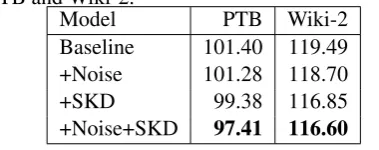
The evaluation metric is the negative log-likelihood (NLL) for each sentence (the lower is the better). Table2presents NLLs for the test data of two datasets with different models. It shows that our proposed methods (both noise injection and self-distillation knowledge) improve the results in the LM task. Note that SKD provides more knowl-edgeable information than Gaussian noise.
Table 2: NLLs for LM with different models on PTB and Wiki-2.
Model PTB Wiki-2
Baseline 101.40 119.49 +Noise 101.28 118.70
+SKD 99.38 116.85
+Noise+SKD 97.41 116.60
4.3 Neural Machine Translation
NMT has been widely used in machine translation research, because of its powerful performance and end-to-end training (Sutskever et al.,2014; Bah-danau et al.,2015;Johnson et al.,2017). Attention-based NMT models consist of an encoder, a de-coder, and the attention mechanism (Bahdanau et al.,2015), which is our baseline in this paper except for replacing GRU with LSTM and using BPE (Sennrich et al.,2016). The encoder takes the sequence of source words in the word embedding form. The decoder works in a similar way to LM, except the attention mechanism. See (Bahdanau et al.,2015) for NMT and the attention mechanism in detail.
In the experiments, we check how much SKD can improve model’s performance using the simple baseline architecture. Since SKD modifies only
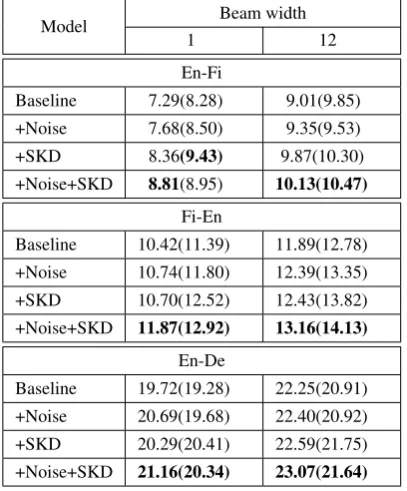
the objective function, we believe that the improve-ment by SKD is regardless of model architectures. Table 3 shows that our proposed method im-proves NMT performance by around 1 BLEU score. For qualitative comparison, some translation results are presented below. The overall quality of transla-tion of the SKD model looks better than baseline model’s. In other words, when the BLEU scores are similar, the sentences translated by the SKD model look better.
• (src) Hallituslähteen mukaan tämä on yksi monista ehdotuksista, joita harkitaan.
(trg) A governmental source says this is one of the many proposals to be considered.
(baseline)According to government revenue, this is one of the many proposals that are being considered to be considered.
(SKD)According to the government, this is one of the many proposals that are being considered.
• (src) Meillä on hyvä tunne tuotantoketjunvahvuudesta. (trg) We feel very good about supply chain capability. (baseline)We have good knowledge of the strength of the production chain.
(SKD)We have a good sense of the strength of the production chain.
• (src) En ole oikein tajunnut, että olen näin vanha. (trg) I haven’t really realized that I’m this old. (baseline)I have not been right to realise that I am so old.
(SKD)I am not quite aware that I am so old.
• (src) Ne vaikuttavat vasta tulevaisuudessa. (trg) They’ll have an impact in the future only. (baseline)They will only be affected in the future. (SKD)They will only affect in the future.
Fig. 3 shows a trajectory of theqnvalues and
scheduling of theαvalue during training the En-Fi NMT model described in Eq. (12), respectively. As expected, theqnvalue becomes larger than0.5
which means thatwn(the predicted word vector)
is close enough to thewt(the target word vector).
Fig. 3(b) shows the scheduled value ofα in Eq. (12). Theαvalue starts from0and increases up to
1while training. The model is trained with only the cross-entropy forK iterations, and then when the model captures enough knowledge to be distilled,
(a)qnvalue during NMT model training
(b) Scheduling ofαvalue of NMT training
Figure 3: (a) Change of qn value during NMT
model training for En-Fi translation task, and (b) scheduling ofαvalue in Eq. (12) of NMT training for En-Fi translation task. (a) shows that when the model is trained more, theqnvalue become more
close to the target.
improves further. It implies that SKD provides dif-ferent kinds of information from noise, while the synergy effect between SKD and noise needs more research.
Table 3: BLEU scores on the test sets for En-Fi, Fi-En and En-De with two different beam widths. The scores on the development sets are in the paren-theses.
Model Beam width
1 12
En-Fi
Baseline 7.29(8.28) 9.01(9.85)
+Noise 7.68(8.50) 9.35(9.53) +SKD 8.36(9.43) 9.87(10.30)
+Noise+SKD 8.81(8.95) 10.13(10.47)
Fi-En
Baseline 10.42(11.39) 11.89(12.78)
+Noise 10.74(11.80) 12.39(13.35)
+SKD 10.70(12.52) 12.43(13.82)
+Noise+SKD 11.87(12.92) 13.16(14.13)
En-De
Baseline 19.72(19.28) 22.25(20.91)
+Noise 20.69(19.68) 22.40(20.92)
+SKD 20.29(20.41) 22.59(21.75)
+Noise+SKD 21.16(20.34) 23.07(21.64)
Figure 4: BLEU scores of validation data while training on En-Fi corpus with four different mod-els: Baseline, +Noise, +SKD, and +Noise+SKD. The vertical axis indicates BLEU score and the horizontal axis the number of training iteration.
5 Conclusion
We proposed a new knowledge distillation method, self-knowledge distillation, from the probabilities of the currently training model itself. The method uses only two soft target probabilities that are ob-tained based on the word embedding space. The experiment results with language modeling and neural machine translation show that our method improves the performance. This method can be straightforwardly applied to other tasks where the cross-entropy is used.
As future works, we want to apply SKD to other applications with different model architectures, to show that SKD does not depend on tasks nor the model architectures. For image classification tasks, if we abuse the term ‘word embedding’ to refer to the layer right before the softmax operation, it may be possible to apply SKD in a similar way, although it is not guaranteed that comparable image classes are closely located in the word embedding space for image related tasks. Also, we can develop an automatic way for the parameters likeαin Eq. (12), and generalize the equation forqnin Eq. (8).
Acknowledgement
References
Sungjin Ahn, Heeyoul Choi, Tanel Pärnamaa, and Yoshua Bengio. 2016. A neural knowledge language model. CoRRabs/1608.00318:1–10.
Dzmitry Bahdanau, Kyunghyun Cho, and Yoshua Ben-gio. 2015. Neural Machine Translation by Jointly Learning to Align and Translate. InProc. Int’l Conf. on Learning Representations (ICLR).
Yoshua Bengio, Aaron C. Courville, and Pascal Vin-cent. 2013. Representation learning: A review and new perspectives. IEEE Trans. Pattern Anal. Mach. Intell.35(8):1798–1828.
Yoshua Bengio, Réjean Ducharme, and Pascal Vin-cent. 2003. A Neural Probabilistic Language Model.
The Journal of Machine Learning Research3:1137–
1155.
Heeyoul Choi, Kyunghyun Cho, and Yoshua Bengio. 2017. Context-dependent word representation for neural machine translation. Computer Speech and
Language45:149–160.
Tommaso Furlanello, Zachary Chase Lipton, Michael Tschannen, Laurent Itti, and Anima Anandkumar. 2018. Born-again neural networks. InProceedings of the 35th International Conference on Machine Learning, ICML 2018, Stockholmsmässan,
Stock-holm, Sweden, July 10-15, 2018. pages 1602–1611.
Kaiming He, Xiangyu Zhang, Shaoqing Ren, and Jian Sun. 2016. Deep residual learning for image recog-nition. In2016 IEEE Conference on Computer Vi-sion and Pattern Recognition, CVPR 2016, Las
Ve-gas, NV, USA, June 27-30, 2016. pages 770–778.
Geoffrey E. Hinton, Oriol Vinyals, and Jeffrey Dean. 2015. Distilling the knowledge in a neural network.
CoRRabs/1503.02531.
Melvin Johnson, Mike Schuster, Quoc V. Le, Maxim Krikun, Yonghui Wu, Zhifeng Chen, Nikhil Tho-rat, Fernanda B. Viégas, Martin Wattenberg, Greg Corrado, Macduff Hughes, and Jeffrey Dean. 2017. Google’s multilingual neural machine translation system: Enabling zero-shot translation. TACL
5:339–351.
Quoc V. Le, Navdeep Jaitly, and Geoffrey E. Hinton. 2015. A simple way to initialize recurrent networks of rectified linear units. CoRRabs/1504.00941.
Mitchell P Marcus, Mary Ann Marcinkiewicz, and Beatrice Santorini. 1993. Building a large annotated corpus of english: The Penn Treebank. Computa-tional Linguistics19(2):313–330.
Stephen Merity, Caiming Xiong, James Bradbury, and Richard Socher. 2016. Pointer sentinel mixture mod-els. CoRRabs/1609.07843.
Tomas Mikolov, Greg Corrado, Kai Chen, and Jeffrey Dean. 2013. Efficient Estimation of Word Repre-sentations in Vector Space. InProc. Int’l Conf. on
Learning Representations (ICLR).
Tomas Mikolov, Martin Karafiat, Lukas Burget, Jan Cernocky, and Sanjeev Khudanpur. 2010. Recurrent neural network based language model. In INTER-SPEECH 2010, 11th Annual Conference of the
Inter-national Speech Communication Association. pages
1045–1048.
Jeffrey Pennington, Richard Socher, and Christopher D. Manning. 2014. Glove: Global vectors for word rep-resentation. InEmpirical Methods in Natural
Lan-guage Processing (EMNLP). pages 1532–1543.
Joseph Redmon and Ali Farhadi. 2017. YOLO9000: better, faster, stronger. In 2017 IEEE Conference on Computer Vision and Pattern Recognition, CVPR
2017, Honolulu, HI, USA, July 21-26, 2017. pages
6517–6525.
Adriana Romero, Nicolas Ballas, Samira Ebrahimi Ka-hou, Antoine Chassang, Carlo Gatta, and Yoshua Bengio. 2014. Fitnets: Hints for thin deep nets.
CoRRabs/1412.6550.
Rico Sennrich, Barry Haddow, and Alexandra Birch. 2016. Neural machine translation of rare words with subword units. In54th Annual Meeting of the Asso-ciation for Computational Linguistics. pages 1715– 1725.
Anders Søgaard, Yoav Goldberg, and Omer Levy. 2017. A strong baseline for learning cross-lingual word embeddings from sentence alignments. In Proceed-ings of the 15th Conference of the European Chap-ter of the Association for Computational Linguistics, EACL 2017, Valencia, Spain, April 3-7, 2017,
Vol-ume 1: Long Papers. pages 765–774.
Ilya Sutskever, Oriol Vinyals, and Quoc V. Le. 2014. Sequence to Sequence Learning with Neural Net-works. InAdvances in Neural Information Process-ing Systems (NIPS).
Ashish Vaswani, Noam Shazeer, Niki Parmar, Jakob Uszkoreit, Llion Jones, Aidan N. Gomez, Lukasz Kaiser, and Illia Polosukhin. 2017. Attention is all you need. InAdvances in Neural Information Pro-cessing Systems 30: Annual Conference on Neural Information Processing Systems 2017, 4-9