The Impact of Semantic Linguistic Features in Relation Extraction:
A Logical Relational Learning Approach
Rinaldo Lima
1, Bernard Espinasse
2, Fred Freitas
31
Departamento de Computação, Universidade Federal Rural de Pernambuco, Brazil
2LIS UMR CNRS 7020, Aix-Marseille Université/Université de Toulon, France
3
Centro de Informática, Universidade Federal de Pernambuco, Brazil
[email protected], [email protected], [email protected]
Abstract
Relation Extraction (RE) consists in detect-ing and classifydetect-ing semantic relations be-tween entities in a sentence. The vast ma-jority of the state-of-the-art RE systems re-lies on morphosyntactic features and super-vised machine learning algorithms. This paper tries to answer important questions concerning both the impact of semantic-based features, and the integration of exter-nal linguistic knowledge resources on RE performance. For that, a RE system based on a logical and relational learning algo-rithm was used and evaluated on three ref-erence datasets from two distinct domains. The yielded results confirm that the classi-fiers induced using the proposed richer fea-ture set outperformed the classifiers built with morphosyntactic features in average 4% (F1-measure).
1
Introduction
Relation Extraction (RE) consists in detecting and classifying binary semantic relations between enti-ties in a sentence.
Many RE systems use statistical machine learn-ing techniques, such as feature-based and tree ker-nels-based methods (Choi et al., 2013) are based on a propositional hypothesis space for representing examples, i.e., they employ an attribute-value rep-resentation achieving robust results. However, this representation is not able to effectively capture structural information from parse trees without loss of information (Choi et al., 2013). More recently, other RE systems using deep learning techniques, such as Convolution Neural Networks (Nguyen and Grishman, 2015) and Recurrent Neural Net-works (Miwa and Bansal, 2016) have also been
proposed. They are based on a dense vector repre-sentation of the input words retrieved from word embeddings (Mikolov et al., 2013).
Some other RE systems rely on natural language processing (NLP) techniques for extracting rele-vant features from the text. They typically integrate shallow NLP tools for coping with lexical and syn-tactic aspects of the texts such as POS tagging, lem-matization, chunking, and syntactic parsing (Choi et al., 2013). However, according to Zouaq (2011), there are two main reasons to seriously consider deeper linguistic processing for RE: (i) it may pro-vide deeper semantic meaning; (ii) NLP tools are becoming sufficiently robust to be considered as re-liable tools for knowledge and model extraction.
Contrarily to related work above, this work sub-scribes to the idea of performing RE employing the Logical and Relational Learning (LRL) (de Raedt, 2008) approach that can generate classification models from complex data structures such as graphs or multiple tables. More precisely, we rely on Inductive Logic Programming (ILP) (Muggle-ton, 1991) as one of the most successful relational learning techniques because it employs a symbolic and declarative representation for the examples and the extraction models are both understandable and interpretable by humans. Moreover, ILP allows for many forms of prior knowledge, including seman-tic resources, to be integrated into the induction of the extraction rules (de Raedt, 2018).
In this paper, we try to answer experimental ques-tions concerning not only the impact of semantic linguistic features but also the integration of exter-nal knowledge resources on RE. For that, an ILP-based RE system was employed and evaluated on three datasets from two distinct domains.
sub-stantial body of deep linguistic knowledge, in com-bination with an expressive inductive learning technique, can generate effective RE models.
2
Relational Learning and Inductive
Logic Programming
Relational Learning (RL) concerns the learning task from complex, heterogeneous examples repre-sented by multirelational datasets. RL enables the development of applications in many fields includ-ing bio-informatics, networks analysis, and drug design (de Raedt, 2008). LRL (DeRead, 2008) combines machine learning and logic-based for-malisms to automatically induce first-order rules from multi-relational examples.
ILP (Muggleton, 1991) is one of the most suc-cessful LRL-based technique that can not only in-duce symbolic rules from examples represented as multi-relational data, but also integrate background knowledge (BK) represented as logical clauses in first-order logic (FOL). Unlike traditional machine learning methods, classification models (rules) in ILP are both understandable and interpretable by humans. Most of the current ILP systems induce a set of Horn-clauses and employ Prolog as their core inference engine (Muggleton, 1991).
3
Logical Relational Learning System
for Relation Extraction
The main contribution of this paper consists in the experimental validation of our working hypothe-sis that a feature engineering step composed by a substantial body of deep linguistic knowledge in combination with an expressive inductive learn-ing technique can generate effective RE models. For testing this hypothesis, a LRL RE system (Lima et al., 2017; Lima et al., 2019) was used. The remainder of this section describes the RE system, the rich feature engineering component, and the underlying model for representing seman-tic features.
3.1 System Architecture
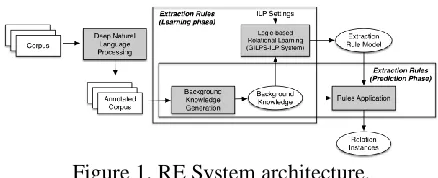
Fig. 1 shows the functional architecture our LRL system for RE. Its major components are high-lighted as darker boxes and briefly presented next.
Deep NLP Component. This component per-forms the automatic annotation of the input docu-ments in English. Its output is formed by XML files containing several layers of linguistics anno-tations. Its distinguishing characteristic consists in various NLP analysis it performs, starting from
tokenization, passing for shallow analysis, and finishing with more advanced semantic analysis.
Figure 1. RE System architecture.
Background Knowledge Generation compo-nent. This component automatically generates and represents relevant features from an annotated set of documents. The generated features are con-verted into a knowledge base implemented as a Prolog factual base.
ILP rule learning component relies on an LRL system rooted on ILP that induces Horn-like ex-traction rules from training data. The exex-traction rules follow the same syntax of a Prolog predicate. This learning component is based on GILPS, a general ILP system proposed by Santos (2010).
Rule application component. It applies the in-duced rules on the Prolog factual base generated from new documents not seen in the rule model learning phase. As a result, new instances of rela-tions are identified and extracted.
Due to their importance, the above first two com-ponents will be detailed next.
3.2 Feature Engineering via Deep NLP
NLP technologies are of paramount importance in RE, since they can analyze unstructured texts and extracting their meaning. Indeed, the result of NLP analyses (or annotation process) is a richer version of the input text with further lexical, syn-tactical, and semantic metadata seem as a normal-ized representation of texts.
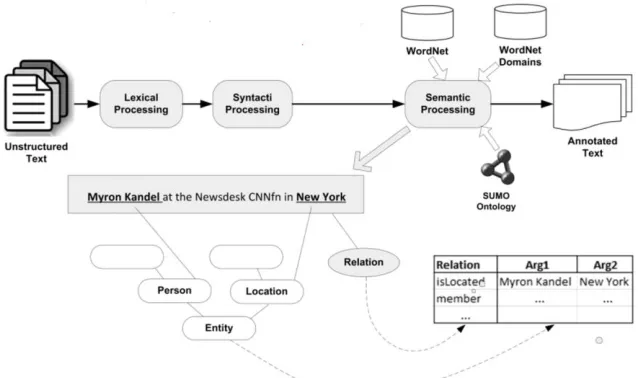
analysis (syntactic parsing) identifies the struc-tural relationships holding between words at the sentence level. The final semantic analysis links words to lexical semantic resources, including WordNet (Fellbaum, 1998), SUMO ontology
(Niles and Pease, 2003), and WordNet Domain hi-erarchy (Bentivoli et al., 2004). Such semantic re-sources offer a variety of semantic relations in-cluding synonyms and hyponyms from WordNet, and additional semantic relations between verbs and their arguments considered here as predicates.
Figure 2. Overview of the Deep NLP pipeline.
The Deep NLP component relies on the Stanford CoreNLP1 for carrying out the following pipeline: tokenization, sentence splitting, POS tagging, lemmatization, NER, and dependency parsing. Chunking analysis is performed by Apache OpenNLP2, while morphological analysis, gazet-teers look-up, and pronoun normalization were implemented as ad hoc programs. That is fol-lowed by the Sense Learner (Mihalcea and Faruque, 2004) that disambiguates noun and verbs. Then, using the Java WordNet library3, the sense_id of nouns and verbs are found in Word-Net, along with of all synonyms and hyponyms of a given word. In addition, Lin´s similar words da-taset (Lin et al., 2003) is used for retrieving a list of N (N = 5) most similar words to a given word. Semantic Role Labeling (SRL) is performed on all verbs by ClearNLP4. Still, for verbs, the Super-Sense Tagger5 (Ciaramita and Altun, 2006) finds their selectional preferences. It annotates text with 41 broad semantic categories (WordNet super-senses) for both nouns and verbs. Next, the map-ping between all WordNet synsets and the SUMO ontology6 is exploited for retrieving the related class from the SUMO ontology. Finally, an
1 https://stanfordnlp.github.io/CoreNLP
2 http://opennlp.apache.org
3 https://sourceforge.net/projects/jwordnet
hoc program maps words to labels from the Word-Net Domains
(
Bentivogli et al., 2004). Table 1 summarizes the entire pipeline.3.3 Relational Representation of Sentences
The goal of the BK Generation Component is to extract and represent features according to a rela-tional model consisting of documents, sentences, phrases, and tokens. They are converted into a Prolog factual base and used as input by the ILP-based learner. There are the four main groups of features:
Lexical features which concern word, lemma, length, and general morphological type infor-mation at the token level.
Syntactic features denote word POS tags; head word of nominal, prepositional or verbal chunk; bi-grams and tri-bi-grams of consecutive POS tags of words, chunking features that segment sentences into a noun, prepositional, and verb phrases, chunk head word, and its relative position to the main verb of the sentence.
Semantic features include named entities, entity mentions provided by the corpus as well as all lex-ical-based semantic features (sense/hypersense,
4 https://github.com/clearnlp/clearnlp
5 https://sourceforge.net/projects/supersensetag
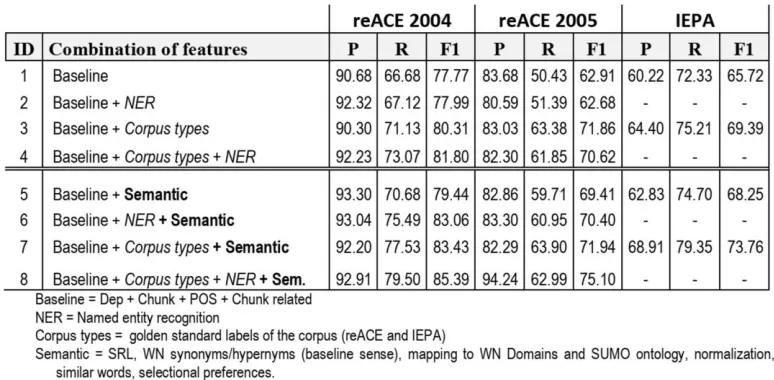
Table 4. Results on reACE 2004/2005 and IEPA datasets.
Table 5. Performance difference between RE models
On Domain Adaptability. Some authors investi-gated the domain adaptation problem on NER.
Ciaramita et al. (2005) studied the effects of do-main adaptation on NER using two distinct datasets for training and testing. They trained several NER classifiers on the CONLL 2003 dataset and evalu-ated them on a manually annotevalu-ated section from the Wall Street Journal portion of the Penn Treebank. They found that, even for such similar types of texts, the results of their supervised NER models dropped significantly. However, they had im-proved scores (almost 5% in F1-measure) just by coupling their original NER system with both a do-main-independent dictionary and a simple string similarity function.
In (Pyysalo, 2008), very similar results were re-ported when a general POS tagger was employed for tagging a dataset from the biomedical domain.
In our work, this same trend was observed since our RE models trained with all the linguistic fea-tures yielded, in average, a relative gain up to 4% in F1-measure. In fact, our RE models trained with deep semantic features outperformed the RE mod-els that did not used them according to the statisti-cal significant tests (Wilcoxon signed-rank) for the difference between F1 scores at α = 0.05 (95% con-fidence interval). These results are very encourag-ing and seem to validate the proposed features even
in a more difficult application scenario handling the changing of domains. To conclude, the overall achieved results suggest that more accurate seman-tic information about entity instances can contrib-ute a great deal to RE. This is not surprising, given that semantic information, e.g., hypernyms, and classes from an ontology, typically impose strong constraints on the types of the entities participating in a relation, indicating that such kind of feature can have significant discriminative power in RE. Thus, we can also positively answer to EQ3.
6
Conclusion and Future Work
This paper presented a LRL system for RE em-ployed to test of our hypothesis that a set of features based on a deep linguistic analysis can improve RE. This was demonstrated by experimental eval-uation showing that automatic acquisition of a sub-stantial body of linguistic knowledge in combina-tion with an expressive inductive learning tech-nique, it is possible to generate effective RE mod-els. Moreover, such features significantly contrib-uted to generalize the proposed RE to other do-mains of interest.
References
Amal Zouap. 2011. An Overview of Shallow and Deep Natural Language Processing for Ontology Learn-ing. In W. Wong, W. Liu, & M. Bennamoun (Eds.), Ontology Learning and Knowledge Discovery
Us-ing the Web: Challenges and Recent Advances.
Her-shey, PA: IGI Global, pages 16-37.
Baeza-Yates, R., Ribeiro-Neto, B., 1999. Modern In-formation Retrieval. Addison-Wesley, Boston. Bentivogli L., Forner P., Magnini B. and Pianta E.
2004. Revising WordNet Domains Hierarchy: Se-mantics, Coverage, and Balancing. In COLING Workshop on Multilingual Linguistic Resources, Geneva, Switzerland, pp. 101-108.
Björne, J., Salakoski, T., 2015. TEES 22: Biomedical event extraction for diverse corpora. BMC
Bioinfor-matics 16 (Suppl 16), S4, PMC Web.
Choi S.P, S. Lee., H. Jung, and S. Song. 2013. An In-tensive Case Study on Kernel-based Relation Ex-traction. In Proceedings of Multimedia Tools and Applications, Springer, US, 2013, pp. 1 -27.
Ciaramita M., Y. Altun. 2005. Named-entity recogni-tion in novel domains with external lexical knowledge. Adv. in Structured Learning for Text and
Speech Processing Workshop (NIPS).
Ciaramita M., Yasemin Altun. 2006. Broad-Coverage Sense Disambiguation and Information Extraction with a Supersense Sequence Tagger. EMNLP, pages 594- 602.
Ding J., Berleant, D., Nettleton, D., and Wurtele, E. 2002. Mining MEDLINE: abstracts, sentences, or phrases? In Proc. of the Pacific Symposium on Bio-computing, 326-337.
Fellbaum, C.D., 1998. WordNet – An Electronic
Lexi-cal Database. Language, Speech and
Communica-tion. MIT Press.
Hachey H., C. Grover, and R. Tobin. 2011. Datasets for Generic Relation Extraction. Journal of Natural
Language Engineering, Cambridge University
Press.
Lin D., Zhao S., Qin L., Zhou M. 2003. Identifying Synonyms among Distributionally Similar Words.
IJCAI 2003: pages 1492-1493.
Lima R., B. Espinasse, F. Freitas. 2017. OntoILPER: an Ontology- and Inductive Logic Programming-based Relations from Text, in: Knowledge And In-formation System (KAIS) Journal, Springer London. Lima, R., Espinasse, B. Freitas, F. 2019. A logic-based relational learning approach to relation extraction: The OntoILPER system. Journal of Engineering Ap-plications of Artificial Intelligence. Volume 78, pages 142-157.
Mihalcea R. and E. Faruque. 2004. SenseLearner: Min-imally supervised word sense disambiguation for all words in open text”. In Proceedings of ACL/SIG-LEX Senseval-3, Barcelona, Spain.
Mikolov, Kai Chen, Greg Corrado, and Jeffrey Dean. 2013. Efficient Estimation of Word Representations in Vector Space. In Proceedings of Workshop at ICLR.
Miwa, M., & Bansal, M. 2016. End-to-End Relation Extraction using LSTMs on Sequences and Tree Structures. In Proceedings of the 54th Annual Meet-ing of the Association for Computational LMeet-inguis- Linguis-tics, Berlin, Germany, pages 1105–1116.
Muggleton S. 1991. “Inductive Logic Programming”
New Generation Computing 8 (4): 29.
Nguyen, T.H., Grishman, R. 2015. Relation extraction: Perspective from convolutional neural networks. In: In Proceedings of the 1st Workshop on Vector Space
Modeling for Natural Language Processing. pages
39–48.
Niles, I. and Pease, A. Linking Lexicons and Ontolo-gies: Mapping WordNet to the Suggested Upper Merged Ontology. 2003. In Proceedings of the 2003 International Conference on Information and
Knowledge Engineering (IKE 03), Las Vegas,
Ne-vada, June 23-26.
Pyysalo S. 2008. A dependency parsing approach to bi-omedical text mining, Ph.D. thesis. Department of Information Technology, University of Turku, 2008. Luc De Raedt. 2008. Logical and Relational Learning:
From ILP to MRDM (Cognitive Technologies). Springer-Verlag, Berlin, Heidelberg.