Proceedings of Recent Advances in Natural Language Processing, pages 394–400,
Joint Unsupervised Learning of Semantic Representation of Words and
Roles in Dependency Trees
Michal Konkol
NTIS – New Technologies for the Information Society, Faculty of Applied Sciences, University of West Bohemia,
Technicka 8, 306 14 Plzen, Czech Republic [email protected]
Abstract
In this paper, we introduce WoRel, a model that jointly learns word embeddings and a semantic representation of word re-lations. The model learns from plain text sentences and their dependency parse trees. The word embeddings produced by WoRel outperform Skip-Gram and GloVe in word similarity and syntactical word analogy tasks and have comparable results on word relatedness and semantic word analogy tasks. We show that the seman-tic representation of relations enables us to express the meaning of phrases and is a promising research direction for seman-tics at the sentence level.
1 Introduction
Over the last few years, word level semantics was used with great success in many natural language processing tasks, e.g. named entity recognition (Lample et al., 2016), question answering (Yih et al., 2013), or sentiment analysis (Maas et al., 2011).
Skip-Gram (Mikolov et al., 2013a) and GloVe (Pennington et al., 2014) are among the most suc-cessful methods for word level semantics. Both methods are based on the Distributional Hypoth-esis (Harris, 1954), which says that words ap-pearing in similar contexts have similar mean-ing. They represent semantics by dense high-dimensional vectors and words with similar vec-tors are supposed to have similar meaning. Levy et al. (2015) shows that Skip-Gram, GloVe, and some other methods can achieve similar results.
The semantics of higher level text units is cur-rently one of the main research directions of nat-ural language processing. A wide variety of algo-rithms was proposed, e.g. distributional tree
ker-nels (Ferrone and Zanzotto, 2014), weighted com-binations of word embeddings (Brychc´ın and Svo-boda, 2016), neural networks (Socher et al., 2011; He et al., 2015), or extensions to word level se-mantics methods (Le and Mikolov, 2014).
A few authors extended Skip-Gram with depen-dency trees. Levy and Goldberg (2014a) redefine the context window to adjacent nodes in the de-pendency tree. Very similar approach to Levy and Goldberg (2014a) was used by Bansal et al. (2014) and Qiu et al. (2015). Bansal (2015) enhanced the context representation by adding new syntax-related features.
We propose a new method, called WoRel (Word Relations), that uses architecture similar to Skip-Gram, but learns not only word embeddings but also a representation of word relations that can be used to combine words into phrases. WoRel does not use the dependency trees to define syntax-based context as in the previous works, but tries to predict the context based on two words connected by an edge in the dependency tree.
2 Skip-Gram Model
Skip-Gram is a neural network model for word level semantics. It was introduced by Mikolov et al. (2013a). Later, Mikolov et al. (2013b) pro-posed a more efficient training procedure called negative sampling.
Skip-Gram represents each word by two d -dimensional vectors. We define amiddle word as the word at the current position in the corpus and acontext wordas any word in a context window (a small neighborhood of the current position). The middle words are represented by vectorsmw ∈R, wherewis a word from the vocabularyV. Con-text words are represented by vectorscw ∈ Rd. We denote wj the word at position j in the cor-pus. We maximize the negative sampling objective
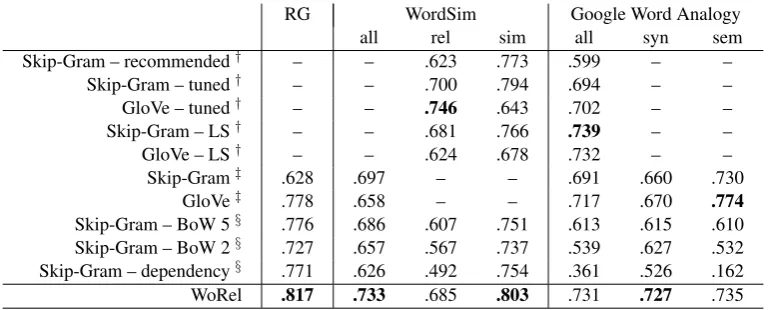
RG WordSim Google Word Analogy
all rel sim all syn sem
Skip-Gram – recommended† – – .623 .773 .599 – –
Skip-Gram – tuned† – – .700 .794 .694 – –
GloVe – tuned† – – .746 .643 .702 – –
Skip-Gram – LS† – – .681 .766 .739 – –
GloVe – LS† – – .624 .678 .732 – –
Skip-Gram‡ .628 .697 – – .691 .660 .730
GloVe‡ .778 .658 – – .717 .670 .774
Skip-Gram – BoW 5§ .776 .686 .607 .751 .613 .615 .610
Skip-Gram – BoW 2§ .727 .657 .567 .737 .539 .627 .532
Skip-Gram – dependency§ .771 .626 .492 .754 .361 .526 .162
WoRel .817 .733 .685 .803 .731 .727 .735
Table 1: Results of WoRel compared with other methods on the word similarity datasets WordSim-353 and RG-65 and the Google Word Analogy dataset. † Results from (Levy et al., 2015).‡ Results from
(Pennington et al., 2014).§Embeddings provided by Levy and Goldberg (2014a).
with the annotated scores. We use Rubenstein-Goodenough corpus (Rubenstein and Goode-nough, 1965), WordSim-353 corpus (Finkelstein et al., 2001), and WordSim-353 partitioned to similarity and relatedness corpora (Agirre et al., 2009).
Word analogy. In the word analogy task the model answers questions in the form “What word (d) is related to c in the same way as b is re-lated to a?” E.g. ifa is France, b is Paris, and c is Germany we would expect d to be Berlin. The quality of the model is measured by accu-racy. We use the Google Word Analogy cor-pus and its semantic and syntactic partitions. We do not remove questions with out-of-vocabulary words as in (Levy and Goldberg, 2014a) because it favors smaller vocabularies. In our experiments we use the original equation (5) to choose word d, wherecos sim(x, y)denotes the cosine similar-ity betweenx and y. Even though the 3CosMul approach (Levy and Goldberg, 2014b) has better results we use the older approach for a fair com-parison with previous works.
d= arg max
w∈V\{a,b,c}cos sim(vb−va+vc,vw) (5)
4.3 Results and Discussion
The results for word similarity and analogy tasks are in Table 1 together with previously published results of Skip-Gram and GloVe. We present sev-eral results from (Levy et al., 2015). We start with Skip-Gram with the recommended hyperparame-ters. This configuration is used in most cases. The models denoted bytuneduse hyperparameters that
were found using cross-validation. This approach is not usable in most cases as it requires super-vision and it would be too demanding to set all hyperparameters for all tasks to optimal values. But it gives us an upper limit to expected results. The models denotedLSuse much bigger data than the previous models (10.5 billion words, previous models 1.5 billion tokens) and the hyperparame-ters are also tuned using cross-validation, but less combinations were tested due to longer training times.
We also compare our results with (Pennington et al., 2014). They provide results for Skip-Gram and GloVe trained on a corpus with 6 billion to-kens.
The last comparison is with Skip-Gram with dependency (and also bag-of-word) contexts pro-vided by Levy and Goldberg (2014a). We see that the dependency Skip-Gram is significantly worse than WoRel or even other models. Levy and Gold-berg (2014a) showed that their model is very good for different purposes (e.g. classification between relatedness and similarity).
Model Annotator 1 Annotator 2 Annotator 3 Annotator 4 Total Average rank
Skip-Gram Dependency 44 43 41 43 171 2.14
Skip-Gram BoW 5 45 51 41 41 185 2.31
WoRel 22 26 27 28 103 1.29
Table 3: The sum of ranks assigned by annotators. Lower numbers are better.
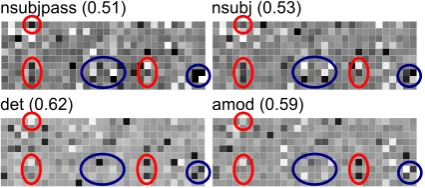
Figure 1: Role representations for selected uni-versal dependency roles. The darker (lighter) the color is, the more information comes from the child (parent). Values in parenthesis show overall importance of the parent (average value ofλr).
6 Conclusion and Future Work
We proposed WoRel, a new distributional seman-tics model based on Skip-Gram. The main con-tribution of WoRel is that it learns not only word embeddings, but also the representations of depen-dency relations between words.
The word embeddings were tested on word sim-ilarity and analogy tasks. WoRel significantly out-performed Skip-Gram and GloVe on syntactical word analogy and word similarity tasks and had similar results to Skip-Gram on semantic word analogy and word relatedness tasks.
Even though the improvement in word embed-dings is important, the main innovation lies in the representation of word relations. The relation rep-resentations have interesting semantic properties and can be used in a variety of NLP tasks. More importantly, we believe that they can be used to represent semantics at the sentence level.
Our further research will focus on the seman-tic representation of sentences. WoRel is able to represent meaning of a single edge in a depen-dency tree (combine a child with its parent), but it is necessary to find a way to properly combine edges with a common parent and ensure transition of the semantic information from leaves of the de-pendency tree to the root.
Other directions for further research include evaluation on several NLP tasks, finding the
op-timal hyperparameters of the model, exploring the effect of data size, proposing other representations of the context (e.g. dependency), or employing more robust and efficient methods for optimiza-tion.
The reference implementation and trained word embeddings are publicly available at the authors web pages2.
Acknowledgments
This publication was supported by the project LO1506 of the Czech Ministry of Education, Youth and Sports under the program NPU I.
References
Eneko Agirre, Enrique Alfonseca, Keith Hall, Jana Kravalova, Marius Pas¸ca, and Aitor Soroa. 2009. A study on similarity and relatedness using
distribu-tional and wordnet-based approaches. In
Proceed-ings of Human Language Technologies: The 2009 Annual Conference of the North American Chap-ter of the Association for Computational Linguistics. Association for Computational Linguistics, Strouds-burg, PA, USA, NAACL ’09, pages 19–27.
Eneko Agirre, Carmen Banea, Daniel Cer, Mona Diab, Aitor Gonzalez-Agirre, Rada Mihalcea, Ger-man Rigau, and Janyce Wiebe. 2016. Semeval-2016 task 1: Semantic textual similarity,
mono-lingual and cross-mono-lingual evaluation. In
Proceed-ings of the 10th International Workshop on Semantic Evaluation (SemEval-2016). Association for Com-putational Linguistics, San Diego, California, pages
497–511.
http://www.aclweb.org/anthology/S16-1081.
Mohit Bansal. 2015. Dependency link embeddings: Continuous representations of syntactic substruc-tures. InProceedings of the 1st Workshop on Vector Space Modeling for Natural Language Processing. Association for Computational Linguistics, Denver, Colorado, pages 102–108.
Mohit Bansal, Kevin Gimpel, and Karen Livescu. 2014. Tailoring continuous word representations for
dependency parsing. In Proceedings of the 52nd
2See http://konkol.me/publications/
Computa-onymy. Commun. ACM 8(10):627–633. https://doi.org/10.1145/365628.365657.
Richard Socher, Eric H. Huang, Jeffrey Pennin, Christopher D Manning, and Andrew Y. Ng. 2011. Dynamic pooling and unfolding recursive autoen-coders for paraphrase detection. In J. Shawe-Taylor, R. S. Zemel, P. L. Bartlett, F. Pereira, and K. Q.
Weinberger, editors, Advances in Neural
Informa-tion Processing Systems 24, Curran Associates, Inc., pages 801–809.
Wen-tau Yih, Ming-Wei Chang, Christopher Meek, and Andrzej Pastusiak. 2013. Question answering
us-ing enhanced lexical semantic models. In