CSEIT1724108 | Received : 02 August 2017 | Accepted : 09 August 2017 | July-August-2017 [(2)4: 512-517]
International Journal of Scientific Research in Computer Science, Engineering and Information Technology © 2017 IJSRCSEIT | Volume 2 | Issue 4 | ISSN : 2456-3307
512
Bit DNA Squeezer (BDNAS) : A Unique Technique for Dna
Compression
Alam Jahaan
1, Dr. T. N. Ravi
2, Dr. S. Panneer Arokiaraj
31Research Scholar in Computer Science, PERIYAR EVR College, Trichy, Tamil Nadu, India 2Assistant Professor, Computer Science, PERIYAR EVR College, Trichy, Tamil Nadu, India 3Associate Professor, Computer Science, PERIYAR EVR College, Trichy, Tamil Nadu, India
ABSTRACT
Data compression plays a vital role in analyzing, decreasing and transferring DNA sequences, hence escalating the creation of DNA compression techniques in order to store and transfer tremendous amount of genomic data. A fresh flow of interest in the development of novel algorithms and tools for storing and managing genomic sequences highlights the increasing demand for efficient methods for DNA compression. This is ultimately, the motivating force behind the development of high-performance compression tools, which are designed specifically for genomic data. Most of the earlier DNA compression methods were essentially dictionary-based methods or statistical methods. Recently 2-bit coding methods have become prominent where the 4-nucleotide bases {A, C, G, T} in DNA sequences are assigned values 00, 01, 10 and 11 respectively. In this paper an attempt has been made to present an approach where a single bit (0 or 1) is assigned for each nucleotide base {A,C,G,T} in a DNA sequence depending on the count of each nucleotide. This proposed technique compresses large bytes of DNA sequences with the average compression ratio of approximately 1.4 bits per base.
Keywords : DNA Sequences, Bit-Based Model, Position Map, Compression, Decompression, Datasets
I.
INTRODUCTION
DNA sequences have become crucial for any biological and clinical research, other research branches working with DNA sequencing are numerous everyday fields such as diagnostic, biotechnology, forensic biology, genealogy, bioinformatics, genetics, genomics, genetic engineering and criminology.
As these sequences are enormous in size, storing and sharing becomes costly and challenging, hence compression becomes mandatory. Lossless Compression Methods focus on reproducing the original data on decompression; these are suitable for DNA sequence compression as the DNA datasets cannot afford to lose any part of their data [1].
A very simple, fast, flexible and effective DNA compression algorithm named Bit DNA Squeezer (BDNAS) is proposed to compress DNA sequences which may be repetitive or non-repetitive in nature.
Organization of the paper:
II.
RELATED WORK
DNA sequences are naturally represented as repetitive or non-repetitive strings of the four nucleotides Adenine(A), Cytosine(C), Guanine(G), & Thymine(T). However, a collection of general-purpose text compressors, such as gzip or bzip2 result in representations that require more than 2 bits per character since they fail to identify and eliminate DNA-specific redundancy. Ultimately, tailored DNA compression methods are needed and several methods have been proposed to-date [2].
Most of the earlier DNA compression methods are concerned with reducing the redundancy within a given DNA string and were essentially dictionary-based methods or statistical methods.
Two-Bit Based methods:
These algorithms implement a bit-preprocessing process by assigning 4 unique two bits (A=00, G=01, C=10, T=11) to each nucleotide before the encoding process. A DNA sequence is represented in minor fragments or sections with each being four 8 bit-characters long before the encoding process to compress both repetitive and non-repetitive DNA sequences. The following algorithms are of two phases with each phase being similar in the bit-preprocessing stage but different in the coding stage [3].
The GENBIT Compress tool [4] was proposed by Rajeswari and Apparao for compressing DNA sequences based on a novel concept of assigning binary bits to the nucleotides.
HUFFBIT compress was proposed by Rajeswari et al., for DNA sequences. Here a bit-preprocessing stage takes place before the encoding [5].
Rajeswari & Apparao later on introduced the DNABIT Compress tool [6] which is a unique concept introduced in DNA compression that assigns binary bits "in the bit-preprocessing stage" to exact and reverse repeats fragments of DNA sequences.
GenCodex introduced by Satyanvesh et al., a two phased algorithm that produces a better compression ratio at a high throughput, it uses graphical processing units and multi-cores. In the first phase, bit-preprocessing is implemented; the next phase represents the fragments using one or two bytes [2].
In the DNACRAMP tool by Prasad & Kumar, a DNA sequence is taken for bit-preprocessing. It performs the encoding and decoding process with the help of a two-stage index bounded linear array data structure using basic procedural language [7].
Prasad then introduced PGBC "Partitioned group binary compression" an improvement over previous algorithms. Here the encoding process starts after bit-preprocessing where every 6 part is grouped as a partition, with two sub-partitions [8].
III.
PROPOSED TECHNIQUE
Step1: It records the total count of each nucleotide in the dataset as 1st, 2nd, 3rd & 4th occurrences.
Step2: It assigns 0 to the highest occurring nucleotide, then it assigns 1 to the 2nd highest nucleotide, the 3rd
nucleotide is assigned 0 similar to the highest occurrence but its position is noted down in a position map called PosMap. Similarly the 4th nucleotide is
assigned 1 and its position is recorded too in the position map (PosMap).
The Decompression process considers the position map and the compressed file as input, and converts all the 0’s in the compressed file according to the positions recorded in the position map to its corresponding 3rd
nucleotide and converts all the 1’s in the compressed file according to the positions recorded in the position map to its corresponding 4th nucleotide. Finally, the
remaining 0’s are converted to the 1st nucleotide and 1’s to the 2nd nucleotide respectively.
3.2 Algorithm 1.1.1
1.1.2 3.2.1 Compression
BDNAS ENCODING ALGORITHM:
Output: Compressed file and PosMap.
Procedure Encode:
Begin
1. Count all the nucleotides in the Dataset (A,C,G,T). 2. Assign names as first, second, third and fourth
respectively to the nucleotides depending on their count. Highest count is assigned first, second highest occurrence as second so on and so forth. 3. Start from beginning of file and assign 0 to all the
first occurrences and 1 to all the second occurrences.
4. Again search for occurrence of third nucleotide and note down its position in the position map (PosMap) then replace it with 0.
5. Similarly search for occurrence of fourth nucleotide and note down its position in the position map (PosMap) then replace it with 1. 6. Compressed file and PosMap are created.
End
3.2.2 Decompression
BDNAS DECODING ALGORITHM:
Input : Input Compressed file and PosMap. Output : Original (Decompressed) file
Procedure Decode:
Begin
1. For each entry equivalent to 0 in PosMap, go to corresponding position in compressed file and change it to 3rd Nucleotide.
2. Similarly change the entry for 1 in PosMap to 4th
nucleotide at the same position in compressed file. 3. Consider the compressed file and replace all the
remaining 0’s to 1st nucleotide
4. Also replace all 1’s in compressed file to 2nd
nucleotide.
5. The original file is obtained. End.
3.3 QUALITY METRICS
Compression Performances may be measured by comparing the quality of the original file with the compressed file using quality metrics as discussed below [9]:
3.3.1 COMPRESSION FACTOR: The ratio between the original file size to the compressed
file size
3.3.2 COMPRESSION RATIO: The ratio between the compressed file size to the original file size.
3.3.3 SAVING PERCENTAGE: The percentage of the size reduction of the DNA sequence, after compression is calculated as given below:
3.3.4 COMPRESSION TIME: The time taken by the proposed algorithm to compress each DNA sequence is calculated in milliseconds.
Implementation of the proposed algorithm BDNAS is carried out by compressing a standard set of DNA sequences. A test prototype has been implemented to evaluate the capability of the algorithm. The code has been written, compiled and run in VC++.
V.
RESULTS AND DISCUSSION
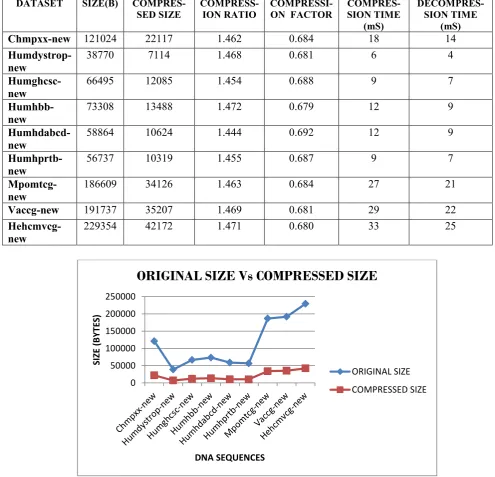
Quality Measures such as Compressed Size, Compression Ratio & factor, Compression & Decompression Time for the above stated 9 standard DNA sequences have been computed using the proposed BDNAS algorithm and experimental
outcomes are tabulated in Table1. Chart1 below illustrates the relationship between original file size and compressed file size of the 9 standard DNA sequences considered for our research. Chart2 depicts the compression time and decompression time of each sequence from the chosen standard data set.
Table 1: Experimental results for selected 9 DNA sequences
DATASET SIZE(B) COMPRES-
SED SIZE COMPRESS- ION RATIO COMPRESSI-ON FACTOR COMPRES-SION TIME (mS)
DECOMPRES-SION TIME
(mS) Chmpxx-new 121024 22117 1.462 0.684 18 14
Humdystrop-new
38770 7114 1.468 0.681 6 4
Humghcsc-new
66495 12085 1.454 0.688 9 7
Humhbb-new
73308 13488 1.472 0.679 12 9
Humhdabcd-new
58864 10624 1.444 0.692 12 9
Humhprtb-new
56737 10319 1.455 0.687 9 7
Mpomtcg-new
186609 34126 1.463 0.684 27 21
Vaccg-new 191737 35207 1.469 0.681 29 22
Hehcmvcg-new
229354 42172 1.471 0.680 33 25
Chart 1 : Comparison of compressed size to the original size of the DNA sequences.
0 50000 100000 150000 200000 250000
SIZE
(B
YTE
S)
DNA SEQUENCES
ORIGINAL SIZE Vs COMPRESSED SIZE
ORIGINAL SIZE
Chart 2 : Compression Time & Decompression Time
VI. CONCLUSION & FUTURE WORK
An attempt has been made to present an approach on compression of DNA sequences analogous to bit based methods. A novel algorithm has been illustrated which compresses a DNA sequence with the average compression ratio of 1.4 bits per base. Unlike existing general DNA compression techniques, Bit-based compression is used for compressing repetitive and non-repetitive DNA sequences without the use of complex dynamic programming. Our proposed algorithm is simple, fast and flexible and is mainly centered on assigning a single bit to each nucleotide unlike a 2-bit based compression technique where 2 unique bits are assigned to each nucleotide. Metrics such as compression ratio, compression time, decompression time and compression factor for 9 standard DNA Sequences have been computed and tabulated.
Our algorithm may be enhanced by using it as a pre-processing step as used in any general 2-bit based compression technique. The proposed Bit DNA Squeezer (BDNAS) algorithm is very simple and flexible hence it may be useful in several researches where large sequence analysis and comparisons may be conducted.
VII.
REFERENCES
[1]. Alam Jahaan, Dr T.N. Ravi, Dr. S. Panneer Arokiaraj, A Comparative Study and Survey on Existing DNA Compression Techniques,
IJARCS, p-ISSN: 0976-5697, volume8,No.3, March-April2017. Online:www.ijarcs.info. [2]. Satyanvesh, D., Balleda, K., Padyana, A., et al.,
2012, GenCodex - A Novel Algorithm for Compressing DNA sequences on Multi-cores and GPUs, Proc. IEEE, 19th International Conf. on High Performance Computing (HiPC), Pune, India, No 37
[3]. Nour S. Bakr et al.: "DNA Lossless Compression Algorithms: Review", American Journal of Bioinformatics Research, p-ISSN: 2167-6992 e-ISSN: 2167-6976, 2013; 3(3): 72-81, doi:10.5923/j.bioinformatics.20130303.04 [4]. Rajeswari, P. R., and Apparao, A., 2010, Genbit
Compress Tool (GBC): A Java-Based Tool To Compress DNA Sequences and Compute Compression Ratio (BITS/BASE) Of Genomes, International Journal of Computer Science and Information Technology, 2(3), 181-191
[5]. Afify, H., Islam, M., Abdel-Wahed, M., et al., 2010, Genomic Sequences Differential Compression Model, Proc., 27th National Radio Science Conf., Egypt
[6]. Rajeswari, P. R., and Apparao, A., 2011, DNABIT Compress - Genome compression algorithm, Bioinformation, 5(8), 350-360
[7]. Prasad, V. H., and Kumar, P. V., 2012, A New Revised DNA Cramp Tool Based Approach of Chopping DNA Repetitive and Non-Repetitive Genome Sequences, International Journal of Computer Science Issues (IJCSI), 9(6), 448-454. [8]. Prasad, V. H., 2013, A new revisited
compression technique through innovation
partition group binary compression: a novel approach, International Journal of Computer Engineering & Technology (IJCET), 4(2), 94-101.
[9]. Alam Jahaan ,Dr T.N. Ravi, "Scrutiny Of Lossless Compression Techniques Using A Few Quality Measures", International Journal Of Advanced Research In Computer Science And Applications Issn 2321- 872x, Volume 4, Issue 3, March 2016.
[10]. S. R. Kodituwakku Et. Al. "Comparison Of Lossless Data Compression Algorithms For Text Data", Indian Journal Of Computer Science And Engineering, Vol 1 No 4 416-425