CSEIT1724118 | Received : 26 July 2017 | Accepted : 06 August 2017 | July-August-2017 [(2)4: 454-461 ]
International Journal of Scientific Research in Computer Science, Engineering and Information Technology © 2017 IJSRCSEIT | Volume 2 | Issue 4 | ISSN : 2456-3307
454
A Protected and Active Multi-Keyword Ranked Explore Scheme
over Encrypted Cloud Data Systems
Singampalli Sankeerthi
1, Shaik Allabakshu
2*1Assistant Professor, Department of MCA , St. Mary's Group of Institutions, Guntur, Andhra Pradesh, India
2
PG Student,Department of MCA , St. Mary's Group of Institutions, Guntur, Andhra Pradesh, India
ABSTRACT
The major aim of this paper is to solve the problem of multi-keyword ranked search over encrypted cloud data (MRSE) at the time of protecting exact method wise privacy in the cloud-computing concept. Data holders are encouraged to outsource their difficult data management systems from local sites to the business public cloud for large flexibility and financial savings. However, for protecting data privacy, sensitive data have to be encrypted before outsourcing, which performs traditional data utilization based on plaintext keyword search. As a result, allowing an encrypted cloud data search service is of supreme significance. In view of the large number of data users and documents in the cloud, it is essential to permit several keywords in the search demand and return documents in the order of their appropriate to these keywords. Similar mechanism on searchable encryption makes center on single keyword search or Boolean keyword search, and rarely sort the search results. In the middle of various multi-keyword semantics, deciding the well-organized similarity measure of “coordinate matching,” it means that as many matches as possible, to capture the appropriate data documents to the search query. Particularly, we consider “inner product similarity” i.e., the amount of query keywords shows in a document, to quantitatively estimate such match measure that document to the search query. Through the index construction, every document is connected with a binary vector as a sub-index where each bit characterize whether matching keyword is contained in the document. The search query is also illustrates as a binary vector where each bit means whether corresponding keyword appears in this search request, so the matched one could be exactly measured by the inner product of the query vector with the data vector. On the other hand, directly outsourcing the data vector or the query vector will break the index privacy or the search privacy. The vector space model facilitate to offer enough search accuracy, and the DES encryption allow users to occupy in the ranking while the popularity of computing work is done on the server side by process only on cipher text. Consequently, data leakage can be eradicated and data security is guaranteed.
Keywords: Searchable Encryption, Multi-Keyword Ranked, Search, Dynamic Update, Cloud Computing.
I.
INTRODUCTION
Cloud computing is a conversational phrase used to express a variety of dissimilar types of computing ideas that occupy large number of computers that are connected through a real-time communication network i.e. Internet. In science, cloud computing is the capability to run a program on many linked computers at the same time. The fame of the term can be recognized to its use in advertising to sell hosted services in the sense of application service provisioning that run client server software on a remote location. Cloud computing relies on sharing of resources to
This mechanism must take full advantage of the use of computing powers thus decreasing environmental damage as well, since less power, air conditioning and so on, is necessary for the same functions. The expression "moving to cloud" also explains to an organization moving away from a traditional CAPEX model i.e. buy the devoted hardware and decrease in value it over a period of time to the OPEX model i.e. use a shared cloud infrastructure and pay as you use it. Proponents maintain that cloud computing Permit Corporation to avoid direct infrastructure costs, and focus on projects that distinguish their businesses as an alternative of infrastructure. Proponents also maintains that cloud computing permit schemes to get their applications should run faster, with better manageability and less maintenance, and enable IT to more quickly adjust resources to meet random and changeable business demand.
II.
EXISTING AND PROPOSED SYSTEMS
A. Existing System
A general approach to protect the data confidentiality is to encrypt the data before outsourcing. Searchable encryption schemes enable the client to store the encrypted data to the cloud and execute keyword search over ciphertext domain. So far, abundant works have been proposed under different threat models to achieve various search functionality, such as single keyword search, similarity search, multi-keyword Boolean search, ranked search, multi-keyword ranked search, etc. Among them, multi-keyword ranked search achieves more and more attention for its practical applicability. Recently, some dynamic schemes have been proposed to support inserting and deleting operations on document collection. These are significant works as it is highly possible that the data owners need to update their data on the cloud server.
Huge cost in terms of data usability. For example, the existing techniques on keyword-based information retrieval, which are widely used on the plaintext data, cannot be directly applied on the encrypted data. Downloading all the data from the cloud and decrypt locally is obviously impractical.
Existing System methods not practical due to their high computational overhead for both the cloud sever and user.
B. Proposed System
This paper proposes a secure tree-based search scheme over the encrypted cloud data, which supports multi-keyword ranked search and dynamic operation on the document collection. Specifically, the vector space model and the widely-used “term frequency (TF) × inverse document frequency (IDF)” model are combined in the index construction and query generation to provide multi-keyword ranked search. In order to obtain high search efficiency, we construct a tree-based index structure and propose a “Greedy Depth-first Search” algorithm based on this index tree. The secure kNN algorithm is utilized to encrypt the index and query vectors, and meanwhile ensure accurate relevance score calculation between encrypted index and query vectors. To resist different attacks in different threat models, we construct two secure search schemes: the basic dynamic multi-keyword ranked search (BDMRS) scheme in the known ciphertext model, and the enhanced dynamic multi-keyword ranked search (EDMRS) scheme in the known background model.
Due to the special structure of our tree-based index, the proposed search scheme can flexibly achieve sub-linear search time and deal with the deletion and insertion of documents.
We design a searchable encryption scheme that supports both the accurate multi-keyword ranked search and flexible dynamic operation on document collection.
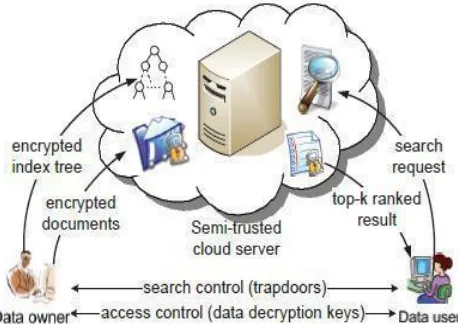
Figure 1. The architecture of ranked search over encrypted cloud data
Committee as indicated on the IJSRCSEIT website. Information about final paper submission is available from the IJSRCSEIT website.
One of the requirements of the graduate Science, Engineering and Technology courses is that you conduct research and write a research paper on some aspects of software engineering. The paper may present original work, discuss a new technique, provide a survey and evaluation of recent work in a given area, or give comprehensive and taxonomic tutorial information. The paper must emphasize concepts and the underlying principles and should provide authentic contribution to knowledge. If your paper does not represent original work, it should have educational value by presenting a fresh perspective or a synthesis of existing knowledge. The purpose of this document is to provide you with some guidelines. You are, however, encouraged to consult additional resources that assist you in writing a professional technical paper.
Before submitting your final paper, check that the format conforms to this template. Specifically, check the appearance of the title and author block, the appearance of section headings, document margins, column width, column spacing and other features.
The organization of this document is as follows. In Section 2 (Methods and Material), I will give detail of any modifications to equipment or equipment constructed specifically for the study and, if pertinent, provides illustrations of the modifications. In Section 3 (Result and Discussion), present your research findings and your analysis of those findings. Discussed in Section 4(Conclusion) a conclusion is the last part of something, its end or result.
III.
MULTI-KEYWORD RANKED SEARCH
OVER ENCRYPTED (MRSE)
Now a day’s cloud computing has become essential for many utilities, where cloud customers can slightly store their data into the cloud so as to benefit from on-demand high-quality request and services from a shared pool of configurable computing resources. Its huge suppleness and financial savings are attracting both persons and enterprise to outsource their local complex data management system into the cloud. To safe guard data privacy and struggle unwanted accesses in the cloud and away from, sensitive data, for example, emails, personal health records, photo albums, videos, land documents, financial transactions, and so on, may have to be encrypted by data holder before outsourcing to the business public cloud; on the other hand, obsoletes the traditional data use service based on plaintext keyword search. The insignificant solution of downloading all the information and decrypting nearby is clearly impossible, due to the enormous amount of bandwidth cost in cloud scale systems. Furthermore, apart from eradicating the local storage management, storing data into the cloud supplies no purpose except they can be simply searched and operated. Thus, discovering privacy preserving and effective search service over encrypted cloud data is one of the supreme importance.
search, as single keyword search often give up far too narrow down the search result further. “Coordinate matching”, as many matches as possible, is an efficient resemblance measure among such multi-keyword semantics to refine the result significance, and has been widely used in the plaintext information retrieval (IR) community. However, the nature of applying encrypted cloud data search system remains a very demanding task in providing security and maintaining privacy, like the data privacy, the index privacy, the keyword privacy, and many others.
Encryption is a helpful method that treats encrypted data as documents and allows a user to securely search through a single keyword and get back documents of interest. On the other hand, direct application of these approaches to the secure large scale cloud data utilization system would not be necessarily suitable, as they are developed as crypto primitives and cannot put up such high service-level needs like system usability, user searching experience, and easy information discovery. Even though some modern plans have been proposed to carry Boolean keyword search as an effort to improve the search flexibility, they are still not sufficient to provide users with satisfactory result ranking functionality. The solution for this problem is to secure ranked search over encrypted data but only for queries consisting of a single keyword. The challenging issue here is how to propose an efficient encrypted data search method that supports multi-keyword semantics without privacy violation. In this paper, we describe and solve the problem of multi-keyword ranked search over encrypted cloud data (MRSE) while preserving exact system wise privacy in the cloud-computing concept. Along with various multi-keyword semantics, select the efficient resemblance measure of “coordinate matching,” it means that as various matches as possible, to confine the significance of data documents to the search query. Particularly, inner product similarity the numbers of query keywords show in a document, to quantitatively calculate such similarity assess of that document to the search query. bit means whether corresponding keyword appears in this search request, so the resemblance could be exactly calculated by the inner product of the query vector.
With the data vector. On the other hand, directly outsourcing the data vector or the query vector will go against the index privacy or the search privacy. To face the challenge of cooperating such multi keyword semantic without privacy breaches, we propose a basic idea for the MRSE using secure inner product computation, which is modified from a secure k-nearest neighbor (kNN) method, and then give two considerably improved MRSE method in a step-by-step way to accomplish different severe privacy needs in two risk models with enlarged attack competence.
IV.
PERFORMANCE ANALYSIS
Figure 2. the precision (a) and rank privacy (b)
of searches with different standard deviation σ.
Variable Σεv’, the EDMRS scheme is supposed to obtain higher precision, and vice versa. The results are shown in Fig.2 (a). In the EDMRS scheme, phantom terms are added to the index vector to obscure the relevance score calculation, so that the cloud server cannot identify keywords by analyzing the TF distributions of special keywords .Here, we quantify the obsceneness of the relevance score by “rank privacy”, which is defined as:
′ = ∑ | −
′|
2
Where ri is the rank number of document in the
retrieved top-k documents, and r′i is its real
rank number in the whole ranked results. The
larger rank privacy denotes the higher security
of the scheme, which is illustrated in Fig. 2(b).
In the proposed scheme, data users can
accomplish different requirements on search
precision and privacy by adjusting the standard
deviation σ, which can be treated as a balance
parameter. We compare our schemes with a
recent work proposed by Sun et al., which
achieves high search efficiency. Note that our
BDMRS scheme retrieves the search results
through exact calculation of document vector
and query vector. Thus, top-k search precision
of the BDMRS scheme is 100%. But as a
similarity-based multi-keyword ranked search
scheme, the basic scheme in suffers from
precision loss due to the clustering of
sub-vectors during index construction. The precision
test of basic scheme is presented in Table I. In
each test, five keywords are randomly chosen as
input, and the precision of returned top 100
results is observed. The test is repeated 16
times, and the average precision is 91%.
B. Efficiency 1. Index Tree Construction:
The process of index tree construction for
document collection F includes two main steps:
1)
Building an unencrypted KBB tree based on
the document collection, and 2) encrypting the
index tree with splitting operation and two
multiplications of a (m×m) matrix. The index
structure is constructed following a post order
traversal of the tree based on the document
collection, and O(n) nodes are generated during
the traversal. For each node, generation of an
index vector takes O(m) time, vector splitting
process
takes
O(m)
time,
and
two
relatively much time at the data owner side, it is
noteworthy that this is a one-time operation. On
the other hand, since the underlying balanced
binary tree has space complexity O (n) and
every node stores two m-dimensional vectors,
the space complexity of the index tree is O (nm).
As listed in Table II, when the document
collection is fixed (n = 1000), the storage
consumption of the index tree is determined by
the size of the dictionary.
Fig.3. Time cost for index tree construction: (a)
for the different sizes of document collection
with the fixed dictionary, m = 4000, and (b) for
the different sizes of dictionary with the fixed
document collection, n = 1000. 2.
Trapdoor Generation:
The generation of a
trapdoor incurs a vector splitting operation and
two multiplications of a (m × m) matrix, thus the
time complexity is O (m2), as shown in Fig. 4(a).
Typical search requests usually consist of just a
few keywords. Fig. 4(b) shows that the number
of query keywords has little influence on the
overhead of trapdoor generation when the
dictionary size is fixed. Due to the dimension
extension, the time cost of EDMRS scheme is a
little higher than that of BDMRS scheme.
3.
Search Efficiency: During the search process,
if the relevance scores at nodes is larger than
the minimum relevance score in result list R
List, the cloud server examines the children of
the node; else it returns. Thus, lots of nodes are
not accessed during a real search. We denote the
number of leaf nodes that contain one or more
keywords in the query as θ. Generally, θ is larger
than the number of required documents k, but
far less than the cardinality of the document
collection n. As a balanced binary tree, the
height of the index is maintained to be log n, and
the complexity of relevance score calculation is
O (m). Thus,
Fig.4. Time cost for trapdoor generation: (a) for
different sizes of dictionary with the fixed
number of query keywords, t = 10, and (b) for
different numbers of query keywords with the
fixed dictionary, m = 4000
query keywords are chosen from the1st level,
our scheme obtains almost the same efficiency
as when we start 4 threads. Fig5 also shows that
the search efficiency of our scheme increases a
lot when we increase the number of threads
from 1 to
4.
Fig.5. The efficiency of a search with ten
keywords of interest as input :(a) for the
different sizes of document collection with the
same dictionary, m = 4000, and (b) for different
numbers of retrieved documents with the same
document collection and dictionary, n=1000,
and m = 4000.
However, when we continue to increase the
threads, the search efficiency is not increase
remarkably. Our search algorithm can be
executed in parallel to improve the search
efficiency. But all the started threads will share
one result list R List in mutually exclusive
manner. When we start too many threads, the
threads will spend a lot of time for waiting to
read and write the R List. An intuitive method to
handle this problem is to
construct multiple
result lists. However, in our scheme, it will not
help to improve the search efficiency a lot. It is
because that we need to find k results for each
result list and time complexity for retrieving
each result list is O(θmlog n=l). In this case, the
multiple threads will not save much time, and
selecting k results from the multiple result list
will further increase the time consumption. In
the Fig. 6, we show the time consumption when
we start multiple threads with multiple result
lists. The experimental results prove that our
scheme will obtain better search efficiency
when we start multiple threads with only one
result list.
Fig.6. the efficiency of a search with ten
keywords of interest as input: (a) for the different
sizes of document collection with the same
dictionary, m = 4000, and (b) for different
numbers of retrieved documents with the same
document collection and dictionary, n1000, and m
= 4000
Update Efficiency: In order to update a leaf node,
the data owner needs to update log n nodes. Since
it involves an encryption
operation for index
vector at each node, which takes O(m2) time, the
time complexity of update operation is thus O(m2
log n).
V.
CONCLUSION
proposed schemes which introduces low transparency on both calculation and communication.
VI.
REFERENCES
[1]. Zhihua Xia, Member, IEEE, Xinhui Wang, Xingming Sun, Senior Member, IEEE,and Qian Wang, Member, IEEE, "A Secure and Dynamic Multi-keyword Ranked Search Scheme over Encrypted Cloud Data", IEEE Transactions on Parallel and Distributed Systems Vol: Pp No: 99 Year 2015.
[2]. K. Ren, C.Wang, Q.Wang et al.,"Security challenges for the public cloud," IEEE Internet Computing, vol. 16, no. 1, pp. 69-73, 2012. [3]. S. Kamara and K. Lauter, "Cryptographic
cloud storage," in Financial Cryptography and Data Security. Springer, 2010, pp. 136-149. [4]. C. Gentry, "A fully homomorphic encryption
scheme," Ph.D. dissertation, Stanford University, 2009.
[5]. O. Goldreich and R. Ostrovsky, "Software protection and simulation on oblivious rams," Journal of the ACM (JACM), vol. 43, no. 3,pp. 431-473, 1996.
[6]. D. Boneh, G. Di Crescenzo, R. Ostrovsky, and G. Persiano, "Public key encryption with keyword search," in Advances in
[7]. Cryptology-Eurocrypt 2004. Springer, 2004, pp. 506-522.
[8]. D. Boneh, E. Kushilevitz, R. Ostrovsky, and W. E. Skeith III,"Public key encryption that allows pir queries," in Advances inCryptology-CRYPTO 2007. Springer, 2007, pp. 50-67. [9]. D. X. Song, D. Wagner, and A. Perrig,
"Practical techniques forsearches on encrypted data," in Security and Privacy, 2000. S&P2000. Proceedings. 2000 IEEE Symposium on. IEEE, 2000, pp. 44-55. [9] E.-J. Goh et al., "Secure indexes." IACR Cryptology ePrint Archive,vol. 2003, p. 216, 2003. [10] Y.-C. Chang and M. Mitzenmacher, "Privacy preserving keyword searches on remote encrypted data," in Proceedings of the Third international conference on Applied Cryptography and Network Security.Springer-Verlag, 2005, pp. 442-455.
[10]. R. Curtmola, J. Garay, S. Kamara, and R. Ostrovsky, "Searchable symmetric encryption: improved definitions and efficient
constructions, "in Proceedings of the 13th ACM conference on Computerand communications security. ACM, 2006, pp. 79-88.
[11]. J. Li, Q. Wang, C. Wang, N. Cao, K. Ren, and W. Lou, "Fuzzy keyword search over encrypted data in cloud computing," in