International Journal of Research in Advent Technology, Vol.2, No.2, February 2014
3.
Preferred Encryption Algorithms
3.1 AES (Advanced Encryption Standard)
AES is based on a design principle known as a substitution-permutation network, and is fast i software and hardware. Unlike its predecessor DES, AES does not use a Feistel network. AES is a variant of Rijndael which has a fixed block size of 128 bits, and a key size of 128, 192, or 256 bits. By contrast, the Rijndael specification per se is specified with block and key sizes that may be any multiple of 32 bits, both with a minimum of 128 and a maximum of 256 bits.
AES operates on a 4×4 column-major order matrix of bytes, termed the state, although some versions of Rijndael have a larger block size and have additional columns in the state. Most AES calculations are done in a special finite field.
The key size used for an AES cipher specifies the number of repetitions of transformation rounds that convert the input, called the plaintext, into the final output, called the ciphertext. The numbers of cycles of repetition are as follows:
• 10 cycles of repetition for 128-bit keys. • 12 cycles of repetition for 192-bit keys. • 14 cycles of repetition for 256-bit keys.
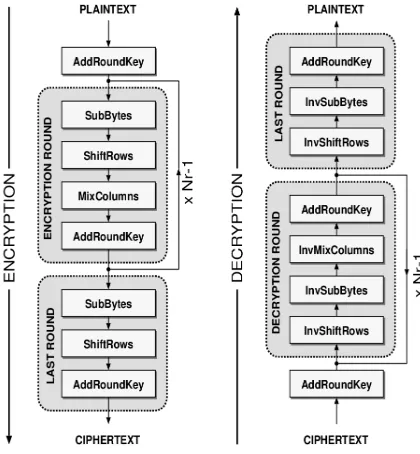
Each round consists of several processing steps, each containing four similar but different stages, including one that depends on the encryption key itself. A set of reverse rounds are applied to transform ciphertext back into the original plaintext using the same encryption key.
3.1 High-level description of the algorithm
KeyExpansion — round keys are derived from the
cipher key using Rijndael's key schedule. AES requires a separate 128-bit round key block for each round plus one more.
AddRoundKey— each byte of the state is combined
with a block of the round key using bitwise xor.
International Journal of Research in Advent Technology, Vol.2, No.2, February 2014
E-ISSN: 2321-9637
Preferred Encryption Algorithms
(Advanced Encryption Standard)
design principle known as a permutation network, and is fast in both Unlike its predecessor DES, AES does not use a Feistel network. AES is a variant of Rijndael which has a fixed block size of 128 bits, f 128, 192, or 256 bits. By contrast, the Rijndael specification per se is specified with block and key sizes that may be any multiple of 32 bits, both with a minimum of 128 and a maximum of
major order matrix of s, termed the state, although some versions of Rijndael have a larger block size and have additional columns in the state. Most AES calculations are done
The key size used for an AES cipher specifies the transformation rounds that convert the input, called the plaintext, into the final output, called the ciphertext. The numbers of cycles
bit keys. bit keys. bit keys.
Each round consists of several processing steps, each containing four similar but different stages, including one that depends on the encryption key itself. A set of reverse rounds are applied to transform ciphertext back into the original plaintext using the same
level description of the algorithm
round keys are derived from the cipher key using Rijndael's key schedule. AES bit round key block for each
each byte of the state is combined with a block of the round key using bitwise xor.
SubBytes — a non-linear substitution step where
each byte is replaced with another according to a lookup table.
ShiftRows — a transposition step where each row of
the state is shifted cyclically a certain number of steps.
MixColumns — a mixing operation which operates
on the columns of the state, combining the four bytes in each column.
AddRoundKey
Final Round (no MixColumns)
SubBytes ShiftRows AddRoundKey.
Figure 3: Working of AES Algorithm
3.2 Triple DES
In cryptography, Triple DES is the common name for the Triple Data Encryption Algorithm (TDEA or Triple DEA)
symmetric-applies the Data Encryption
algorithm three times to each data block.
International Journal of Research in Advent Technology, Vol.2, No.2, February 2014
linear substitution step where each byte is replaced with another according to a
transposition step where each row of the state is shifted cyclically a certain number of
a mixing operation which operates on the columns of the state, combining the four bytes
(no MixColumns)
Working of AES Algorithm
International Journal of Research in Advent Technology, Vol.2, No.2, February 2014
E-ISSN: 2321-9637
The original DES cipher's key size of 56 bits was generally sufficient when that algorithm was designed, but the availability of increasing computational power made brute-force attacks feasible. Triple DES provides a relatively simple method of increasing the key size of DES to protect against such attacks, without the need to design a completely new block cipher algorithm.
Figure 4: Working of Triple DES
3.3 Algorithm:
Triple DES uses a "key bundle" which comprises three DES keys, K1, K2 and K3, each of 56 bits (excluding parity bits). The encryption algorithm is:
ciphertext = EK3(DK2(EK1(plaintext)))
I.e. DES encrypt with K1, DES decrypt with K2, then DES encrypt with K3.
Decryption is the reverse:
plaintext = DK1(EK2(DK3(ciphertext)))
I.e., decrypt with K3, encrypt with K2, then decrypt with K1.
Each triple encryption encrypts one block of 64 bits of data.
In each case the middle operation is the reverse of the first and last. This improves the strength of the algorithm when using keying option 2, and provides backward compatibility with DES with keying option 3.
Conclusion
Security in Hybrid peer to peer network is achieved using client side key cryptography. An intermediate server is used for generating key used for encryption and data is encrypted using symmetric algorithm. This approach successfully avoids Man in the middle attack. Data size limited to 5 MB is supposed to be tested at time of execution.
References
[1] R. Ranjan, A. Harwood, and R. Buyya, "Peer-to-peer based resource discovery in global grids: a tutorial," IEEE Commun. Surv., vol. 10, no. 2. and P. Trunfio, "Peer-to-Peer resource discovery in Grids: Models and systems," Future
Generation Computer Systems archive, vol. 23,
no. 7, Aug. 2007.
[2] Krishnan, R., Smith, M. D., Tang, Z., & Telang, R. (2004, January). The impact of free-riding on peer-to-peer networks. In System Sciences, 2004. Proceedings of the 37th Annual Hawaii International Conference on (pp. 10-pp). IEEE.
[3] Basu, A., Fleming, S., Stanier, J., Naicken, S., Wakeman, I., & Gurbani, V. K. (2013). The state of peer-to-peer network simulators. ACM Computing Surveys (CSUR), 45(4), 46.
[4] Darlagiannis, Vasilios (2005). "Hybrid Peer-to-Peer Systems". In Steinmetz, Ralf & Wehrle, Klaus. Peer-to-Peer Systems and Applications. Springer. ISBN 9783540291923.
[5] Li, Deng et al. (2009). Vasilakos, A.V. et al., ed. An Efficient, Scalable, and Robust P2P
Overlay for Autonomic Communication. Springer.
p. 329. ISBN 978-0-387-09752-7.
[6] Stutzbach, Daniel et al. (2005). "The scalability of
swarming peer-to-peer content delivery". In
Boutaba, Raouf et al. NETWORKING 2005 --
International Journal of Research in Advent Technology, Vol.2, No.2, February 2014
E-ISSN: 2321-9637
Communications Systems. Springer. pp. 15– 26. ISBN 978-3-540-25809-4.
[7] Gareth Tyson, Andreas Mauthe, Sebastian
Kaune, Mu Mu and Thomas Plagemann. Corelli:
A Dynamic Replication Service for Supporting
Latency-Dependent Content in Community
Networks. In Proc. 16th ACM/SPIE Multimedia
Computing and Networking Conference
(MMCN), San Jose, CA (2009).
[8] Glorioso, Andrea et al. (2010). "The Social
Impact of P2P Systems". In Shen et
al. Handbook of Peer-to-Peer Networking.
Springer. p. 48.ISBN 978-0-387-09750-3.
[9] John Borland, Judge: File-Swapping Tools are
Legal
,http://news.cnet.com/Judge-Fileswapping-tools-are-legal/2100-1027_3-998363.html/
[10] Ahson, Syed A. & Ilyas, Mohammad, ed.
(2008). SIP Handbook: Services, Technologies,
and Security of Session Initiation Protocol.