Bachelor thesis
Design proposal for the FLUKE
Wireless Touch Power Quality Analyzer
O
.F.
P
eu
sc
he
I
Design proposal for the FLUKE
Wireless Touch Power Quality Analyzer
25th of June 2012
no. of copies: 04
Benchmark electronics lelyweg 10 7602 ae almelo +31 (0)546 535 111
student o.F Peuscher s0150266
coordinator at Benchmark eng. c. suurmeijer
Project coordinators eng. t.G.m krone
dr. eng. a.o eger
university of twente
V
Abstract
Final report for the bachelor assignment.
BackGround
Fluke has the idea to use an excisting consumer tablet in their future power quality analyzer. an early study by Philip jansen, a bachelor student at the univirsity of twente, shows that a touchscreen interface is a real addition to the functionality of a power quality analyzer. Philip used an iPad 2 to test the touchscreen interface he designed.the problem is that such consumer tablet is very vulnerable for the typical use of a Fluke product.
aPProach
a design study will give insight in which way a consumer tablet could be integrated in a new design for a power quality analyzer. the goal is to create a design proposal which complies to Fluke’s design standards. the design has to meet both esthetical and functional desires.
results
after a design traject, a design proposal for the next generation power quality analyzer was created. the design features several functions Fluke wanted to integrate in previous models but never succeeded for different reasons. the design also has a different design than other Fluke products which could be an inspiration for Fluke’s other future designs.
conclusions
Table of Contents
introduction
1
research Phase
01 Fluke corporation
3
Introducing Fluke 3
Almelo Plant 3
Products 4
Target group 7
Fluke versus other brands 7
02 the Power Quality analyzer
13
Portable Power Quality Analyzers 13
Power quality explained 13
Safety standards 15
Thor’s housing 17
Thor’s successor 17
concePtualisation Phase
03 Future model
19
Touch screens 19
Touch screen integration 19
Domestic tablet PCs 21
Wireless communication 21
Other design issues 23
04 design requirements
25
05 concept generation
27
Tab module 27
Listed features 27
Shape and sizes 29
Esthetics and housing’s design 31
Concept 1: PowerWedge 32
Concept 2: Powerslide 33
Concept 3: Powerslide Two 35
Testing and redesigning 37
Concept 4: Sliding Donar 39
VII
Finalisation Phase
06 concept modeling
43
Size and materials 43
The Fluke wireless touch Power Quality Analyzer 45
Analyzer module 47
Tab module 49
07 Concept verification
51
Assembling 51
Verification 51
08 recommendations
52
Model recommendations 52
Interface recommendations 53
Wireless communication recommendations 53
09 evaluation
54
Glossary
56
reference list
58
aPPendices
RE
SE
AR
CH
P
H
AS
E
01
02
03
04
05
06
07
02.3 Fluke 435 Power Quality Analyzer 34
VOL
TA
GE
TIME
average RMS
Peak maximum
positive
maximum negative
02.2 Peak and RMS voltage 16
Rated Voltage IEC 61010-1 2nd edition
CAT IV CAT III CAT II
150V 4000V 2500V 1500V
300V 6000V 4000V 2500V
600V 8000V 6000V 4000V
1000V 12000V 8000V 6000V
Resistance 2 ohms 2 ohms 12 ohms
Service entrance
Service entrance
transformer machine
local distributor
CAT I CAT II CAT III CAT IV
Optocoupler 18mm
03.6 Housing parts of Donar.
Co
n
CE
Pt
u
Al
iS
At
io
n
PH
AS
E
Brand and model Operating system Size Screen size Docking mode
iPad 2: ios 241x186x8,6mm 9.7 inch Portrait
Asus eee tablet TF101 android 271x171x12.98 mm 10.1 inch landscape
Samsung Galaxy tab 10.1 android 256,7x175,3x8,6 mm 10.1 inch landscape
Acer Iconia A500 Windows mobile 7 260x177x13 mm 10.1 inch landscape
iPad2
Asus Eee
Samsung Galaxy
Acer Iconia
on/off buttons
Connectors
REQUIREMENTS
overmold shape
Module coupling Cable storage Grip and holding Battery pack Carrying/Protection Standing/hanging SD card Measure module Recharging Measure module interface
01 02 03 04 05 06 07 08 09
Slide in Fit in Slide on Click on
None
X
In a case
Slide in Body part
Bottom insert
In a case Display cover
Under battery Bottom SD card slot Front SD card slot Side SD card slot
Connector Inductive Shaking
Small touchscreen Small screen with
buttons Status digits and buttons Status leds and buttons
Standard magnetic strap
31
esthetics and housinG’s desiGn
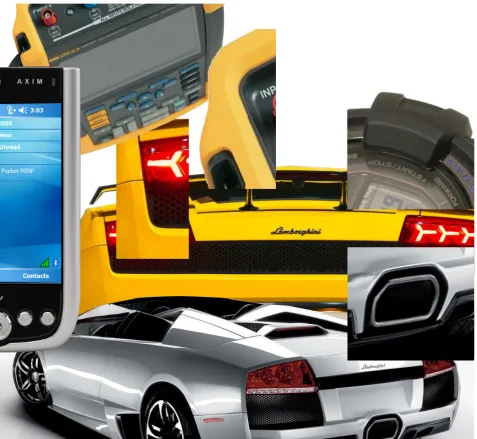
All Fluke products have a typical design, defined by the company’s design requirements. most current Fluke products look heavy and robust, it would be challenging to design a more elegant still robust device, which correspondents with the wireless technology and consumer tablet used in the future power quality analyzer.
to obtain design inspiration, watching other elegant and robust products with inspirating shapes, like fast and strong cars, watches and tools, would be useful. especially for the main shape and the way
the overmold could be used. the typical yellow overmold has much effect on the device’s design, so the way overmold is being used is very important. yellow overmold has to be applied on the device’s corners for shock absorbance, but also provide grip when the device is placed on a slant surface.
Figure 05.4 shows a small shapstudy used for inspiration. First design sketches are displayed in figure 05.3. The main design focus was the use of overmold, the basic shape and the connector and display orientation.
33
Concept 1
PowerWedge
The first concept, shown in figure 05.5 - 05.9, the PowerWedge, features a yellow holster to protect the tablet, which can be opened to place the tablet, which has te be done once. the concept’s size is about 200x300x80 mm, providing enough space for a tablet, electronics and battery.
the yellow holster protects the tablet against shocks and features a handle to transport the tablet while wearing gloves. the handle can also be used as a stand when the tablet is used on a table or knees. Fluke’s standard magnetic strap can be attached to this handle to hang up the tab module.
the analyzing module slides with it’s top in the handle and falls into the opposite shape. When fully slided into the handle, the analyzing module’s back clicks into the tab module. the shape looks solid and rugged and the color use complies to the Fluke standards.
05.7 Concept one.
05.6 Concept one’s merging procedure.
Concept 2
Powerslide
the second concept, shown in figure 05.10 - 05.13, the Powerslide, has a yellow holster that is not able to be parted. the gray top will be able to open which makes is possible to place a tablet. the concept’s size is also about 200x300x80mm,
the yellow holster provides a rugged surround on the tablet which holds the analyzing module and a click system to hold the analyzing module in place. the holster provides a stand while the tablet is used on a table or knees and two handles. the tab module has two holes to connect a standard tablet connector and two buttons to control the tablet’s top buttons.
the shape looks solid and rugged and the color use complies to the Fluke standards. the overmold’s shape is different from current Fluke products.
05.10 Concept two’s top.
05.11 Concept two’s bottom.
05.12 Concept two.
35
Concept 3
Powerslide Two
the third concept, shown in figure 05.14 - 05.17, the Powerslide two, looks a lot like the Powerslide but the sliding feature has been designed different. the tab module slides on the analyzing module instead of sliding the analyzing module into the tab module, using a trapezoid and cone-shaped body the concept’s footprint size is also about 200x300mm but the height is 90mm for the fact that te tab module’s height must be 20mm at least for providing a good grip.
this makes the tab module smaller but doesn’t feature a handle for the tablet. the
analyzing module has a usefull stand like the current power quality analyzer. such stand could be applied to the PowerWedge and Powerslide as well.
the Powerslide two will propably slide the most intuitive and fool proof but looks less sleek than both other two concepts.
05.15 Concept three.
05.14 Concept three’s sliding procedure.
05.18 Concept 1 foam model.
05.19 Concept 2 foam model.
05.21 Concept 4.
39
Concept 4
Sliding Donar
concept 4, shown in figure 05.21 - 05.24, called sliding donar looks a lot like the current new power quality analyzer with the donar casing. the concept has the opposite sliding method used in concept 3.
the concept features an adjustable stand which lays into the body to provide a flat bottom. the tablet module slides intuitive from the top to the bottom and has a leading on the sides and in the middle (figure 05.22). the concept features knobs and holes to provide acces to the consumer tablet.
since the concept’s shape looks a lot like the donar body, the concept would be a good current Fluke product but a bad future model, even though the model contains all features. 40
the model’s shape has to be more like concept one or two. 40
05.23 Back view of Concept 4.
05.25 Concept 5.
41
Concept 5
Streamline
concept 5, shown in figure 05.25 - 05.28, has different shapes than concept 4 and all other current Fluke products. the concept not only shows a functional solution fot using a consumer tablet, but also a new design, inspired again by the shown shapestudy on page 31.
even though the model is a solid shape, the yellow overmold, diffuser shaped bottom and the shadow under the model make the model look less heavy. the concept features an adjustable stand that lays into the bottom to provide a flat bottom. the concept also features a big hook to hang up the device, a feature that Fluke wanted to add to previous power quality analyzers but didn’t pass esthetical requirements.
the model has concept four’s functionality and concept two’s use of yellow overmold. this concept is a starting point for a more detailed rebuild version that encloses the current donar electronics.41
fi
n
Al
iS
At
io
n
PH
AS
E
43
06 |Concept modeling
The final concept is a detailed version of Concept five, consisting of custom and
original equipment manufacturer [OEM] parts. The current Donar electronics fit in
the housing and there is a high level of detail.
The final concept features all requirements stated in the design phase.43
size and materials
the concept’s size follows by measuring the acer iconia a500 tablet, which is the widest reference android or Windows based tablet26, the battery and
the current donar electonics.
making the analyzing module as thin as possible, the battery and electronics have to be placed in a line instead of one above the other, which defines the total inside length en height necessary. The Acer tablet defines the necessary width inside the tab module.
all plasic parts will be made of Pc/aBs/ V0 which is also used in the current power quality analyzer.38 For the model, all wall thicknesses are
set to 1,5 millimetres with some exceptions. some reinforcing ribs will be two millimetres thick and the screw fixing buses have a wall thickness of two millimetres. the battery holder’s wall thickness is one millimetres and the stand has a three millimetres wall thickness.
the chosen thicknesses are copied from the current power quality analyzer, which hass wall thickesses between 1 and 2 mm and similar screw fixing buses. The reinforcement ribs on the stand draw inspiration of the Fluke 123 scopemeter’s stand and an other stand shown in figure 06.2. All yellow parts are made of tPu overmold and will be added on the gray parts during the production process.the overmold’s thickness is three
06.3 Render of the Fluke wireless touch power quality analyzer.
01
02
02 02
02
02
03
04 05 06
07 08
09 10
10
11
06.10 Exploded view of the analyzing module 01 Stand
02 Overmold
03 Battery connector and SD card print 04 Donar Electronics
05 Secondary display on print with buttons 06 Battery cover
07 Friction hinge
08 Wide hook for sliding 09 Mushroom shaped tabs
10 Batterycover fixation
11 Battery 12 Top 13 bottom
leg
enda
12
01
01
02
03 03
03
04
05 06
07
07
06.12 Exploded view of the tab module 06.11 Transparent view of the tab module
06.13 Slider for the sliding system 01 Samsung galaxy tablet
02 Foam 03 Blue sliding tab 04 Metal spring 05 Bottom plate 06 Top cover 07 Overmold
leg
07.1 SLA model standing
07.2 SLA model of the analyzing module
07.3 The complete SLA model with the user interface by Philip Jansen
07.4 Bottom view of the SLA model
53
be controlled by using plastic tabs that hit thetablet button by pushing these plastic tabs. since all consumer tablets have a different size, some adapters to adjust the plastic tab’s length have to be designed for every supported consumer tablet.
interFace recommendations
the analyzing module has a small display with four buttons. this display is a placeholder for a future display to show that it is possible to fit a small display with buttons into the device.
Wireless communication recommendations
55
later that week to show the concept to Philips.i also helped my supervisor with different small internal projects and a small project he does for iBm.
Overall I’m very satisfied with the result of the project. i managed it to maintain the project’s focus and respected the earlier choices I made. The final design is not a revolutionary looking design, but it perfectly matches Fluke’s expectations and it is realistic for the target market.
Being a industrial designer is more than only being creative, a designer needs to make choices and focus on the project’s goal. i think i succeeded both parts of this description.
57
Tablet: a typical small portable computer with atouch screen, also called a pad named to the most famous tablet, the apple iPad. tablets are more and more used these days.
Thor: the project name for the old Fluke equipment.
Transient: a signal measured by an oscilloscope that only occurs once.
VA: volt-ampere (Va) is the unit used for the apparent power in an electrical circuit, equal to the product of root-mean-square [RMS] voltage and rms current.
MEETINGS
37. suurmeijer, c, Peuscher, o.F.
mock-ups and design issues for domestic tablet integration. Benchmark electronics almelo, 2012/01/25, 13.00 - 14.30,
38. alphen, m. van, Peuscher, o.F.
Wireless datatransfer possibilities for the power quality analyzer. Benchmark electronics almelo, 2012/01/26, 10.45 - 12.00,
39. Vegte, F. van der, Grob m.B.c, suurmeijer, c, hallink, n, Peuscher o.F
First foam concept testing. Benchmark electronics almelo, 2012/02/23, 14.00 - 14.30.
40. suurmeijer, c, Peuscher, o.F.
concept evaluation and brainstorm for new concept. Benchmark electronics almelo, 2012/02/29, 10.00 - 11.00,
41. suurmeijer, c, Peuscher, o.F.
evaluating and choosing concept. Benchmark electronics almelo,
2012/03/21, 11.00 - 12.00,
42. krone, t.G.m, suurmeijer, c, Peuscher, o.F. meeting with both supervisors, planning the furter project. Benchmark electronics almelo,
2012/04/12, 13.30 - 15.00,
43. suurmeijer, c, Peuscher, o.F.
Final concept confirmation. Benchmark Electronics almelo, 2012/05/04, 15.00 - 16.00,
44. suurmeijer, c, Peuscher, o.F.
AP
PE
n
d
iC
63
Appendix B - Detailed renders
B.01 reinforcement ribs of the stand in detail
67
B.04 Detail of the ribs for reinforcing the knob interface. The ribs also feature the screwbusses for holding the PCB. An edge for fi tting the display is also featured.Appendix C - Detailed pictures
C.01 All unfinished parts
69
C.03 Picking up the batteryAppendix D - Touchscreen interfaces by
Philip jansen
36
this appendix shows some interface screens Philip jansen made for a future touch power quality analyzer. the study of Philip jansen concentrated on how a tablet size touch screen could be integrated in the Power Quality analyzer.
the main goal was to research in what way a this size of touch screen gives the device more functionality. the reasearch concluded that a Power Quality analyzer could perform very well with the use of such display. this conclusion made Fluke decide to do more research for the implementatuion of a consumer tablet.
D.01