CSEIT1833170 | Received : 20 March 2018 | Accepted : 10 April 2018 | March-April-2018 [ (3 ) 3 : 1235-1244]
© 2018 IJSRCSEIT | Volume 3 | Issue 3 | ISSN : 2456-3307
1235
Comparative Studies of Various Techniques for Encrypting
Digital Image
Salil Bharany1, Prabhpreet Kaur2
1MTech Student , CET Department GNDU, Amritsar ,India
2Assistant Professor , CET Department, GNDU, Amritsar, India
ABSTRACT
The images has bestow significantly to the multimedia communication. When a user transfers an image to an unsafe communications network, absolute protection is a challenge for image surveillance. Encryption is a method of preserving the mystery of images This document provides a brief overview of cryptography and comparative comparison of criteria for the many radical securities of Image Cryptography algorithms. This work shows a number of technical studies on cryptographic images and computations for individual analysis, illustrations, conclusions, and future suggestions.
Keywords : Encrypted image; histogram; image, image encryption; image security parameters; permutation and substitution; scrambling, XOR operation.
I.
INTRODUCTION
The Internet and information technology are evolving rapidly. As a result, people use media to communicate extensively. For example audio and video images. The image occupies most of the multimedia. The image plays an important role in communication .For example Military, national security agents, and diplomatic affairs. Since these images may contain the most confidential information, these images require additional protection when you accumulate somewhere in the repository. Additionally, when people want to transfer their images over the network, then it is important to give absolute protection. Overall, the image needs protection against various attacks .The primary purpose of preserving the protected image is to maintain confidentiality and accuracy [16]. Different techniques can make the image safer and more technical is encryption. Usually, cryptography is a procedure that transforms a picture into a mysterious image by victimization of keys. In addition, the user can download the original image by applying the encryption method to the encryption image, which is usually performed instead of the
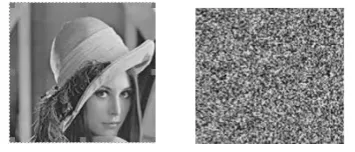
encoding process. For illustration of figure 1 is a main picture. Users use cryptographic techniques and create cryptographic images. Figure 2 shows encrypted images as a result of the coding process. On the other hand, when you get this hidden image, it performs the decryption and restore the information back. Figure 3 shows the resultant image
Figure 1. Original image Figure 2. Cipher
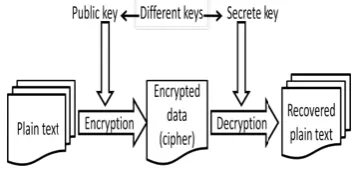
More important, cryptography has two main types. (1) symmetric key cryptography, (2) incompatible key cryptography[16].
In cryptographic cryptography same keys is used for encrypt and decrypt images[16].
Figure 4. Symmetric Key Encryption
Asymmetric or public key cryptography for decrypting and encryption different keys are being used [16]. This technique uses public keys and private keys to encode and decode the image respectively. However, these two keys are unique, but mathematically connects.
Figure 5. Asymmetric Key Encryption
Additionally, a hashing authenticates the received image due to having the one way property. Many algorithms exist for encryption of particular information. RSA, DES, AES, etc. These algorithms, are most important to encrypt text data, however, are not suitable for encrypting the image. [6] Since this image intrinsic features such as several elevators and a close relationship between pixels [6] adjacent to each other So it's easier to pinpoint the location of neighbouring pixels. Therefore, the image needs an effective method to achieve invulnerable security.
Techniques for image encryption based on three methods.(1) Pixel permutation :scrambling of alternative set of pixels [22,23].
(2) Pixel substitution : Replacement of the pixel: changing Pixel change value [22,23] . (3) Visual transformation [22, 23]. An artificial nerve network is a different approach to the protection of this image and is useful because of its nonlinear and its own unique properties [11].In ANN ,to calculate the final result is easy, in contrast, downloading raw data from the resulting task is a problem. Thus ,it will be not possible to decide what kind of initial data from result[11].in figure 6 there is a feed forward neutral network and formula which figure out the output of network
Figure 6. Artificial Neural Network
n
Y f (Wi X i b)
(1)
i1
Where Y is output, W is the weight, X is an input; b
is bias and n is the number of neurons in different layer.
In addition, compression is another technique for image encoding by abbreviating an image. So the compressed image form is hard to understand. In addition, the main advantage of encryption through a compressive process is that it helps to reduce image size without losing the information provided, without loss of information. However, lossy compression can be used when minor distortion is allowed.
II.
INTRODUCTION TO IMAGE SECURITY
PARAMETERS
your word processor, please use the font closest in appearance to Times. Avoid using bit-mapped fonts if possible. True-Type 1 or Open Type fonts are
preferred. Please embed symbol fonts, as well, for math, etc.
Generally, an excellent encryption technique qualifies various security criteria and some of them are following as:
2.1 Large key space :A huge keys space should be needed for reducing the chances of brute force attack [2]. For example, the key of size 512 bits provides the key space of 2512 (≅ 10154 possible
combinations).Thus, if a computation machine does 1010 calculations per second, will take about 10136
years to find the right key which is simply not possible .
2.2 Key sensitivity: It ensures that this system will have a completely opposite effect, regardless of key changes [8].this leads to if we make change to the shortest part of key it will surely create a different encrypted image
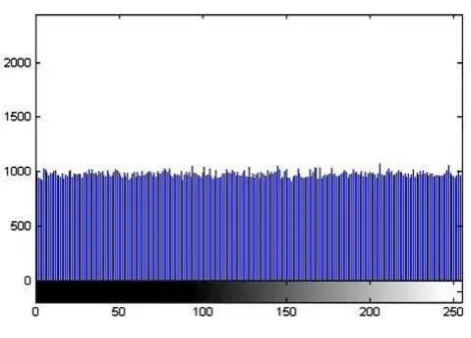
2.3 Constant Image histogram: Continuous pixel distribution and density estimation [19, 20] are provided by the histograms. Therefore, the encrypted image must have the different histogram to make it more secure from that the plain text attack [21].In Fig 7 original image is represented by the histogram and in fig 8 the histogram of the encrypted image is there which is highly desirable and uniform
Figure 7. Histogram of an original image
Figure 8. Histogram of Cipher Image
2.4 Information entropy: It limits the level of uncertainty and even distribution within the system [17]. Therefore, Randomness and Even distribution must be shown in the encryption process. By using a formula (2) Information entropy is calculated.
Where p (mi) defines the probability of a pixel and N
is the number of bits in each pixel. For a grey level image, each pixel has 8 bits, so the probability of a pixel is 1∕ 28. Hence, information entropy of the grey
level image is H (m) = 8. However, practically it is intricate to obtain ideal entropy; so slight difference is also tolerable.
Where xi and yi are grey level value of two adjacent
pixels, N is the number of pairs (xi, yi) and E(x) is the
mean of xi and E(y) is the mean of yi.
2.6 Differential analyses : NPCR (Rate of Exchange Rate Ratings) and UACI (Compression of the Unified Medium Normalization Level) measure the variability of the anti-apartheid algorithm over the image [17]. The NPCR estimates the rate of change in pixels in the encoded image after a pixel correction of the main image [17] [18] so that the high NPCR value is effective. Additionally ,the amend between the pixels of the plain image and encrypted image is being calculated by the UACI [18], Before changing the bit of the original image , if the C1 and C2 are encoded in the image the by the use of the formula (7) and (8) we can obtain UACI and NPCR .
Image Encryption Using Affine Transform and XOR Operation (2011)
In this work, Amitava Nag, Jyoti Prakas Singh, Srabanin han, Susanna Bisvas, D. Sarkar, and Parta
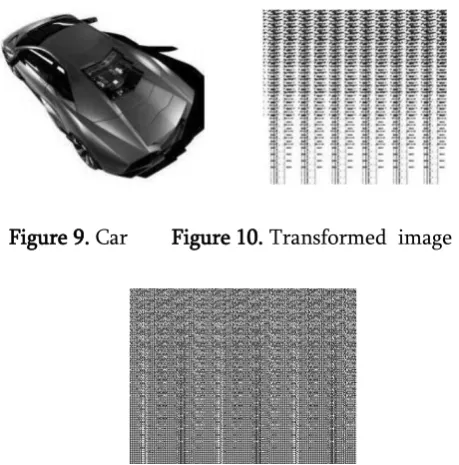
Pratim Sarkar [1] has used a technique with a 64-bit key to encryption. A techniques in which affine transformation of dissipate the pixels by applying sub keys of 8 bits each and use 4 sub keys.Next, the image is decomposed in 2 × 2 pixels of the block, and then apply the XOR operation on each block with 4 sub keys of 8 bits to change the value of the pixel. Figure 9 shows the image. Relevant systems manage the processing operations on the original image to create the transformed image. The fiction process uses XOR operations on the transformed image of an encrypted image Figure 9 shows the original image and Figure 10 shows the transformed image . Figure 11,12,13 Represents the image converted , display the histogram of the original image and display the histogram of the secret image
Figure 9. Car Figure 10. Transformed image
Figure 12. Histogram of the original car
Figure 13. Histogram of Cipher
Consequently, the method shown is less effective in reducing the pixel ratio and also having short key space. This algorithm is not complicated enough in the main procedures that are used by the encryption process. Therefore, the provided technique does not provide a picture-security level, due to short and simple operations with the XOR
A New Chaotic System for Image Encryption (2012)
In this scenario, Longboe and Yixing Cho have proposed a new chaotic system that represents three 1-dimensional chaotic maps. In purposed technique random sequences [2] is generated by using logistic map as the controller which select the tent or sine map .The algorithm then uses the node replacement structure (SPN) to get confusion and diffusion assets [2, 15]. This scheme uses a 240-bit key for large key space. Normally , for excessive sensitivity for encryption and decryption we can change the parameters settings of key.Therefore, the proposed approach offers good protection against attacks of brute force, as well as the variations of key words and chaotic behavior.
Novel Digital Image Encryption Method Based on One-dimensional Random Scrambling (2012)
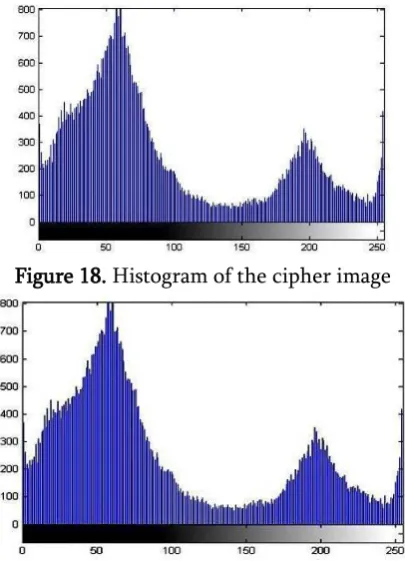
In this, Ping Guan, Yunfeng Xue ,Yongping and, Qiudong Sun [3] use a random scrambling technique using one- dimensional . starting the process convert 2-dimensional image into one- dimensional image and then a random shuffling (one-dimensional)is applied .then works against the transformation on the dispersed vector to create an encrypted picture. So the design scheme does not require a computational requirement as one or two execution are sufficient for the best result. Figure 14 shows the original image. After the initial operation of technical procedure, produce the encoded image with the code as shown in Figure 15. After 15 operating cycles. Encrypted image is produced are shown in Figure 16.Orginal image is shown in fig 17 and in Fig 18 histogram representation of original image and encrypted image of dog .
Figure 14. Dog Figure 15. Cipher at iteration 1
Figure 18. Histogram of the cipher image
Figure 19. Histogram of the cipher image
After the experiment it was found that the histogram of the original image and the ciphered image was the same because of the scrambling process. However, scrambling processes reduce the interconnection between pixels but does not affect histograms. Because the histogram of the image shows enough information about the original image. Therefore, the requested technique does not fit into the high confidential image.
Technique for Image Encryption Based On Explosive n*n Block Displacement Followed By Inter-Pixel Displacement of RGB Attribute of A Pixel (2012)
In this scenario , Amnes Goel and nidhi Chandra[4] have proposed an efficient method that decomposes the original image of image having a size of n*n size of block .After this ,minimizing the correlation between pixels[4] is done using an algorithm .In general, the technique provided has two main stages. This is the initial settlement process of the blocking of the block, followed by the vertical movement of the block. Then, in the second stage, the RGB value is changed between pixels. Each stage contains a mask or its own key used in the process [4]. Figure 19
represents the original image with 300 * 300 dimensions, and after applying this image block, Figure 20 was created. In addition, after performing the vertical movement of the unit on a horizontal motion image, a picture was created, shown in Figure 21. Then use the pixel shift in the RGB value to obtain an encrypted picture that is represented in Figure 22.
Figure 21.Vertical displacement Figure 22. Cipher Image at 10*10 block size
Figure 19. Original Image Figure 10. Horizontal displacement of 10*10
The experimental outcomes validate that the propounded system generates a robust cipher image with the help of explosive displacement in RGB values.
Novel Neural Network Approach for Digital Data Encryption/Decryption (2012)
decoded the images that include three stages [5].In the first phase this system will clear irregularities which were added . Then 2 stage ,network discards the extra conjoined columns in matrix. In addition, the third stage , stimulation of the network is done by the received image data and weight which were stored after training . The effect of this method is due to arbitrary encryption on the sender side and prevents the change of keys. Therefore, the proposed technique provides a powerful level of security. The basic assumption is that the decryption process is longer and take time .
A Novel Encryption method for Image Security (2012)
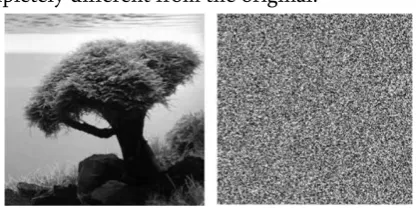
In this article, Mohammed Abbas and Fajil al-Hussein have developed a method that relies on changes on bit level permutation. Security is enhanced by using two Boolean operations XOR and rotation of pixels bits .this will create diffusion and confusion .In addition to this procedure, the algorithm has applied XOR functions sequentially to all pixel bits in the image and by the circular right rotation of these bits. Techniques have repeatedly made these two actions to provide better security. In addition, this method uses same encryption and encryption key generally. Figure 23 is the main image, and Figure 24 is an encrypted image completely different from the original.
Figure 23. Original Image Figure 24. Cipher Image
Two Layer Chaotic Network Based Image Encryption Technique (2012)
In this article, Angel Jain and Navin Ripal provide technical reliance which relies on the diffusion and substitution. A doubled layered chaotic neural
networks is used in propound system for encryption and decryption of image In addition, this method uses a logical chaotic map to Design weights and biases for neural networks and external keys that provide initial conditions [7]. Defined algorithms typically use an 80-bit key. However, the chaotic order sequence is the same as coding and decoding [7].Diffusion is being used by the first layer and the second layer is used for substitution while decrypting Layout of layers is in reverse order. Therefore, the technology provided gives significant security against the attacks of brute force and known plaintexts or chosen plaintext attack .
A New Cryptographic Approach for Image Encryption (2012)
In this scenario, Nidhi Seth and Dipika Sharma [8] provide an encryption method that takes advantage of the logistic mapping to encode and compress images. The full implementation of the proposed algorithm is as follows: First the imparted scheme abbreviates an image through Haar Wavelet transformation. Then the system breaks the image into 8 * 8 size of block ; then this disjoint picture goes into the encoding process.. Typically, this encoding procedure has two stages. At first, the inter pixel correlation by using a block based scrambling is minimized by the propounded program. A crossover approach is being utilized by the shuffling method that relies on genetic algorithm [8].Additionally, in phase 2, this system is used to encrypt the pixel values of the dispelled facsimile a 2D Logistic map. including, the Logistic based mode satisfies the confusion and diffusion properties in the cipher picture, which makes it harder to encrypt or decrypt it from a third party. The logistic map then generates the key that is sent to the recipient through a prohibited method (watermarking) for powerful security. The results suggest that the proposed strategy can provide reliable protection.
In this script, the Somdip dev [9] provides a technical approach to be proposed depends on three methods of cryptography: (1) reversal and rotation of bit,(2)
extended Hill Cipher, (3) modified MSA
randomization[9]. In addition, the requested system uses four stages of encrypting the image. In the early stages, the algorithm produces a unique number for symmetric key. In step 2, the rotation of bits and the reversal are applied based on the length of the symmetric key. Then, in the third phase, extended hill cipher is being used as an encryption technique. Then, in step four, this project uses MSA randomization approach for substitution. The experimental results indicate that the coding procedure for SD-AEI has an impact on the SD-EI due to additional randomization.
J. Digital Image Encryption Algorithm Based on Multi-Dimensional Chaotic System and Pixels Location (2012)
In this article, Hazern Mohammad al-Najjar [10] has requested the creation of digital encoding technology based on multidimensional chaotic functionality. This system will dispels pixels and change the pixel value. . By applying two substitution methods and using two scrambling processes to scatter pixels is used to change the pixel values In addition, the proposed courses encrypt the following images first applies the first substitution scheme using column index value ,followed by the first scrambling method which utilizes X,Y,Z planes of Rossler equation. Then system operates the second replacement process using row index followed by shuffling plan which employs X,Y,Z planes [10]. Observes that the algorithm is sensitive to the original state and may also invulnerable to brute force attacks and other types because of the large key size 10 ^ 45.
K. Unified Approach with Neural Network for Authentication, Security and Compression of Image: UNICAP (2012)
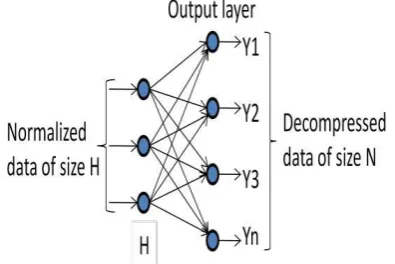
In this paper, Dattatherya, S. Venkata Chalam and Manoj Kumar Singh provide three stage encryption method : compression, security, and authentication. The proposed method uses an neural network to perform these tasks. The proposed scheme uses a universal approximation for the compression.In addition, this method carries forward neural network for compression. the hidden layer has the least number of neurons compared to the input layer. The procedures being carried out ensure the safety of the neural network, due to the one way property of neural networks .the system provides authenticity by the one to one mapping.Later on, this method offers sufficient security, along with image area detection features. A separate section of the system is shown in the image below. Figure 25 shows the architecture of an artificial neural network that causes compression. Figure 26 is a compact module that is used which is used for the abridgement and generates a compact output for a block. In addition, Figure 27 displays a module, which decompresses the squashed data for a block.
Figure 25. Architecture of Artificial Neural Network for compression training
Figure 27. Decompression part of Artificial Neural Network
L. Image Encryption and Decryption Using Blowfish Algorithm in MATLAB (2013)
In this research, Pia Singh and Karameet Singh [12] developed a technique based on the blowfish algorithm. Generally, the Blowfish algorithm is a 64-bit symmetric block cipher, in which it repeats 16 times and applies a range of variable key lengths from 32 to 448 bits.The offered system follows the two processes; the first is a key expansion, and the second is a data encryption. Furthermore, the Blowfish algorithm includes a swap operation after executing two exclusive-or operations that are performed after 16 rounds. The complications have proved that blowfish method is fast and safe.
M. Digital Color Image Encryption Using RC4 Stream Cipher and Chaotic Logistic Map (2013)
In this situation, Riah Ukur Ginting and Rocky Yefrences Dillak [13] have built up the algorithm utilizing the RC4 Stream Cipher and Chaotic Logistic maps. The invented strategy comprises of three phases. At the beginning, the system changes the system key to its original value .Then, in the second step, the technique applies the original value to the chaotic Logistic Map to In this scenario, Riah Ukur Ginting and Rocky Yefrences Dillak [13] have developed the algorithms using the RC4 Stream Cipher and Chaotic Logistic maps. The developed technique consists of three stages which generate the
random number pseudo. Subsequently, in the third stage, the system XOR the byte stream of the plain picture with the stream of pseudo arbitrary number for the encryption. Test results of this encryption calculation approve that the decryption procedure is the very high tactful.
N. GS-IES: An Advanced Image
Encryption Scheme (2013)
In this article, Amandeep Kaur [14] , Gurpreet Singh has developed a new method which use SD_IES by
adding a new permutation block in SD-IES techniques .The latest developed method consists of five stages. In the first step, the technique uses an RSA algorithm to generate a password and perform a one-bit rotation based on the generated password. In addition, in the second phase, the technique proposed to implement the extended hill cipher technique which make encryption insusceptible.In addition, in the third step techniques apply bit’s reversal. Then, in stage 4, the process uses permutation and combination rotation using password length , and in fifth stage ,the encrypted image stored . ultimately , the GS-IES algorithm is authoritative on the last SD-IES due to the intimacy of permutation block in the last stage.
III.
COMPARION OF VARIOUS IMAGE
ENCRYPTION TECHNIQUES
Comparison is done on the basis of; key space, key sensitivity, entropy of original and cipher image, and change in the
Table 1. Comparison of various image encryption algorithms S.
N Authors Technique Key Histogram NPCR %
Used space
1 A. Nag, J.P.
264
Singh, S. Transformation Not good 0
Khan, S. & XOR (negligible)
Biswas et.al [1]
2 Long Bao and
2240
Yicong Zhou Three one- Good 99.61
[2] dimensional
chaotic map
3 Qiudong Sun,
Ping Guan, One Not No change 99.36
Yongping and dimensional fix (same as
Yunfeng Xue random original
[3] scrambling image)
4 Mohammed
Abbas and Bit level Not Good 0
Fadhil Al- permutation, fix (negligible)
Husainy [6] XOR & rotation
5 Nidhi Sethi
10112
and Deepika Two Good 0
Sharma [8] dimensional (negligible)
6 Hazern
1045
Mohammad Multi- Good 99.63
Al-Najjar [10] dimension
chaotic function
The zero or negligible NPCR value means that the technique achieves negligible NPCR (less than .01%).
IV.
CONCLUSION
This work has found a lot of algorithms for encrypting images and concludes that the chaotic method presents extreme uncertainty and offers incredible security.Moreover, study shoes that the NPCR is not depended on the sensitivity of keys so, to achieve satisfactory NPCR in the block based encryption methods, the values of an encrypted block should be dependent on the other cipher blocks .Further, results shoes that to offer the remarkable security only scrambling is not enough : so there should include substitution along with shuffling .Consequently, this review infers that a unrivalled image encryption technique has the following properties to provide the best protection; (1) large key space , (2)high sensitivity of keys, (3) unique histogram is generated , (4) Shannon's Confusion and diffusion property is contented (5) Effective interrelationship between two pixels which are adjacent to each other (6) High security due to systemic uncertainty (7) High NPCR (Nearly 100%) and UACI that are appropriate 33%.
V.
REFERENCES
[1]. Nag, Jyoti Prakash Singh, Srabani Khan, Sushanta Biswas, D. Sarkar, Partha Pratim
Sarkar "Image Encryption Using Affine Transform and XOR Operation" 2011
International Conference on
SignalProcessing, Communication, Computing and Networking Technologies
[2]. Long Bao, Yicong Zhou, C. L. Philip Chen, Hongli Liu "A New Chaotic System for Image Encryption" 2012 International Conference on System Science and Engineering
[3]. Qiudong Sun, Ping Guan, Yongping Qiu, Yunfeng Xue "A Novel Digital Image Encryption Method Based on One-dimensional Random Scrambling" 2012 9th International Conference on Fuzzy Systems and Knowledge Discovery
[4]. Amnesh Goel, Nidhi Chandra "A Technique for Image Encryption Based On Explosive n*n Block displacement Followed By Inter-Pixel Displacement of RGB Attribute of A Pixel"
2012 International Conference on
Communication Systems and Network
Technologies
[5]. Saraswati D. Joshi, Dr. V.R. Udupi, Dr. D.R. Joshi, "A Novel Neural Network Approach for Digital Image DataEncryption/Decryption", Power, Signals, Controls and Computation (EPSCICON), 2012 International Conference [6]. Mohammed Abbas Fadhil Al-Husainy, "A
Novel Encryption Method for Image Security", International Journal of Security and Its Applications,
[7]. Anchal Jain, Navin Rajpal, "A Two Layer Chaotic Network Based Image Encryption Technique", Computing and Communication Systems (NCCCS), 2012 National Conference [8]. Nidhi Sethi, Deepika Sharma, "A New
Encryption", Parallel, Distributed and Grid
Computing (PDGC), 2012 2nd IEEE
International Conference
[9]. Somdip Dey, "SD-AEI: An Advanced Encryption Technique for Images", Digital Information Processing and Communications
(ICDIPC), 2012 Second International
Conference
[10]. Hazem MohammadAl-Najjar, "DigitalImage Encryption Algorithm Based on Multi-Dimensional Chaotic System and Pixels Location",International Journal of Computer Theory and Engineering
[12]. Pia Singh, Karamjeet Singh, "Image Encryption and Decryption Using Blowfish Algorithm in MATLAB", International Journal of Scientific & Engineering Research
[13]. Riah Ukur Ginting, Rocky Yefrences Dillak, "DigitalColor Image Encryption Using RC4 Stream Cipher and Chaotic Logistic Map", Information Technology and Electrical Engineering (ICITEE), 2013 International Conference on
[14]. Gurpreet Singh, Amandeep Kaur, "GS-IES: An Advanced Image Encryption Scheme" International Journal of Engineering Research & Technology,
[15]. D. R.Stinson, Cryptography, Theory and Practice. Third edition: Chapman & Hall/CRC, 2006. William Stallings, Cryptography and Network Security, Principles and Practice. Fifth edition.
[16]. William Stallings, Cryptography and NetworkSecurity,Principles and Practice. Fifth edition.
[17]. Shujiang Xu, Yinglong Wang, Jizhi Wang, Yucui Guo,"A Fast Image Encryption Scheme
Based on a Nonlinear Chaotic Map", 2010 2nd International Conference on Signal Processing Systems (ICSPS), 5-7 July 2010
[18]. Linhua Zhang, Xiaofeng Liao, Xuebing Wang, "An image encryption approach based on chaotic maps", Chaos, Solitons & Fractals. Volume 24, Issue 3, May 2005, Pages 759–765. [19]. http://en.wikipedia.org/wiki/Histogram
[20]. Karl Pearson (1895), "Contributions to the Mathematical Theory of Evolution II, Skew Variation in Homogeneous Material". Philosophical Transactions of the Royal Society A: Mathematical, Physical and Engineering Sciences 186:
[21]. Xu Shujiang Wang Yinglong, Guo Yucui Wang Cong,"A Novel Chaos-based Image Encryption Scheme", International Conference on Information Engineering and Computer Science (ICIECS) 2009, 19-20 Dec. 2009, [22].
http://www.waset.org/journals/waset/v3/v3-7.pdf Analysis and Comparison of Image Encryption Algorithms by Ismet Öztürk and Ibrahim Soukpinar.
[23]. Abhinav Srivastava, "A survey report on Different Techniques of Image Encryption", International Journal of Emerging
[24]. Technology and Advanced Engineering,