International Journal of Scientific Research in Computer Science, Engineering and Information Technology
© 2018 IJSRCSEIT | Volume 3 | Issue 4 | ISSN : 2456-3307
Self-Replicating Robotic System in a Structured Environment
J Shashavali1, K. Thanweer Basha2
1Department of MCA Sree Vidyanikethan Institute of Management, Sri Venkateswara University, Tirupati,
Andhra Pradesh, India
2Assistant Professor, Department of MCA, Sree Vidyanikethan Institute of Management,
Tirupati, Andhra Pradesh, Inida
ABSTRACT
The idea of self-replicating machines was presented over fifty years prior by John von Neumann. In any case, as far as anyone is concerned a completely self-sufficient self-replicating robot has not been executed as of not long ago. Here we portray a completely independent model that exhibits mechanical self replication. This work expands on our past outcomes in remote-controlled automated replication and semi-self-sufficient replicating mechanical frameworks.
Keyword: Self-Replication, Robot, Artificial Life, Modular Robots
I.
INTRODUCTION
In this paper, we build up a physical model able to do completely autonomous self replication in a research center setting. This work expands upon our past outcomes in remote controlled automated replication exhibited and a semiautonomous repeating mechanical framework introduced. The new model uses two light sensors in its route framework to recognize protests and to likewise track lines. Our model is built from changed LEGO Mindstorm packs in which the electrical associations are improved. Magnets and shape-compelling pieces are utilized to help in the adjusting and interlocking of the reproduction's subsystems. We likewise examine the inspiration for concentrate self-imitating frameworks and audit past works. At long last, aftereffects of investigations with our model framework are talked about. Inspiration People have envisioned for quite a long time a plant that could autonomously duplicate itself for different ages, requiring neither individuals nor the colossal apparatus normally connected with a
tumult. This is comparative from numerous points of view to the cutting edge work of Whitesides, just at an alternate length scale. Over 20 years after Penrose, NASA set up a progression of concentrates on the theme of "Cutting edge Automation for Space Missions". These examinations researched the likelihood of building a self-reproducing manufacturing plant on the moon. References likewise illustrated procedures for space use. As of late, inquire about on robots that are fit for planning different machines with little assistance from people has additionally been performed and references in that). This depends on the utilization of quick prototyping advancements.
II.
DESIGN AND DESCRIPTIONS OF AN
AUTONOMOUS SELF-REPLICATING ROBOT
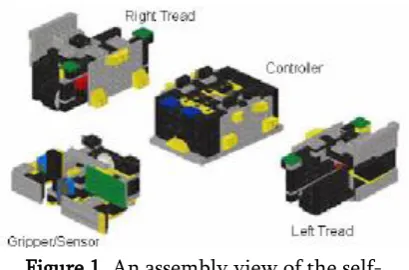
The robot and its copies each comprise of four subsystems: controller, left tread, right tread, and gripper/sensor subsystems. All subsystems are associated with others utilizing magnets and shape imperatives. Figure 1 demonstrates a gathering perspective of the robot. The controller subsystem is comprised of a LEGO RCX programmable controller fit inside an undercarriage. The undercarriage's sides are utilized to interface with the left and right treads. Each side has an arrangement of magnets, an arrangement of shape constraining pieces, and an arrangement of electrical associations. The front end of the body is intended to join with the gripper. The front end additionally has an arrangement of magnets, an arrangement of shape-obliging blocks, and an arrangement of electrical associations, which exchange electrical and electronic signs from the controller to the gripper's engine and the exploring sensors introduced on the gripper subsystem.
Figure 1. An assembly view of the self-replicatingrobot.
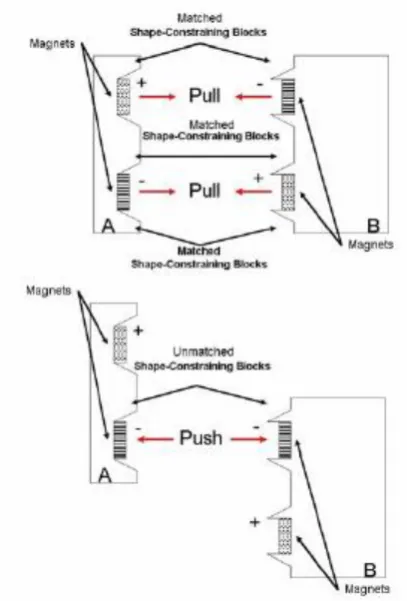
The magnets and the shape-constraining blocks are utilized as a part of joint effort to help adjusting and interlocking subsystems. On every suspension side, the magnets are symmetrically set in inverse polar ways to each other. This is to ensure against inaccurate situating of the subsystems. The idea of utilizing the magnets (with various polarizations) and shape-obliging pieces was impacted by the self-reciprocal particles of Rebek. Figure 2 shows the ideas of utilizing the polar magnets and shape-obliged pieces to adjust and interlock subsystems. By plan, it is extremely troublesome for these connectors to misalign.
Figure 2. This diagram illustrates the concept of usingpolar magnets and shape-constraining blocks (top:correctly aligning, and bottom: incorrectly aligning.)
A tread subsystem has an elastic tread with a driving rigging framework, a 9V LEGO DC engine, and a light-intelligent cushion which helps the first robot’s route. One side of the tread has an arrangement of magnets, an arrangement of shape-compelled pieces, and an arrangement of electrical associations, all of which compare to the side of the controller subsystem. On the opposite side, the tread has a wedge which is fitted to the gripper. The wedge is utilized amid the tread subsystem's exchanging and gathering forms. Figure 3 indicates how the first robot gets a handle on the tread subsystem, and Figure 4 demonstrates the associations situated between the controllers and tread subsystems.
Figure 3. The original robot grasps the treadsubsystem.
Figure 4. The connections located between controllerand tread subsystems.
objects (the subsystems of the reproduction) which the robot keeps running into.
Figure 5. The original robot grasps the gripper/sensorsubsystem.
Figure 6. The connections located
betweengripper/sensor and controller subsystems.
Figure 7. A map of the experimental area.
The test zone is a 2m x 3m territory made of white shaded paper with lines and spots painted in blue and silver acrylic hues. The first robot begins at the underlying position, and the copy's subsystems are at their areas. Figure 7 demonstrates the test territory with areas of the copy's subsystems and the
III.
CONTROL AND PROGRAMMING
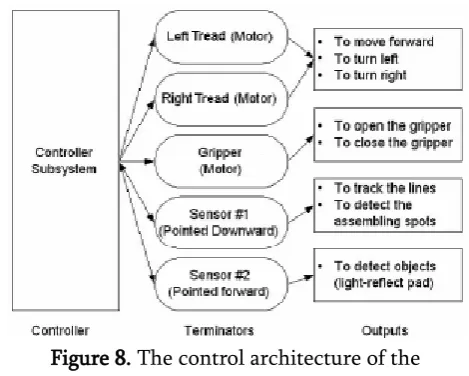
The model robot is a completely independent framework. Figure 8 demonstrates the control engineering of the robot. The robot and its reproductions, utilizing the LEGO light sensor No. 1 (pointed descending), is fit for following the blue lines, and it can perceive the collecting spots, painted in a silver acrylic. The sensor recognizes and returns diverse simple esteems, comparing to various hues. The robot tracks the painted lines to explore between positions. Once the robot distinguishes the gathering spot, the robot starts the collecting procedure. The LEGO light sensor No. 2 (pointed forward) restores a simple esteem once it recognizes a light-intelligent cushion connected to the tread and gripper/sensor subsystems. This tells the robot to start getting a handle on the distinguished subsystem. The getting a handle on process comprises of an adjusting push toward the subsystem, and shutting the gripper to get a handle on the subsystem. Then again, the get together process comprises of opening the gripper to discharge the subsystem, and an adjusting push forward to snap the subsystem to the controller. Figure 9 demonstrates the first robot getting a handle on a subsystem, and advancing toward a gathering spot, in silver acrylic, along the blue line.
Figure 8. The control architecture of the autonomousself-replicating robot.
In the request in which occasions occur in the replication procedure, the writing computer programs is isolated into seven phases: 1) replication process is initiated, 2) line following and scanning for a subsystem, 3) getting a handle on the subsystem and changing to another way which prompts the subsequent stage, 4) line following and hunting down the get together area, 5) gathering the subsystem to the controller and changing to another way, 6) the new way prompts the following subsystem, 7) The last advance circles back to stages 2 through 6 so the procedure rehashes uncertainly. Figure 10 outlines the programming flowchart of the self-reproducing robot framework.
IV.
EXPERIMENT AND RESULTS
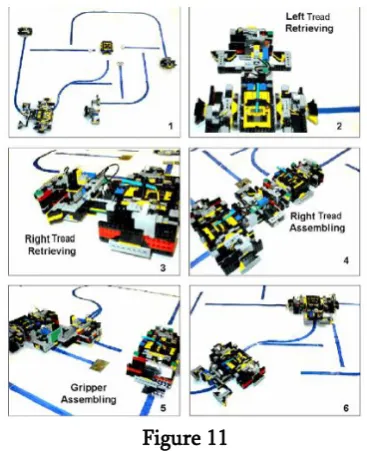
The accompanying is a well ordered strategy for our autonomous self-repeating robot framework (Figure 11 is a photographic portrayal of these means): 1. The first robot begins following the line from the beginning stage to the principal subsystem utilizing sensor No. 1.
2. When light sensor No. 2 recognizes the principal subsystem (right tread), the first robot starts the grasping process and handles the correct tread subsystem.
3. After the grippers are shut the first robot turns to one side until the point when it recognizes a line. 4. The first robot takes after the second line until the point that it achieves the get together area.
5. at the point when light sensor No. 1 on the first robot recognizes the silver acrylic detect (the assembly location), the robot stops, and starts the connecting procedure.
6. The first robot opens the grippers, and gives a last push to secure the correct tread subsystem to the controller subsystem.
9. When light sensor No. 2 distinguishes the second subsystem, the robot will stop, and start the getting a handle on process by shutting its gripper around the left tread's wedge.
10. The first robot turns ideal until the point that it recognizes the following line.
11. The first robot will take after the second line until the point that it achieves the get together area. 12. The first robot opens its gripper to discharge the left tread subsystem.
13. The first robot gives a last push on the left tread subsystem to help secure it.
14. The first robot at that point moves down and turns left until the point when it distinguishes the following line, utilizing sensor No. 1.
15. The first robot takes after the line to the last subsystem.
16. When it comes to the gripper/sensor subsystem, it stops, and starts the getting a handle on process. 17. The first robot shuts its gripper, and turns ideal until the point that it distinguishes a line an incentive with sensor No. 1.
18. The gripper/sensor subsystem is presently exchanged to the get together area.
Figure 9. The robot is searching for the assemblylocation while holding the replica’s
Figure 10. The flowchart of the self-replicationprocess.
19. Once the first robot achieves the get together area it stops, and opens the gripper.
20. The first robot moves down and turns left until sensor No. 1 is line esteem.
21. The first robot at that point takes after the line back to the beginning stage, and is prepared to recreate once more.
22. The finished reproduction self-actuates (20 seconds after culmination) and starts following the line to the beginning stage.
23. Once every robot achieves the beginning stage, it starts the replication strategy once more.
The replication procedure takes two minutes and fifteen seconds for each cycle. Albeit every subsystem is required to be put in its beginning area, blunders in introductory position and introduction are not extremely basic.
Figure 11
We discovered slight blunders amid the getting a handle on process in a couple of analyses caused by shameful situation of the subsystems. By and large, the framework is hearty and extremely repeatable.
V.
CONCLUSION
Anautonomous self-repeating robot model has been built and tried. It utilizes two light sensors in its route framework to recognize items and furthermore to track lines. Magnets and shape-obliging pieces are utilized to help in adjusting and interlocking the subsystems of the copy. Subsequently, the robot is prepared to do consequently gathering its imitations. Every one of the copies is likewise equipped for finishing the same replicating process. We trust that this model is simply the world's first completely practical independent replicating robot.
VI.
REFERENCES
[1]. Prof. Whitesides, G.M., "Self-Assembling Materials,"Scientific American, 273(3), 1995, pp. 146-149.
[3]. Freitas, R.A., Jr., and Valdes, F., "Comparison ofReproducing and Non-Reproducing StarprobeStrategies for Galactic Exploration", Journal of theBritish planetary Society, Vol. 33, November 1980,pp 402-408.
[4]. Freitas, R.A., Jr., "Terraforming Mars and VenusUsing Machine Self-Replicating Systems", Journalof the British planetary Society, Vol. 36, March 1983,pp 139-142. [5]. Freitas, R.A., Jr., "A Self-Reproducing
InterstellarProbe", Journal of the British Interplanetary Society,Vol. 33, July 1980, pp 251-264.
[6]. Tiesenhausen, G.V., and Darbro, W.A., "Self-Replicating Systems-A Systems EngineeringApproach", Technical Memorandum: NASA TM-78304, Washington, DC, July 1980.
[7]. Lipson, H., and Pollack, J. B., "Automatic design andManufacture of Robotic Lifeforms," Nature, Vol.406, 2000, pp. 974-978.
[8]. Rebek, Jr., J., "Synthetic Self-ReplicatingMolecules," Scientific American, Vol. 271, No. 1,1994, pp. 48-55.
[9]. Chirikjian, G.S., and Suthakorn, J., "Towards Self-Replicating Robots", Proceedings of the EightInternational Symposium on Experimental Robotics(ISER), Italy, July 2002. [10]. Suthakorn, J., Kwon, Y., and Chirikjian, G.S.,
"ASemi-Autonomous Replicating Robotic System,"Proceedings of the 2003 IEEE InternationalConference on Robotics and Automation (ICRA),Taipei, Taiwan, 2003, (submitted)
[11]. Freitas, R.A., Jr., and Gilbreath, W.P. (Eds.),"Advanced Automation for Space Missions,"Proceedings of the 1980 NASA/ASEE summer study,Chapter 5: Replicating Systems
[12]. Suthakorn, J., Zhou, Y., and Chirikjian, G.S., "Self-Replicating Robots for Space Utilization",Proceedings of the 2002 Robophere workshop on SelfSustaining Robotic Ecologies, NASA Ames ResearchCenter, California, 2002. [13]. Chirikjian, G.S., Zhou, Y., and Suthakorn, J.,
"Self-Replicating Robots for Lunar Development", ASME& IEEE Transactions on Mechatronics (Special Issueof Self-Reconfiguration Robots) (Accepted).
[14]. Yim, M., Zhang, Y., Lamping, J., Mao, E.,"Distributed Control for 3D Metamorphosis",Autonomous Robots, Vol. 10, 2001, pp. 41-56.
[15]. Kotay, K., Rus, D., Vona, M., and McGray, C., "TheSelf-reconfiguring Molecule: Design and ControlAlgorithms", 1999 Workshop on AlgorithmicFoundations of Robotics, 1999.
[16]. Chirikjian, G.S., Pamecha, A., and Ebert-Uphoff, I.,"Evaluating Efficiency of Self-Reconfiguration in aClass of Modular Robots", Journal of RoboticSystems, Vol. 13(5), 1996, pp. 317-338.
About Authors: