DRESSING ROOMS: LOVE IT OR LEAVE IT!
To what extent does the setting of a dressing room influence consumer experiences?
Master thesis Jennifer Hengevelt S1258753
University of Twente
Master Communication Studies Marketing Communication
First supervisor: M. Galetzka
Second supervisor: T.J.L van Rompay
- 2 -
SUMMARY
It is commonly believed that dressing rooms are able to influence consumer experiences, as it represents that final moment where the consumer decides whether to purchase the apparel or not. Dressing rooms are able to influence the approach behavior of consumers, which
generates the desire to stay in the store, fit several clothes, repeat dressing room visits and increase purchase intentions. For this reason, retailers need to understand how aspects of the physical environment affect consumers’ emotional states and self-evaluations.
This study was conducted to examine the effect of lighting direction and mirrors on several dependent variables: emotional states (pleasure, arousal and dominance), perceived spaciousness, self-evaluation (facial and body appearance), overall dressing room experiences and consumer behavior. Besides, this study focused on gender differences in dressing rooms too. These aspects were measured using two studies. First, the hypotheses were examined by using a 2 (mirrors: with versus without) x 2 (lighting direction: frontal versus frontal and overhead) between subjects design. An online questionnaire with four randomly shown manipulated images of dressing room settings was used. A total of 207 participants between ages of 18 and 62 were randomly assigned to one of the four dressing room settings. The second study used interviews in a field experiment, to gather more information about dressing room environments and to compare the results of the online questionnaires to a real setting.
As assumed, this study found significant results for the influence of both mirrors and lighting direction. It could be concluded that the effects of mirrors in dressing rooms are more important than lighting direction, though both appear to be relevant. Retailers seem to be able to create positive dressing room experiences by using mirrors. Besides, there seems to be propensity in favor of frontal and overhead lighting, though participants mentioned that they liked both lighting directions. Additionally, when focusing on perceived spaciousness in dressing rooms, lighting direction only influenced perceived spaciousness of participants in dressing room with mirrors. No statistically significant differences were found for perceived spaciousness in dressing rooms without mirror. Besides, this study found that other aspects in dressing room appeared to be relevant too, such as privacy, cleanliness, hooks and a chair. These findings offer insight into the influence of lighting direction and mirrors in dressing rooms, which could help retailers to make decisions regarding their dressing room
TABLE OF CONTENT
SUMMARY ... - 2 -
INTRODUCTION ... - 5 -
2. THEORETICAL FRAMEWORK ... 7
2.1 CONSUMER EXPERIENCE ... 7
2.2 LIGHTING DIRECTION ... 8
2.3 USE OF MIRRORS... 9
2.4 LIGHTING DIRECTION AND EMOTIONAL STATES ... 10
2.5 LIGHTING DIRECTION, MIRRORS AND PERCEIVED SPACIOUSNESS ... 11
2.6 LIGHTNG DIRECTION, MIRRORS AND SELFEVALUATION ... 12
2.7 OVERALL DRESSING ROOM EXPERIENCE ... 13
2.8 CONSUMER BEHAVIOR ... 14
3. METHOD OF STUDY 1 ... 15
-3.1 ONLINE QUESTIONNAIRES ...- 15 -
3.2 STUDY DESIGN AND PARTICIPANTS ... 15
3.3 PROCEDURE ... 16
3.4 STIMULUS MATERIALS ... 17
3.5 MEASURES... 18
3.6 CONTENT ANALYSIS ... 20
4. RESULTS OF STUDY 1 ... 21
4.1 IMPORTANT DRESSING ROOM ASPECTS ... 21
4.2 PLEASURE, AROUSAL AND DOMINANCE ... 21
4.3 LIGHTING EVALUATION AND PERCEPTION ... 22
4.5 SELF EVALUATION: FACIAL AND BODY APPEARANCE ... 23
4.6 OVERALL DRESSING ROOM EXPERIENCE ... 24
4.7 CONSUMER BEHAVIOR ... 24
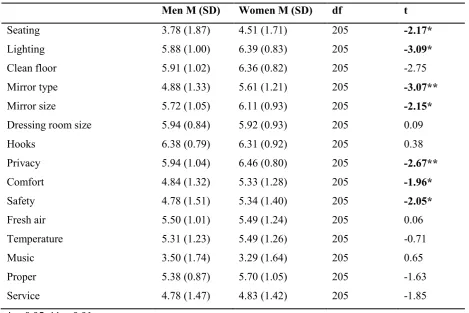
4.8 GENDER DIFFERENCES ... 24
4.9 CONTENT ANALYSIS ... 25
5. METHOD OF STUDY 2 ... 28
5.1 INTERVIEWS ... 28
-5.2 PARTICIPANTS ...- 28 -
5.3 INTERVIEW MEASUREMENT ... 29
6. RESULTS OF STUDY 2 ... 30
6.1 INTERVIEWS ... 30
7. CONCLUSION AND DISCUSSION ... 32
7.1 CONCLUSION ... 32
7.2 DISCUSSION ... 33
7.3 LIMITATIONS AND FUTURE RESEARCH ... 38
7.4 MARKETING IMPLICATIONS... 39
REFFERENCES ... 41
APPENDICES ... 41
APPENDIX A. ONLINE QUESTIONNIARE ... 45
-APPENDIXB. STATISTICS ... 51
- 6 -
spaciousness, self-evaluation, overall dressing room experience and consumer behavior. Besides, gender differences in dressing rooms will be discussed.
Lighting direction and mirrors seem to determine whether shoppers are trying on apparel and make purchases (All Dressed Up, 2006). Retailers could make shopping
experiences more appealing by using appropriate lighting direction and mirrors (The Perfect Fit, 2007). The Stimulus – organism – response paradigm of Mehrabian and Russell (1974) was used to evaluate consumer emotional states and responses in dressing rooms. Lighting direction and use of mirrors seems to be able to influence emotions of consumers (Summers & Hebert, 2001) and Baumstarck (2008) found that frontal lighted dressing rooms were more stimulating than overhead lighted dressing rooms.
The influence of lighting direction and mirrors on perceived spaciousness appears to be relevant too. Lighter environments seem to be more spacious (Stamps, 2010) and dressing rooms with frontal lighting appeared to be more roomy (Baumstarck, 2008). Besides, it is generally assumed that mirrors create spaciousness in rooms too (Rea, 2000). Additionally, personal appearance could be influenced by lighting direction and mirrors (Baumstarck, 2008; Baumstarck & Park, 2010). Facial appearance of consumers was rated better in overhead lighted dressing rooms, while frontal lighting could be used to eliminate harsh shadows.
- 7 -
2. THEORETICAL FRAMEWORK
In this section an overview is given of the extent to which lighting direction and mirrors affect emotional states, perceived spaciousness, self-evaluation and the overall dressing room
experience, which will lead to approach or avoidance behavior in dressing rooms as shown in figure 1.
Figure 1. Model of the research.
2.1 CONSUMER EXPERIENCE
Nowadays, the focus of retailers on experience-based consumption increased. Retailers are able to improve the consumer experience by meeting their needs and expectations (Seven Ways, 2013). Additionally, it is believed that retailers may be missing opportunities to attract consumers by not paying attention to dressing room environments (Baumstarck, 2008). There are several aspects which influence these environments, such as atmospherics. In 1973, Kotler defined atmospherics as “the conscious designing of space to create certain effects in
- 13 -
appearance of consumers was rated better when using overhead lighting, more than frontal lighting. These results were contradicted to the assumptions of Rea (2000), on lighting preferences in dressing rooms, which found that overhead lighting can create harsh shadows on the face and body. Besides, Baumstarck (2008) actually found that the frontal lighting group experienced fewer harsh shadows than the overhead lighting group and Baumstarck and Park (2010) found that lighting direction is able to influence self-evaluation through
shadowing, with a stronger preference of frontal lighting.
Next to the influence on facial appearance, Baumstarck (2008) found that “overhead lighting may cause users to waste time finding a suitable position or angle from which to evaluate the product and self. The focus on the clothes is lost and interrupts the experiential quality retailers are trying to attain in the dressing room” (p.74). In conclusion, facial and body appearance of consumers seem to be rated better when using overhead lighting, while frontal lighting eliminates facial and body shadowing (Baumstarck, 2008; Baumstarck & Park, 2010).Besides, using mirrors in a dressing room seems to influence consumers self-evaluation too, because consumers who are able to evaluate themselves in a mirror in the dressing room will be more aware of their appearance. Based on the abovementioned, the following hypothesis is stated:
Hypothesis 3. Facial and body appearance of consumers will be positively (negatively) influenced, when using frontal and overhead (frontal) lighting in dressing rooms.
2.7 OVERALL DRESSING ROOM EXPERIENCE
- 14 -
Hypothesis 4a.The overall dressing room experience of consumers will be positively
(negatively) influenced when using frontal and overhead (frontal) lighting in dressing rooms.
Hypothesis 4b. The overall dressing room experience of consumers will be positively (negatively) influenced when using dressing rooms with (without) mirrors.
2.8 CONSUMER BEHAVIOR
At last, it seems that organizations are given more attention to variables such as pricing and promotion, than to the physical setting as ways in which consumers can be attracted (Bitner, 1992), while bad store atmospherics can distract consumers and discourage them from staying in the store (Baker, Grewal & Parasuraman, 1994).
In a dressing room environment, approach behavior of consumers could be seen as a positive response to atmospherics in a dressing room, which generates the desire of
consumers to stay in the dressing room, fit several clothes, repeat their dressing room visits and finally increase their purchase intention, while avoidance is the opposite. On basis of the above mentioned information it is stated that:
Hypothesis 5a. Approach behavior in dressing rooms will be significantly higher (lower) when using frontal and overhead (frontal) lighting.
Hypothesis 5b. Approach behavior in dressing rooms will be significantly higher (lower) when using dressing rooms with (without) mirror.
In addition to consumer behavior, Underhill (1999) found that men and women are affected differently by the retail environment. Women are more likely to enter a dressing room and try on clothes than men. Women prefer to view products in the actual setting before they decide to purchase (Underhill, 1999; Moye & Kincade, 2003), while men purchase the clothes they try on in 65% of the time. Women are less certain in their decision to purchase clothes when entering the dressing room. Women purchase the product only 25% of the time.
- 16 -
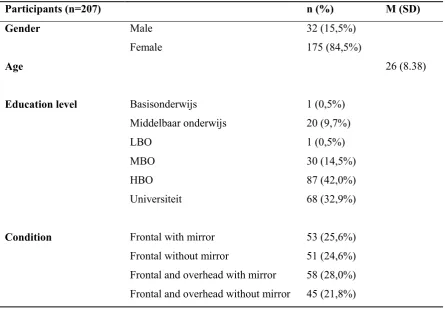
males (15,5%). The age of the respondents varied from 18 to 62 with a mean of 26 years (SD=8.38). All participant characteristics are summarized in table 2.
Table 2. Participant characteristics of the sample.
Participants (n=207) n (%) M (SD)
Gender Male 32 (15,5%)
Female 175 (84,5%)
Age 26 (8.38)
Education level Basisonderwijs 1 (0,5%) Middelbaar onderwijs 20 (9,7%)
LBO 1 (0,5%)
MBO 30 (14,5%)
HBO 87 (42,0%)
Universiteit 68 (32,9%)
Condition Frontal with mirror 53 (25,6%) Frontal without mirror 51 (24,6%) Frontal and overhead with mirror 58 (28,0%) Frontal and overhead without mirror 45 (21,8%)
3.3 PROCEDURE
- 17 -
Figure 2. Scenario.
3.4 STIMULUS MATERIALS
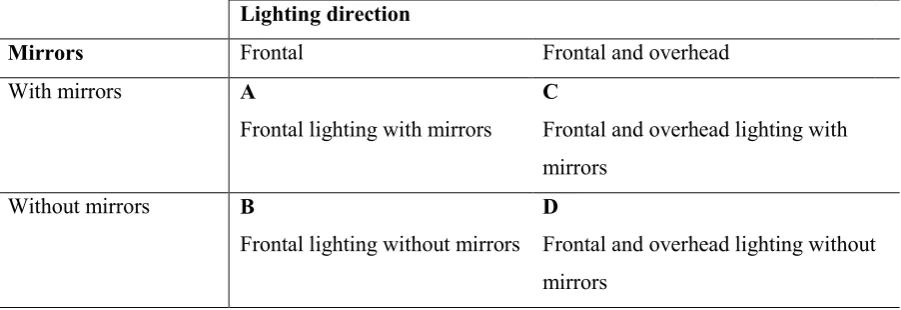
In order to manipulate the consumer experience of the participants, lighting direction and mirrors were varied. Four manipulated images were used for the construction of the four different dressing room settings. Lighting direction was manipulated by using frontal or
frontal and overhead lighted dressing rooms. Dressing rooms with mirror and dressing rooms
without mirror were used to manipulate the influence of mirrors (figure 3). Images were used to increase the feeling of actually being in a dressing room.
- 19 -
reason, eight items were used to measure the effects of dressing room lighting on self-evaluation. A five-item scale for facial appearance included good/bad, young/old,
healthy/unhealthy, harsh shadows/no shadows, and flattering skin tones/unflattering skin tones. And a three-item scale for overall body appearance included positive/negative, attractive/unattractive, and slender/heavy.
Dressing room evaluations were measured using eight bipolar adjective word pairs derived from Mehrabian and Russell (1974), Donovan and Rossiter (1982), Baumstarck (2008) and Baumstarck and Park (2010). The used word pairs were inconvenient/convenient, cramped/roomy, bad quality/good quality, lack of privacy/adequate privacy, small/large, unkempt/well kept, unimpressive/impressive, and bad/good.
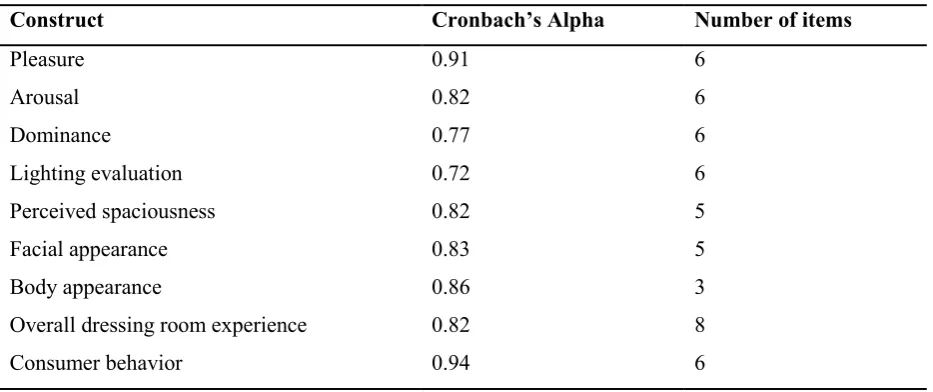
Additionally, six items were added to specify the consumer behavior in dressing rooms: ‘This dressing room meets my expectations of a good dressing room’, ‘I am satisfied about this dressing room’, ‘I would like to try on clothes in this dressing room’, ‘I would like to repeat my visits in this dressing room’, ‘I would leave this dressing room immediately’ and ‘This dressing room fits with my personality’. Table 3 shows the internal reliability of the constructs. As shown, a Cronbach’s Alpha above .70 was found for all constructs.
The second part of the questionnaire included demographic questions, such as age, gender, and educational level. Besides, participants were able leave a comment about the dressing room.
Table 3. Internal reliability of the constructs.
Construct Cronbach’s Alpha Number of items
Pleasure 0.91 6
Arousal 0.82 6
Dominance 0.77 6
Lighting evaluation 0.72 6
Perceived spaciousness 0.82 5
Facial appearance 0.83 5
Body appearance 0.86 3
Overall dressing room experience 0.82 8
- 20 - 3.6 CONTENT ANALYSIS
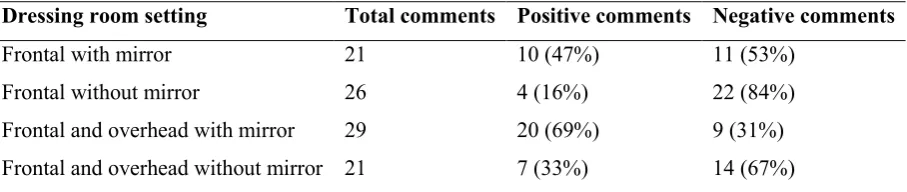
Additionally, a content analysis of the qualitative data in study 1 was used to determine the ratio of positive and negative phrases for the four dressing room settings (Baumstarck, 2008). Participants were able to leave a comment about the dressing room settings in the
questionnaire. In order to understand the qualitative data and make it comparable to the quantitative results of the study, a content analysis was made.
- 23 -
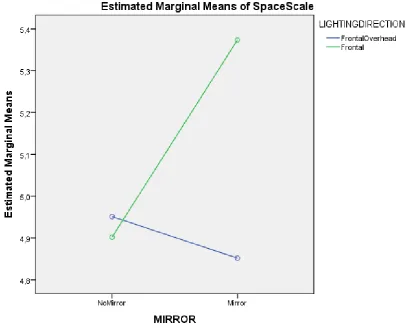
perceived spaciousness depend on mirrors (F(1,203)=3.60, p=.05). The nature of this
interaction is illustrated in figure 4. Simple effects analyses were used to further examine the interaction between lighting direction and mirrors. These analyses showed that only under conditions when a mirror was used, lighting direction has an impact on perceived
spaciousness (F(1,203)=6.49, p=.01). When there is no mirror, lighting direction does not have an impact on perceived spaciousness (F(1,203)=0.50, p=.82).
Figure 4. The interaction effect of lighting direction and mirror on perceived spaciousness.
4.5 SELF EVALUATION: FACIAL AND BODY APPEARANCE
The self-evaluation of the participants was divided in facial appearance and body appearance. A factorial between groups analysis of variance (ANOVA) was used to investigate the effects of lighting direction and mirrors on facial appearance and body appearance.
- 27 -
about the lighting. One participant said ‘It is pleasant to have light both in front of your face and above your head’. Of all comments, 6 comments were made about the mirror. One participant said: ‘A mirror in a dressing room is very important, but I would prefer two mirrors to see myself on both sides’. Additionally, some participants (6 comments) only focused on the overall dressing room experience. They all mentioned that they liked the dressing room and they were positive about the space.
Comments on the frontal and overhead lighting without mirror dressing room were mostly negative (14 comments). In total, 12 comments were made about the absence of the mirror. All these comments were negative and participants said they missed the mirror. One participant said: ‘I think that the absence of a mirror in dressing rooms is a big disadvantage’. 3 comments were made about lighting. These 3 comments were positive. One participant said ‘Lighting in front and above me makes me feel like I am in daylight, very nice’. In the
- 28 -
5. METHOD OF STUDY 2
A qualitative research method was used to find out whether consumer experiences in a real dressing room setting are equal to the results of study 1. This study used interviews to gather more information.
5.1 INTERVIEWS
Based on the results of the online questionnaire and content analysis, semi-structured interviews were developed to gain insights into important dressing room aspects in real settings. This method was used, because the interviewer is able to deeper explore the topics the participants raise during the interviews (Baxter & Babbie, 2004). By using this method, in-depth information was found about important dressing room aspects, which could be compared with the results found in study 1.
5.2 PARTICIPANTS
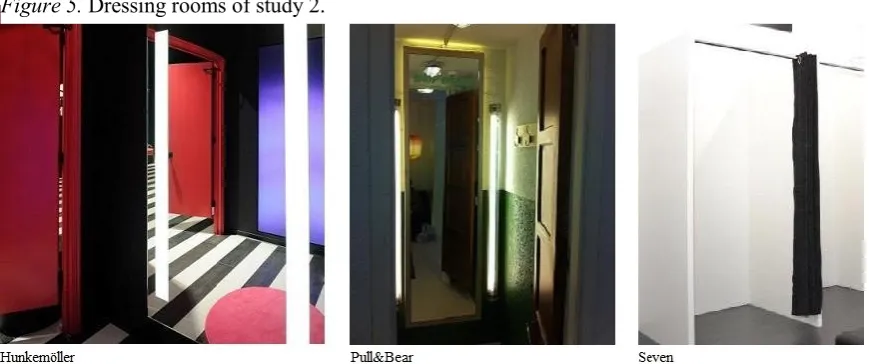
In total 10 participants were interviewed. The participants of the research were all females, who were found by the social network of the researcher. Prior to the interviews, the
participants were asked to visit three dressing rooms in Utrecht (figure 5). When entering the dressing room, they were aware of the subject of the interview and they were able to create an opinion about the dressing rooms. First, they visited a dressing room in the Pull&Bear, then they visited the Hunkemöller and at last they visited Seven. Similar to the quantitative research, the dressing rooms used two lighting directions (frontal versus frontal and
overhead). The dressing rooms of Pull&Bear and Hunkemöller had a mirror and the dressing room of Seven had no mirror.
- 29 - 5.3 INTERVIEW MEASUREMENT
- 31 -
participant had chosen the dressing room of Pull&Bear, because it was cozy and she liked the mirror.
Purchase intention
- 32 -
7. CONCLUSION AND DISCUSSION
This chapter provides a conclusion and discussion of the findings in this study. The
hypotheses in chapter two, which are based on each key variable: emotional states (pleasure, arousal and dominance), perceived spaciousness, self-evaluation (facial and body
appearance), overall dressing room experience and consumer behavior, will be discussed. Findings in this study will be related to previous theory. Later, limitations and suggestions for future research are presented, followed by marketing implications.
7.1 CONCLUSION
The goal of this study was to gain insights in the influence of lighting direction and mirrors on consumer experiences in dressing rooms. Based on the results of this study, it could be
concluded that retailers should be aware of this influence. Significant results were found for both mirrors and lighting direction. It could be concluded that the effects of mirrors in
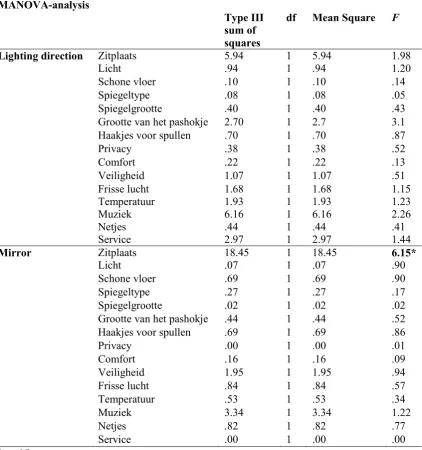
dressing rooms are more important than lighting direction, though both appear to be relevant. The results of this study indicate that there are several aspects in dressing rooms which influence dressing room experiences. First, the importance of mirrors in dressing rooms seems to be significant for almost every scale. That is why it could be concluded that mirrors are very important aspects for retailers to create positive dressing room experiences.
Second, the importance of lighting direction seems to be relevant too, though it is not as significant as mirrors. There seems to be a propensity in favor of frontal and overhead lighting though participants reported that they liked both lighting directions. Besides, when focusing on perceived spaciousness, lighting direction only influenced the perceived
spaciousness of consumers in dressing rooms with mirrors. No effects were found in dressing rooms without mirror. Another goal of this study was to gain insights in the differences between men and women when criticizing a dressing room. There appeared to be differences for important dressing room aspects, but the number of men in this study was too low to attach conclusions to this.
- 40 -
- 44 -
10.1016/S0148-2963(99)00010-7.
Underhill, P. (1999). Why we buy: the science of shopping. New York: Simon and Schuster. Veitch, J.A., Tiller, D.K., Pasini, I., Arsenault, C.D., Jaekel, R.R., & Svec, J.M. (2002).
Effects of fluorescent lighting filters on skin appearance and visual performance,
Journal of the Illuminating Engineering Society, 31(1), 40-60.
Veitch, J.A., Miller, N., McKay, H., & Jones, C. (2006) Lighting system effects on judged lighting quality and facial appearance. Paper presented at the 1996 Annual
Conference of the Illuminating Engineering Society of North America, Cleveland. Accessed online at http://irc.nrc-cnrc.gc.ca/pubs/fulltext/nrcc39865.php on January 25, 2008.
Veitch, J. A., Miller, N., McKay, H., & Jones, C. C. (1996, August). Lighting system effects on judged lighting quality and facial appearance. In Annual Conference of the
Illuminating Engineering Society of North America, Cleveland, OH.
- 46 -
geeft u de mogelijkheid om de afbeelding tijdens de enquête nogmaals zorgvuldig te bekijken. Het wordt aangeraden om dit te doen, zodat u zeker bent van uw antwoorden.FRONTALMET SPIEGEL
Ik heb de afbeelding goed bekeken
Q2b. Stelt u zich eens voor dat u zich in de situatie van de onderstaande afbeelding bevindt.
U bent aan het winkelen en u heeft in deze winkel leuke kleding gevonden, die u graag even wilt passen omdat u wilt zien of de kleding goed past en aan uw verwachtingen voldoet.
U bent de persoon in de paskamer. Probeer u zo goed mogelijk in te leven, totdat u een mening heeft gevormd over deze paskamer. Vervolgens kunt u doorgaan naar de vragenlijst. Deze vragen zullen allemaal betrekking hebben op uw beleving in deze paskamer, dus onthoud de afbeelding goed!
LET OP: als u op de afbeelding klikt zal de afbeelding automatisch openen in een nieuw venster. Dit geeft u de mogelijkheid om de afbeelding tijdens de enquête nogmaals zorgvuldig te bekijken. Het
wordt aangeraden om dit te doen, zodat u zeker bent van uw antwoorden.FRONTAL ZONDELS
Ik heb de afbeelding goed bekeken
Q2c. Stelt u zich eens voor dat u zich in de situatie van de onderstaande afbeelding bevindt.
U bent aan het winkelen en u heeft in deze winkel leuke kleding gevonden, die u graag even wilt passen omdat u wilt zien of de kleding goed past en aan uw verwachtingen voldoet.
U bent de persoon in de paskamer. Probeer u zo goed mogelijk in te leven, totdat u een mening heeft gevormd over deze paskamer. Vervolgens kunt u doorgaan naar de vragenlijst. Deze vragen zullen allemaal betrekking hebben op uw beleving in deze paskamer, dus onthoud de afbeelding goed!
- 47 -
geeft u de mogelijkheid om de afbeelding tijdens de enquête nogmaals zorgvuldig te bekijken. Het wordt aangeraden om dit te doen, zodat u zeker bent van uw antwoorden. BEIDE MET SPIEGEL
Ik heb de afbeelding goed bekeken
Q2d. Stelt u zich eens voor dat u zich in de situatie van de onderstaande afbeelding bevindt.
U bent aan het winkelen en u heeft in deze winkel leuke kleding gevonden, die u graag even wilt passen omdat u wilt zien of de kleding goed past en aan uw verwachtingen voldoet.
U bent de persoon in de paskamer. Probeer u zo goed mogelijk in te leven, totdat u een mening heeft gevormd over deze paskamer. Vervolgens kunt u doorgaan naar de vragenlijst. Deze vragen zullen allemaal betrekking hebben op uw beleving in deze paskamer, dus onthoud de afbeelding goed!
LET OP: als u op de afbeelding klikt zal de afbeelding automatisch openen in een nieuw venster. Dit geeft u de mogelijkheid om de afbeelding tijdens de enquête nogmaals zorgvuldig te bekijken. Het wordt aangeraden om dit te doen, zodat u zeker bent van uw antwoorden.BEIDE ZONDER SPIEGEL
Ik heb de afbeelding goed bekeken
Q3. Bij het zien van deze afbeelding voel ik mij:
1 2 3 4 5 6 7
Gelukkig o o o o o o o Ongelukkig
Vrolijk o o o o o o o Boos
Tevreden o o o o o o o Ontevreden
Voldaan o o o o o o o Zwaarmoedig
Hoopvol o o o o o o o Wanhopig
- 50 -
Q14. Mijn hoogst genoten opleiding is (afgerond of huidig):
Basisonderwijs o
Middelbaar onderwijs o
LBO o
MBO o
HBO o
Universiteit o
Q15. Als u kans wilt maken op een van de drie tijdschriftabonnementen dan kunt u hieronder uw e-mailadres achterlaten.
- 54 - APPENDIX C. INTERVIEW GUIDE
Naam: Leeftijd:
1. Wat is volgens jou zeer belangrijk in een paskamer?
1a. Waarom zijn die aspecten volgens jou zo belangrijk aan een paskamer?
2. Heeft een paskamer grote invloed op jouw aankoopgedrag?
2a. Waarom is dat zo?
3. Welke paskamer heeft je voorkeur?
3a. Waarom heeft die paskamer jouw voorkeur?
4. Waar heb je op gelet toen je de paskamers aan het bekijken was?
5. Zou je kleding willen passen in deze paskamers?
5a. Waarom zou je wel/niet kleding willen passen in deze paskamers?