DOI : https://doi.org/10.32628/CSEIT195322
Texture Feature Extraction for Batik Images Using GLCM and GLRLM with
Neural Network Classification
K. Chandraprabha*1, S. Akila2,
*1Associate Professor and Head of the Department Computer Science and Engineering, Alagappa Chettiar
Government College of Engineering and Technology, Karaikudi, India
2PG Scholar, Department of Master of Computer Application, Alagappa Chettiar Government College of
Engineering and Technology, Karaikudi, India
ABSTRACT
Batik has a vast variety of motifs and colors. Aside from its popularity as being part of Indonesian culture, it has
become the source of Indonesia’s income. Batik was more promising in the past years for the business opportunities. Batik has economic and high export value as the commodity. Batik has become the main part of national culture; however there is a lack of understanding for many people, as they are still unaware about batik motifs and patterns. Therefore, it is needed for building a model to identify batik motifs. This study aims
to combine the features of texture and the feature of shapes’ ornament in batik to classify images using artificial
neural networks. The value of texture features of images in batik is extracted using gray level co-occurrence matrices (GLCM) which include Contrast, Correlation, Homogeneity and Energy. And include the Gray level Run length matrices (GLRLM) which includes Gray Level Non-Uniformity (GLN), Long Run Emphasis (LRE), Short Run Emphasis (SRE), Run Percentage (RP). At this phase of the training and testing, we compare the value of a classification accuracy of neural networks in each class in batik with their texture features, and the combination of GLCM and GLRLM. From the three features used in the classification of batik image with artificial neural networks it includes Probabilistic Neural network, it was obtained that GLCM feature has the lowest accuracy rate of 78% and the combination of GLCM and GLRLM features produces a greater value of accuracy by 84%. The results obtained in this study indicate that there is an increase in accuracy of batik image classification using the probabilistic neural network with the combination of GLCM and GLRLM features in batik image.
Keywords : Batik images, Texture Features, GLCM, GLRLM, Classification, Neural Networks
I. INTRODUCTION
Batik is a technique of wax-resist dyeing applied to whole cloth, or cloth made using this technique, originated from Indonesia, Batik is made either by drawing dots and lines of the resist with a spouted tool called a tjanting, or by printing the resist with a copper stamp called a cap. A tradition of making batik is found in various countries; the batik
mythology and therefore resulting typical geometrical patterns, various motifs of batik with different names. Thus it makes it difficult in classifying any pattern. The purpose of image classification in batik is to divide batik image based on the class of each pattern thus can easily be recognized by its features. Batik has a structure model consisting of primary and additional ornaments. Each main ornament in batik has philosophical meaning, for example, Grompol ornament, worn in a wedding ceremony. Grompol means to gather or to unite, the hope of collecting everything was excellent as fortune, happiness, offspring, living in harmony and so on. Additional ornamentation is smaller and simple and does not have a philosophical meaning in the composition of batik patterns. In one batik pattern may comprise several other ornamentations.
Batik’s textures are diverse. For instance, there are
textures with patterns of the edges of bold lines which have a high contrast value or the edges of fuzzy lines which have low contrast values. Regarding the size of the edges of the lines, there are thick and thin. Meanwhile, there is a large, medium and small size of the main batik ornaments. The various number of batik pattern causes difficulties in identifying the patterns in Indonesia. For that, we need a method that can classify each batik pattern based on its main ornament pattern. In this paper, we proposed a classification model of batik image by using neural networks based on texture features and shape features of the main ornaments.
Fig 1: Batik's motif (a) ceplok (b) grompol (c) gurda (d) kawung (e)mega mendung (f)parang (g) sido asih
II. RELATED WORK
Several studies have been conducted for proper classification of batik image [1][5][6][7]. One research on batik was performing classification by color, contrast, and motifs which were the work by Moertini and Sitohang [8]. They used the HSV color model for classifying batik based on wavelet method to extract the color of batik texture feature. The results obtained showed a clustering algorithm with the colors and textures looking good. The batik texture features can be achieved by the method of co-occurrence matrices of sub-band images. This method can be used to classify batik image which was randomly obtained from the internet. This approach combines the methods of gray-level co-occurrence matrices (GLCM) and discrete wavelet transform (DWT). First of all, the image is composed with DWT to become sub-band image. Then, the texture features of sub-band image are extracted with GLCM. The values of the extracted results become the input to the probabilistic neural networks (PNN). The results are good enough to classify the image of batik. The maximum accuracy that can be achieved is 72% [
selection of commonly used test databases and for moderate to large numbers of samples, random sampling gives equal or better classifiers than the sophisticated multi scale interest operators that are in common use. Although interest operators work well for small numbers of samples, the single most important factor governing performance is the number of patches sampled from the test image and ultimately interest operators cannot provide enough patches to compete. The four main implementation choices are thus how to sample patches, what visual patch descriptor to use, how to quantify the resulting descriptor space distribution, and how to classify images based on the resulting global image descriptor.
Xiaodong Yang,et.al,…[3] analyzed Clothes pattern recognition is a challenging task for blind or visually impaired people. Automatic clothes pattern recognition is also a challenging problem in computer vision due to the large pattern variations. A new method to classify clothes patterns into 4 categories: stripe, lattice, special, and pattern less. While existing texture analysis methods mainly focused on textures varying with distinctive pattern changes, they cannot achieve the same level of accuracy for clothes pattern recognition because of the large intra-class variations in each clothes pattern category. To solve the problem, extract both structural feature and statistical feature from image wavelet sub bands. Furthermore, develop a new feature combination scheme based on the confidence margin of a classifier to combine the two types of features to form a novel local image descriptor in a compact and discriminative format. The recognition experiment is conducted on a database with 627 clothes images of 4categories of patterns Textons are the repetitive basic primitives to characterize a specific texture pattern. Because of the robustness to photometric and affine variations, SIFT is commonly used to capture the structural information of texture. On the other hand, it was observed that the combination of multiple complementary features usually achieves better
results than the most discriminative individual feature.
Yingli Tian, et.al,…[4] analyzed the system that includes Doors are significant landmarks for indoor way finding and navigation to assist blind people accessing unfamiliar environments. Most camera based door detection algorithms are limited to familiar environments where doors demonstrate known and similar appearance features. A robust image-based door detection algorithm based on doors’
general and stable features instead of appearance features. A generic geometric door model is built to detect doors by combining edges and corners. Furthermore, additional geometric information is employed to distinguish doors from other objects with similar size and shape. The robustness and generalizability of the proposed detection algorithm are evaluated against a challenging database of doors collected from a variety of environments over a wide range of colors, textures, occlusions, illuminations, scale, and views. There have been many efforts to study blind navigation and way finding with the ultimate goal of developing useful travel aids for blind people but very few have met with more than limited success. The most useful and accepted independent travel aids remain the Hoover white cane and the guide dog, both of which have been in use for many years. While GPS-guided electronic way finding aids show much promise in outdoor environments, there is still a lack of orientation and navigation aids to help people with severe vision impairment to independently find doors, rooms, elevators, stairs, bathrooms, and other building amenities in unfamiliar indoor environments.
III. EXISTING METHODOLOGIES
acquired from one fabric that captured from different sides. Dataset are acquired randomly from the internet, thus one class of batik motif contains various fabrics but has the same basic motif. Moreover, as randomly from the internet may contain various types of noise. First, the image colour could be light (high intensity) in one side and dark (low intensity) in another side. It can be caused by unbalanced brightness when capturing the images. Second, there are folds on fabrics. Third, the different size of basic motifs. Fourth, the low contrast that caused the edges of batik motif could not be clearly visualized. Lastly, there is watermark on batik images. Because of these complexity, classification of these complicated batik images is not the trivial task. In the feature extraction phase, we process the image resulted in the pre-processing phase into two, with the texture image and the image of batik with main shapes of ornament in batik. The values of texture feature were obtained by using co-occurrence matrices on gray level co-occurrence matrices (GLCM). GLCM is one method to obtain a texture feature by calculating the probability of adjacency relationship between two pixels at a certain distance and angular orientation. Then existing system includes GLCM and ANN that provides low level accuracy and to provide high level error rate.
IV.PROPOSED METHODOLOGY
The proposed system starts with Collection of various batik images. To extract texture features, apply GLCM methods and GLRLM (Grey Level Run Length Matrix) methods. To classify the images using PNN. It has 2 phases such as Training phase and testing phase. In Training phase, texture features are extracted from a given set of training images. In testing phase given test image texture feature is extracted and classify the results. Compare the accuracy level with existing system.
➢ The combination of various texture feature extraction methods such as GLCM & GLRLM produces a significant increase in accuracy level.
➢ Gray Level texture features such as, a) Contrast b) Correlation c) Energy d) Entropy e) Homogeneity
➢ Run Length texture features such as, a) GLN b) LRE c) SRE d)RP
➢ Classify the regions using PNN method to predict its values.
Evaluate the performance in terms of time, accuracy and error rate. The proposed framework is shown as fig 2.
Fig 2 : Proposed Framework
The proposed layout is derived as follows:
IMAGE ACQUISITION MODULE
from which to work. One of the ultimate goals of the process is to have a source of input that operates within such controlled and measured guidelines that the same image can, if necessary, be nearly perfectly reproduced under the same conditions so anomalous factors are easier to locate and eliminate. Depending on the field of work, a major factor involved in image acquisition in image processing sometimes is the initial setup and long-term maintenance of the automatically capturing images. Real-time image acquisition creates a stream of files that can be automatically processed, queued for later work, or stitched into a single media format. One common technology that is used with real-time image processing is known as background image acquisition, which describes both software and hardware that can quickly preserve the images flooding into a system.
PRE-PROCESSING MODULE:
Preprocessing model can implement the training dataset to convert RGB image to gray image and remove the noises from images. The goal of conventional image is
➢ Enhance the visual appearance of images.
➢ Improve the manipulation of datasets.
Using image resampling to reduce or increase the number of pixels of the dataset and improve the visualization by brightening the dataset. The first step in process is to convert the acquired color image to a gray scale image. Image segmentation is performed to identify batik pixels and background pixels. After holes have been closed and small regions removed, the segmented image is converted to binary and the interior of the batik is subtracted, leaving an image of
the batik image’s outline contour. Converting image
to store the Mat file function.
➢ Convert RGB images into grey scale images.
➢ Using rgb2gray (variable name).
TESTING DATASET MODULE
The next process is carried out after storage extraction results is to perform data sample that have been stored before and also training data that recently extracted and have been stored. In a dataset a training set is implemented to build up a model, while a test (or validation) set is to validate the model built. Data points in the training set are excluded from the test (validation) set. Usually a dataset is divided into a training set, a validation set (some people use 'test set' instead) in each iteration, or divided into a training set, a validation set and a test set in each iteration.
FEATURE EXTRACTION MODULE
GLCM and GLRLM methods are used to extract texture feature. Texture feature calculations use the contents of the GLCM to give a measure of the variation in intensity at the pixel of interest. In computing GLCM and GLRLM of an image two parameters Offset and Distance d between pixels are considered. Most of the texture calculations are weighted averages of the normalized symmetrical GLCM cell contents. Contrast (Con): Contrast is a measure of intensity or gray-level variations between the reference pixel and its neighbor. GLCM is implemented on all the training images, from which texture features of each and every training image are obtained. PNN is implemented on those values of the training image set.
GLCM METHOD
Contrast : Size Contrast or Local intensity variations
Correlation: Correlation (correlation) is the size of the gray level inter-pixel linear dependent on the tightness of distribution of the elements in the GLCM to the GLCM diagonal. For diagonal GLCM its value is 1 and its range is [0,1].Opposite of contrast weight is homogeneity weight values, with weight decreases exponentially loose from the diagonal
Homogeneity = ∑N−1i,j=0P(i, j)/R ASM(Angular Second Moment) texture character is used as Energy. Its range is[0 1].Since constant image its value is 1. The equation of energy is calculated as follows:
Energy = ∑N−1i,j=0P(i, j)^2
GLRLM METHOD
The gray-level run length matrix (GLRLM) gives the size of homogeneous runs for each gray level. The matrix is computed for 13 different directions in 2D. Used to extract the texture features such as
GLN: GLN measures the similarity of gray-level intensity values in the image, where a lower GLN value correlates with a greater similarity in intensity values.
LRE: LRE is a measure of the distribution of long run lengths, with a greater value indicative of longer run lengths and more coarse structural textures.
LRE = ∑ (∑ P(i,j|θ)j
SRE: SRE is a measure of the distribution of short run lengths, with a greater value indicative of shorter run lengths and more fine textural textures.
SRE = ∑ (∑ short runs (indicates a more fine texture).
TESTING MODULE
the leaf is subtracted, leaving an image of the leaf’s
outline contour. Finally test image result condition.
PNN CLASSIFICATION MODULE
Probabilistic Neural Network [PNN] is a network
formulation of “probability density estimation”. It is a model based on competitive learning with a “winner
takes all attitude” and the core concept based on
multivariate probability estimation. The distinguishing feature of PNN is that the computational load in the training phase is transferred to the evaluation phase. The main advantage of PNN is that training is instantaneous, easy and faster compared to back propagation networks. The development of PNN relies on the Parzen window concept of multivariate probabilities. The PNN is a classifier version, which combines the
Baye’s strategy for decision-making with a nonparametric estimator for obtaining the probability density function. The PNN architecture consists of an input layer, a pattern layer, a summation layer, and an output layer. Fig 2 shows the basic structure of PNN approach.
➢ Pattern layer
➢ Summation layer
➢ Output layer
➢ Input layer
PNN is often used in classification problems. When an input is present, the first layer computes the distance from the input vector to the training input vectors. The vector produces a vector where its elements indicate how close the input is to the training input. The second layer sums the contribution for each class of inputs and produces its net output as a vector of probabilities. Finally, a compete transfer function on the output of the second layer picks the maximum of these probabilities, and produces a 1 (positive identification) for that class and a 0 (negative identification) for non-targeted classes.
1) INPUT LAYER
Each neuron in the input layer represents a predictor variable. In categorical variables, N-1 neurons are used when there are N number of categories.
2) PATTERN LAYER
Pattern layer contains one neuron for each case in the training data set. It stores the values of the predictor variables for the case along with the target value.
3) SUMMATION LAYER
For PNN there is one pattern neuron for each category of the target variable. The actual target category of each training case is stored with each hidden neuron; the weighted value coming out of a hidden neuron is fed only to the pattern neuron
that corresponds to the hidden neuron’s category.
The pattern neurons add the values for the class they represent.
4) OUTPUT LAYER
The output layer compares the weighted votes for each target category accumulated in the pattern layer and uses the largest vote to predict the target category. Based on proposed methodology, texture patterns are extracted with improved accuracy rate.
V. EXPERIMENTAL RESULTS
The proposed work can be implemented as texture features classification can be shown in following
figures.
Fig 4 : Image Directory
Fig 5: Gray Scale Conversion
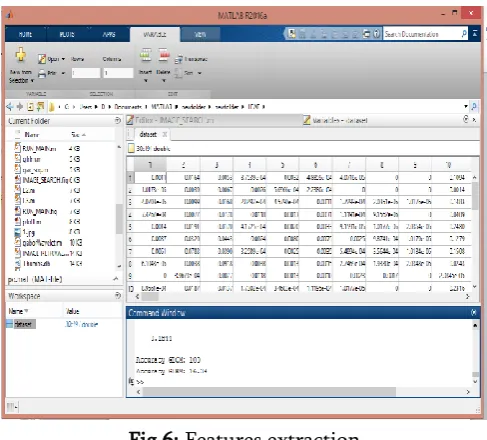
Fig 6: Features extraction
Fig 7: Trained Work space
Fig 8: Classification results
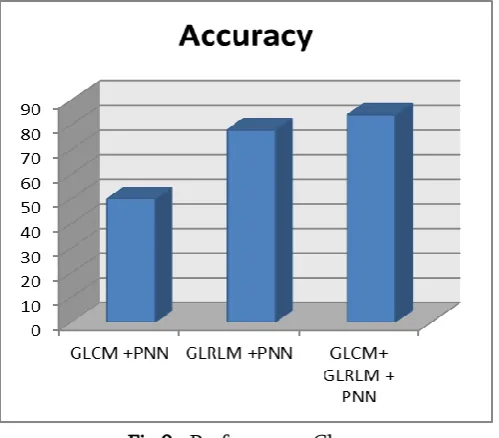
The performance of the system can be calculated in terms of accuracy. The accuracy can be calculated as follows:
𝐴𝑐𝑐𝑢𝑟𝑎𝑐𝑦 = 𝑇𝑃 + 𝑇𝑁
𝑇𝑃 + 𝑇𝑁 + 𝐹𝑃 + 𝐹𝑁 𝑋100
Fig 9 : Performance Chart
The proposed system which includes GLCM and GLRLM features extraction and using PNN classification to extract the relevant images with high level accuracy and can be shown in above figure.
VI.CONCLUSION
The paper proposed a new method to extract texture of batik images. Feature extract method is proposed to overcome problem in classifying batik images that are acquired randomly. The objective of the research is to obtain the pattern value of batik to classify the irregulars , stripped , designed batik using feature extraction with grey level occurrence matrix (GLCM) as a method for extracting textured feature and grey level run length matrix (GLRLM) as a method for extracting texture feature and probabilistic neural network (PNN) as a method for classify. This method is proposed to overcome the problem in classifying batik images that acquired randomly from the internet. Next, the acquired batik images are called the main dataset. Then, as comparison, there is another dataset that acquired from capturing fabric in fine condition. The result of study shows the average accuracy 78% data training. While on data testing the average value of accuracy84%.
VII. REFERENCES
[1]. A. Kitipong, W. Rueangsirasak, and R.
Chaisricharoen, “Classification System for
Traditional Textile : Case Study of the Batik,” in 13th International Symposium on Communications and Information Technologies (ISCIT) Classification, 2013, pp. 767–771. [2]. Nowak, Eric, Frédéric Jurie, and Bill Triggs.
"Sampling strategies for bag-of-features image classification." European conference on computer vision. Springer, Berlin, Heidelberg, 2006.
[3]. Yang, Xiaodong, Shuai Yuan, and YingLi Tian. "Recognizing clothes patterns for blind people by confidence margin based feature combination." Proceedings of the 19th ACM international conference on Multimedia. ACM, 2011.
[4]. Tian, Yingli, Xiaodong Yang, and Aries Arditi. "Computer vision-based door detection for accessibility of unfamiliar environments to blind persons." International Conference on Computers for Handicapped Persons. Springer, Berlin, Heidelberg, 2010.
[5]. I. Nurhaida, A. Noviyanto, R. Manurung, and
A. M. Arymurthy, “Automatic Indonesian’s
Batik Pattern Recognition Using SIFT
Approach,” Procedia - Procedia Comput. Sci., vol. 59, no. Iccsci, pp. 567–576, 2015.
[6]. N. Suciati, W. A. Pratomo, and D. Purwitasari,
“Batik Motif Classification using Color -Texture-Based Feature Extraction and
Backpropagation Neural Network,” in IIAI 3rd International Conference on Advanced Applied Informatics, 2014, pp. 517–521.
[7]. Imanudin, “Batik Identification Based On Batik
Pattern And Characteristics Using Fabric
Pattern Feature Extraction,” 2010.
[8]. V. S. Moertini and B. Sitohang, “Algorithms of
on Color , Contrast and Motif,” in PROC. ITB Eng. Science, 2005, vol. 37, no. 2, pp. 141–160. [9]. A. E. Minarno, Y. Munarko, A.
Kurniawardhani, F. Bimantoro, and N. Suciati,
“Texture Feature Extraction Using Co -Occurrence Matrices of Sub-Band Image For
Batik Image Classification,” in 2nd
International Conference on Information and Communication Technology (ICoICT) Texture, 2014, pp. 249–254.
[10]. A. D. Nugrowati, A. R. Barakbah, N.
Ramadijanti, and Y. Setiowati, “Batik Image
Search System with Extracted Combination of
Color and Shape Features,” in International Conference on Imaging and Printing Technologies, 2014.
Cite this article as :
K. Chandraprabha, S. Akila, "Texture Feature Extraction for Batik Images Using GLCM and GLRLM with Neural Network Classification", International Journal of Scientific Research in Computer Science, Engineering and Information Technology (IJSRCSEIT), ISSN : 2456-3307, Volume 5 Issue 3, pp. 06-15, May-June 2019. Available at doi : https://doi.org/10.32628/CSEIT195322