Use of unsupervised word classes for entity recognition:
Application to the detection of disorders in clinical reports
Maria Evangelia Chatzimina
Cyril Grouin
Pierre Zweigenbaum
CNRS, UPR 3251, LIMSI 91403 Orsay, France
[email protected],{firstname.lastname}@limsi.fr
Abstract
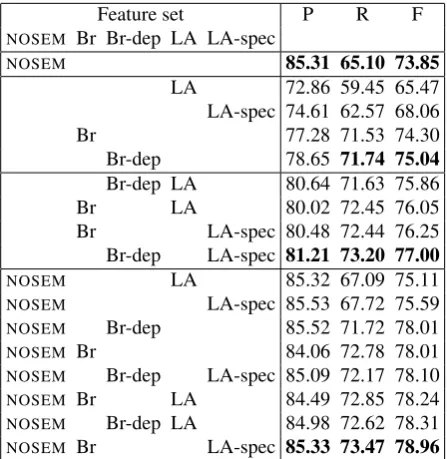
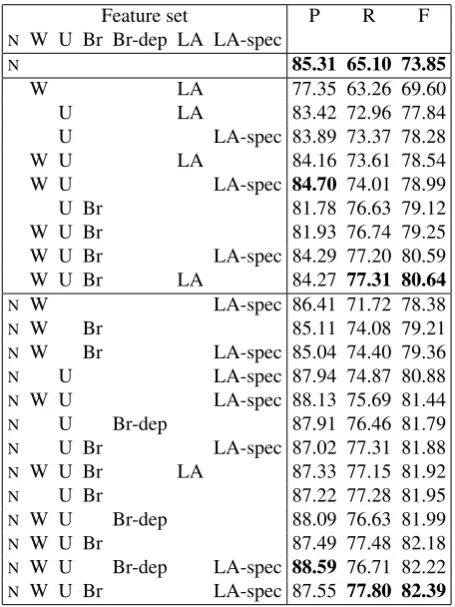
Unsupervised word classes induced from unannotated text corpora are increasingly used to help tasks addressed by supervised classification, such as standard named entity detection. This paper studies the contribution of unsupervised word classes to a medical entity detection task with two specific objectives: How do unsupervised word classes compare to available knowledge-based semantic classes? Does syntactic information help produce unsupervised word classes with better properties? We design and test two syntax-based methods to produce word classes: one applies the Brown clustering algorithm to syntactic dependencies, the other collects latent categories created by a PCFG-LA parser. When added to non-semantic features, knowledge-based semantic classes gain 7.28 points of F-measure. In the same context, basic unsupervised word classes gain 4.16pt, reaching 60% of the contribution of knowledge-based semantic classes and outperforming Wikipedia, and adding PCFG-LA unsupervised word classes gain one more point at 5.11pt, reaching 70%. Unsupervised word classes could therefore provide a useful semantic back-off in domains where no knowledge-based semantic classes are available. The combination of both knowledge-based and basic unsupervised classes gains 8.33pt. Therefore, unsupervised classes are still useful even when rich knowledge-based classes exist.
Keywords:Clinical Texts; Natural Language Processing; Unsupervised Word Classes
1.
Introduction
Clinical texts and biomedical literature are important sources of medical knowledge. The exponentially growing amount of biomedical sources in recent years requires ded-icated tools to process this domain (Meystre et al., 2008). Named entity recognition is the task that identifies an en-tity’s boundaries within text and assigns the entity to their corresponding class or category. It is usually one of the ba-sic steps applied when extracting information from texts. Supervised learning based on annotated corpora, typically using sequence learning algorithms such as Conditional Random Fields (Lafferty et al., 2001; Sutton and McCal-lum, 2006), is now a standard method to detect entities. Unannotated corpora are larger than annotated corpora, making them useful for unsupervised methods to learn word classes and help supervised methods perform entity detection (Turian et al., 2010).
The main objective of this work is to study the use of un-supervised word classes in medical entity recognition, and more specifically to test different methods and variants of unsupervised word class construction which use more ini-tial information thanks to syntactic analysis.
The remainder of the paper is organized as follows. Sec-tion 2. provides a brief descripSec-tion of previous work related to our study. Section 3. describes the corpora we take as a testbed for our experiments. Section 4. describes the design and implementation of our study. Section 5. presents and discusses experimental results. We conclude in Section 6.
2.
Related Work
In an early attempt to help supervised learning with the use of supervised word classes, Brown et al. (1992)’s cluster-ing algorithm was used to detect standard named entities (Miller et al., 2004). The combined method achieved a 25% reduction in error on a standard named-entity prob-lem. In further experiments, Turian et al. (2010) also tested
the word embeddings obtained by neural language models (Collobert and Weston, 2008; Mnih and Hinton, 2009) but observed that Brown clusters were superior when helping chunking or named entity recognition.
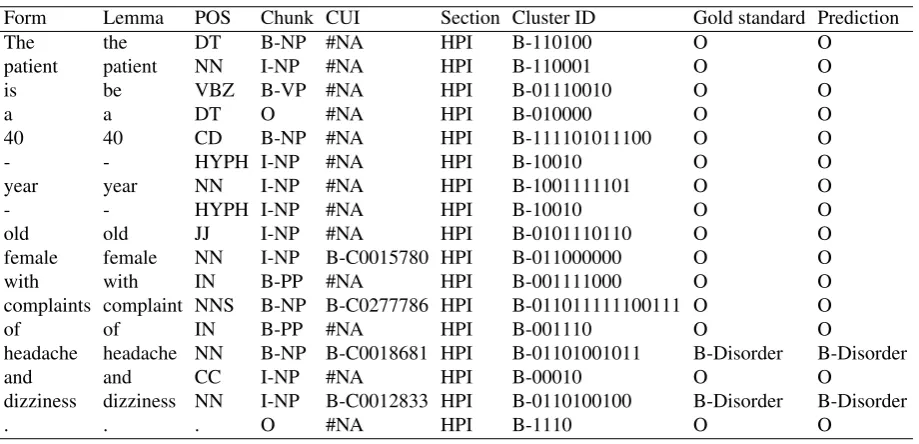
Form Lemma POS Chunk CUI Section Cluster ID Gold standard Prediction
The the DT B-NP #NA HPI B-110100 O O
patient patient NN I-NP #NA HPI B-110001 O O
is be VBZ B-VP #NA HPI B-01110010 O O
a a DT O #NA HPI B-010000 O O
40 40 CD B-NP #NA HPI B-111101011100 O O
- - HYPH I-NP #NA HPI B-10010 O O
year year NN I-NP #NA HPI B-1001111101 O O
- - HYPH I-NP #NA HPI B-10010 O O
old old JJ I-NP #NA HPI B-0101110110 O O
female female NN I-NP B-C0015780 HPI B-011000000 O O
with with IN B-PP #NA HPI B-001111000 O O
complaints complaint NNS B-NP B-C0277786 HPI B-011011111100111 O O
of of IN B-PP #NA HPI B-001110 O O
headache headache NN B-NP B-C0018681 HPI B-01101001011 B-Disorder B-Disorder
and and CC I-NP #NA HPI B-00010 O O
dizziness dizziness NN I-NP B-C0012833 HPI B-0110100100 B-Disorder B-Disorder
. . . O #NA HPI B-1110 O O
Table 2: Excerpt from the annotated corpus processed by our pipeline. POS = Part-of-Speech; CUI = Concept Unique Identifier; Reference = expected category; Prediction = predicted category
show the gold standard word label and the label predicted by our system.
4.2.
Knowledge-based semantic classes
Semantic classes for words were obtained from two human-curated resources (Bodnari et al., 2013).
The UMLS. The Unified Medical Language System
(Bo-denreider, 2004) contains a large repository of biomedical terms with associated semantic types. We produced for each word eleven attributes based on various ways to ac-cess this resource.
The Wikipedia. The Wikipedia contains an increasing
number of articles relevant to the medical domain. We used Wikipedia category data to collect a lexicon with nine se-mantic groups, which was used to produce two attributes for each word.
4.3.
Unsupervised, data-driven word classes
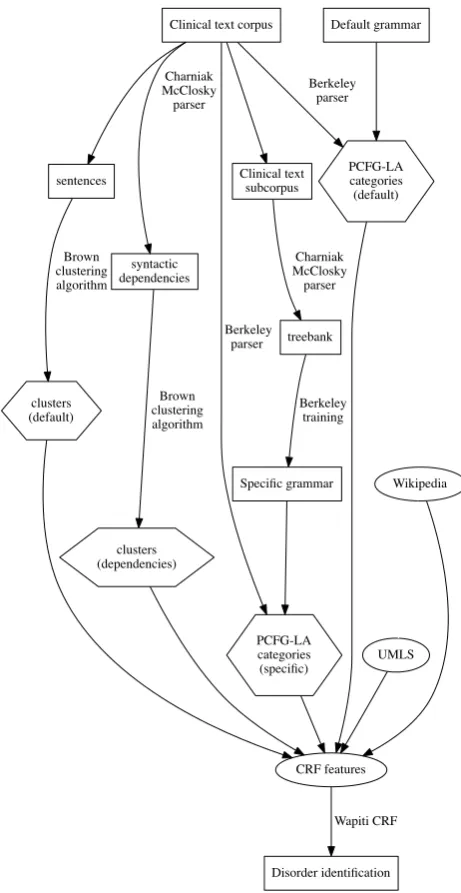
Unsupervised learning induces word representations from unannotated corpora. We explore here the use of Brown clusters (Brown et al., 1992) in their usual form as well as a novel application of this method to dependency re-lations (Section 4.3.1.), then categories obtained through training a probabilistic context-free parser with latent cate-gories (PCFG-LA, (Petrov et al., 2006), Section 4.3.3.). In all cases, unsupervised learning results in a lexicon which associates words to classes; this lexicon is then ap-plied to the training or test corpus to add attributes to the input words for supervised entity detection.
4.3.1. Brown clusters
Brown clusters optimize a class bigram language model over the corpus on which they are computed, here the unan-notated corpus of discharge summaries. We created Brown clusters using Liang (2005)’s implementation of Brown et al. (1992)’s clustering algorithm, requesting 320 and 1000
clusters (these provided the best results in preliminary ex-periments) combined to five thresholds (21...5) on the min-imum number of word occurrences. The 10 resulting clus-terings were used as attributes to create CRF features for each input word: for each clustering, the identifier of the cluster which contains this word (or #NAif the word is not
present in the clusters) is added as an attribute.
An example of cluster is that named01101111011111, com-puted with the unannotated corpus, which contains the fol-lowing words: LLL, RLL, RUL, bibasilar, dense, dif-fuse, expiratory, faint, linear, multifocal, nodular, partial, patchy, retrocardiac, scattered, trace, etc., many of which occur as modifiers in disorder expressions in the training corpus: patchy opacities, retrocardiac opacification, ex-piratory wheeze, insex-piratory wheeze, etc. Among these, RUL (right upper lobe) does not occur as a term in the UMLS. In the sentence “77 year old man with question-able RUL pneumonia,” the wordpneumoniais present as a disorder in the UMLS, but RULis unknown and as a re-sult the CRF only labelspneumoniaas a disorder, missing RUL. When using Brown clusters, the feature for cluster 01101111011111obtains a high score for being part of a dis-order, andRULis therefore labeled as part of the disorder too, thus obtaining the correct complete entity.
4.3.2. Dependency-based Brown clusters
In previous approaches, the Brown clusters were computed over bigrams in an input string of words. In the present work, we tested whether computing clusters based on syn-tactic dependencies instead of word bigrams might improve entity detection.
The unannotated corpus was parsed with McClosky and Charniak (2008)’s self-trained parser and the output was converted into Stanford reduced dependency format (De Marneffe and Manning, 2008).
documents in the electronic health record: a review of re-cent research. InYearbook of Medical Informatics, pages 128–144. Shattauer, Stuttgart.
Mikolov, T., Yih, W., and Zweig, G. (2013). Linguistic regularities in continuous space word representations. In Vanderwende, L., III, H. D., and Kirchhoff, K., editors, HLT-NAACL, pages 746–751. The Association for Com-putational Linguistics.
Miller, S., Guinness, J., and Zamanian, A. (2004). Name tagging with word clusters and discriminative training. InProc of HLTC, pages 337–42.
Mnih, A. and Hinton, G. E. (2009). A scalable hierarchical distributed language model. Advances in neural infor-mation processing systems, 21:1081–88.
Petrov, S., Barrett, L., Thibaux, R., and Klein, D. (2006). Learning accurate, compact, and interpretable tree anno-tation. InProc of ACL, pages 433–40.
Saeed, M., Villarroel, M., Reisner, A. T., Clifford, G., Lehman, L.-W. W., Moody, G., Heldt, T., Kyaw, T. H., Moody, B., , and Mark, R. G. (2011). Multiparame-ter Intelligent Monitoring in Intensive Care II: a public-access Intensive Care Unit database. Critical Care Medicine, 39(5):952–60.
Savova, G. K., Masanz, J. J., Ogren, P. V., Zheng, J., Sohn, S., Kipper-Schuler, K. C., and Chute, C. G. (2010). Mayo clinical Text Analysis and Knowledge Extraction System (cTAKES): architecture, component evaluation and applications. J Am Med Inform Assoc, 17(5):507– 13.
Suominen, H., Salanter¨a, S., Chapman, W. W., Velupil-lai, S., Savova, G., Elhadad, N., Pradhan, S., South, B. R., Mowery, D. L., Jones, G. J., Leveling, J., Kelly, L., Goeuriot, L., Martinez, D., and Zuccon, G. (2013). Overview of the ShARe/CLEF eHealth evaluation lab 2013. InProc of CLEF.
Sutton, C. and McCallum, A. (2006). An introduction to Conditional Random Fields for relational learning. In Getoor, L. and Taskar, B., editors, Introduction to Sta-tistical Relational Learning. MIT Press.
Tang, B., Cao, H., Wu, Y., Jiang, M., and Xu, H. (2013). Recognizing clinical entities in hospital discharge sum-maries using Structural Support Vector Machines with word representation features. BMC Med Inform Decis Mak, 13(Suppl 1):S1. Published online Apr 5, 2013. Turian, J., Ratinov, L., and Bengio, Y. (2010). Word
rep-resentations: a simple and general method for semi-supervised learning. InProc of ACL, pages 384–94. Uzuner, O., South, B. R., Shen, S., and DuVall, S. L.
(2011). 2010 i2b2/VA challenge on concepts, assertions, and relations in clinical text. J Am Med Inform Assoc, 18(5):552–6.