DOI : 10.32628/CSEIT1726141
A Phishing Detection Framework for Websites Based on Data
Mining
Srushti Nawade1, Shubhangi Wankhede1, Dhanshree Bhaspale1, Shubhangi Sathwane1, Prof. Vikas Bhowate2 1BE Scholar, Department of Information Technology, St. Vincent Pallotti College of Engineering and
Technology, Nagpur, Maharashtra, India
2Assistant Professor, Department of Information Technology, St. Vincent Pallotti College of Engineering and
Technology, Nagpur, Maharashtra, India
ABSTRACT
Detecting any Phishing site is extremely an intricate and dynamic issue including numerous variables and criteria. Due to the ambiguities associated with phishing location, fluffy information mining procedures can be a viable instrument in detecting phishing websites. In this paper, we propose a strategy which consolidates fluffy rationale alongside information digging algorithms for detecting phishing websites. Here, we characterize 3 diverse phishing types and 6 unique criteria for detecting phishing websites with a layer structure. We have utilized the SVM Data Mining algorithm for classification. Besides, this we also compare the efficiency of SVM in terms of time and space complexity with Naive Bayes algorithm, the framework proactively disposes of the Phishing site or Phishing page by sending a notice to the System Administrator of the host server that it is hosting a Phishing site which may result in the evacuation of the site. Moreover, in the wake of ordering the Phishing email, the framework recovers the location, IP address and contact data of the host server.
Keywords : Data Mining, SVM, Phishing, URL, Naive Bayes, Classification
I. INTRODUCTION
Social engineering assault is a typical security risk used to uncover private and secret data by just deceiving the clients without being distinguished. The primary motivation behind this assault is to increase touchy data, for example, username, secret word and record numbers. As per, phishing or web ridiculing strategy is one case of social engineering assault. Phishing assault may show up in numerous sorts of correspondence structures, for example, informing, SMS, VOIP and fraudster messages. Clients usually have numerous client accounts on different websites including social system, email and furthermore represents keeping money. Thusly, the guiltless web clients are the most defenceless focuses
towards this assault since the way that the vast majority are unconscious of their profitable data, which makes this assault effective.
web caricaturing assault. The execution of Secure Socket Layer (SSL) and computerized testament (CA) additionally does not ensure the web client against such assault. In web satirizing assault, the aggressor redirects the demand to counterfeit web server. Truth be told, a specific sort of SSL and CA can be produced while everything seems, by all accounts, to be authentic. As per, secure perusing association does essentially nothing to shield the clients particularly from the aggressors that have information on how the "safe" associations really work.
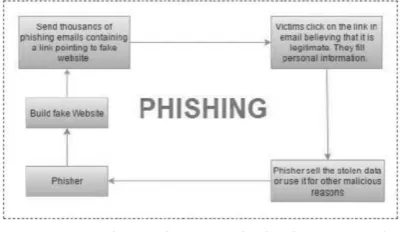
Figure 1. Flow of General phishing attack
Digital Crime examination cell of Mumbai, India [3] has ordered cybercrimes in following categories: Hacking, Child Pornography, Cyberstalking, Denial of administration attack, Virus Dissemination, Software protection, Internet Relay Chat(IRC) wrongdoing, Credit card misrepresentation, Net blackmail, Phishing andInternet fraud. According to George K. Kostopoulos in his book Cyberspace and Cybersecurity [4], vulnerabilities are presented while the framework is being overhauled or adjusted to new operational condition. Individuals are becoming more 'tech-savvy' with the enhancement of innovation. The web has turned into a proficient system among individuals for correspondence and collaboration. Web offices can be utilized with PCs, PCs, cell phones, tablets, media player, tablet and so forth. Through these computerized gadgets connected by the web, programmers additionally assault individual protection utilizing an assortment of web dangers, for example, infections, Trojans, Worms, botnet assaults, rootkits, adware, spam, and social designing stage. Phishing is such social building
assault which endeavors to acquire people groups' close to home data by misleading. Digital hoodlums enjoy the act of phishing are known as 'Phishers'. Phishing locales are made by malevolent people to appear as certified destinations. When all is said in done terms, Phishing is a demonstration of sending an email to a customer unscrupulously stating to be a valid business establishment attempting to trap or trap the customer to surrender private information that will be used for extortion. The impact is the crack of information security through the deal of private data and the loss may at long last endure the loss of cash and other kinds."Phishing" at first created in the 1990s[5].
The early software engineers normally use "ph" instead of "f" to make new words in the developer's gathering, since they regularly hack by phones. Phishing is another word conveyed from 'angling'. The more often than not used in the phishing assault is to send messages to potential targets, which had all the earmarks of being sent by banks, online affiliations, or ISPs. In these messages, phishers will make up a couple of reasons, for example, the mystery key of client's Visa has been entered mistakenly or an offer of redesigning organizations in only a single tick. These messages will take the client to the independent site page that requests the client to give or change their record number and secret word through the hyperlink given in the email. On the off chance that the client presents the record number and mystery key, the phishers at that point adequately accumulate the information at the server side, and can perform the noxious movement with that information (e.g., haul back money out from your record, changing of secret word and so on.).
II. LITERATURE REVIEW
malignant exercises numerous enemy of phishing methods have been proposed.
In [1] Jain Mao, Wenqian Tian And Zhenkai Liang has proposed a system which detect the phishing using page component similarity which analyzes URL tokens to increase prediction accuracy phishing pages typically keep its CSS style similar to their target pages. Based on the observation, a straightforward approach to detect phishing pages is to compare all CSS rules of two web pages, It prototyped Phishing-Alarm as an extension to the Google Chrome browser and demonstrated its effectiveness in evaluation using real-world phishing samples.
Zou Futai, Pei Bei and Pan Li [2] Uses Graph Mining technique for web Phishing Detection. It can detect some potential phishing which can't be detected by URL analysis. It utilize the visiting relation between user and website. To get dataset from the real traffic of a Large ISP. After anonymizing these data, they have cleansing dataset and each record includes eight fields: User node number (AD), User SRC IP(SRC-IP) access time (TS), Visiting URL (URL), Reference URL(REF), User Agent(UA), access server IP (DSTIP), User cookie (cookie). For a client user, he is assigned a unique AD but a variable IP selected from ISP own IP pool. system which analysis ACT-R cognitive behaviour architecture model. Simulate the cognitive processes involved in judging the validity of a representative webpage based primarily around the characteristics of the HTTPS padlock security indicator. ACT-R possesses strong capabilities which map well onto the phishing use case and that further work to more fully represent the range of human security knowledge and behaviours in an ACT-R model could lead to improved insights into how best to combine technical
and human defense to reduce the risk to users from phishing attacks.
Xin Mei Choo, Kang Leng Chiew and Nadianatra Musa [4] this system is based on utilizing support vector machine to perform the classification. This method will extract and form the feature set for a webpage. It uses a SVM machine as a classifier which has two phase training phase and testing phase during training phase it extracts feature set and while testing it predict the website is legitimate or a phishing.
In [5] Giovanni Armano, Samuel Marchal and N.Asokan proposed a use of add on in the browser, which is Real-Time Client-Side Phishing Prevention. It uses information extracted from website visited by the user to detect if it is a phish and warn the user. It also determines the target of the phish and offers to redirect the user there. A warning message is displayed in the foreground while the background displays the phishing webpage darkened by a black semi-transparent layer preventing interactions with the website.
Trupati Kumbhare and Santosh Chobe [6] have discussed various Association Rule Mining Algorithm. Association rule learning searches for relationships among variables. Various Association algorithm discussed are AIS algorithm, SETM algorithm, Apriori algorithm, Apriori algorithm, Apriori hybrid algorithm, and FP-growth algorithm.
In [7] S.Neelamegam and Dr. E. Ramaraj discussed various Classification Algorithm used in data mining. Data Classification is a data mining technique used to predict group membership for data instances Various Classification Algorithm discussed are decision tree, Bayesian networks, k-nearest Neighbor classifier, Neural Network, Support vector machine.
phishing URLs because it executes multiple tests such as Blacklist search Test, Alexa ranking test, and different URL features test. However, this solution is effective only for HTTP URLs.
In paper [9], the method to detect Phishing website is based on the analysis of legitimate website server log information. Every time a victim opens the phishing website, the phishing website will refer to the legal website by asking for resources. Then, there will be a log, which is recorded by the legitimate website server and from this logs Phishing site can be Detected.
Samuel Narchal, Giovanni Armano And Nidhi Singh [10] propose a application Off-the-Hook application for detection of phishing website. Off-the-Hook, exhibits several notable properties including high accuracy, brand-independence and good language-independence, speed of decision, resilience to dynamic phish and resilience to evolution in phishing techniques.
III. PROPOSED METHODOLOGY
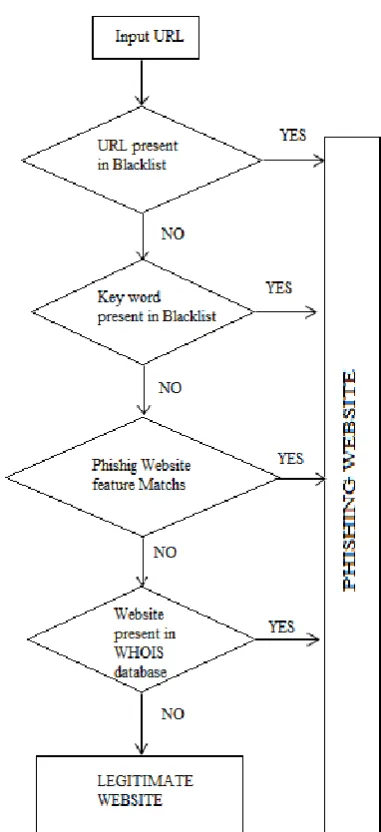
The whole work is divided into several steps. We propose to use the classification technique for generating the classified patterns. We are using SVM as a main algorithm for classification. For analysis of the result with the existing system, we are classifying the data using Naive Bayes algorithm. The different steps involved for the analysis are as follows:
1. Input Dataset 2. Pre-processing 3. Input URL
4. Check URL is present in blacklist 5. Check Keyword present in Black list 6. Phishing website feature matching 7. Classification using SVM
8. Provide class for URL (phishing or not phishing)
Figure 2. Flowchart of the System
URLs having the image "@".These features are investigated utilizing a lot of standards so as to recognize URLs of phishing webpages from the URLs of genuine websites.
A. Utilizing the IP Address
On the off chance that an IP address is utilized as an option of the space name in the URL, for example, "http://125.98.3.123/fake.html", clients can make sure that somebody is attempting to take their own touchy data. Once in a while, the IP address is even changed into hexadecimal code as appeared in the accompanying connection
"http://0x58.0xCC.0xCA.0x62/2/paypal.ca/index.html ".
Standard: IF The Domain Part has an IP Address → Phishing
Otherwise→ Legitimate
B. Long URL to Hide the Suspicious Part
Phishers can utilize long URL to shroud the suspicious part in the address bar.
For instance:
http://federmacedoadv.com.br/3f/aze/ab51e2e319e51 502f416dbe46b773a5e/?cmd=_home&dispatch=1 1004d58f5b74f8dc1e7c2e8dd4105e811004d58f5b74f8 [email protected]
To guarantee the precision of our investigation, we determined the length of URLs in the dataset and delivered a normal URL length. The outcomes demonstrated that if the length of the URL is more noteworthy than or meet 54 characters then the URL named phishing. By looking into our dataset, we could discover 1220 URLs lengths equivalents to at least 54, which establish 48.8% of the absolute dataset measure.
Principle: IF URL length is ≤ 75→legitimate otherwise→Phishing
We have possessed the capacity to refresh this element rule by utilizing a strategy dependent on recurrence and therefore enhancing its precision.
C. Including Prefix or Suffix Separated by (- ) to the Domain
The dash image is occasionally utilized in real URLs. Phishers will in general include prefixes or suffixes isolated by (-) to the space name so clients feel that they are managing a real webpage. For instance http://www.Confirme-paypal.com/.
Guideline: IF Domain Name Part Includes
(- )Symbol → Phishing Generally → Legitimate
D. Boycott based
A Blacklist is made in the proposed model in which the site identified as phishing is put something aside for the future utilize a to keep a reputation and information of the phishing site this can be valuable in investigating the phishing site to build the proficiency of the framework.
E. WHOIS Database
The life of phishing site is exceptionally short, subsequently; this DNS data may not be accessible after some time. On the off chance that the DNS record is not accessible anywhere, at that point the site is phishing. In the event that the space name of the suspicious webpage is not coordinate with the WHOIS database record, at that point webpage considers as phishing.
IV. CONCLUSION
Web clients must know about all security tips which are given by specialists. Each client ought to likewise be prepared not to aimlessly pursue the connections to websites where they need to enter their delicate data. It is basic to check the URL before entering the site. In Future System can move up to programmed Detect the page and the similarity of the Application with the internet browser. Extra work additionally should be possible by adding some different qualities to recognizing the phony site pages from the authentic site pages. PhishChecker application additionally can be overhauled into the web telephone application in detecting phishing on the portable stage.
V. REFERENCES
[1] Jian Mao, Wenqian Tian, Pei Li, Tao Wei, And Zhenkai Liang Phishing-Alarm: Robust and Efficient Phishing Detection via Page Component Similarity.
[2] Zou Futai, Gang Yuxiang, Pei Bei, Pan Li, Li Linsen Web Phishing Detection Based on Graph Mining.
[3] Nick Williams, Shujun Li Simulating human detection of phishing websites: An investigation into the applicability of ACT-R cognitive behaviour architecture model.
[4] Xin Mei Choo, Kang Leng Chiew, Dayang Hanani Abang Ibrahim, Nadianatra Musa, San Nah Sze, Wei King Tiong Feature-Based Phishing Detection Technique.
[5] Giovanni Armano, Samuel Marchal and N. Asokan Real-Time Client-Side Phishing Prevention Add-on.
[6] Trupti A. Kumbhare and Prof. Santosh V. Chobe An Overview of Association Rule Mining Algorithms.
[7] S. Neelamegam, Dr. E. Ramaraj Classification algorithm in Data mining: An Overview
[8] Varsharani Ramdas Hawanna, V. Y. Kulkarni and R. A. Rane A Novel Algorithm to Detect Phishing URLs.
[9] Jun Hu, Xiangzhu Zhang,Yuchun Ji, Hanbing Yan, Li Ding, Jia Li and Huiming Meng Detecting Phishing Websites Based on the Study of the Financial Industry Webserver Logs.
[10] Samuel Marchal, Giovanni Armano and Nidhi Singh Off-the-Hook: An Efficient and Usable.
Cite this article as :
Srushti Nawade, Shubhangi Wankhede, Dhanshree Bhaspale, Shubhangi Sathwane, Prof. Vikas Bhowate, "A Phishing Detection Framework for Websites Based on Data Mining", International Journal of Scientific Research in Computer Science, Engineering and Information Technology (IJSRCSEIT), ISSN : 2456-3307, Volume 5, Issue 2, pp.651-656, March-April-2019.