Computational Linguistics and Chinese Language Processing
Vol. 12, No. 4, December 2007, pp. 443-458 443 © The Association for Computational Linguistics and Chinese Language Processing
[Received December 7, 2006; Revised October 16, 2007; Accepted October 17, 2007]
Automatic Pronunciation Assessment for Mandarin
Chinese: Approaches and System Overview
Jiang-Chun Chen
∗, Jyh-Shing Roger Jang
∗, and Te-Lu Tsai
+Abstract
This paper presents the algorithms used in a prototypical software system for automatic pronunciation assessment of Mandarin Chinese. The system uses forced alignment of HMM (Hidden Markov Models) to identify each syllable and the corresponding log probability for phoneme assessment, through a ranking-based confidence measure. The pitch vector of each syllable is then sent to a GMM (Gaussian Mixture Model) for tone recognition and assessment. We also compute the similarity of scores for intensity and rhythm between the target and test utterances. All four scores for phoneme, tone, intensity, and rhythm are parametric functions with certain free parameters. The overall scoring function was then formulated as a linear combination of these four scoring functions of phoneme, tone, intensity, and rhythm. Since there are both linear and nonlinear parameters involved in the overall scoring function, we employ the downhill Simplex search to fine-tune these parameters in order to approximate the scoring results obtained from a human expert. The experimental results demonstrate that the system can give consistent scores that are close to those of a human’s subjective evaluation. Keywords: CAPT, CALL, Speech Recognition, Tone Recognition, Speech Assessment, GMM, Mandarin Chinese, Downhill Simplex Method, Phoneme, Intensity, Rhythm, Forced Alignment.
1. Introduction
With the fast-growing power of personal computers and the advances in speech and language processing technologies, software systems for CALL (Computer Assisted Language Learning) now allow a person to learn a language by interacting solely with computers, especially for second language (L2) learning. In general, a CALL system involves testing procedures for both the receptive and productive skills of a given subject. To evaluate receptive skills such as
∗
Department of Computer Science, National Tsing Hua University, Taiwan E-mail: {jtchen; jang}@cs.nthu.edu.tw
+
444 Jiang-Chun Chen, and Jyh-Shing Roger Jang
reading and listening, the procedure is relative simple, since the evaluation is usually based on exams containing questions of single or multiple choices. On the other hand, to evaluate the productive skills of speaking or writing, the procedure is relatively difficult and time-consuming, since a human expert is usually required to evaluate the speech or writing in a subjective and time-consuming manner. With advances in automatic speech recognition, a Computer-Assisted Pronunciation Training (CAPT) system can evaluate the pronunciation quality using various speech features, and provides high-level feedback (hints for further improvement, etc.) to the user. Successful applications of CAPT have been reported in the literature [Neumeyer et al. 2000; Kim and Sung 2002; Neri et al. 2003].
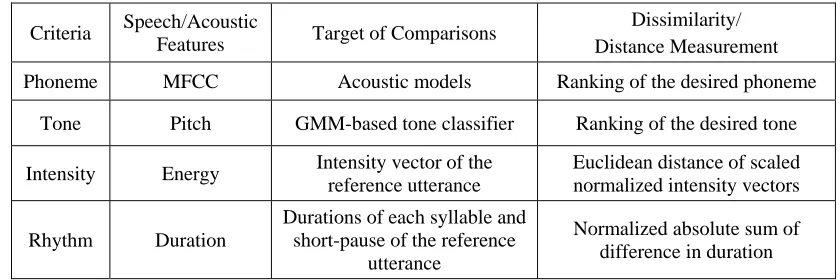
In this paper, we propose several algorithms for constructing a CAPT system that can assess a test utterance in Mandarin Chinese with respect to a target utterance by a native speaker. Basically, there are four evaluation criteria based on different acoustic features, as explained in the following.
1. Phoneme: This is based on the log probabilities of the test utterance with respect to the acoustic models derived from a large speech corpus for speaker-independent speech recognition. Note that the target utterance is not required for this evaluation.
2. Tone: Each syllable is associated with a tone in Mandarin Chinese. The pronounced tone of a syllable can be identified by a tone classifier, and the result is then compared with the correct tone for evaluation. Note that we can obtain the correct tones from the text of the utterance; hence, the target utterance is not used directly for this evaluation.
3. Intensity: Each syllable has an intensity vector, which is compared to that of the corresponding syllable in the target utterance to ensure it has a similar score.
4. Rhythm: The duration of each syllable and the silence in between are compared to those of the target utterance to ensure they have a similar score.
Each of the scoring functions for the above four criteria involves several nonlinear parameters. These four scoring functions are then linearly combined to give a score between 0 and 100. We then employ a search method that can find optimum values of these parameters such that the computed scores can approximate those of a human expert. The experimental results demonstrate the feasibility of the proposed approach, which can give consistent results when compared with human evaluation.
Automatic Pronunciation Assessment for Mandarin Chinese: 445 Approaches and System Overview
describes the GUI of our system. Section 5 demonstrates the experimental results and Section 6 gives concluding remarks.
2. Related Work
In general, a CAPT system can evaluate pronunciation quality using various speech features. Moreover, the system is expected to have optimum performance by minimizing the discrepancies between the scores from computers and those from a human expert. However, most of the reported systems do not take the characteristics of tonal languages into consideration. In particular, Mandarin Chinese is a tonal language, and each character is associated with one out of five possible tones. The tone of a given character is also context-dependent according to tone sandhi [Lee 1997]. Hence, the correct pronunciation of the tone of each character in a sentence is the most challenging problem for a Mandarin-learning non-native speaker. The proposed system takes this specific problem into consideration and tries to create a comprehensive Mandarin Chinese pronunciation assessment system.
3. The Proposed Approach
The proposed pronunciation assessment system uses four criteria to evaluate a test utterance with respect to a target utterance. The algorithms of these four criteria are explained in this section.
3.1 Syllable/Phone Segmentation using HMM-based Forced Alignment
446 Jiang-Chun Chen, and Jyh-Shing Roger Jang
For pronunciation assessment, we need to build a lexicon net consisting of the models of the uttered text. Then, Viterbi decoding is used to do forced alignment between the speech signals and the models in the lexicon net. The final results include frame indices of isolated syllables/phones and the corresponding log probability. The log probability is an absolute measure of how closely the utterance matches the acoustic models identified from the speech corpus. Consequently, the log probability varies considerably among different models due to their different phonetic characteristics, and thus cannot be used directly for phoneme assessment. Instead, we use a ranking-based confidence measure to be explained later.
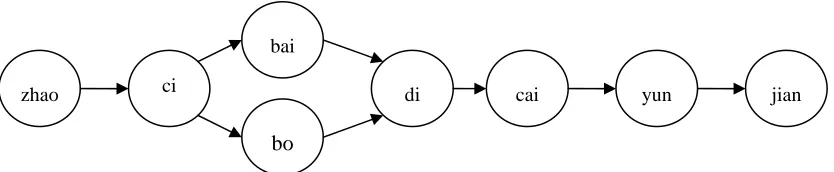
To deal with characters having multiple pronunciations in Mandarin, we use a sausage-like lexicon net. Take the sentence “朝辭白帝彩雲間” in Tang Poetry for example, where the third character can be pronounced as “bai” or “bo”. Both pronunciations are commonly used. Therefore, our lexicon net has two branches for this character to accommodate both pronunciations, as shown in Figure 1 where Hanyu Pinyin is used for phonetic transcription.
Figure 1. The lexicon net for “
朝辭白帝彩雲間
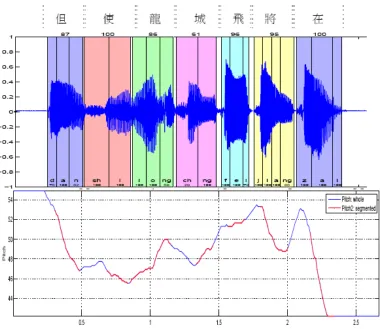
”.Figure 2 shows a typical result of forced alignment for the sentence “但使龍城飛將在” in Tang Poetry. The solid lines in the waveform plot indicate the boundaries of phones. The score for each syllable is labeled under each Chinese character, while the score for each phone is labeled under the phone name. The scores depend on the quality of the pronunciation as well as the correctness of forced alignment. In particular, we can see that the fricative phone “sh” in the second character is correctly segmented with a score of 100, while the phone “ch” in the forth character is badly segmented (due to its mispronunciation as a non-retroflexed consonant) with a score of 29. The details of phoneme assessment will be described in the next section.
Figure 2 also shows the pitch vector of this utterance. The dotted lines represent the pitches of the voiced parts, while the union of the dotted and the solid lines represents the pitch curve of the whole utterance derived by dynamic programming. Details of the pitch tracking method can be found in Chen and Jang [2007].
ci
bai
di cai yun jian
bo
Automatic Pronunciation Assessment for Mandarin Chinese: 447 Approaches and System Overview
Figure 2. An example of forced alignment for the test utterance “
但使龍城飛將在
”.The upper panel shows the phone segmentation results and the
corresponding phoneme scores. The bottom panel plots the pitch vector
where the dotted linescorrespondtothe voiced parts in the utterance.
3.2 Ranking-Based Confidence Measure for Phoneme Assessment
448 Jiang-Chun Chen, and Jyh-Shing Roger Jang
system is able to track down phone-level pronunciation errors for detailed and better assessment.
The phone-based phoneme assessment proceeds as follows.
1. For a given biphone model of “x+y”, we define the set of competing models as “*+y” where * is a wildcard representing all the possible phones that form a legal biphone with y. 2. After forced alignment, we can obtain the speech signals corresponding to the biphone
“x+y”. We then send the speech signals to the competing models for a log probability evaluation and find the rank (zero-based) of “x+y” in the competing models.
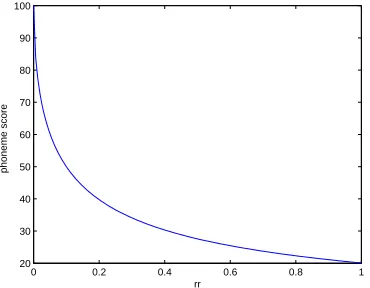
3. Since each biphone has a different set of competing models, we divide the rank of “x+y” by the size of its competing models to obtain a rank ratio between 0 and 1. Once the rank ratio is obtained, the phoneme score of the i-th phone in an utterance is then determined by the following formula:
phoneme,
100
1
i b
i
s
rr a
= +
,
( 1 )
where rri is the rank ratio of the
i
th biphone, and a and b are the tunable parameters of this scoring function. In particular, when rri is equal to 0, a perfect score of 100 is obtained. On the other hand, if rri is larger, the score is lower. The values of parameters a and b are empirically set to 0.1 and 2 respectively. A typical plot of functions
phoneme,i is shown in Figure 3. (An on-going research focus is to make the parameters a and b model-dependent and to determine their values automatically, which will be covered in our future publication.)0 0.2 0.4 0.6 0.8 1
20 30 40 50 60 70 80 90 100
phoneme score
rr
Figure 3. A typical plot of
s
phoneme with respect torr
i, wherea
andb
are set to0.1 and 2 respectively (For simplicity, wehaveremoved the subscript
i
454 Jiang-Chun Chen, and Jyh-Shing Roger Jang
1 phoneme 2 tone 3 intensity 4 rhythm
score=w score⋅ +w ⋅score +w ⋅score +w ⋅score , ( 9 )
wherew1+w2+w3+w4 =1.Apparently, the overall scoring function is formed within several parameters, including pphoneme , ktone , ptone , kintensity , pintensity and krhythm , and
1, 2, 3, 4
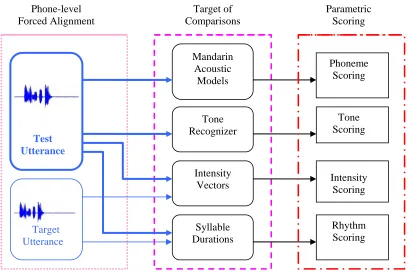
w w w w . To fine-tune these parameters to approximate the scores by the human expert, we employ the downhill Simplex method [chapter 7 of Jang et al. 1997] to find the optimal values of these parameters. Basically, the downhill Simplex method is a derivative-free optimization method, which is less efficient than some methods, but simple and flexible in implementation. The flowchart of each of the evaluation processes is shown in Figure 5. The experimental results are covered in the next section.
Figure 5. The flowchart of the proposed approach.
4. Experimental Results
To construct the scoring function, we used a dataset containing 400 utterances from 20 speakers, including 10 males and 10 females, each with various levels of proficiency in Mandarin Chinese. Each speaker was asked to utter 20 sentences chosen from the 300 most famous poems of the Tang dynasty. Some of the utterances are purposely pronounced
Phoneme Scoring
Tone Scoring
Intensity Scoring
Rhythm Scoring Mandarin
Acoustic Models
Tone Recognizer
Target Utterance
Test Utterance
Phone-level Forced Alignment
Target of Comparisons
Intensity Vectors
Syllable Durations
Automatic Pronunciation Assessment for Mandarin Chinese: 455 Approaches and System Overview
incorrectly in either content or tone to give “low-score” examples of the training data. These utterances were evaluated by a human expert who subjectively gave a score between 0 and 100 to each utterance, according to the “correctness”. We then used the downhill Simplex method to fine tune the parameters of w w w w1, 2, 3, 4, pphoneme,ktone , ptone,kintensity ,
intensity
p and krhythm. The resulting value of w1 for phoneme was 0.52, w2 for tone was 0.22 and w3 for intensity was 0.1 and w4 for rhythm was 0.16, indicating that phoneme and tone were more important factors for speech assessment. This is also consistent with the observation that an utterance with wrong phonemes or wrong tones is much more easily recognized than an utterance with wrong intensity or rhythm.
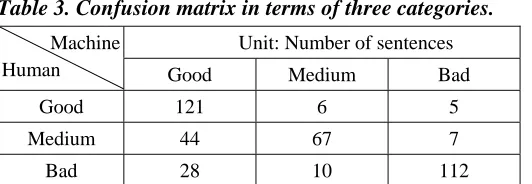
Table 3. Confusion matrix in terms of three categories.
Unit: Number of sentences Machine
Human Good Medium Bad
Good 121 6 5
Medium 44 67 7
Bad 28 10 112
To evaluate the performance of the system, another set of 400 utterances recorded from 10 subjects was used for an outside test. Each utterance was assigned a category out of three candidates: good (above 80), medium (between 60 and 80), and bad (below 60). Table 3 lists the test results in the form of a confusion matrix in which each column corresponds to a category assigned by our system, and each row corresponds to a category assigned by the human expert. The median category has a smaller score range of [60, 80], therefore the data count is also lower.
In the above table, it is obvious that our system can match the categories assigned by a human expert in a satisfactory manner. The overall recognition rate in terms of these three categories is (121+67+112)/400 = 75%. In addition, the average of the absolute difference between scores from the computer and the human is 5.42, where the standard deviation is 2.31. In a related work, Kim and Sung [2002] reported a recognition rate of about 60% for intonation assessment in English learning, while Neumeyer et al. [2000] reported a machine-to-human correlation of 70% for American speakers learning French. Note that the result by Neumeyer is evaluated in the speaker level in their posterior scoring approach, which is different from our evaluation method.
456 Jiang-Chun Chen, and Jyh-Shing Roger Jang
5. Overview of the Software System Using the Proposed Approaches
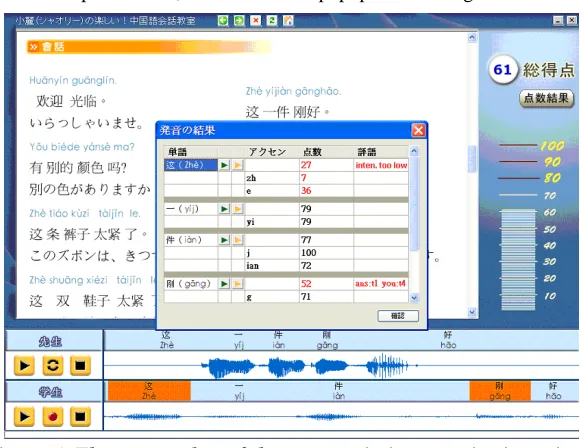
Our software system, primarily for Japanese students, provides three different approaches to the learning of Mandarin Chinese, including pronunciation practice, interactive dialogue, and video-aided real-world dialogue. Figure 6 is a screen shot of our system when the pronunciation practice is in action. First, the student can choose a sentence, then the system will show the reference utterance at the bottom. The student can listen to the reference utterance before recording. After finishing the recording, the score of the test utterance is shown at the right-upper corner. The user can click the button labeled “點數結果” to check detailed scores to the phone level, as shown in the popup menu in Figure 6.
Figure 6. The screen shot of the pronunciation practice in action.
To make a vivid visual feedback, low scores for phones/syllables are displayed in red, as shown in the popup dialog, where “這” and “剛” have scores in red. In fact, “這” and “剛” were pronounced as “那” and “不”, respectively, in the test utterance. The system was able to detect the mispronunciation and gave both syllables poor scores of 27 and 52, respectively. Note that the target sentence is displayed with Chinese characters, their Hanyu Pinyin transcription, and the corresponding tone symbols, including “–” (tone 1), “ˊ” (tone 2), “ˇ” (tone 3) and “ˋ” (tone 4). Hanyu Pinyin without any tone symbol represents “tone 5”.
Automatic Pronunciation Assessment for Mandarin Chinese: 457 Approaches and System Overview
same as that of interactive dialogue, except that a video is played to imitate real-world conversations.
Figure 7. A screen shot of the video-aided real-world dialogue.
6. Conclusions
In this paper, we have developed the algorithms to construct a CAPT system for evaluating the pronunciation of Mandarin Chinese. The proposed system uses several techniques from speech signal processing and recognition, including the HMM-based forced alignment, a pitch determination using autocorrelation, and tone recognition using GMM. By using downhill Simplex search, we successfully derived a set of parameters for a scoring function that can approximate the scores from a human expert. Similar approaches can be applied to construct CAPT systems for other tonal languages, such as Taiwanese, Minnan, Cantonese, Tibetan, Punjabi, and so on.
References
Chen J.C. and J.S. R. Jang, “Extended Supratone Modeling for HMM-based Continuous Tone Recognition,” ACM Transaction on Speech and Language Processing, 2007. [submitted]
458 Jiang-Chun Chen, and Jyh-Shing Roger Jang
Chen S.H. and Y.R. Wang. “Tone Recognition of Continuous Mandarin Speech Based on Neural Networks,” IEEE Transactions on Speech and Audio Processing, 3(2), 1995, pp. 146-150.
Chen J.C., J.L. Lo, and J.S. R. Jang, “以 語 音 辨 識 與 評 分 輔 助 口 說 英 文 學 習,” In Proceedings of Conference on Computational Linguistics and Speech Processing (ROCLING), 2004, available at http://www.aclclp.org.tw/rocling/2004/M25.pdf
Huang S.C., ”Improvement and Error Analysis of Tone Recognition for Mandarin Chinese”, MD thesis, National Tsing Hua University, 2006.
Huang X., A. Acero, and H.W. Hon, Chapter 12 of “Spoken Language Processing: A Guide to Theory, Algorithm, and System Development,” Prentice Hall PTR, Upper Saddle River, New Jersey, 2001, pp. 585-636.
Jang J.S. R., and S.S. Lin, "Optimization of Viterbi Beam Search in Speech Recognition," In Proceedings of International Symposium on Chinese Spoken Language Processing, 2002, paper 114.
Jang J.S. R., C.T. Sun and E. Mizutani, “Neural-Fuzzy and Soft Computing: A Computational Approach to Learning and Machine Intelligence,” Prentice Hall PTR, Upper Saddle River, New Jersey, 1997.
Kim C. and W. Sung, "Implementation of An Intonational Quality Assessment System,” In Proceedings of International Conference on Spoken Language Processing, 2002, pp. 1857-1860.
Lee L.S., "Voice Dictation of Mandarin Chinese," IEEE Signal Processing Magazine, 14(4), 1997, pp. 63-101.
Li J.Y., “Speech Evaluation,” MD thesis, National Tsing Hua University, Taiwan, 2002. Lin W.Y., and L.S. Lee, “Improved Tone Recognition for Fluent Mandarin Speech Based on
New Inter-Syllabic Features and Robust Pitch Extraction,” In Proceedings of IEEE Workshop on Automatic Speech Recognition and Understanding, 2003, pp. 237-242. Neri A., C. Cucchiarini, and W. Strik, “Automatic Speech Recognition for Second Language
Learning: How and Why It Actually Works,” In Proceeding of International Congresses of Phonetic Sciences, 2003, pp. 1157-1160.
Neumeyer L., H. Franco, V. Digalakis, and M. Weintraub, “Automatic Scoring of Pronunciation Quality,” Speech Communication, 30(2-3), 2000, pp. 83-93.
Rabiner L. and B.H. Juang, “Fundamentals of Speech Recognition,” Prentice Hall PTR, Upper Saddle River, New Jersey, 1993
Sukkar R. A. and C.H. Lee, “Vocabulary Independent Discriminative Utterance Verification for Nonkeyword Rejection in Subword Based Speech Recognition,” IEEE Transactions on Speech and Audio Processing, 4(6), November 1996, pp. 420-429.