Computational Linguistics and Chinese Language Processing
Vol. 13, No. 2, June 2008, pp. 157-170 157
© The Association for Computational Linguistics and Chinese Language Processing
[Received January 16, 2007; Revised August 21, 2007; Accepted September 3, 2007]
A Study on Consistency Checking Method of
Part-Of-Speech Tagging for Chinese Corpora
1Hu Zhang
∗and Jiaheng Zheng
∗Abstract
Ensuring consistency of Part-Of-Speech (POS) tagging plays an important role in the construction of high-quality Chinese corpora. After having analyzed the POS tagging of multi-category words in large-scale corpora, we propose a novel classification-based consistency checking method of POS tagging in this paper. Our method builds a vector model of the context of multi-category words along with using the k-NN algorithm to classify context vectors constructed from POS tagging sequences and to judge their consistency. These methods are evaluated on our 1.5M-word corpus. The experimental results indicate that the proposed method is feasible and effective.
Keywords: Multi-Category Words, Consistency Checking, Part of Speech Tagging, Chinese Corpus, Classification
1.
Introduction
The construction of high-quality and large-scale corpora has always been a fundamental research area in the field of Chinese natural language processing. In recent years, rapid developments in the fields of machine translation (MT), information retrieval (IR), etc. are demanding more Chinese corpora of higher quality and larger scale. Ensuring the consistency of Part-of-Speech (POS) tagging plays an important role in the construction of high-quality Chinese corpora. In particular, we focus on consistency checking of the POS tagging of multi-tagged words, which consist of same Chinese characters and are nearly synonymous, yet have different grammatical functions. No matter how many different POS tags a multi-category word may be tagged with, it must be assigned the same POS tag when it appears in a similar context.
1
This research was partially supported by the National Natural Science Foundation of China No. 60473139, 60775041 and the Natural Science Foundation of Shanxi Province No. 20051034.
∗
School of Computer & Information Technology, Shanxi University, Taiyuan 030006, China Tel: +86-3517010566
158 Hu Zhang, and Jiaheng Zheng
The general process of tagging text in the Chinese corpora consists of two steps: (1) automatic POS tagging is used to generate preliminary POS tags; (2) the preliminary POS tags are checked manually by domain experts. Novel approaches and techniques have been proposed for automatic rule-based and statistics-based POS tagging, and the “state-of-the-art” approaches achieve a tagging precision of at least 95% [Zhang et al. 1998; Huang et al. 2004; Xue et al. 2002; Ng et al. 2004]. A vast proportion of the words appearing in Chinese corpora are multi-category words. We have studied the textual data from the 2M-word Chinese corpus published by Peking University, and statistics show that the number of multi-category words is 5,473, covering 11% of the word types, while the number of word tokens is as high as 438,624, the percentage of which is 47%. Relevant works indicate that the different POS tag sets have different Stat. Huang et al. [2004] provided some important facts based on the 5M-word Sinica Corpus, wherein categorically ambiguous words only take up only 4.298% of all lexical items; however, categorically ambiguous words compose over 54.5% of all tokens. When checking the POS tags, human experts may have disagreements or may make mistakes in some cases. After analyzing 10,000 sentences containing the multi-category words, which were extracted from the 2M-word Chinese corpus of Peking University, the number of incorrect tags for multi-category words was found to be 133, which accounts for around 1.33% of the total.
So far in the field of POS tagging, most of the works have focused on novel algorithms or techniques for POS tagging. There are only a limited number of studies that have focused on consistency checking of POS tagging. Xing et al. [1999] analyzed the inconsistency phenomena of word segmentation (WS) and POS tagging. Qu and Chen [2003]improved the corpus quality by obtaining POS tagging knowledge from processed corpora. Qian and Zheng [2003] introduced a rule-based consistency checking method that obtained POS tagging knowledge automatically from processed corpora by machine learning (ML) and rough set (RS) methods. For real corpora, Du and Zheng [2001] proposed a rule-based consistency checking method to identify the inconsistency phenomena of POS tagging. However, the algorithms and techniques for automatic consistency checking of POS tagging proposed in the prior researches still have some insufficiencies. For example, the assignment of POS tags of the inconsistent POS tagging that are not included in the instance set needs to be conducted manually.
A Study on Consistency Checking Method of 159 Part-Of-Speech Tagging for Chinese Corpora
The rest of the paper is organized as follows. Section 2 introduces the context vector model of POS tagging sequences. Section 3 describes the proposed classification-based consistency checking algorithm. Section 4 discusses the experimental results. Finally, the concluding remarks are given in Section 5.
2.
Describing the Context of Multi-Category Words
The basic idea of our approach is to use the contextual information of multi-category words to judge whether they are tagged consistently or not. In other words, if a multi-category word appears in two locations and the surrounding words in those two locations are tagged similarly, the multi-category word should be assigned with the same POS tag in those two locations as well. Hence, our approach is based on the context of multi-category words, and we model the context by looking at a window around a given multi-category word and the tagging sequence of this window. In the rest of this section, we describe the vector representation of the context of multi-category words and how to determine various parameters in our vector representations.
2.1 Vector Representation of the Context of Multi-Category Words
Our vector representation of context consists of three key components: the POS tags of each word in a context window (POS attribute), the importance of each word to the center multi-category word based on distance (position attribute), and the dependency of POS tags of the center multi-category word and its surrounding words (Dependency Attribute).
Given a multi-category word and its context window of size l, we represent the words in sequential order as (w1,w2,…,wl) and the POS tags of each word as (t,t2, …,tl). We also refer to
the latter vector as POS tagging sequence.
In practice, we choose a proper value of l so that the context window contains a sufficient number of words and the complexity of our algorithm remains relatively low. We will discuss this matter in detail later. In this study, we set the value of l to be 7, which means w4 is our
multi-category word of interest and the context window includes 3 preceding and following words, where w4-i is the ith preceding word and w4+i is the ith following word.
POS Attribute
The POS tagging sequence contains information of the POS of each preceding and following word in a POS tagging sequence as well as the position of each POS tag. The POS of surrounding words may have different effect on determining the POS of the multi-category word, which we refer to as POS attribute and represent it using a matrix as follows.
Definition 1. Suppose we have a tag set of size m(c1,c2,…,cm). Given a multi-category word with
162 Hu Zhang, and Jiaheng Zheng
where f(w4) is the frequency of the appearance of the multi-category word w4in the entire
corpus and f(w4 is tagged as t4) is the frequency of the appearance where the word w4 is tagged
as t4in the entire corpus.
The second one is transition probability, which is the probability of the appearance of the POS tag ti+1in the i+1 position after the POS tag ti in the i position and is shown as follows:
( , 1)Ti i T( ,i i 1) ( ,i i 1) /( )i
P + =P t t+ = f t t+ t
The last is emission probability, which is the probability of the appearance of the POS tag ti-1in the i-1 position before the POS tag tiin the i position and is shown as follows:
( 1, )Ei i T(i 1, )i (i 1, ) /( )i i
P − =P t− t = f t− t t
According to the above three probability formulas, we can build a seven-dimensional vector, where each dimension corresponds to one POS tag, respectively.
Definition 5: Given a multi-category word with a context window of size 7 and its POS tagging
sequence, the dependency attribute vector VP of the multi-category word is defined as follows:
1 2 3 4 5 6 7
( , , , , , , )
P
V = P P P P P P P ,
where
1 (1,2)T 2; ; ; 2 (2,3)T 3 3 (3,4)T 4 4 CX( );4 P =P ×P P =P ×P P =P ×P P =P t
5 (4,5)E 4; ; ;6 (5,6)E 5 7 (6,7)E 6 P =P ×P P =P ×P P =P ×P
Context Vector of Multi-Category Words
Now we are ready to define the context vector of multi-category words.
Definition 6. Given a multi-category word with a context window of size l and its POS attribute
matrix Y, position attribute vector VX , and dependency attribute vector VP, the context vector VS
of the multi-category word is defined as follows:
( )
S X P
V = αV +βV ×Y
where
α
andβ
are the weights of the position attribute and the dependency attribute, respectively.164 Hu Zhang, and Jiaheng Zheng
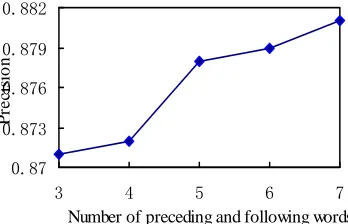
attribute vector increases from 7 to 15, which results in a significant change in run time. Suppose the run time of our algorithm with 3 preceding and following words is 1, then, extending the context vector to 15 dimensions, the change in run time of our algorithm is plotted in Figure 2.
As shown in Figures 1 and 2, the increase of complexity is much higher than that of precision when extending the number of preceding and following words. Hence, we chose 3 as the number of preceding and following words to form context windows and calculate context vectors.
2.3 Effect on Consistency Checking Precision of
α
and
β
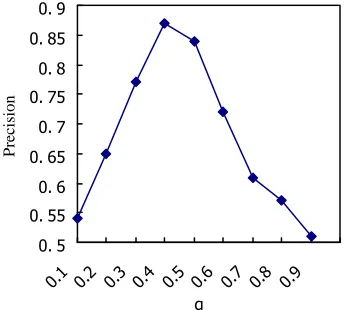
When using our sampled 1M-word training corpus to conduct closed test, we found that consistency checking precision changes significantly with different values of α and β . Figure 3 shows the trend when α varies from 0.1 to 0.9.
0. 5 0. 55 0. 6 0. 65 0. 7 0. 75 0. 8 0. 85 0. 9
0.1 0.2 0.3 0.4 0.5 0.6 0.7 0.8 0.9 α
Precision
Figure 3. Effect on consistency checking precision of α and β.
As shown in Figure 3, when α=0.4 (β=0.6), consistency checking precision reaches the highest value. Hence, we used α=0.4 andβ =0.6 in our experiments. At the same time, the results show α and β have an important effect on consistency checking precision, namely the position attribute vector and the dependency attribute vector are very important for describing the context vector of multi-category word, which is consistent with our experience.
3.
Consistency Checking of POS Tagging
168 Hu Zhang, and Jiaheng Zheng
may use other widely known attributes of words to improve the consistency checking of POS tagging.
In the future, we plan to investigate more types of word attributes and incorporate linguistic and mathematical knowledge to develop better consistency checking models, which ultimately provide a better means of building high-quality Chinese corpora.
Acknowledgements
This research was partially supported by the National Natural Science Foundation of China No. 60473139, 60775041 and the Natural Science Foundation of Shanxi Province No. 20051034.
References
Du, Y.-P., and J.-H. Zheng, “The proofreading method study on consistence ofsegment and part-of-speech,” Computer Development and Application, 14(10), 2001, pp. 16-18. Huang, C.-R., and R.-Y. Chang, “Categorical Am biguity and Information Content: A
Corpus-based Study of Chinese,” Journal of Chinese Language and Computing, 14(2), 2004, pp. 157-165.
Ng, H. T., and K. L. Jin, “Chinese Part-of-Speech Tagging: One-at-a-Time or All-at-Once? Word-Based or Character-Based?,” In Proceedings of the 2004 Conference on Empirical Methods in Natural Language Processing (EMNLP 2004), 2004, Barcelona, Spain, pp. 277-284.
Qian, W.-N., and A.-Y. Zhou, “Analyzing Popular Clustering Algorithms from Different Viewpoints,” Journal of Software, 13(8), 2002, pp. 1382-1394.
Qian, Y.-L., and J.-H. Zheng, “Research on the method of automatic correction of chinese POS tagging,” Journal Of Chinese Information Processing, 18(2), 2003, pp. 30-35. Qian, Y.-L., and J.-H. Zheng, “An approach to improving the quality of part-of-speech tagging
of Chinese text,” In Proceedings of the 2004 IEEE International Conference on Information Technology:Coding and Computing (ITCC 2004), 2004, USA, pp. 183-187. Qu, W.-G., and X.-H. Chen, “Research and practice on the machine proofreading of the
tagged corpora,” In Proceeding of the 7th National Computation Linguistics(JSCL’03), 2003, Beijing, China, pp. 318-324.
Xing, H.-B., “Analysing on the words classified hard in pos tagging,” In Proceedings of the 5th National Computational Linguistics (JSCL’99), 1999, Beijing, China, pp. 187-192. Xue, N., F.-D. Chiou, and M. Palmer, “Building a Large-Scale Annotated Chinese Corpus,” In
Proceedings of the 19th international conference on Computational linguistics, 2002, Taipei, Taiwan, pp. 1-8.
A Study on Consistency Checking Method of 169 Part-Of-Speech Tagging for Chinese Corpora