222 An-Ta Huang et al.
3.
Methodology
3.1
Overview
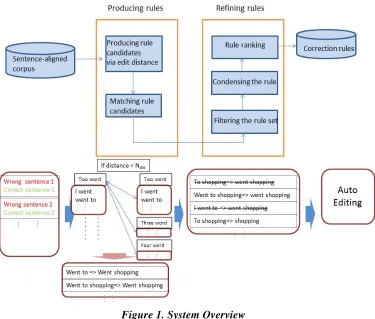
Figure 1. System Overview
Figure 1 shows that our framework consists of two parts. It produces some raw rules in the first stage and tries to refine them in the next stage.
3.2
Corpus Description
Discovering Correction Rules for Auto Editing 225
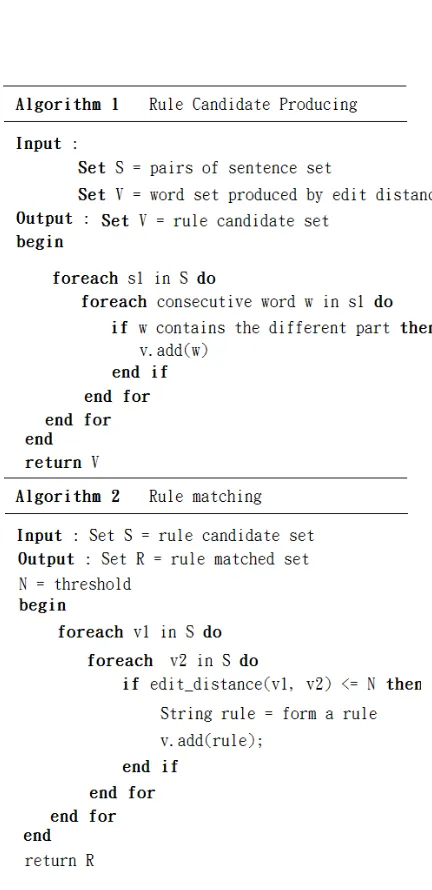
Figure 2. Pseudo code of producing rules
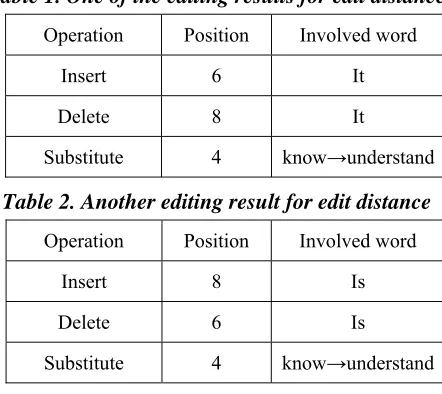
After applying the modified Levenshtein distance algorithm, it is possible to obtain a set of involving words Ri, as shown below.
{is , it ,understand , know}
Ri=
228 An-Ta Huang et al.
Figure 3. Pseudo code of condensing rules
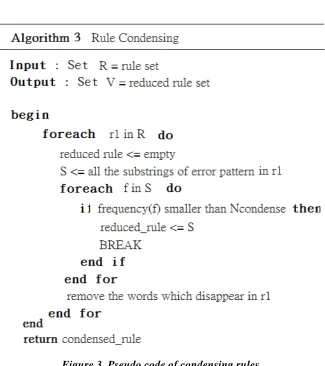
The final step of the refinement is to rank the rules based on their qualities. We proposed two plausible strategies to rank the rules. First, it is possible to rank the rules according to freS+(KL) from low to high. In other words, a rule is less likely to incorrectly modify something right into something wrong if its freS+ is low. Second, it is possible to rank the rules according to the number of sentences in the corpus that can be applied using it. The first strategy is similar to the definition of precision while the second is closer to the meaning of recall.
4.
Experiments
Discovering Correction Rules for Auto Editing 229
4.1
Evaluation
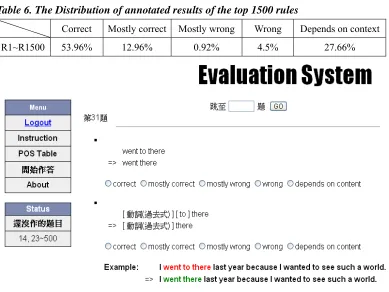
We ranked all of the rules according to their freS+,and four English majors were invited to annotate the top 1500 ranked rules. Each rule was annotated by two persons. The labels for annotations were “correct,” “mostly correct,” “mostly wrong,” “wrong,” and “depends on context”. Table 6 presents the experimental results and Figure 4 presents the evaluation system screenshot. A fair agreement was found between the two annotations, as the kappa value equals 0.49835.
Table 6. The Distribution of annotated results of the top 1500 rules
Correct Mostly correct Mostly wrong Wrong Depends on context
R1~R1500 53.96% 12.96% 0.92% 4.5% 27.66%
Figure 4. Screenshot of Evaluation System
Discovering Correction Rules for Auto Editing 231
Figure 5. Rule distribution
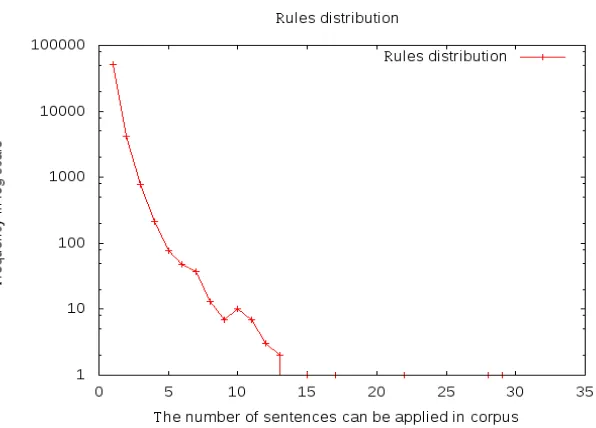
Figure 5 shows the rule distribution. Table 9 lists some example rules discovered by our system that can hardly be detected and corrected by Microsoft Word 2007 grammar checker.
Table 9. Example rules discovered by the proposed system
Example rules
am worry about => am worried about help me to study => help me study I will appreciate it => I would appreciate it went to shopping => went shopping am so exciting => am so excited waked => woke
look forward to read => look forward to reading for read my => for reading my
The street name => The street’s name to playing with => to play with
He promised to me => He promised me asked repeat => repeatedly asked
Have you listen to => Have you listened to It’s rains => It’s raining
I ate a milk => I had milk
for the long time => for a long time don’t cooking => don’t cook will success => will succeed
232 An-Ta Huang et al.
4.3
Auto-editing System
We constructed an online, real-time auto-editing system and demonstrated the usefulness of our rules, which aimed to provide editorial assistance. We first tried to test whether a part of the real-time typing sentence could match the erroneous patterns. If there was a match, the chunk would be marked in red, and we applied the correction rule to suggest replacing it with the correct pattern. The user(s) was able to click the correct part (marked in green) to tell the system the given correction was accepted, and the system automatically made the change. The link to our system is: http://mslab.csie.ntu.edu.tw/~kw/new_demo.html.
4.3.1 Auto Editing
Figure 6. Screenshot of demo system
Discovering Correction Rules for Auto Editing 233
Figure 7. Screenshot of auto-editing
In Figure 7 shows one can type sentences in English in edit area. If any of the rules is matched, the suggested correction will appear on the above area in green. If the users agree with the corrections, they can click on the green word and the sentence will be edited accordingly.
4.3.2 Rules Keyword Search
Figure 8. Screenshot of keywords search in rule database
Discovering Correction Rules for Auto Editing 235
Sun, G., Cong, G., Liu, X., Lin, C.-Y., & Zhou, M. (2007). Mining Sequential Patterns and Tree Patterns to Detect Erroneous Sentences. Proceedings of the 22nd national conference on Artificial intelligence - Volume 1. 925-930.
Shi,Y., & Zhou, L. (2005). Error Detection Using Linguistic Features. Proceeding of Human Language Technology Conference and Conference on Empirical Methods in Natural Language Processing, 41-48.
Levenshtein, VI. (1966). Binary codes capable of correcting deletions, insertions and reversals. Soviet Physics Doklady, 10(8), 707-710.
Lü, Y., & Zhou, M. (2004). Collocation translation acquisition using monolingual corpora. In Proceeding of Association for Computational Linguistics.
Leacock, C., Gamon, M., & Brockett, C.(2009). User Input and Interactions on Microsoft Research ESL Assistant. Proceeding of the Fourth Workshop on Innovative Use of NLP for Building Educational Applications, 73-81.
Levenshtein. (n.d.). Retrieved from the Levenshtein Wiki: http://en.wikipedia.org/wiki/Levenshtein_distance
236 An-Ta Huang et al.