Idioms in Context: The IDIX Corpus
Caroline Sporleder, Linlin Li, Philip John Gorinski, Xaver Koch
Computational Linguistics / Cluster of Excellence MMCI Saarland University
{csporled,linlin,philipg,xkoch}@coli.uni-saarland.de
Abstract
Idioms and other figuratively used expressions pose considerable problems to natural language processing applications because they are very frequent and often behave idiosyncratically. Consequently, there has been much research on the automatic detection and extraction of idiomatic expressions. Most studies focus on type-based idiom detection, i.e.,
dis-tinguishing whether a given expression can (potentially) be used idiomatically. However, many expressions such asbreak
the icecan have both literal and non-literal readings and need to be disambiguated in a given context (token-based detec-tion). So far relatively few approaches have attempted context-based idiom detection. One reason for this may be that few annotated resources are available that disambiguate expressions in context. With the IDIX corpus, we aim to address this. IDIX is available as an add-on to the BNC and disambiguates different usages of a subset of idioms. We believe that this resource will be useful both for linguistic and computational linguistic studies.
1. Introduction
Idioms are multi-word expressions whose meaning cannot be inferred from the meaning of their parts in a completely compositional manner. As a class, idioms and other figurative expressions are relatively frequent. For example, Burchardt et al. (2006) found that nearly 15% of all verb occurrences in a Ger-man newspaper corpus are used figuratively, rising to nearly 83% for high frequency verbs like nehmen(to take).
Idioms tend to behave idiosyncratically, not only with respect to their semantics but also with respect to other linguistic properties. For example, they typically ex-hibit some degree of lexical and syntactic fixedness (e.g., raining cats and dogs vs. *raining cats and
houndsor*raining dogs and cats). They can also be
syntactically anomalous (e.g.,in linewithout a deter-miner in front ofin), violate selectional restrictions (as
inpush one’s luckunder the assumption that only
con-crete things can normally be pushed), or change the default assignment of semantic roles to syntactic cate-gories (e.g., inbreak sth with X, the argument X would typically be an instrument but for the idiombreak the iceit is more likely to fill a patient role, as inbreak the
ice with Syria).
Such anomalies can cause significant problems to nat-ural language processing (NLP) tools, and the situa-tion is considerably worsened by the fact that idioms occur frequently in natural texts. For instance, Bald-win et al. (2004) found that 8% of all parse failures ob-tained with the English Resource Grammar could be attributed to idioms and other multi-word expressions. Proper recognition and modelling of idioms has also
been shown to benefit other applications (Lin, 1998; Gerber and Yang, 1997; Bond and Shirai, 1997; Lewis and Croft, 1990).
Hence, being able to recognise idioms is crucial for NLP applications. However, this is not a trivial task. Machine readable idiom dictionaries could help to some extent but usually lack coverage. To alleviate this problem, several studies have addressed the ques-tion of whether idiom lists can be compiled automati-cally from text corpora, e.g., by employing statistical measures to assess the idiomaticity of a phrase (so-calledtype-based idiom classification(Bannard, 2007; Fazly and Stevenson, 2006; Baldwin et al., 2003; Lin, 1999)).
While there has been some success in this direction, type-based idiom classification only solves part of the problem; many expressions can have a literal as well as an idiomatic meaning (see Examples (1a) vs. (1b) and (2a) vs. (2b))1and thus need to be disambiguated in context (token-based idiom classification). So far, relatively few studies have addressed this task, though there has been an increased interest recently (Li and Sporleder, 2010; Fazly et al., 2009; Diab and Krishna, 2009a; Diab and Krishna, 2009b; Li and Sporleder, 2009a; Sporleder and Li, 2009; Li and Sporleder, 2009b; Cook et al., 2007; Birke and Sarkar, 2006; Katz and Giesbrecht, 2006; Hashimoto et al., 2006a; Hashimoto et al., 2006b).
One reason why token-based idiom detection has
re-1The examples in this paper are taken either from
the BNC http://www.natcorp.ox.ac.uk/ or
the Gigaword corpus http://www.ldc.upenn.
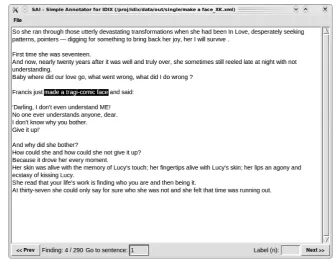
erro-Figure 3: SAI tool with highlighted instance of the target expressionmake a face
(18) The most reliable standby for climbing or simply to cover the ground, has to be ivy.
[BNC C9C]
We distinguish these meanings by assigning an id-number to each non-literal sense and then suffixing this id-number to the label in the annotation. A docu-mentation file providing information on the number of non-literal senses and a short definition for each will be made available as part of IDIX.
2.5. Corpus Statistics and Evaluation
Work on the IDIX corpus is still ongoing. We aim to expand the corpus to at least 100 idioms. So far we have annotated 78 expressions. This amounts to 5,836 instances in total (excluding false extractions), i.e., on average around 75 instances per expression, ranging from one instance for lower the bar to 540
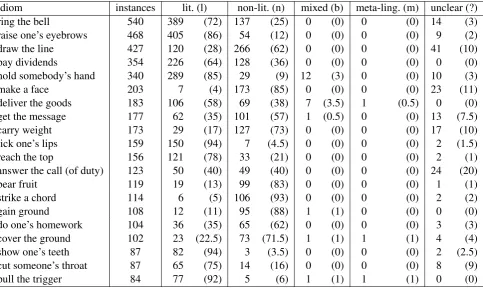
for ring the/a bell. Table 1 gives an overview of the
20 most frequent expressions and their distributions of annotation labels. It can be seen that expressions behave quite differently with respect to the frequency of literal an non-literal usages. For some expressions,
like make a face, the non-literal usage is much more
frequent. For others, likeshow one’s teethorpull the
trigger, literal usage is much more frequent.
Figure 4 shows the proportions of annotation labels in the currently annotated data set. It can be seen that a small majority of 49.4% was annotated as ’lit-eral’, 45.61% of the instances were annotated as ’non-literal’, 0.15% as ’meta-linguistic’, 0.69 % as ’both
literal and non-literal readings’ and the rest as ’unde-cided’. Cases where an expressions is embedded in a larger figurative context have not yet been annotated separately; they are currently included in the set of id-iomatic usages but will be annotated as ’embedded’ in the release version of the corpus. However, we be-lieve that these cases are also relatively rare. The rel-atively large proportion of literal usages can probably be attributed to the fact that we extract both canoni-cal forms, for which idiomatic usages tend to be more frequent, and non-canonical forms, for which literal usages occur more frequently (Riehemann, 2001).
Figure 4: Percentage of labels in the currently anno-tated data set
idiom instances lit. (l) non-lit. (n) mixed (b) meta-ling. (m) unclear (?)
ring the bell 540 389 (72) 137 (25) 0 (0) 0 (0) 14 (3)
raise one’s eyebrows 468 405 (86) 54 (12) 0 (0) 0 (0) 9 (2)
draw the line 427 120 (28) 266 (62) 0 (0) 0 (0) 41 (10)
pay dividends 354 226 (64) 128 (36) 0 (0) 0 (0) 0 (0)
hold somebody’s hand 340 289 (85) 29 (9) 12 (3) 0 (0) 10 (3)
make a face 203 7 (4) 173 (85) 0 (0) 0 (0) 23 (11)
deliver the goods 183 106 (58) 69 (38) 7 (3.5) 1 (0.5) 0 (0)
get the message 177 62 (35) 101 (57) 1 (0.5) 0 (0) 13 (7.5)
carry weight 173 29 (17) 127 (73) 0 (0) 0 (0) 17 (10)
lick one’s lips 159 150 (94) 7 (4.5) 0 (0) 0 (0) 2 (1.5)
reach the top 156 121 (78) 33 (21) 0 (0) 0 (0) 2 (1)
answer the call (of duty) 123 50 (40) 49 (40) 0 (0) 0 (0) 24 (20)
bear fruit 119 19 (13) 99 (83) 0 (0) 0 (0) 1 (1)
strike a chord 114 6 (5) 106 (93) 0 (0) 0 (0) 2 (2)
gain ground 108 12 (11) 95 (88) 1 (1) 0 (0) 0 (0)
do one’s homework 104 36 (35) 65 (62) 0 (0) 0 (0) 3 (3)
cover the ground 102 23 (22.5) 73 (71.5) 1 (1) 1 (1) 4 (4)
show one’s teeth 87 82 (94) 3 (3.5) 0 (0) 0 (0) 2 (2.5)
cut someone’s throat 87 65 (75) 14 (16) 0 (0) 0 (0) 8 (9)
pull the trigger 84 77 (92) 5 (6) 1 (1) 1 (1) 0 (0)
Table 1: The 20 expressions with the most instances, excluding erroneous extractions; numbers per label and idiom (percentage per label/idiom)
expected chance agreement. A Kappa score ofK ≥ .80 is considered as reliable agreement. The Kappa score on our data set isK =.87. Moreover, only a mi-nority of disagreements (37.66% of the disagreements, 2.56% of the instances overall) involved cases where one annotator had classified an instance as literal and the other as idiomatic. Disagreements about ’literal’ or ’non-literal’ vs. ’mixed/undecided’ accounted for another 35% of all disagreements. Hence, overall, the annotators agreed rather well, especially with re-spect to the crucial distinction between literal and non-literal usages.
3. Conclusion
In this paper, we introduced the IDIX corpus, which provides information about the usage of potentially idiomatic expressions in a given discourse context. We distinguish six different usages: ’literal’, ’non-literal’, ’mixed’, ’embedded in larger figurative con-text’, ’meta-linguistic’, and ’unclear/undecidable’. In addition, we also distinguished between different non-literal senses as far as they exist for a given target ex-pression. We found that the distinction between differ-ent usages can be made relatively reliably. In our data, literal readings are most common, accounting for just under half of all cases. Non-literal readings account for most of the remaining cases, while other usages
are rarer.
The IDIX corpus will be made available as an add-on for the BNC.6 Like the BNC, IDIX covers data from several domains. Furthermore, for each of the cho-sen expressions, the annotation is exhaustive, in the sense that all BNC occurrence of the target expres-sion are annotated. We believe that this resource will be useful for NLP researchers working on context-dependent, token-based idiom detection, as well as linguists working on corpus-based studies of non-literal language.
The annotation effort is still ongoing. For the first release, we aim to annotate at least 100 expressions. While IDIX provides annotations for all occurrences of a given expression, i.e., the coverage is complete with respect to the expression, we did not aim for complete coverage of individual texts, i.e., the texts may contain additional idioms or other figurative us-ages which are not annotated. For certain linguistic or computational linguistic studies it would also be in-teresting to exhaustively annotate sample text with all figuratively used expressions. We plan to complement IDIX with such a resource in the future. Exhaustive annotation of texts is a harder task, especially if the
6The corpus will be downloadable soon from
http://www.coli.uni-saarland.de/
David D. Lewis and W. Bruce Croft. 1990. Term clus-tering of syntactic phrase. InProceedings of SIGIR-90, 13th ACM International Conference on
Re-search and Development in Information Retrieval.
Linlin Li and Caroline Sporleder. 2009a. Classi-fier combination for contextual idiom classification without labelled data. In Proceedings of EMNLP-09.
Linlin Li and Caroline Sporleder. 2009b. A cohesion graph based approach for unsupervised recognition of literal and nonliteral use of multiword expres-sions. In Proceedings of the ACL 2009 Workshop on TextGraphs-4: Graph-based Methods for
Natu-ral Language Processing.
Linlin Li and Caroline Sporleder. 2010. Using Gaus-sian Mixture Models to detect figurative language in context. InProceedings NAACL-2010 Short
Pa-pers.
Dekang Lin. 1998. Using collocation statistics in in-formation extraction. InProceedings of MUC-7. Dekang Lin. 1999. Automatic identification of
non-compositional phrases. InProceedings of ACL-99, pages 317–324.
Susanne Riehemann. 2001. A Constructional
Ap-proach to Idioms and Word Formation. Ph.D.
the-sis, Stanford University.